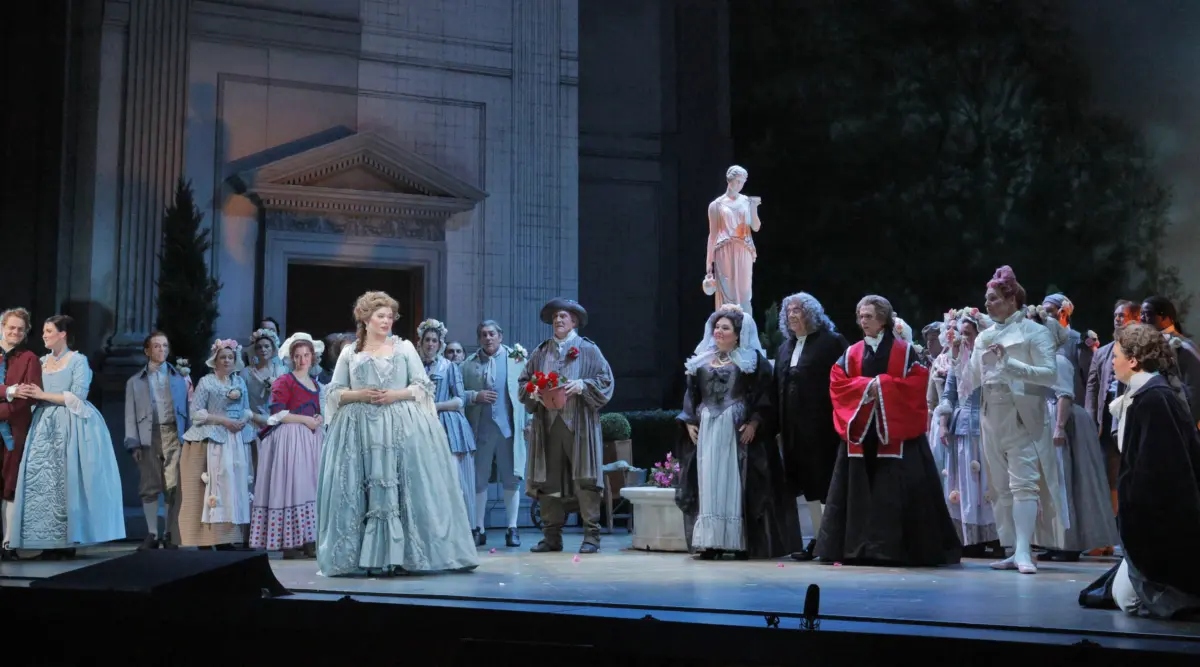

On Halloween night, the San Francisco War Memorial Opera House transformed into a vibrant epicenter of theatrical pageantry, community celebration, and musical brilliance. True to the idiosyncratic and inclusive spirit of the Bay Area, a significant portion of the audience arrived bedecked in elaborate costumes and masks, bridging the gap between historical aristocratic masquerade and modern-day revelry. Against this festive backdrop, the San Francisco Opera’s presentation of Wolfgang Amadeus Mozart and Lorenzo Da Ponte’s enduring masterwork, Le Nozze di Figaro (The Marriage of Figaro), shone as the crowning jewel of the company’s Fall Festival.
This mounting utilizes Michael Cavanagh’s acclaimed 2019 production framework, which for this run was directed with incisive theatricality by Opera San José Music Director Shawna Lucey and conducted with sparkling momentum by maestro Sebastian Weigle. From the first downbeat to the final, triumphant ensemble, the production honored the timeless vitality of Mozart and Da Ponte’s 18th-century gem. While firmly rooted in historical flavor—accented by striking visual motifs such as an American flag in Act I and the evocative blueprints of an 18th-century American manor projected on movable boards—the staging championed a progressive, forward-looking ethos.
By emphasizing the subversion of archaic feudal laws and marriage customs (droit du seigneur), the production underscored a universal societal evolution: the arrogant aristocrat would ultimately be outwitted, and love, wit, and humanity would prevail. Bolstered by a stellar international cast, imaginative stagecraft, and a deeply committed orchestra, this Halloween performance proved that after more than two centuries, Le Nozze di Figaro retains an unmatched capacity to captivate, amuse, and profoundly move contemporary audiences.
Detailed Chronology & Performance Analysis
The Overture and Act I: Setting the Stage for Intrigue
The evening commenced with an electrifying Overture under the baton of Sebastian Weigle. If the orchestral introduction initially felt as though it were starting at a breathless gallop, the physical arrival of the characters onto the stage immediately grounded the kinetic energy. The production’s design team—featuring set designs by Erhard Rom, lighting by Jane Cox and Justin A. Partier, and costumes by Constance Hoffman—established an atmosphere brimming with spatial and dramatic possibility.
The dramatic core of the opera hinges upon its three central couples, anchored initially by the dynamic relationship between Figaro and Susanna. Making his highly anticipated San Francisco Opera debut, bass Peter Kellner partnered with his real-life wife, soprano Slávka Zámečníková, to portray the iconic engaged couple. Kellner delivered a skillful, sonorous, and robust Figaro. Possessing a rich, resonant vocal timbre, he moved with astonishing athletic agility, even executing physical somersaults during the course of the performance.
While Kellner’s Figaro was quick-witted, clever in repartee, and endlessly engaging, his portrayal retained a youthful buoyancy, suggesting a rogue still in the process of earning his stripes. Navigating the grueling four-hour performance demands with remarkable stamina, Kellner’s patter remained crisp—matching the dizzying verbal gymnastics of Susanna, Marcellina, and Bartolo—even if rapid-fire delivery occasionally sacrificed text clarity in favor of momentum. His infectious enthusiasm ensured the audience rooted fiercely for his ultimate victory.
Opposite him, Slávka Zámečníková’s Susanna was a masterclass in nuanced characterization. Zámečníková infused the role with meticulous detail, marrying facial expressiveness and physical grace with lustrous vocal articulation. Her transitions between shifting emotional states were seamless, driven by a colorful, flexible voice that brought continuous joy to the house. Though her Act IV solo leaned toward charming rather than soul-stirring—staying true to the pragmatic and mischievous essence of Susanna’s character—her dynamic stage presence and rich vocal coloring cemented her performance as an artistic triumph.
Act II and Act III: Aristocratic Friction and Ensemble Mastery
As the plot thickened into the aristocratic domains of Count and Countess Almaviva, the dramatic stakes escalated significantly. Baritone Thomas Mole stepped into the role of Count Almaviva, bringing an appropriately commanding presence, rich projection, and formidable acting chops. Mole cut a convincing figure throughout the drama: active, decisive, and relentlessly assertive. Although his robust, rounded voice showed minor signs of vocal fatigue toward the final third of the performance, he rebounded with unstoppable gusto for the opera’s climactic resolution. His effective manipulation of a cape and commanding physical stagecraft highlighted a young artist of immense promise, expertly balancing predatory lust with eventual, compassionate grace.
Portraying Countess Rosina Almaviva, soprano Olivia Smith delivered a thoughtful performance defined by emotional development and vocal variety. Smith tackled the character’s two monumental arias, "Porgi Amor" and "Dove Sono," with a generous vocal palette and considerable volume. However, staging choices occasionally placed her in near-constant motion during these reflective numbers, creating a sense of restless grievance rather than the deep, soulful introspection woven into the score by Mozart and Da Ponte. Despite this directorial choice, Smith’s commitment and vocal richness shone through.
The comedic and narrative counter-balance arrived via the secondary couple: Dr. Bartolo and Marcellina, brought to life by veteran bass Maurizio Muraro and mezzo-soprano Catherine Cook. Cook executed a delightful, seamless character arc, pivoting effortlessly from a litigious, demanding adversary to a fiercely devoted mother while maintaining an uproarious comedic stance. Muraro proved an ideal foil, matching her with adept musicianship, high energy, and infectious vitality.
Meanwhile, mezzo-soprano Simone McIntosh triumphed in the breeches role of the perpetually hormonal page, Cherubino. McIntosh proved to be a fluent, charismatic actor and singer, effortlessly navigating the notoriously challenging vocal and physical transformations between adolescent boy and disguised girl. Her full, resonant sound and fluid stagecraft charmed the auditorium, most notably during a breathtaking rendition of "Voi che sapete."
The supporting ensemble further elevated the evening’s comedic and dramatic architecture. Bass-baritone Philip Skinner anchored the role of the disgruntled gardener Antonio with rustic charm, while tenor Chance Jonas-O’Toole (Curzio) and Sofia Gotch (Barbarina) kept the narrative jaunty and well-paced. Of particular note was tenor Alek Shrader as Don Basilio. Decked out in a brilliant red wig, pink ballet shoes, and executing a delightfully mincing walk, Shrader played the effete music teacher with exquisite theatricality, enriching his vocal lines with charm devoid of cheap clichés.
Act IV and Finale: A Symphony of Coordination
The overarching triumph of the production lay in its extraordinary musical coordination. Conductor Sebastian Weigle maintained an unyielding grip on Mozart’s score, delivering a masterclass in balance, contrast, and melodic radiance. The multiple ensemble pieces—ranging from intricate duets and trios to sweeping quartets and the magnificent Act II septet—were executed with near-perfection. The iconic numbers, from Figaro’s swaggering "Non più andrai" to the soaring elegance of the Count and Countess’s vocal interplay, functioned like precision-cut jewels.
As the evening hurtled toward its chaotic yet harmonious conclusion, the production achieved a rare theatrical synthesis. The convergence of colliding storylines, musical harmony, comic absurdity, and poignant humanity felt entirely organic. It was a production that respected the intelligence of its audience, sweeping spectators along without ever demanding a suspension of disbelief regarding why events unfolded as they did.
Watching the deeply flawed, intensely human characters quarrel, reconcile, and stumble through their own romantic traps, one could not help but recall Puck’s immortal observation from A Midsummer Night’s Dream: "Lord, what fools these mortals be." In this concluding sentiment, the San Francisco Opera captured the very essence of Le Nozze di Figaro—an enchanting, adorable, and profoundly human reflection on life itself.
Supporting Context & Metrics
To fully appreciate the scope and historical resonance of the San Francisco Opera’s Fall Festival production of Le Nozze di Figaro, it is vital to examine its pedigree within both the company’s institutional history and the broader landscape of operatic performance.
- Historical Legacy at San Francisco Opera: Le Nozze di Figaro holds a foundational place in the annals of the San Francisco Opera. Since its company premiere in 1936—a legendary mounting that featured operatic royalty Ezio Pinza as Figaro and Elisabeth Rethberg as the Countess—the opera has remained a staple of the repertoire. The 2026 iteration marks a continuation of this noble tradition, updating the staging idiom while preserving the vocal standards expected of a world-class house.
- Literary and Musical Origins: Based on Pierre-Augustin Caron de Beaumarchais’s revolutionary 18th-century play (La Folle Journée, ou le Mariage de Figaro), the opera debuted at the Burgtheater in Vienna on May 1, 1786. Lorenzo Da Ponte’s libretto famously sanitized and streamlined Beaumarchais’s politically explosive anti-aristocratic satire just enough to pass imperial censorship, while retaining the core critique of feudal privilege.
- Production Metrics & Creative Architecture:
- Runtime: Approximately 3 hours and 45 minutes (including one intermission).
- Creative Team Size: Direction by Shawna Lucey; Musical Direction by Sebastian Weigle; Set Design by Erhard Rom; Costume Design by Constance Hoffman; Lighting Design by Jane Cox and Justin A. Partier; Choreography by Colm Seery; Chorus Direction by John Keene.
- Orchestral and Choral Forces: Featuring the full San Francisco Opera Orchestra and the San Francisco Opera Chorus, demonstrating rigorous ensemble synchronization across complex multi-part vocal writing.
Official Statements & Artistic Insights
Reflecting on the collaborative nature of mounting a production that bridges 18th-century Viennese classicism with modern American theatrical sensibilities, the artistic leadership emphasized the timeless relevance of Mozart’s human comedy.
On the Production’s Vision:
While formal press releases from the San Francisco Opera focused on the seamless integration of Michael Cavanagh’s conceptual framework, guest director Shawna Lucey noted in pre-performance artistic notes the importance of maintaining emotional authenticity amidst high-comedy farce:
"Figaro is not merely a sparkling comedy of errors; it is a mirror reflecting the shifting power dynamics of human relationships. When we strip away the powdered wigs and place these characters in a space of evolving social architecture, we discover that their struggles with jealousy, forgiveness, and class mobility are entirely our own."
On the Musical Approach:
Conductor Sebastian Weigle consistently underscored the imperative of letting Mozart’s score breathe beneath the action:
"Mozart writes the psychology of his characters directly into the notes. The tempo is not just a matter of speed; it is the heartbeat of the drama. If the orchestra and the singers listen to one another with absolute fidelity, the comedy and the tragedy lock together automatically."
Future Outlook
The resounding success of Le Nozze di Figaro on Halloween night at the San Francisco War Memorial Opera House offers an encouraging bellwether for the future of grand opera in the United States. In an era where performing arts institutions continually grapple with questions of relevance, accessibility, and audience engagement, this production provided a masterclass in how to honor historical masterworks without turning them into museum pieces.
By marrying high-concept, visually engaging design with top-tier international vocal talent—featuring impressive company debuts alongside seasoned interpreters—the San Francisco Opera has demonstrated that the standard operatic canon remains a fertile ground for innovation. The production successfully dissolved the invisible barrier between the stage and the house, inviting an eclectic, costumed audience into a shared meditation on human folly, forgiveness, and love.
As the company looks toward subsequent programming in its Fall Festival and future seasons, the triumph of this Figaro serves as a powerful reminder of the art form’s enduring resilience. While pessimists periodically question the longevity of classical opera in a fast-paced digital world, evenings like this prove that as long as composers and librettists put intimately human stories onto the stage with such fearless mastery, audiences will continue to find sanctuary, joy, and essential life lessons within the walls of the opera house.