
Executive Overview
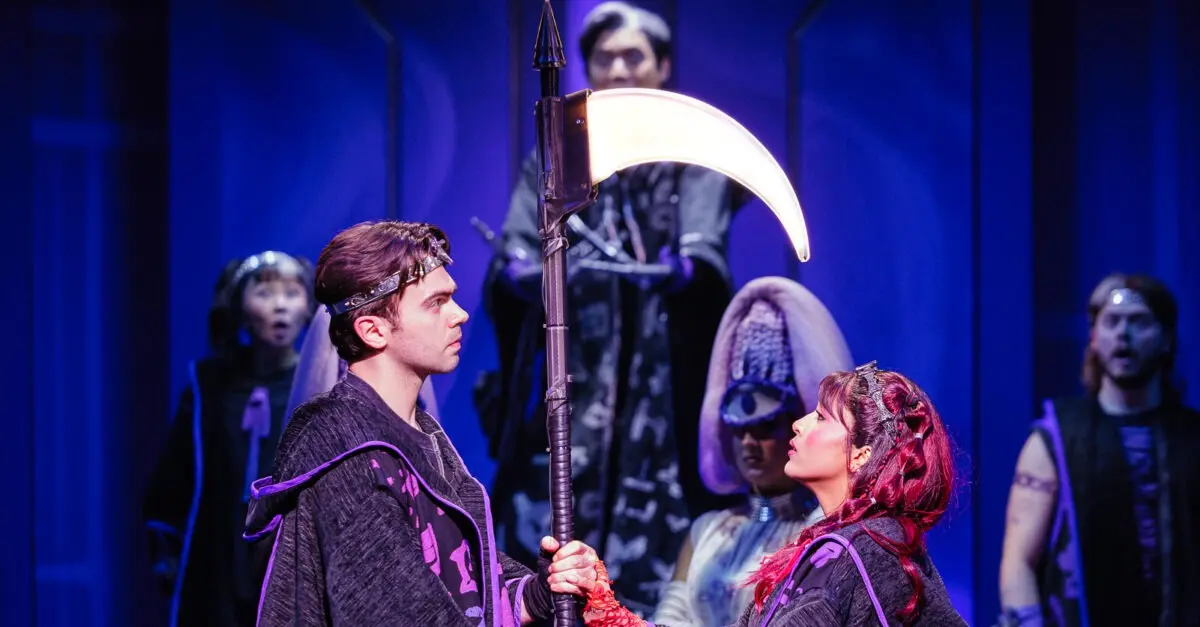
What happens when the ultimate arbiter of mortality decides to hang up his scythe, only to have his succession plan upended by the most unpredictable force in the universe: young love? This is the high-concept, sharply comedic, and unexpectedly poignant premise driving Grim, a dazzling new musical eyeing a coveted run on Broadway. Currently making waves on the West Coast with a celebrated, twice-extended world-premiere run at the prestigious La Jolla Playhouse in California—now slated to close on December 13—the production is already generating deafening industry buzz.
Helmed by visionary director Sammi Cannold (How to Dance in Ohio) and featuring choreography by Hamilton Tony winner Andy Blankenbuehler, Grim merges the theatrical gravitas of Broadway with the infectious, chart-topping sensibilities of contemporary pop. The score is co-crafted by a powerhouse team of songwriters boasting major mainstream credentials, including Petro AP (renowned for his work with Reneé Rapp and One Direction) and Scott Hoying of the a cappella phenomenon Pentatonix, alongside musical comedy trailblazers Joey Orton and Brad Silnutzer.
At its core, Grim follows the ancient, weary Grim Reaper—who has diligently collected souls for a staggering 300,000 years—as he prepares for a well-earned retirement. His ambitious, dutiful daughter, Diana, is poised to take over the family business, provided she can successfully pass a deceptively simple final evaluation. However, her cosmic trajectory is thrown entirely off-kilter when she unexpectedly falls head-over-heels for a mortal human named Josh.
Backed by an extraordinary ensemble cast, a stellar coterie of Broadway designers, and unprecedented ticket demand that has forced multiple extensions, Grim is rapidly evolving from a daring regional experiment into a formidable contender for the upcoming Broadway season. This in-depth report explores the genesis, creative architecture, stellar ensemble, and high-stakes future of a musical that dares to ask: Can the embodiment of death truly learn how to live?
Detailed Chronology
The journey of Grim from a speculative writer’s room concept to a runaway box-office hit at the La Jolla Playhouse is a masterclass in modern musical theatre development. While many contemporary musicals spend decades languishing in developmental limbo, Grim’s trajectory has been characterized by rapid momentum, precision casting, and an uncompromising creative vision.
Genesis and Conceptualization
The conceptual seeds of Grim were planted several years ago when musical comedy writers Joey Orton and Brad Silnutzer began exploring the absurdities of eternal bureaucracy. They envisioned the afterlife not as a place of fire and brimstone, but as a tedious, highly structured corporate entity where even existential dread requires paperwork. To elevate the material from dry satire into a soaring theatrical event, the creative team brought in pop songwriters Petro AP and Scott Hoying. This fusion of theatrical storytelling and stadium-ready pop composition established the show’s distinct auditory signature—one that blends clever, character-driven lyricism with soaring, radio-friendly hooks.
The La Jolla Playhouse Premiere and Extensions
The production officially touched down at the La Jolla Playhouse in California, a breeding ground for legendary Broadway transfers ranging from Jersey Boys to Come From Away. Directed with kinetic precision by Sammi Cannold, the show immediately captured the imaginations of Southern California audiences.
The response was so overwhelmingly positive that the run has been extended twice, cementing its status as one of the hottest tickets of the regional theatre season. Originally scheduled for a standard limited engagement, the production is now safely anchored through December 13. This extended window has allowed the creative team crucial breathing room to fine-tune book nuances, adjust orchestrations under music supervisor Ted Arthur, and gauge audience reactions ahead of expected out-of-town and Broadway timelines.
The Audition and Rehearsal Process
Casting for a musical requiring both powerhouse vocal athletics and high-octane physical comedy is no small feat. Under the guidance of casting directors Benton Whitley (Whitley Theatrical) and Peter Dunn (Hannah Reinert Casting), the production assembled an ensemble capable of navigating Andy Blankenbuehler’s intricate, athletic choreography while delivering the complex pop-infused score. Rehearsals brought together Broadway veterans and rising stars, fostering a collaborative workshop environment where actors like Akshara Gunda (Diana) and Mateo Lizcano (Josh) could organically build the central, high-stakes chemistry that anchors the emotional core of the show.
Supporting Context & Metrics
To truly understand the commercial viability and artistic weight of Grim, one must examine the metrics of its mounting, the pedigree of its artisans, and the specific structural choices that set it apart in a crowded theatrical marketplace.
The Creative Heavyweights
The production benefits immensely from a creative team that reads like a who’s who of modern Broadway royalty. Director Sammi Cannold brings her signature empathetic storytelling—previously showcased in her critically acclaimed staging of How to Dance in Ohio—ensuring that even amidst metaphysical high jinks, the emotional stakes remain intensely human.
Choreographer Andy Blankenbuehler, whose work on Hamilton fundamentally redefined movement on the musical stage, infuses Grim with a driving, kinetic visual language. Whether depicting the rigid, robotic bureaucracy of the afterlife or the chaotic, breathless energy of human romance, Blankenbuehler’s choreography serves as a primary narrative vehicle.
On the sonic front, music supervisor and director Ted Arthur, orchestrator John Clancy, and arranger Cian McCarthy have worked in tandem with pop writers Petro AP and Hoying to bridge the often-gaping chasm between Broadway pit orchestras and modern pop production. The resulting soundscape is lush, dynamic, and tailor-made for contemporary cast album streaming metrics.
Design Architecture
Visually, Grim constructs a seamless bridge between the mundane and the supernatural. Scenic designer Jason Sherwood has engineered a flexible, striking physical world that shifts effortlessly from the sterile corridors of the afterlife to the vibrant, messy reality of the mortal plane. Complementing Sherwood’s vision, costume designer Paloma Young deploys sharp sartorial contrasts—outfitting immortal beings in austere, structural silhouettes while dressing mortal characters in accessible, contemporary streetwear.
Lighting designer Amanda Zieve wields illumination not merely as visibility, but as a storytelling tool, utilizing stark contrasts between ethereal blues and warm, chaotic human tones. Sound designer Connor Wang ensures that the hybrid pop-theatre score maintains absolute clarity, balancing the demands of belting vocalists with intricate electronic sound design. Completing the aesthetic framework are wig, hair, and makeup designers Krystal Balleza and Will Vicari, whose transformative styling allows actors to seamlessly transition between divine and mortal avatars.
Comprehensive Cast Roster
The sheer depth of the Grim ensemble is a testament to the production’s expansive scope. Anchored by Paolo Montalban as the retiring Grim and Akshara Gunda as his reluctant daughter Diana, the principal cast features top-tier talent across the board:
- Akshara Gunda as Diana
- Mateo Lizcano as Josh
- Paolo Montalban as Grim
- Dana Costello as Tammy
- Jeremy Davis as Norman
- Jennifer Fouché as Death of Love
- Julio Rey as Mort
The principal players are supported by a formidable ensemble of triple-threat performers, including Aaron J. Albano, Valentine d’Arabian, Alex Gibson, Kendyl Ito, Patricia Jewel, Sean Harrison Jones, Zachary Daniel Jones, Samantha Littleford, Jaygee Macapugay, Fredric Rodriguez Odgaard, Jonathan Sangster, Bella Serrano, and Jazz Washington. The production’s bench strength is further secured by an elite roster of swings: Travante S. Baker, Lili Froehlich, Austyn Myers, and Nio Russell.
Official Statements
While formal press releases from lead producers regarding a definitive Broadway timeline remain tightly guarded, members of the creative and executive teams have spoken candidly about the ethos driving the project.
In early production notes shared with the La Jolla Playhouse community, director Sammi Cannold emphasized the show’s underlying thematic resonance:
"At its heart, Grim is not a story about death; it is a story about the terrifying, magnificent urgency of life. When you strip away eternity, every second matters. Our goal with this production has been to honor the high-concept comedy of the piece while anchoring it in an emotional truth that resonates universally, whether you are an immortal reaper or a twenty-something trying to figure out your place in the world."
Pop songwriter Scott Hoying, reflecting on his transition from a cappella global superstardom to the theatrical stage, noted the unique collaborative energy required to write for musical theatre characters rather than pop radio formats:
"Writing for Pentatonix or pop charts teaches you how to catch a listener’s ear instantly, but writing for a musical like Grim demands that every hook, every lyric, and every key change must actively move the narrative forward. Collaborating with Petro AP, Joey, and Brad has been a masterclass in storytelling. We aren’t just writing catchy tunes; we are building emotional architecture for characters undergoing profound existential shifts."
Stage management—led by production stage manager Matthew Kurtis Lutz alongside assistant stage managers Alexa Burn and Jack Ganguly—has maintained a seamless backstage operation through the grueling twice-extended run, ensuring that the physical and technical demands of the production are executed with clockwork precision night after night.
Future Outlook
As the sun sets on Grim’s extended West Coast engagement on December 13, industry insiders and theatrical prognosticators are training their sights on the horizon. The primary question on everyone’s mind is no longer if the show will make the leap to Broadway, but when and where.
The Broadway Pipeline
Transferring a musical from a major regional incubator like the La Jolla Playhouse to Broadway requires a delicate alchemy of capitalization, theatre availability, and critical momentum. Given the show’s dual appeal—drawing both traditional subscription-heavy theatregoers with its sharp comedic book and younger, streaming-age demographic through its pop-infused score—producers possess a uniquely broad marketing mandate.
Furthermore, the involvement of mainstream heavyweights like Scott Hoying and Petro AP opens doors to crossover promotional opportunities that traditional theatre marketing campaigns rarely access. Expect strategic announcements regarding New York dates, potential theatrical house partnerships, and a targeted cast recording rollout in the coming months.
Artistic Implications
Beyond its commercial prospects, Grim represents a vital ongoing evolution in contemporary musical theatre writing. By successfully integrating millennial and Gen-Z pop sensibilities with traditional Broadway structural craftsmanship, the creative team has charted a viable blueprint for how the Great White Way can continue to attract younger, diverse audiences without alienating its historical core base.
As Diana learns to navigate the terrifying, beautiful friction between her immortal lineage and her mortal desires, Grim positions itself not merely as a seasonal novelty, but as a resonant cultural touchstone for an era increasingly obsessed with time, legacy, and connection. When the final curtain falls in La Jolla this December, it will undoubtedly mark not an end, but the prologue to a much larger theatrical journey.