
Executive Overview
The opening night of the LA Opera’s 2026–2027 season arrived with the electric anticipation typical of Southern California’s premier cultural institutions. Stepping onto the red carpet at The Music Center’s outdoor plaza, operagoers dressed to the nines on a Saturday evening, embracing a night of opulence that even Hollywood royalty could not resist. Jennifer Lopez turned heads—and caught the eyes of her 240 million Instagram followers—in a sheer Dolce & Gabbana coat, setting a high-fashion tone for an audience that blended classic civic patronage with modern star power. Outside the auditorium, patrons sipped champagne, posed for cameras, and watched vibrant flamenco dancing, enveloped in a celebratory atmosphere.
Yet, this veneer of high-society excitement contrasted sharply with the artistic realities inside the hall. The evening marked the highly anticipated debut of Domingo Hindoyan as the company’s new Music Director, an appointment widely praised as a step toward bold, contemporary perspectives. To mark the occasion, LA Opera launched a brand-new Spanish Gothic production of Georges Bizet’s timeless masterpiece, Carmen, directed by Thaddius Strassberger. Promising an unflinching look into the darker, eerier dimensions of Spanish history, the production aimed to subvert conventional expectations.
Unfortunately, the grand ambitions of the creative team ultimately resulted in a theatrical and musical paradox. While the production was rich in thoughtful, avant-garde concepts, it suffered from a persistent timidity in execution. Hindoyan’s subdued musical direction drained the score of its necessary vitality, while Strassberger’s scenic design struggled to marry grand architectural scale with a lived-in human reality. Despite stellar vocal work from supporting cast members like Kathleen O’Mara and Joshua Guerrero, the production ultimately played as a cautious overture rather than the triumphant home run LA Opera had hoped for.
Detailed Chronology: Opening Night and Production Analysis
A Tepid Musical Beginning Under Hindoyan
Few opening notes in the operatic canon carry the weight and instant recognition of Carmen. The iconic theme, which heralds the bullfighter’s procession, is designed to plunge spectators immediately into a topsy-turvy world of fatal allure, danger, and dramatic urgency. On this particular evening, however, the orchestral prelude felt more like atmospheric background music than a psychological welcome.
Under Domingo Hindoyan, the LA Opera Orchestra delivered a soft, muffled start that noticeably lacked its trademark rhythmic bounce. This muted tendency persisted throughout the evening. Hindoyan consistently refused to lean into Bizet’s more theatrical, showy inclinations—those dynamic swells that typically lift the material to breathtaking emotional heights. Consequently, transitional sequences left entirely to the orchestra, such as the entr’actes between acts, felt pale and emotionally detached.
Nevertheless, the orchestra proved to be exceptionally competent accompanists. While Hindoyan’s restrained approach dampened crowd-pleasing moments, it successfully carved out a transparent sonic space for the vocalists to articulate their interpretations. The evening’s prime musical highlight occurred at the conclusion of Act I, when Carmen persuades Don José to release her from custody. Here, the orchestra performed with a thoughtful, probing intensity that mirrored the precarious, shifting dynamics between the characters. Sharp, punchy accents accompanied each singer, capturing the delicate threshold where sudden infatuation crosses into psychological manipulation.
While occasional dissonances emerged between the pit and the stage, these were largely attributable to vocal insecurities rather than a disconnect with the conductor. Hindoyan ensured that every singer had ample room to breathe and project, establishing a solid foundation of collaborative support even if the voices themselves did not always illuminate the hall.
Scenic Misfires and Architectural Ambiguity
The hesitant start of the musical direction found an unfortunate parallel in Thaddius Strassberger’s stage direction and scenic design. Strassberger attempted to frame the narrative through thin, flowing projections during the prelude—a visual motif that continued intermittently throughout the performance to accent the physical scenery. While the projections were technically accomplished, they ultimately cheapened an otherwise elaborate physical set. A jarring disconnect persisted between the projected digital patterns and the emotional text of the libretto. Details such as rolling smoke drew unnecessary attention, functioning more as a visual distraction than an aid to musical immersion.
The physical sets themselves suffered from a curious inconsistency in the level of detail. The construction of the Spanish Gothic architecture boasted an impressive sense of depth, extending far into the cavernous reaches of the LA Opera stage. Yet, this robust infrastructure was undermined by a sterile, museum-like quality; the environment lacked any genuine "lived-in" feeling. Ornaments and stage decorations were arranged in over-aligned, rigid symmetries that directly clashed with the inherent verve and earthy passion of the opera.
Strassberger’s concept of setting the action in a "Seville suspended between centuries" read more as frustratingly vague than genuinely mysterious. While historical commentary was occasionally hinted at, it lacked the narrative bite required to leave a lasting impression.
A Tale of Two Leads: Chaieb and Guerrero
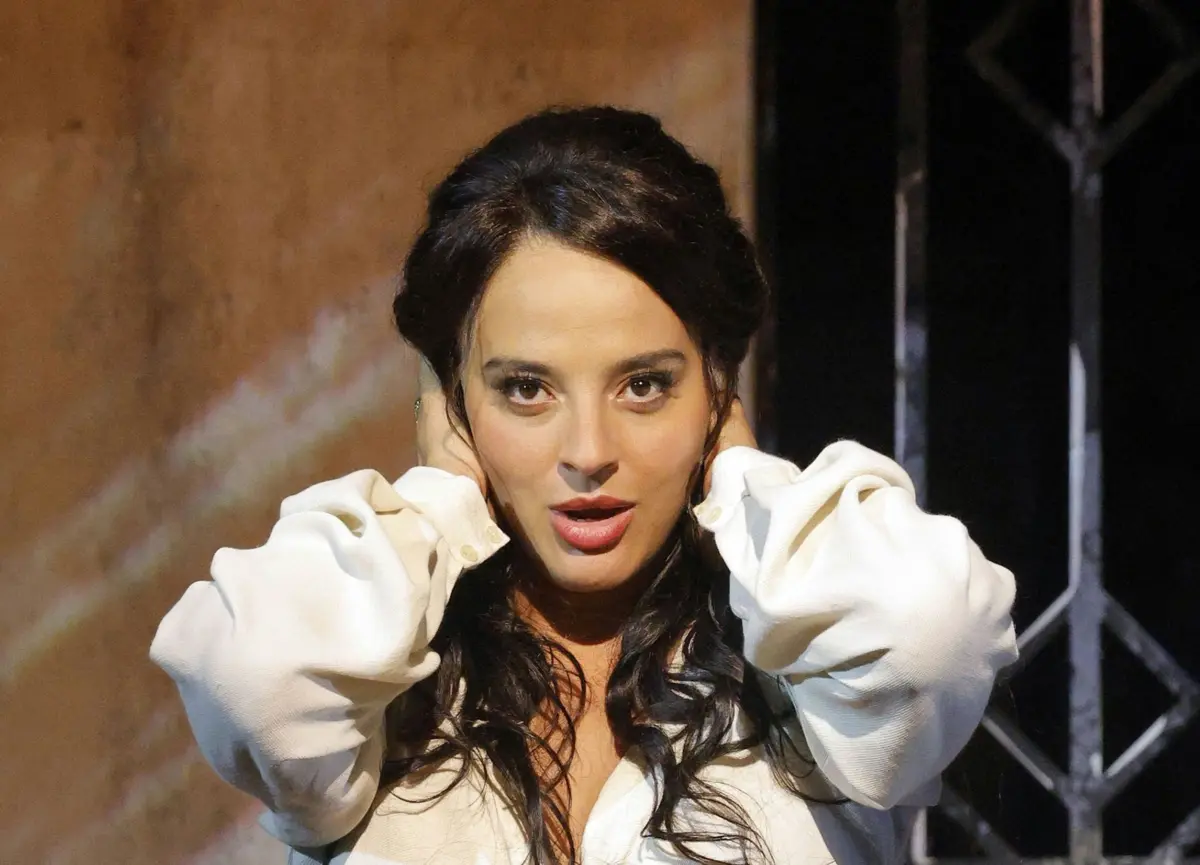
The character of Carmen stands as one of the most volatile and magnetic creations in dramatic history. Yet, Rihab Chaieb portrayed the iconic gypsy less as a force of nature and more as a soothing authority figure. Upon her initial entrance, townspeople looked to Carmen as a matriarch rather than a personification of untamed desire. This directorial choice resulted in a pervasive lack of theatrical energy, leaving the audience to wonder precisely why this particular Carmen caused such civic and romantic upheaval. Her performance frequently felt overly comfortable and lackadaisical.
Vocally, Chaieb maintained a polished, careful approach that avoided blatant errors but failed to generate dramatic electricity. Her delivery of the immortal “L’amour est un oiseau rebelle” (Habanera) offered neither surprises nor dynamic risk-taking, rendering Carmen’s inherent unpredictability unconvincing. However, Chaieb possessed a genuinely beautiful midrange that soared during moments of quiet vulnerability. She found her truest artistic footing when portraying Carmen’s emotional confusion toward Don José, though her higher register occasionally lacked the projection necessary to create stark vocal contrast.
In stark contrast, tenor Joshua Guerrero grounded the production with a deeply humane, empathetic portrayal of Don José. Eschewing the traditional interpretation of a verbose buffoon, Guerrero presented a puppy-eyed, emotionally vulnerable soldier whose tragic descent felt plausible right up until the final curtain. Guerrero also displayed an unexpected comedic aptitude, bringing a desperate, drunken edge to his character’s unraveling. His clean-cut aesthetic steadily degraded over the course of the evening, effectively visualizing a trajectory of utter hopelessness.
Guerrero’s vocal performance matched this vulnerable interpretation. While his singing could occasionally be described as wholesome or mild, it served his characterization well. His finest moments arrived early in the opera, particularly in his tender duet with Micaëla, “Parle-moi de ma mère!” Singing with a heartbreaking sweetness, Guerrero made Don José’s subsequent poor decisions feel genuinely tragic. His duets with Chaieb were similarly grounded, presenting their relationship as a viable, nuanced romantic discourse rather than an explosive flash of instantaneous infatuation.
Standout Performances: O’Mara, Karai, and Trigg
Amidst the unevenness of the central pairing, soprano Kathleen O’Mara delivered the evening’s strongest lead performance as Micaëla. Possessing a voice of luminous clarity, O’Mara effortlessly filled the sprawling auditorium—a distinct acoustic achievement in a production otherwise plagued by sonic modesty. Her Act I duet with Guerrero balanced youthful innocence with true vocal power, generating genuine theatrical anticipation for her return in Act III. The only blemish on O’Mara’s performance stemmed from stage direction, specifically Strassberger’s perplexing choice to heavily invoke the Virgin Mary during the opera’s tragic climax.
In the supporting ranks, Liam James Karai brought a refreshing, comedic energy to Escamillo. Channeling shades of Will Ferrell, Karai leaned fearlessly into the self-important ridiculousness of the swaggering matador. While his vocal timbre was largely traditional, he possessed more than enough power to cleanly strike the high F4 in “Votre toast, je peux vous le rendre.”
Meanwhile, Karie Trigg emerged as a major audience favorite as Mercédès, combining sharp vocal delivery with impeccable comedic timing. Her cheeky line regarding her desire to be a rich widow elicited some of the evening’s most genuine and memorable laughter from the audience.
Supporting Context & Metrics
To understand the weight of LA Opera’s 2026–2027 season opener, one must examine the institutional metrics and cultural positioning of the company:
- Digital Reach: The star-studded opening night instantly captured global attention, amplified by celebrity endorsements such as Jennifer Lopez’s social media broadcast to her 240 million Instagram followers.
- Artistic Leadership Transition: The production served as the official debut for Domingo Hindoyan as Music Director, signaling a generational shift in the company’s artistic governance toward contemporary, risk-tolerant interpretations.
- Aesthetic Shift: The production budget prioritized elaborate Spanish Gothic physical sets and dynamic projection mapping, handled by costume designer Mattie Ulrich—whose work universally won critical praise as the standout visual element of the night—alongside director Thaddius Strassberger.
- Repertory Weight: Choosing Carmen as a season opener inherently carries massive institutional gravity. As one of the most frequently performed operas globally, it invites immediate comparison to traditional staging norms, making departures from convention uniquely high-stakes.
Official Statements
While formal post-opening press releases from LA Opera management emphasized institutional growth and the excitement surrounding Domingo Hindoyan’s tenure, critical consensus highlighted the friction between ambition and execution.
In pre-season statements, LA Opera’s artistic administration stressed that the company’s programming philosophy for the 2026–2027 season centers on "fresh perspectives and uninhibited storytelling." The company’s official public guidelines humorously note that "there is no wrong way to dress" for the opera—aside from "meat dresses and swim trunks"—a sentiment mirrored in their encouragement of directors to challenge historical conventions.
Reflecting on the production’s thematic goals, director Thaddius Strassberger noted in program notes that his vision sought to strip away romanticized clichés of Andalusia to examine the "eerier, more haunting undercurrents of Spanish history." While critics noted that this conceptual ambition occasionally lost its footing in theatrical translation, the administration remains confident that Hindoyan’s tenure will serve as a dynamic catalyst for future productions.
Future Outlook
Ultimately, LA Opera’s new production of Carmen may not be the immediate home run the company had hoped for to kick off its 2026–2027 campaign. Much like a talented sports franchise experiencing early-season jitters, the evening featured exceptional, world-class individual components that were occasionally undermined by a lack of sustainable, driving momentum.
Thoughtful, intelligent decisions were undeniably made across all departments of this staging. It is abundantly clear that Domingo Hindoyan and his creative collaborators are being granted the artistic freedom to reinterpret standard repertoire rather than merely recreating tired norms. The misstep on opening night was not an excess of freedom, but rather a lingering timidity in presenting that uniqueness with absolute conviction.
Selecting Carmen as a season opener set an exceptionally high bar, burdened by centuries of audience expectation and deeply ingrained performance traditions. As Hindoyan continues to settle into his role as Music Director, the true test of his tenure will lie in how effectively he pairs with different vocalists and explores less canonical material. If opening night is any indication, Hindoyan is a conductor who thinks deeply about every structural layer of an opera; local audiences have ample reason to look forward to his artistic evolution as the season unfolds.