For centuries, the classical and contemporary music education paradigms have placed the learning of repertoire at the forefront of instrumental training. Students spend months, sometimes years, polishing single pieces of music to a mirror-shine, executing complex fingerings, dynamics, and expressive phrasing from memory or heavily annotated pages. Yet, beneath the polished veneer of recitals and exams lies a profound, widespread systemic failure: a staggering number of pianists—many with over a decade of formal lessons under their belts—cannot fluently sight-read even a basic level-one score.
This paradox has long plagued the music community. How can a musician dedicate thousands of hours to the piano yet remain functionally illiterate when confronted with a novel piece of sheet music?
According to pianist, educator, and sight-reading specialist Lara Mirinjian, the root cause is not a lack of innate talent, cognitive focus, or dedication on the part of the student. Rather, it is a critical void in traditional pedagogical frameworks. Most method books and private instructors fail to teach sight-reading as a distinct, standalone skill governed by specific core principles. Instead, they treat sheet music acquisition merely as a byproduct of learning standard repertoire.
This comprehensive investigative report examines the scale of the sight-reading deficit in modern music education, analyzes the underlying pedagogical flaws, explores foundational principles that govern fluent reading, and outlines a step-by-step methodology designed to transform novices and struggling intermediates into confident, real-time interpreters of musical notation.
Detailed Chronology: A Pianist’s Journey from Frustration to Fluency
To understand the mechanics of effective sight-reading instruction, one must first examine the trajectory of those who struggle with it. The narrative arc experienced by millions of piano students follows a remarkably consistent, disheartening chronology.
Phase 1: The Illusion of Progress (Years 1–3)
In the early stages of piano instruction, students are introduced to the fundamental building blocks of music: the treble and bass clefs, basic note values (quarter notes, half notes, whole notes), and simple finger placements. During this honeymoon phase, pieces are short—often just four to eight measures long. Because the amount of information on the page is minimal, students can easily decode and memorize the music within a few repetitions.
At this stage, parents and teachers often mistake this rapid memorization and mechanical execution for genuine sight-reading proficiency. The student appears to be "reading" the music, but in reality, they are rapidly committing the brief exercise to memory, relying on tactile and auditory feedback rather than real-time visual processing.
Phase 2: The Complexity Wall (Years 4–7)
As the repertoire advances into intermediate territory, the pieces grow exponentially longer and more harmonically complex. Two-hand coordination demands independent movement, key signatures introduce multiple sharps and flats, and rhythms incorporate syncopation and sixteenth notes.
This is the point where the traditional pedagogical model collapses for the average student. Because the student has never been taught how to visually chunk patterns, maintain a steady pulse without stopping, or scan ahead, they hit the "Complexity Wall." Every new piece becomes an arduous, weeks-long decoding project. The student can no longer rely on quick memorization to mask their reading deficiencies.
Phase 3: Chronic Stagnation and Imposter Syndrome
By the decade mark, a profound psychological barrier solidifies. Adult amateurs and advanced teens alike confess to deep embarrassment regarding their reading skills. As Lara Mirinjian notes from her own personal journey:
"Over ten years of lessons and I still couldn’t read fluently from a level one book. It was ridiculous. How was this possible?"
Students begin to internalize this failure, attributing it to personal personal shortcomings—such as Attention Deficit Disorder (ADD), poor memory, or a lack of natural musicality. They avoid accompanying choirs, playing chamber music, or picking up new pieces for fun because the act of reading music feels like translating an alien language letter by letter.
Phase 4: Pedagogy Realignment and the Breakthrough
For Mirinjian, the turning point arrived only after years of struggle, when she encountered a mentor who understood the true mechanics of sight-reading. By shifting the focus away from repertoire accumulation and toward minimalist, principle-based reading drills, her reading abilities—and those of her students—underwent exponential growth. The realization that sight-reading is governed by universal principles rather than arbitrary methods changed everything.
Supporting Context & Metrics: The Pedagogical Blind Spot
To contextualize Mirinjian’s personal experience, one must look at empirical data regarding how piano teachers approach sight-reading in studio environments. The systemic neglect of sight-reading is not an anomaly; it is an industry-wide blind spot.
Academic Insights into Teacher Preparation
In a seminal research study conducted by Dr. Dianne Hardy, Assistant Professor of Music Education and Piano at Dickinson State University, researchers investigated why sight-reading was so frequently omitted from structured lesson plans. The findings exposed a startling cycle of inadequacy within the teaching community:
Absence of Training: The majority of surveyed teachers admitted that sight-reading was excluded from their curricula simply because they were never taught how to teach it.
Method Book Deficiencies: Instructors noted that standard piano method series do not include systematic, progressive instruction in sight-reading pedagogy. They provide repertoire, not reading exercises.
Conflation of Skills: Many educators failed to recognize sight-reading as a distinct cognitive and physical skill set, operating under the assumption that students would naturally "get better at reading" simply by playing more challenging pieces over time.
The Perpetuation Cycle: Perhaps most telling, a significant cohort of teachers confessed they would never attempt to teach sight-reading because they themselves were poor sight-readers.
This data reveals an educational vacuum. If instructors do not possess the tools to teach sight-reading, and if standard method books ignore the discipline, students are left to flounder on their own, reinforcing poor habits with every page they turn.
Official Statements & Core Principles: Methods vs. Principles
To bridge this educational gap, educators must move away from rigid, proprietary "methods" and focus instead on fundamental, immutable principles. As the legendary philosopher and essayist Ralph Waldo Emerson famously observed:
"As to methods there may be a million and then some, but principles are few. The man who grasps principles can successfully select his own methods. The man who tries methods, ignoring principles, is sure to have trouble."
Applying Emerson’s wisdom to piano pedagogy, Lara Mirinjian and other contemporary sight-reading advocates have isolated the core pillars that govern all fluent musical reading.
Pillar 1: Radical Simplification
Regardless of whether a student is an intermediate or advanced performer, sight-reading practice must begin with the simplest possible music—often material intended for absolute beginners. This counterintuitive approach is essential. When the brain is burdened with complex rhythms, shifting hand positions, and dense harmonies, it cannot devote the necessary cognitive bandwidth to developing smooth eye-tracking and pattern-recognition habits. By stripping the music down to basic elements (such as single-line melodies centered around Middle C), the student can reprogram their visual-to-motor reflexes.
Pillar 2: The Two-Reading Rule
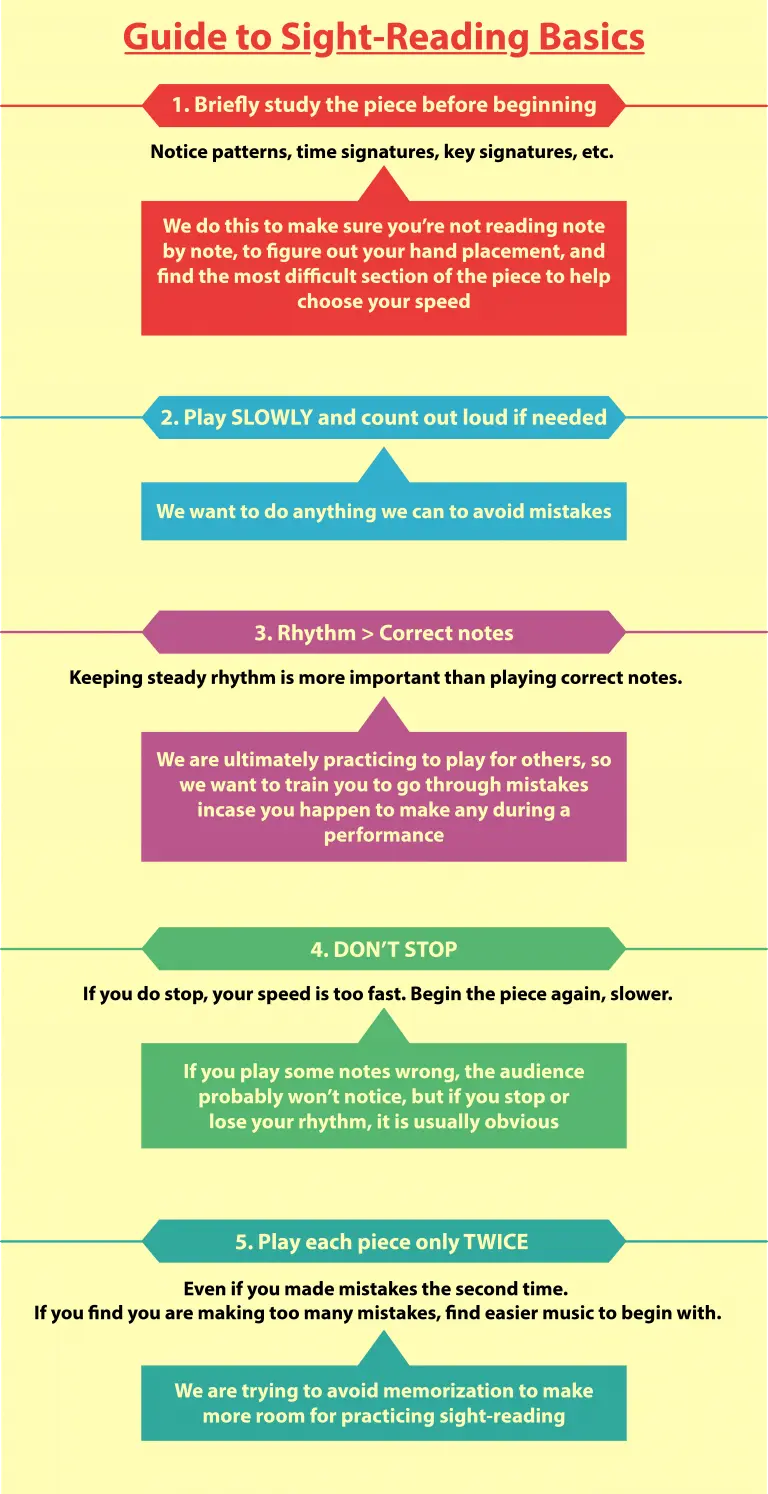
One of the most destructive habits in amateur piano practice is "staring and fixing"—spending twenty minutes agonizing over a single measure, working out the notes through trial and error, and eventually memorizing it. Sight-reading requires the exact opposite approach. A piece designated for sight-reading must be read only twice.
First Reading: Focus entirely on maintaining a slow, unbroken pulse. If a wrong note is played, the student must keep moving forward without stopping.
Second Reading: Play the piece one final time, incorporating immediate corrections for any spatial or rhythmic errors made during the first run-through.
Progression: Once the second reading is complete, the piece is discarded, and the student moves on to fresh material. Never labor over a sight-reading piece until it is perfected; that is the definition of repertoire building, not sight-reading.
Pillar 3: Rhythmic Primacy Over Note Perfection
Many students halt their playing the moment they misidentify a pitch. This shatters the rhythmic integrity of the music. Principles of fluent reading dictate that rhythm and pulse are paramount. A wrong note played in time is infinitely preferable to stopping the performance entirely to search for the correct key.
What This Looks Like in Practice: A Step-by-Step Methodology
To demystify this process, Mirinjian outlines a practical, highly replicable workflow that can be applied to any instrument, though demonstrated here at the piano keyboard.
Prerequisite Assumption: The practitioner can recognize basic note values (quarter and half notes) and locate fundamental treble clef notes such as Middle C, D, and E.
Step 1: Material Selection and Setup
Print a fresh, ultra-simple piece of music—such as a single-line exercise focusing on Middle C—or display it clearly on a tablet. Place the device or sheet music securely on the piano music stand.
Before playing a single note, scan the score. Look for geometric and melodic patterns. For instance, notice if the first note (Middle C) repeats twice, steps up to D, repeats five times, and then steps back down to C. Recognizing these shapes visually before the fingers touch the keys primes the motor cortex.
Step 3: Rhythmic Internalization and Counting Aloud
Examine the time signature. Determine how the beats will be counted. Crucially, commit to counting out loud (1, 2, 3, 4, 1, 2, 3, 4…) as you play. Externalizing the rhythm prevents internal hesitation and maintains momentum.
Step 4: Hand Placement
Position your hand comfortably on the keys, resting your thumb firmly on Middle C. Ensure your posture is relaxed and free of physical tension.
Step 5: Establishing the Non-Stopping Mindset
Prepare to play with the ironclad rule: Do not stop. Accept that mistakes will happen. If a reading hesitation forces a stop, the tempo was too fast. Return to the beginning, lower the metronome or internal pulse to an extreme crawl, and try again.
Step 6: The First Slow Run-Through
Begin playing at an exceptionally slow, meditative pace. Sound the notes while continuously vocalizing the count: "One… Two… Three… Four…" Keep the fingers moving forward at all costs.
Step 7: The Second and Final Execution
Having completed the initial run, execute the piece one final time. In this second pass, integrate the micro-lessons learned moments ago—adjusting for any spatial miscalculations while maintaining the unbroken pulse. Once finished, archive the piece.
Step 8: Progression
Advance immediately to the next piece in your graded collection (e.g., a piece featuring "Stepping Up and Down") and repeat the cycle from Step 2.
Advanced Application and Future Outlook
For pianists who already possess moderate to advanced sight-reading capabilities, the temptation is to dismiss these foundational drills as beneath their skill level. However, Mirinjian issues a direct challenge to advanced players: seek out music that is extremely easy, but ruthlessly elevate your attention to micro-details.
Even conservatory-trained musicians harbor hidden "cracks" in their visual-motor foundation—small gaps in clef fluidity, rhythmic insecurity with odd meters, or an inability to process dynamic markings (forte, piano, crescendo) in real-time. By systematically running through easy material with an obsessive focus on articulation, phrasing, and dynamic shading, advanced players can shore up these invisible vulnerabilities.
The Future of Music Literacy
As digital tools, tablet-based music readers, and interactive sight-reading applications proliferate in the 21st century, the landscape of music education is shifting. Yet, technology cannot replace pedagogical principles. Apps can flash notes on a screen, but without the disciplined application of the Two-Reading Rule, rhythmic primacy, and radical simplification, students will continue to hit the dreaded Complexity Wall.
Ultimately, mastering sight-reading is not about achieving perfection on the first try; it is about developing the fearless resilience to engage with the unknown. By embracing simplicity, honoring the pulse, and prioritizing principles over memorization, pianists of all levels can finally unlock the boundless universe of unspoken music waiting for them on the printed page.