
Executive Overview
For contemporary audiences, the name William Balfe is scarcely a footnote in the grand, sweeping history of nineteenth-century opera, surviving largely as an esoteric literary Easter egg in James Joyce’s Ulysses. Yet, there was an era when Balfe’s 1857 comic opera, The Rose of Castile, reigned supreme across the English-speaking theatrical world. Generating thousands of performances up to the outbreak of the First World War in 1914, the work was a juggernaut of light-hearted melody and breezy Victoriana.
When the Wexford Festival Opera was inaugurated in 1951, it was The Rose of Castile that graced the stage for its maiden production—a natural choice given that Balfe spent his early childhood in the Wexford locality. Following a subsequent revival in 1991, the festival has once more reached into its institutional archives to present a fresh, abridged staging as part of its pocket opera program, celebrating the landmark 75th anniversary of the festival.
Helmed by director Heather Hadrill and musically directed by pianist Rebecca Warren, this 2025 anniversary staging attempts a high-wire balancing act: breathing modern theatrical life into a convoluted Victorian narrative while honoring the charming, unpretentious score that once captivated the British Empire. Relocated to 1929 Spain and framed through the lens of early tabloid journalism, the production leans into its own inherent absurdity. While the work’s musical numbers and stellar cast—led by soprano Eleri Gwilym and tenor Eamonn Walsh—delight the ear, the performance ultimately highlights why The Rose of Castile remains a fascinating museum piece rather than a viable candidate for standard operatic repertory.
Detailed Chronology and Production Mechanics
From Victorian London to the Joycean Era
Commissioned and premiered in London in 1857, The Rose of Castile was born into an era of strict bourgeois values, tight-laced morality, and predictable narrative resolutions. With a libretto penned by Augustus Glossop Harris and Edmond Falconer, the opera’s plot is a convoluted web of mistaken identities and royal intrigue. The narrative revolves around Queen Elvira of Leon who, disguised as a commoner, finds herself cross-purposed with a muleteer who is actually King Don Sebastian in disguise. Add to this a power-hungry cousin, Don Pedro, who attempts to usurp the throne by forcing the Queen to marry a commoner, and the structural foundation is laid for a classic comedy of errors.
Yet, unlike the razor-sharp wit of Rossini or the sparkling comedic machinery of Donizetti, Balfe’s score and the accompanying libretto fail to fully exploit the inherent comic potential. The Victorian sensibilities defang the narrative tension, reducing potential moments of genuine hilarity to mild, polite amusement. Following its pre-WWI heyday, the opera vanished from international stages so entirely that Joyce’s famous riddle in Ulysses—“Which opera do you associate with a railway line? The rows of cast steel”—now evokes widespread bewilderment rather than knowing laughter.
Hadrill’s 1929 Reshaping and the Winchell Device
Faced with an abridged score and a plot line that would challenge even the most dedicated operatic scholar, director Heather Hadrill sought a conceptual anchor. Her solution was to shift the setting from a generic, mythic Middle Ages to Spain in the year 1929.
The rationale was rooted in structural historical parallels: Don Pedro functions as an ambitious military figure eager to seize absolute control from the monarchy, mirroring Spain’s 1929 constitutional reality under the military dictatorship of General Miguel Primo de Rivera. This political tightrope walk between crown and military established a fittingly tense backdrop for the romantic entanglements.
Crucially, Hadrill introduced a non-singing, spoken narrator to bridge the narrative gaps: Walter Winchell, the trailblazing American gossip columnist who rose to prominence precisely in 1929. Played with swaggering, larger-than-life conviction by Peter McCamley—complete with a scruffy wardrobe, heavy Brooklyn drawl, and unmistakable tabloid energy—Winchell acted as a societal narrator. He periodically stepped forward to explain the escalating absurdities of characters donning disguises to unmask other characters who were already masquerading under false names.
While this metatheatrical framing device successfully maintained narrative momentum, it introduced a stylistic trade-off. By injecting rapid-fire spoken English dialogue into the light score, the production occasionally tipped away from grand-scale opera and drifted dangerously close to the aesthetic domain of operetta.
Staging and Aesthetic Design
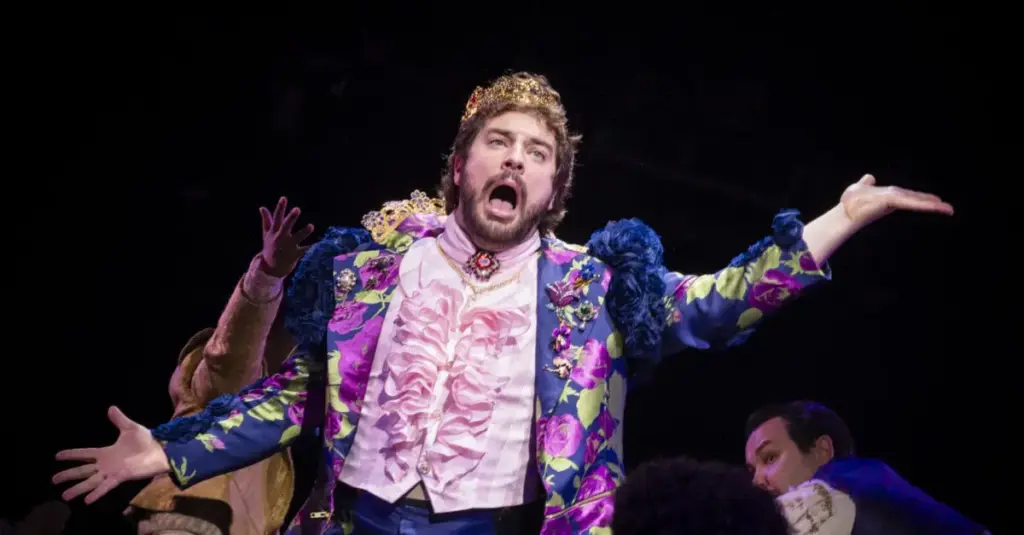
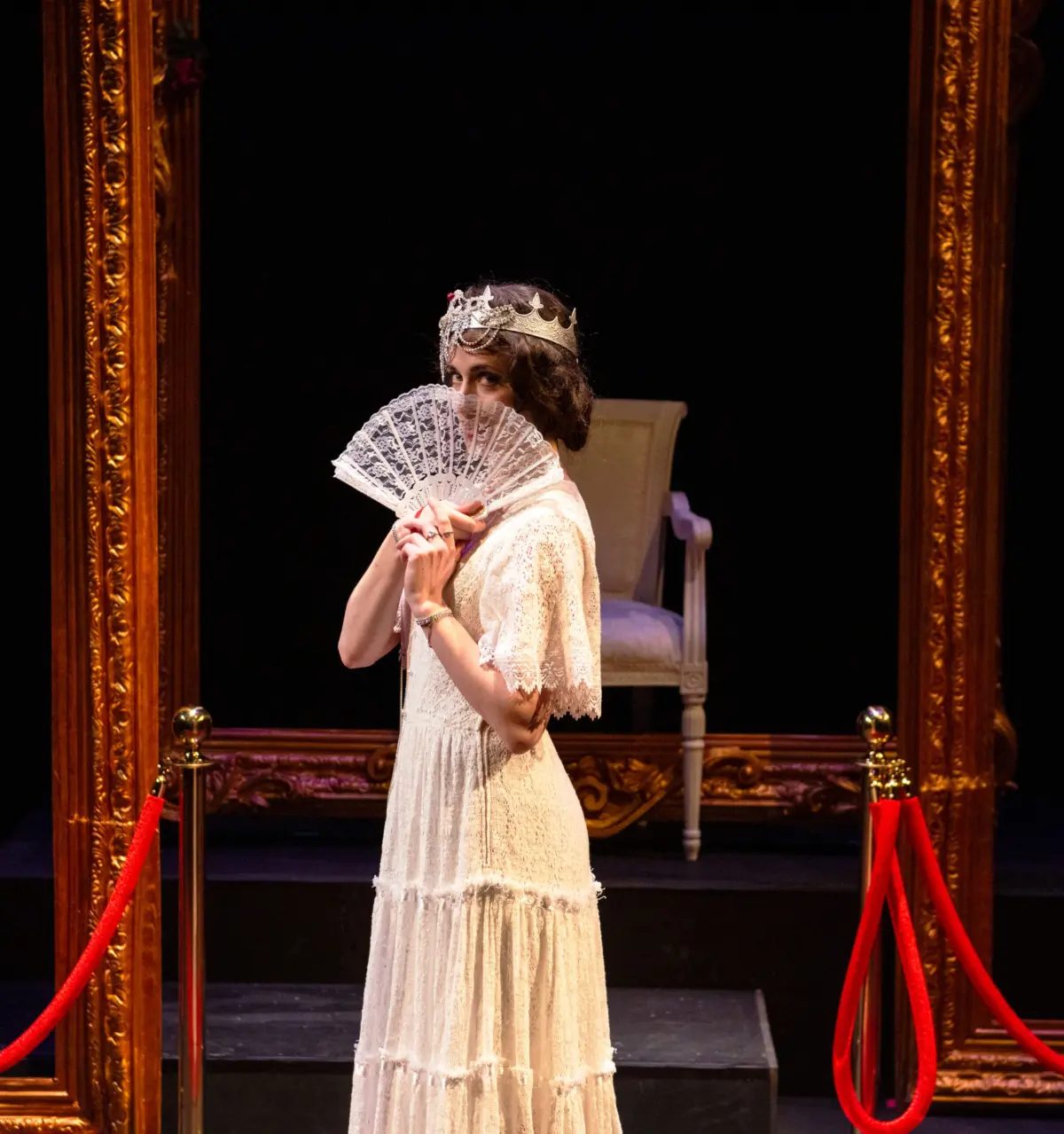
Working within the confines of a pocket opera program, stage and costume designer Lisa Krügel engineered a remarkably efficient, low-budget visual framework. Blending traditional Spanish iconography with 1929 period attire, the staging utilized minimal furniture—principally tables and chairs—to evoke the intimate, atmospheric environment of a Spanish bar or nightclub.
At the rear of the performance space sat a raised platform functioning as a throne, flanked by three oversized golden picture frames. These frames served a dual narrative and visual purpose: characters periodically struck static poses within them, explicitly simulating photographs destined for Winchell’s gossip columns. Large props, including giant playing cards representing the Queen of Hearts (Elvira) and the Prince of Diamonds (Manuel), further reinforced the whimsical, fable-like nature of the proceedings. Lighting designer Cian Redmond utilized dynamic color washes to compensate for minimalist set pieces, generating the necessary mood shifts and theatrical atmosphere.
Supporting Context & Metrics
The 75th Anniversary Milestone
The staging of The Rose of Castile is not merely an isolated revival; it serves as a cornerstone of the Wexford Festival Opera’s diamond jubilee. Over 75 years, the festival has carved out a distinct international reputation precisely for championing the neglected, the obscure, and the unconventional. Resurrecting the very opera that launched the festival in 1951 underscores the institution’s commitment to self-reflection and historical continuity.
Performance Metrics & Historical Reception
- Original Premieres & Run: Premiered in London in 1857 to immediate commercial acclaim.
- Global Footprint: Achieved thousands of professional and amateur performances across the English-speaking world up to the onset of World War I in 1914.
- Wexford Milestones:
- 1951: Inaugural festival production.
- 1991: 40th-anniversary revival.
- 2025: 75th-anniversary pocket opera abridged production.
- Musical High Points: The Act II laughing trio ("I am not the Queen, ha, ha!") and the central romantic duet between Elvira and Manuel ("’Twas rank and fame that tempted thee").
Official Statements and Artistic Perspectives
While no formal government or corporate manifestos were issued for the production, the artistic team’s aesthetic philosophy was clearly articulated through the staging choices and musical execution.
Director Heather Hadrill defended the radical conceptual shift to 1929 by emphasizing the universal nature of political ambition. By framing the power struggle not as a dusty medieval feud, but as a high-society scandal column item, the production consciously invited contemporary audiences to laugh at the mechanical tropes of Victorian melodrama rather than attempt to take them at face value.
Musical Director and Pianist Rebecca Warren noted the unique demands of accompanying a pocket opera score under festival conditions:
"The music requires absolute transparency and lightness. It is a score that demands a flippant, breezy touch to honor Balfe’s melodic intentions, while simultaneously keeping an underlying tension alive to remind the audience that Don Pedro’s political ambitions are genuinely predatory, however comic the packaging may be."
The vocalists themselves embraced the stylistic challenge. Soprano Eleri Gwilym contrasted her work in The Rose of Castile with her much darker, more harrowing role in Zemlinsky’s The Dwarf at the previous year’s festival:
"Elvira is a breath of fresh air. Where previous roles demanded a haughty, vicious intensity, this score invites pure, unadulterated vocal joy. It is an opportunity to dance across the vocal line with carefree abandon, high register ornaments, and a genuine smile."
Musical Execution and Vocal Performances
Under the deft musical direction of Rebecca Warren at the piano, the cast delivered an energetic, bright, and dynamically alert reading of Balfe’s score. The instrumental accompaniment remained consistently light, ensuring the singers’ diction and phrasing were never obscured.
- Soprano Eleri Gwilym (Queen Elvira of Leon): Building on her acclaimed performance in Zemlinsky’s The Dwarf, Gwilym demonstrated remarkable stylistic versatility. Trading aristocratic malice for effervescent charm, she navigated Elvira’s vocal lines with agile grace. Her upper register proved especially secure, characterized by ringing high notes, effortless coloratura runs, and tasteful embellishments executed with infectious theatrical enthusiasm.
- Tenor Eamonn Walsh (Manuel / King Don Sebastian): Playing the disguised monarch, Walsh leaned deliberately into the archetype of the dashing, virile tenor. Endowed with a suave physical presence and a smooth, lyrically appealing vocal tone, he anchored the romantic core of the opera. His Act II duet with Gwilym, "’Twas rank and fame that tempted thee," stood out as the undisputed musical high point of the afternoon, featuring sublime vocal blending and creamy phrasing.
- Baritone Rory Musgrave (Don Pedro): Musgrave approached the villainous cousin with a playful, swaggering confidence that deliberately stripped away any genuine menace. Recognizing the lightweight nature of the opera, he infused his performance with comedic vanity, ensuring the audience understood that no real harm would befall the sovereign. Vocally, Musgrave deployed an attractive timbre and sensitive phrasing to shape a distinct, memorable character.
- Mezzo-Soprano Erin Fflur (Donna Carmen): Providing a rich, dark, and weighty vocal counterweight to Gwilym’s sparkling soprano, Fflur anchored the supporting ensemble with authority as the Queen’s loyal confidante.
- Mezzo-Soprano Myrnna Tennant (Beatrix): Tennant offered a sharply etched portrait of traditional courtly propriety, maintaining her character’s stiff-upper-lip defense of royal honor amid mounting chaos.
- Tenor Jonah Halton (Don Sallust) & Bass-Baritone Conor Cooper (Don Florio): Don Pedro’s bumbling sidekicks were executed with broad, physical comedy and solid musical support, extracting maximum laughs from their minor stage time.
Future Outlook
As the Wexford Festival Opera looks beyond its 75th-anniversary celebrations, the revival of The Rose of Castile offers a compelling case study in archival programming. It proves that forgotten historical works can still captivate modern audiences—provided they are approached with conceptual courage, tight abridgment, and self-aware theatrical framing.
Yet, the production also establishes clear boundaries for the future of nineteenth-century British-Irish light opera. Despite Heather Hadrill’s inventive 1929 tabloid framing and Peter McCamley’s charismatic narration, the underlying work remains too frothy, conventional, and dramatically inert to spearhead a major international renaissance for William Balfe.
Instead, The Rose of Castile functions ideally within its current festival niche: a delightful, charmingly eccentric afternoon diversion that allows exceptional young vocalists to showcase their agility, while paying a fitting, affectionate tribute to Wexford’s unique operatic origins. For festival regulars and music historians alike, this diamond jubilee pocket opera was a gamble well worth taking—not because it revealed a lost masterpiece, but because it reminded us of the sheer, unpretentious joy that animated the operatic stages of a bygone age.