
Executive Overview
The human voice is perhaps our most intimate and dynamic instrument. It communicates our deepest emotions, our cultural identities, and our intellect, yet its underlying mechanics remain a marvel of biological engineering. Long before the era of modern digital vocal processing and advanced laryngeal imaging, a select group of pioneers was working tirelessly at the intersection of medicine, art, and science to decode how we speak and sing. Among the most prominent of these visionaries is Dr. Robert Thayer Sataloff, a world-renowned otolaryngologist, conductor, and vocal health authority.
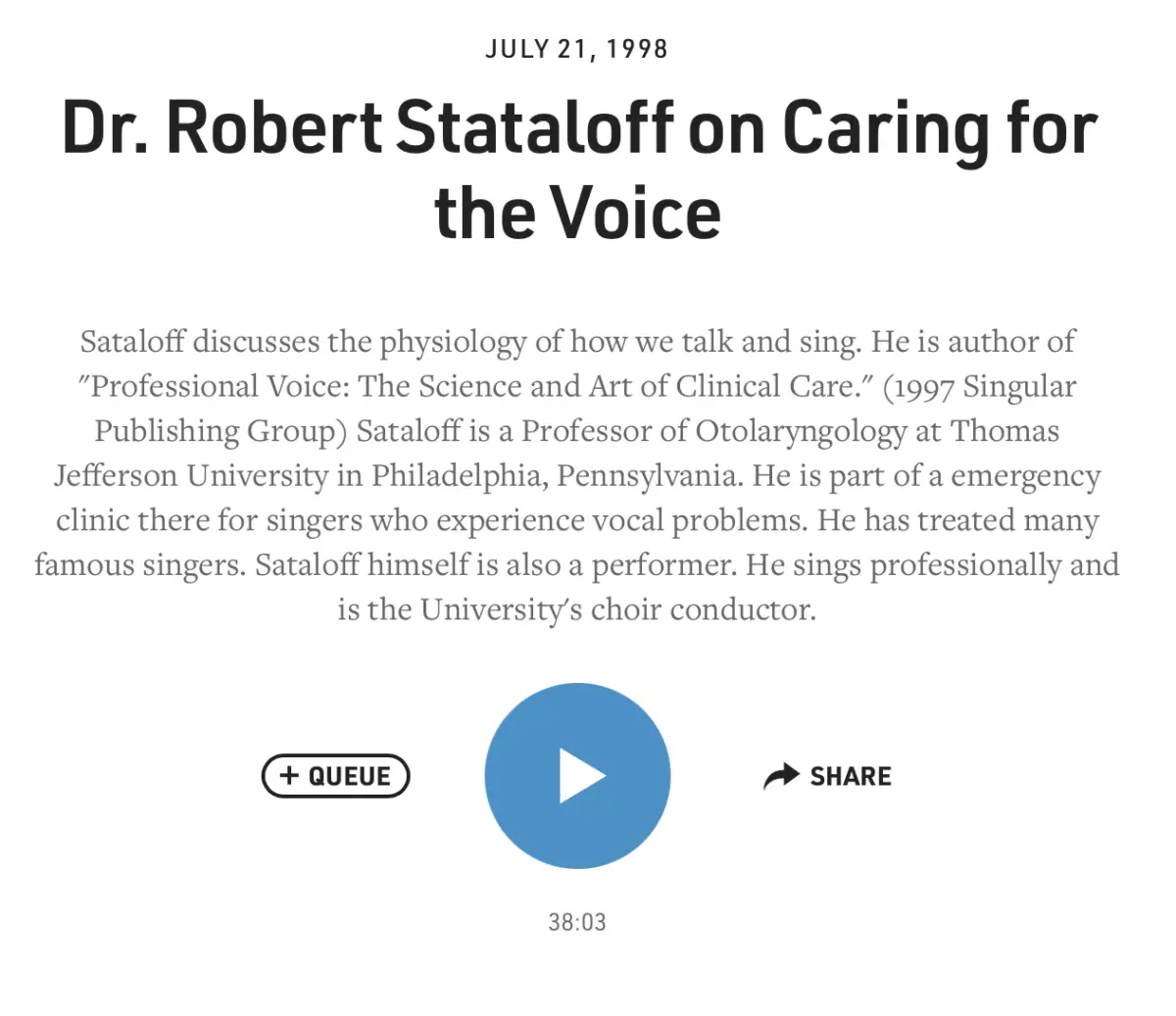
In January 2023, The Voice Foundation spotlighted a piece of broadcasting history that continues to resonate with performers, medical professionals, and audio enthusiasts alike: Dr. Sataloff’s classic 1998 interview on NPR’s Fresh Air with host Terry Gross. Originally broadcast during an era when voice medicine was still emerging as a distinct, highly specialized medical discipline, the conversation offered millions of listeners a rare, behind-the-scenes look at the fragility, resilience, and extraordinary physics of the human vocal folds.
This retrospective analysis examines the enduring impact of that 1998 interview, contextualizing Dr. Sataloff’s pioneering contributions within the broader landscape of laryngology. By revisiting the dialogue between Gross’s incisive questioning and Sataloff’s expert clinical insights, we gain a profound appreciation for how medical science protects the instruments of the world’s greatest speakers and singers—and why the lessons imparted over two decades ago remain foundational today.
Detailed Chronology: The Evolution of Voice Medicine and the 1998 Broadcast
To truly understand the weight of the 1998 Fresh Air interview, one must trace the trajectory of voice care from a time when vocal disorders were poorly understood to the sophisticated, multidisciplinary field it is today.
The Pre-Specialized Era of Vocal Care
For centuries, performers experiencing vocal issues had few options. Singers and actors suffering from hoarseness, nodules, or hemorrhages were often told simply to "rest" or were subjected to rudimentary, sometimes damaging, surgical treatments. Ear, nose, and throat (ENT) doctors traditionally treated the larynx as just one of many structures in the upper aerodigestive tract, frequently lacking the specialized tools needed to analyze the microscopic vibrations of the vocal folds in real-time.
The Rise of Laryngology and Dr. Sataloff’s Entry
By the late 20th century, the advent of stroboscopy, high-speed digital imaging, and acoustic analysis revolutionized the field. Dr. Robert Thayer Sataloff was at the vanguard of this revolution. Combining rigorous medical training with a deep, lifelong passion for music and conducting, Sataloff recognized that professional voice users—opera singers, Broadway actors, politicians, and trial lawyers—required a specialized standard of care comparable to that given to elite athletes.

January 1998: The Fresh Air Milestone
When Terry Gross welcomed Dr. Sataloff to Fresh Air in January 1998, NPR’s cultural magazine program was cementing its status as a premier platform for deep intellectual discourse. Gross, renowned for her meticulous preparation and empathetic interviewing style, immediately engaged Sataloff on a level that bridged high-level medicine and everyday human experience.
During the broadcast, Sataloff demystified common vocal pathologies. He explained how microscopic changes in vocal fold mucosa could derail a professional career, discussed the psychological toll of vocal injury on performers whose identities are tied to their sound, and detailed the delicate surgical interventions required to preserve vocal quality. The interview served as an inflection point, bringing the specialized world of voice medicine into the public consciousness and validating the struggles of performers who previously suffered in silence.
Supporting Context & Metrics: The Anatomy and Vulnerability of the Voice
To appreciate the clinical insights Dr. Sataloff shared with Terry Gross, one must examine the astonishing biomechanics of the human voice. The vocal folds are tiny, layered structures housed within the larynx. Despite measuring only about 10 to 25 millimeters in adults, they are capable of producing an infinite variety of tones, volumes, and textures.
[Lung Power Source] ──> [Vocal Fold Oscillation] ──> [Resonant Tract Shaping] ──> [Speech/Song]The Physics of Phonation
Phonation occurs when air expelled from the lungs creates subglottic pressure beneath closed vocal folds. When this pressure overcomes the muscular tension holding the folds together, they are blown apart, releasing a puff of air. The elastic properties of the tissue, combined with the Bernoulli effect, cause the folds to snap back together. This cycle repeats hundreds to over a thousand times per second:
- Adult Males: Typically vibrate at roughly 100 to 150 cycles per second (Hertz).
- Adult Females: Typically vibrate at roughly 180 to 250 cycles per second (Hertz).
- Sopranos hitting high notes: Can exceed 1,000 Hertz.
Common Pathologies Addressed in Voice Medicine
Dr. Sataloff’s work frequently centers on diagnosing and treating conditions that disrupt this delicate oscillation:
- Vocal Nodules: Benign, callus-like growths caused by chronic vocal abuse or misuse (often referred to as "singer’s nodes").
- Vocal Polyps: Fluid-filled lesions, frequently resulting from a single traumatic event, such as shouting at a sporting event or concert.
- Vocal Fold Hemorrhage: A medical emergency for professional performers, occurring when a blood vessel on the surface of the vocal fold ruptures, filling the tissue with blood and stiffening the mucosal wave.
- Laryngopharyngeal Reflux (LPR): Stomach acid reaching the larynx, causing irritation, inflammation, and chronic hoarseness.
| Condition | Primary Cause | Typical Symptom | Treatment Approach |
|---|---|---|---|
| Vocal Nodules | Chronic vocal misuse / overuse | Breathy, rough voice, fatigue | Voice therapy, behavioral modification |
| Vocal Polyps | Acute vocal trauma | Sudden hoarseness, loss of range | Microsurgery followed by therapy |
| Vocal Hemorrhage | Acute physical trauma / straining | Sudden loss of voice | Strict voice rest, possible laser treatment |
| LPR (Reflux) | Gastric acid exposure | Throat clearing, chronic cough | Dietary changes, anti-reflux medication |
Official Statements and Archival Significance
The preservation of the 1998 interview through archival platforms like the Fresh Air Archive and its promotion by organizations such as The Voice Foundation underscores its lasting educational and cultural value.

Organizations dedicated to vocal health emphasize that public awareness is the first line of defense against career-ending injuries. When institutions like The Voice Foundation—founded by Dr. Sataloff and other luminaries to advance scientific understanding of the voice—highlight these historical broadcasts, they bridge the gap between academic research and public literacy.
"The human voice is a barometer of health, emotion, and identity. Understanding its vulnerabilities is essential not only for the elite performer, but for anyone who relies on spoken communication to navigate the world."
— Archival Commentary on Voice Health Paradigms
Terry Gross’s interview style in 1998 provided a masterclass in accessible science journalism. By prompting Dr. Sataloff to explain complex laryngeal aerodynamics using relatable metaphors, the broadcast helped destigmatize vocal injuries. Performers listening to the episode realized that conditions like nodules or hemorrhages were not moral failings or signs of poor artistry, but predictable physical injuries amenable to modern medical science.
Future Outlook: The Next Generation of Voice Care
As we look toward the future, the foundation laid by pioneers like Dr. Robert Thayer Sataloff continues to shape modern otolaryngology and vocal pedagogy. The intersection of medicine, technology, and art is entering an unprecedented era of innovation.
Technological Advancements in Laryngology
- High-Speed Digital Imaging (HSDI): Capturing thousands of frames per second to visualize mucosal waves with microscopic precision, far surpassing traditional stroboscopy.
- Regenerative Medicine: Ongoing research into stem cell therapies and tissue engineering aimed at repairing scarred vocal fold tissue—a historically difficult challenge that can permanently alter a singer’s career.
- Telehealth and Remote Voice Monitoring: Wearable sensors and smartphone applications that track vocal load, helping performers avoid fatigue and injury before clinical pathology develops.
The Interdisciplinary Future
The philosophy championed by Dr. Sataloff—that optimal voice care requires a team approach involving laryngologists, speech-language pathologists, singing voice specialists, and voice scientists—has become the gold standard globally. Voice clinics in major medical centers now routinely blend medical diagnosis with pedagogical coaching, ensuring that patients not only heal physically but regain their artistic and communicative freedom.
Conclusion
Revisiting Dr. Sataloff’s 1998 conversation with Terry Gross reminds us that while medical technology will continue to evolve, the fundamental marvel of the human voice remains constant. It is an instrument of profound beauty and delicate complexity. By honoring the historical milestones of voice science, we not only celebrate the achievements of medical pioneers like Dr. Sataloff, but we also ensure a healthier, more resonant future for every voice that shapes our world.