
Executive Overview
For over two decades, the Twin Cities educational and cultural landscape has been deeply enriched by the collaborative efforts of teaching artist and pianist Anita Ruth and acclaimed vocalist and educator T. Mychael Rambo. Working under the banner of the VocalEssence WITNESS School Program—originally launched during the era of the Plymouth Music Series—the pair has brought the history, struggle, and art of African American Spirituals into hundreds of Minnesota classrooms.
What began as a chance meeting in a downtown Minneapolis music venue roughly thirty years ago evolved into a transformative pedagogical partnership. By pairing historical instruction with immersive vocal music, Ruth, Rambo, and their fellow VocalEssence Teaching Artists provide students with a direct window into the lived experiences of enslaved Africans in the United States.
Beyond its foundational goal of historic and cultural education, the WITNESS program has repeatedly demonstrated a profound capacity for therapeutic breakthrough. In classrooms designed for students with severe emotional, behavioral, and learning disabilities, the medium of music has bridged communication barriers where traditional interventions often stall. This report examines the evolution of Ruth’s tenure with VocalEssence, the socio-historical framework of the WITNESS curriculum, and the documented impact of creative arts integration on non-traditional learners.
Detailed Chronology
[Circa Early 1990s] ----------------------------------------------------
  • Anita Ruth meets vocalist T. Mychael Rambo at Ruby’s Cabaret in downtown Minneapolis.
  • Initial musical collaborations begin in local performance spaces.

[Mid-to-Late 1990s] ----------------------------------------------------
  • Rambo invites Ruth to accompany him for auditorium presentations under the Plymouth Music Series.
  • Onstage pivotal moment: Rambo challenges Ruth to step out from behind the piano.
  • Ruth officially transitions into a full-fledged WITNESS Teaching Artist.

[2002] -----------------------------------------------------------------
  • Plymouth Music Series officially renames and rebrands as VocalEssence.
  • The WITNESS School Program expands its reach across Twin Cities school districts.

[2000s–Present] --------------------------------------------------------
  • Over two decades of classroom residencies, interactive workshops, and educational concerts.
  • Ongoing partnerships with educators (such as Jason Etten) and guest artists (including composer Melanie DeMore).
  • Continued focus on special education contexts, delivering music-based interventions.
The Genesis at Ruby’s Cabaret
The origins of this twenty-year educational partnership trace back roughly three decades to downtown Minneapolis. Anita Ruth, an accomplished local pianist and music director, was working a gig at Ruby’s Cabaret—a staple of the city’s nightlife and theater scene at the time. It was there she met T. Mychael Rambo, a vocalist whose commanding stage presence was matched by a warm, approachable personal demeanor.
The immediate professional chemistry between Ruth and Rambo quickly grew into a close personal friendship. Shortly after their initial meetings, Rambo approached Ruth with an invitation to accompany him during a series of school auditorium performances he was conducting for the Plymouth Music Series.
The Catalyst: From Accompanist to Teaching Artist
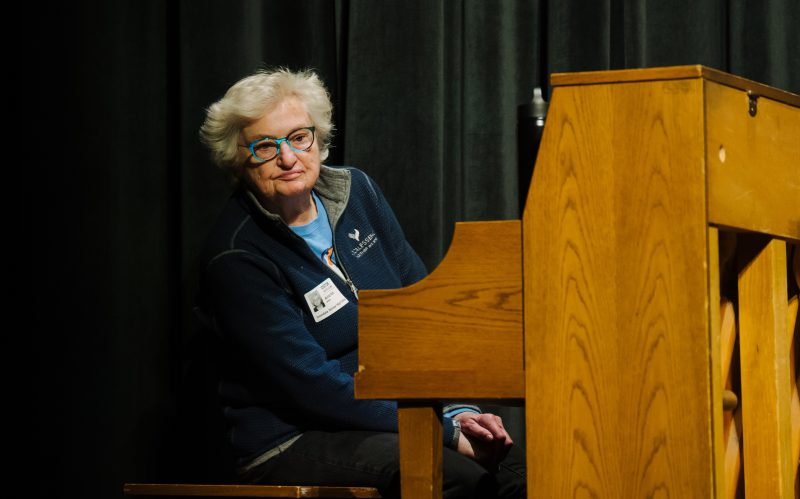
At the time of their early school tours, the Plymouth Music Series—founded by Artistic Director Philip Brunelle—was laying the groundwork for what would become one of the region’s most robust arts-in-education initiatives. Ruth initially viewed her role strictly through the lens of a supporting musician, remaining positioned behind the upright pianos provided by host schools.
During one auditorium performance, Rambo turned to Ruth mid-show and posed a direct question: "What are you doing behind that piano?"
The query marked a critical turning point in Ruth’s career. Encouraged by Rambo’s mentorship and modeling, Ruth stepped out of the traditional accompanist role to become a full co-facilitator of the workshops. This shift marked the beginning of her formal tenure as a WITNESS Teaching Artist, a role she has held for more than 20 years.
Institutional Evolution: Plymouth Music Series to VocalEssence
In 2002, the Plymouth Music Series officially changed its name to VocalEssence to better reflect its expanding mission as a champion of choral music and community engagement. Throughout this organizational transition, the WITNESS program remained a core pillar of its outreach strategy. Over the subsequent decades, Ruth and Rambo, alongside a cohort of specialized teaching artists, expanded their footprint, visiting thousands of K–12 students across urban, suburban, and rural Minnesota school districts.
Supporting Context & Metrics
+-----------------------------------------------------------------------------------+
|                        VOCALESSENCE WITNESS PROGRAM MATRIX                        |
+------------------------------------+----------------------------------------------+
| Core Curriculum Focus              | African American History via Spirituals      |
+------------------------------------+----------------------------------------------+
| Primary Pedagogical Mechanism      | Interactive Workshops & School Residencies   |
+------------------------------------+----------------------------------------------+
| Target Student Demographics        | K-12 Students; General & Special Education   |
+------------------------------------+----------------------------------------------+
| Key Historical Themes              | Enslavement, Resistance, Underground Railroad|
+------------------------------------+----------------------------------------------+
| Clinical / Behavioral Outcomes     | Increased engagement, verbal activation,     |
|                                    | tactile participation in EBD/special ed      |
+------------------------------------+----------------------------------------------+
The Pedagogical Framework of African American Spirituals
The VocalEssence WITNESS School Program operates on the principle that music is an active historical text. Rather than treating Spirituals merely as artistic artifacts, the curriculum presents them as primary sources detailing the history, resilience, and coded communications of enslaved Africans in antebellum America.
Teaching artists use these compositions to illuminate complex historical narratives:
- Dual-Coded Lyrics: Explaining how songs like "Steal Away" or "Wade in the Water" functioned simultaneously as spiritual expressions and practical instructions for navigating the Underground Railroad.
- Oral Traditions and History: Demonstrating how history, genealogy, and cultural values were preserved and transmitted orally when literacy was legally denied to enslaved populations.
- Vocal Interpretation: Utilizing Rambo’s expertise as a dramatic vocal interpreter to help students analyze tone, phrasing, and emotional resonance in historical music.
Arts Integration in Special Education and EBD Environments
A key dimension of the WITNESS program is its work within specialized learning environments, including classrooms serving students with severe emotional and behavioral disabilities (EBD), as well as profound neurodevelopmental challenges.
Educational research consistently underscores the neurological benefits of music-integrated instruction for non-traditional learners:
[Acoustic/Rhythmic Stimulus]
       │
       ▼
[Bypasses Traditional Language Processing Blocks]
       │
       ▼
[Activates Limbic System & Motor Cortex]
       │
       ▼
[Facilitates Behavioral Regulation & Verbal Activation]
By introducing rhythm, shared singing, and accessible percussion instruments (such as tambourines), teaching artists create an environment that bypasses conventional verbal barriers. The multi-sensory nature of music allows students who struggle with standard social-emotional processing to engage at their own comfort level.
Official Statements & Case Studies
Personal Reflection: Anita Ruth on the Power of Partnership
Reflecting on her multi-decade career with VocalEssence, Anita Ruth emphasized the deep educational impact of using musical storytelling to convey historical truths to younger generations.
"Together with T. Mychael, we were able to bring the true history of enslaved Africans to the students who needed to know this story," Ruth stated. "And best of all, we brought the story to hundreds of students through music. T. Mychael is a wonderful interpreter of the songs created by enslaved Africans—the Spirituals. The effect of the enrichment of African American history that VocalEssence Teaching Artists provide is invaluable. I have gained so much knowledge and important insights from working with these wonderful people."
Case Study: Classroom Breakthrough with a Non-Verbal Student
The practical efficacy of the WITNESS program’s therapeutic approach is illustrated by an encounter documented by Ruth during a residency in an elementary special education classroom.
The workshop focused on teaching a composition by renowned singer, songwriter, and vocal activist Melanie DeMore. Among the participants was a fourth-grade girl who, according to school administrators, consistently refused to speak, make eye contact, or participate in group activities, spending her days isolated from her peers.
+-----------------------------------------------------------------------------------+
|                  CHRONOLOGY OF A CLASSROOM BREAKTHROUGH                           |
+-----------------------------------------------------------------------------------+
| Initial State    | Student sits isolated by the window, completely disengaged.     |
+------------------+----------------------------------------------------------------+
| Phase 1 (10 min) | Music begins (Melanie DeMore song); student physically edges   |
|                  | closer to the piano.                                           |
+------------------+----------------------------------------------------------------+
| Phase 2          | Student reaches the piano bench; Ruth offers a direct, low-    |
|                  | pressure invitation to sit together.                           |
+------------------+----------------------------------------------------------------+
| Phase 3          | Student breaks verbal isolation, clearly answering "Yes!"      |
+------------------+----------------------------------------------------------------+
| Outcome          | Student picks up a tambourine and actively joins the ensemble. |
+------------------+----------------------------------------------------------------+
Ruth recalled the progression of the breakthrough:
"In one particular instance, we were told that a young girl, a fourth grader, refused to speak or participate in any activities in the classroom. We were teaching the kids a wonderful Melanie DeMore song, and she was sitting away from the class, looking out the window.
As we were teaching, I could see she was edging closer to the group. After ten minutes, she had worked her way to the piano. I asked if she wanted to sit with me on the bench, and she said, ‘Yes!’
The teacher was amazed at that, but even more so when she picked up a tambourine and started to play with us! It was truly an example of the power of music."
This moment illustrates a broader phenomenon observed by educators throughout the WITNESS program: music can provide a low-stakes, highly regulating environment that allows reluctant or traumatized learners to safely re-enter a shared educational experience.
Future Outlook
Sustaining Arts Outreach in Modern Curricula
As school districts across the United States navigate tightening budgets and an increasing emphasis on standardized testing, programs like VocalEssence WITNESS represent a critical model for sustainable arts integration. By aligning musical performance directly with state social studies, history, and literacy standards, the program ensures that arts education remains an essential component of core academic instruction rather than an dispensable extracurricular activity.
The Long-Term Impact of VocalEssence WITNESS
Looking ahead, VocalEssence continues to update and adapt its WITNESS program to meet the changing needs of contemporary classrooms. Key focus areas for the program’s ongoing legacy include:
- Expanding Teaching Artist Coalitions: Continuing to recruit diverse rosters of local musicians, vocalists, and historians to maintain a wide breadth of cultural perspectives.
- Deepening Educator Partnerships: Working alongside classroom teachers—such as long-term collaborators like Jason Etten—to build multi-week residency models that integrate seamlessly into existing lesson plans.
- Preserving Sacred Cultural Traditions: Ensuring that the history, performance practice, and context of African American Spirituals remain accessible to future generations of students from all backgrounds.
Through the ongoing efforts of artists like Anita Ruth and T. Mychael Rambo, the VocalEssence WITNESS School Program continues to demonstrate that music can serve both as a vital bridge to understanding historical truths and as a catalyst for personal connection.