
Executive Overview
Music education is universally recognized as one of the most profoundly rewarding vocations, yet it remains one of the most demanding. Educators continually navigate a complex labyrinth of responsibilities: managing sprawling rehearsals, tracking intricate student progress, planning curriculum-aligned assignments, and keeping pace with administrative mandates. For many, the daily routine feels less like an artistic endeavor and more like a relentless race against the clock.
To combat burnout and elevate instructional quality, modern music pedagogy is experiencing a paradigm shift centered entirely on collaboration. Whether partnering with an on-site co-teacher, collaborating with a colleague across the district, or tapping into a global network of peers, sharing the pedagogical workload transforms the teaching experience from an isolating struggle into a sustainable, dynamic profession.
Recognizing these systemic challenges, platforms like MakeMusic are leading the charge by introducing innovative, connectivity-driven features designed to bridge the gap between solo educators and collaborative departments. By rolling out advanced co-teaching capabilities and streamlined intra-organization assignment sharing, the platform is redefining how educators manage their classrooms. This report explores the evolving landscape of music education technology, detailing how these new tools alleviate educator fatigue, foster departmental alignment, and ultimately enhance student outcomes across diverse learning environments.
Detailed Chronology: The Evolution of Music Tech Collaboration
The journey toward seamless digital collaboration in music education has been gradual, evolving from isolated desktop software to interconnected cloud ecosystems.
Phase One: The Siloed Era of Desktop Notation (Late 1990s – Early 2010s)
In the early days of digital music software, tools were largely built for individual productivity. Composers and educators used notation software to write scores and print physical sheets. Collaboration was restricted to physical handoffs, USB flash drives, or cumbersome email attachments. If two teachers wanted to share a quiz or a practice assignment, they essentially had to recreate the materials from scratch on their respective computers. There was no centralized repository, and collaborative teaching models—such as split-ensemble directors or special education integration—required tedious manual synchronization.
Phase Two: The Shift to Cloud-Based Classrooms (Mid 2010s – 2020)
As educational technology transitioned to cloud-based architectures, platforms like MakeMusic Cloud began centralizing sheet music libraries, assignment distribution, and grading. Teachers could finally assign interactive practice modules and track student submissions online. However, these early cloud iterations were primarily designed around a single-teacher-to-student paradigm. Co-teachers and department chairs often had to share login credentials to access the same classes—a practice that raised security concerns and complicated administrative accountability.
Phase Three: The Modern Collaborative Ecosystem (2023 – Present)
Recognizing that modern music programs rely heavily on team teaching, mentorship, and standardized curricula, platform developers have shifted focus toward multi-user workflows. Recent developments have introduced native co-teaching architectures that grant independent, secure access to multiple instructors within a single roster. Furthermore, the introduction of customizable, multi-choice assessments and inter-organizational sharing protocols marks a significant milestone. Educators can now pass complex instructional assets directly between peers, mirroring the cooperative spirit inherent in musical performance itself.
Supporting Context & Metrics: The Crisis of Educator Burnout
The urgency behind these technological advancements is underscored by alarming trends in teacher retention and workload management.
The Weight of the Podium
Recent educational surveys consistently highlight workload volume and administrative fatigue as the primary drivers of educator attrition. In music departments, these pressures are uniquely compounded. Unlike traditional classroom teachers who may grade papers at a desk, music educators constantly transition between physical ensemble direction, individual technical troubleshooting, public performance preparation, and digital assignment tracking.
- The Soloist Dilemma: A significant percentage of music educators operate as a "department of one" in their schools, particularly in rural or private districts. These solo practitioners shoulder the responsibilities of band director, choir master, orchestra conductor, and general music instructor simultaneously.
- The Large Ensemble Challenge: For educators managing comprehensive programs—such as high school marching bands involving upwards of 100 students—tracking individual musical growth through traditional paper-based methods is nearly impossible without digital automation.
The Power of Professional Learning Communities (PLCs)
Research in educational psychology strongly supports the implementation of Professional Learning Communities. When teachers actively share resources, align assessment standards, and co-plan curricula, several positive outcomes emerge:
- Reduced Preparation Time: Eliminating the need to "reinvent the wheel" for standard theory quizzes or sight-reading exercises saves educators hours of unpaid prep time each week.
- Curricular Consistency: Students transitioning between different grade levels or parallel course sections experience a seamless continuity in instructional standards.
- Enhanced Mentorship: New educators integrated into a collaborative digital workspace adapt faster, benefiting from the institutional knowledge and pre-built resource libraries of veteran colleagues.
Official Features & Operational Mechanics
To address these systemic needs, modern platforms have implemented targeted features designed to bridge the gap between isolated instruction and collaborative teamwork.
Two Conductors, One Vision: The Mechanics of Co-Teaching
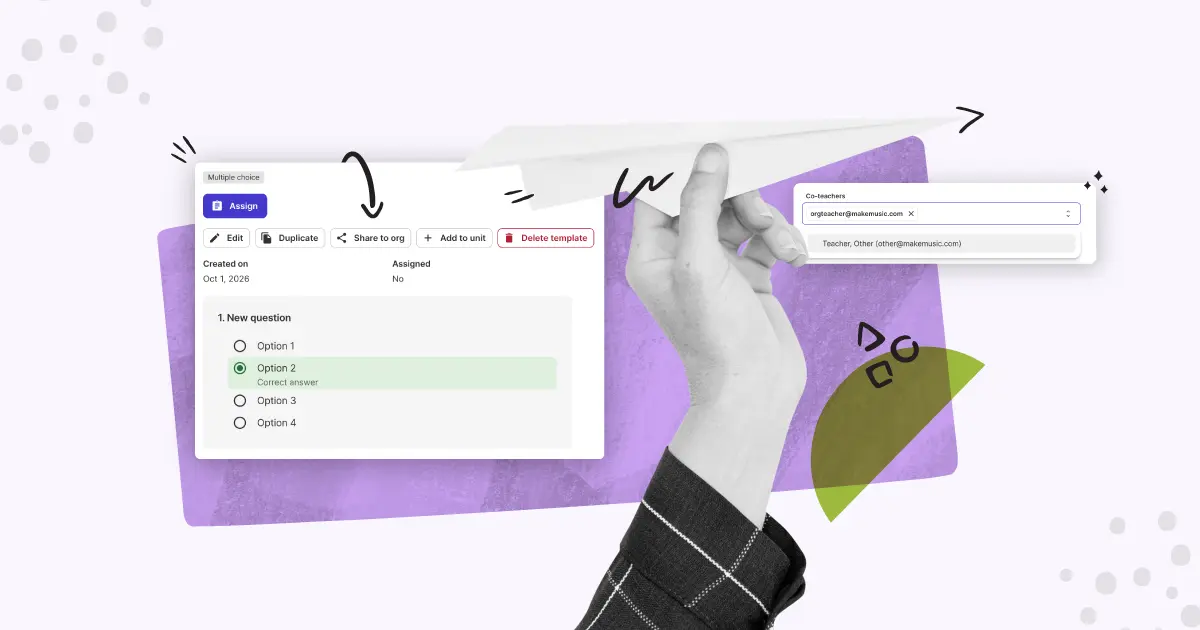
One of the most impactful modern developments in music ed-tech is the native co-teaching feature. Rather than forcing co-directors to share a single user account—or worse, maintain entirely separate gradebooks for the same ensemble—platforms now allow primary educators to invite secondary instructors directly into a class via email.
Once a co-teacher accepts the invitation, they gain full, independent access to the classroom ecosystem. This architecture proves transformative across several distinct educational scenarios:
- Large Ensembles and Marching Bands: Programs co-managed by multiple directors can operate from a single, unified source of truth. Brass instructors and percussion directors can review submissions, grade assignments, and manage student rosters simultaneously without needing to reconcile conflicting notes post-rehearsal.
- Student Teacher Integration: Veteran educators mentoring university interns can now onboard them as active co-teachers. Instead of watching passively from the sidelines, student teachers gain hands-on experience managing digital assignments, grading student performances, and interacting with the class curriculum under direct supervision.
- Special Education and Support Integration: In inclusive classrooms where specialized support professionals assist students with individualized education programs (IEPs), giving those specialists platform access ensures they possess the exact pedagogical context needed to support their students effectively.
Streamlining the Workflow: Intra-Organizational Assignment Sharing
Beyond live classroom co-teaching, asynchronous collaboration has taken a major leap forward with the introduction of shareable written assignments and multiple-choice assessments.
Previously, if an educator designed a comprehensive multiple-choice quiz on advanced rhythm notation or music history, that asset remained locked within their individual user account. Colleagues teaching parallel sections within the same school or district were forced to build their own versions from scratch.
The new sharing protocols dismantle these barriers:
- Library Integration: Educators navigate to a created assessment within their personal library.
- Organizational Sharing: By selecting the sharing parameter, the assignment is made visible and accessible to other approved educators within the same school or district organization.
- Cloning and Customization: Colleagues can instantly preview, import, and save a functional copy of the assignment directly into their own accounts, modifying it if necessary to suit their specific student demographic.
This capability fundamentally alters department dynamics. High school band directors can instantly standardize music theory assessments across all concert bands. Choral directors can share standardized solfa identification exercises. Incoming faculty members can inherit a rich, pre-established institutional library of quizzes and exercises on their very first day, allowing them to focus on student engagement rather than administrative setup.
The Broader Community: Finding Support Beyond the School Walls
While institutional tools streamline day-to-day operations, emotional and professional support often extends beyond physical school boundaries. For educators operating as solo departments, digital communities serve as vital lifelines.
Dedicated online forums—such as specialized educator networks and active digital communities like the Teaching with MakeMusic Cloud Facebook group—act as virtual staff rooms. In these spaces, thousands of music educators exchange troubleshooting tips, share creative lesson plans, and provide mutual encouragement. This digital camaraderie acts as a crucial sounding board, ensuring that educators grappling with unique scheduling conflicts, repertoire selections, or technical hurdles never feel entirely on their own.
Future Outlook: The Next Horizon in Collaborative Music Pedagogy
As educational technology continues to mature, the trajectory of music instruction points firmly toward deeper integration, greater automation, and enhanced interoperability.
Predictive Analytics and Collaborative Intervention
Future iterations of collaborative music platforms are expected to leverage advanced data analytics to flag struggling students automatically. In a co-teaching environment, these predictive insights will be shared instantaneously between primary directors, sectional coaches, and support specialists. This multi-tiered visibility will allow music teams to intervene early, offering targeted practice assignments or individualized feedback before a student falls behind.
Cross-District Artistic Partnerships
Beyond single-school organizations, the future promises expanded regional and national collaboration. Imagine high school ensembles in different cities collaborating on shared composition projects, sharing custom-built digital arrangement assignments, or participating in cross-district peer review circles mediated through secure cloud platforms.
Preserving the Human Element
Ultimately, the primary goal of introducing advanced collaborative tools into music education is not to automate the artistic process, but to protect it. By eliminating redundant administrative burdens, streamlining assignment creation, and fostering robust peer-to-peer partnerships, technology gives educators back their most precious commodity: time.
When music teachers are freed from the exhaustion of administrative isolation, they can redirect their energy toward what truly matters—inspiring the next generation of musicians, fostering creative expression, and building vibrant, connected artistic communities. Making music has always been a collective endeavor; it is only fitting that teaching it should be, too.