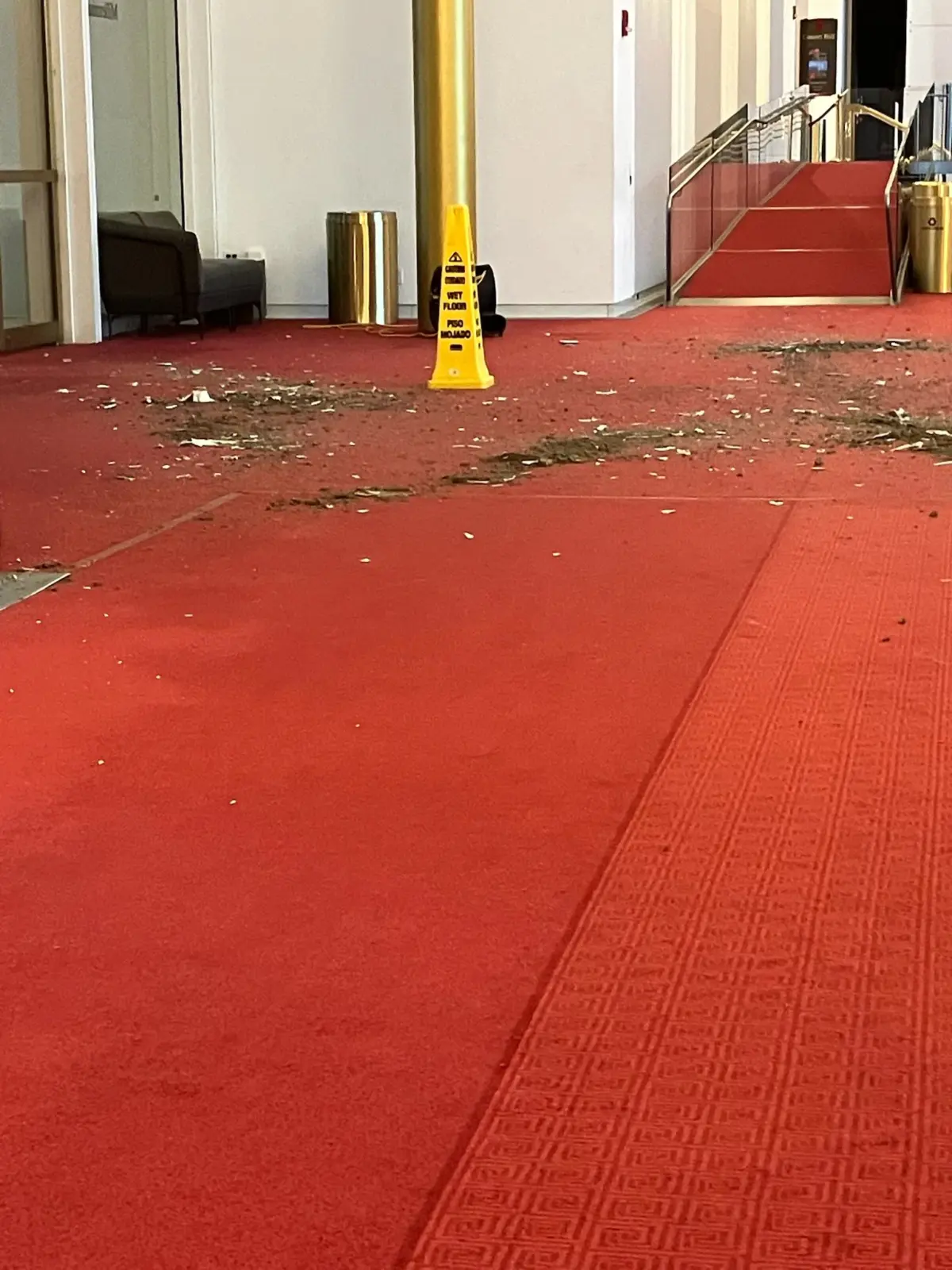

WASHINGTON — A dramatic partial ceiling collapse within the iconic Grand Foyer of the John F. Kennedy Center for the Performing Arts has dramatically escalated an already fierce political and institutional battle over the future of America’s national cultural flagship.
The structural failure, which occurred in the wake of a severe regional storm system, has left a portion of the soaring, 630-foot-long hall restricted to visitors and reignited urgent debates regarding decades of deferred maintenance. While institution officials have confirmed that no injuries were reported, the incident has instantly transformed from a localized engineering failure into a flashpoint for a broader confrontation involving the center’s leadership, the Trump administration, preservationists, and the national media.
The collapse serves as the latest chapter in a turbulent period for the Kennedy Center, characterized by legal battles, contentious board votes, and sweeping proposals that could fundamentally alter the identity, governance, and physical footprint of the nation’s premier performing arts institution.
Executive Overview: A Landmark at a Crossroads
The incident at the Kennedy Center is not merely a story of storm damage; it is the physical manifestation of a structural and political crisis years in the making. According to center officials, years of underfunded upkeep and delayed capital improvements made a failure of this magnitude an inevitability.
The timing of the collapse could not be more politically charged. It arrives on the heels of several high-profile developments:
- A federal judge’s recent decision to temporarily halt plans to rename portions of the cultural center.
- Public comments from Commerce Secretary Howard Lutnick hinting at the possibility of a full-scale demolition and rebuilding project.
- A controversial August 13 vote by the Kennedy Center board of trustees to approve new inscriptions and naming rights honoring President Donald J. Trump, contingent upon specific fundraising milestones.
As leadership uses the ceiling collapse to press for immediate, comprehensive renovations, critics and legal adversaries warn that the push is being leveraged to fast-track politically motivated structural changes under the guise of emergency repairs. Meanwhile, the incident has exposed deep rifts between the institution’s current administration and major journalistic outlets, with leadership launching public attacks against the national press for its initial coverage of the event.
Detailed Chronology of Events
The Storm and the Collapse
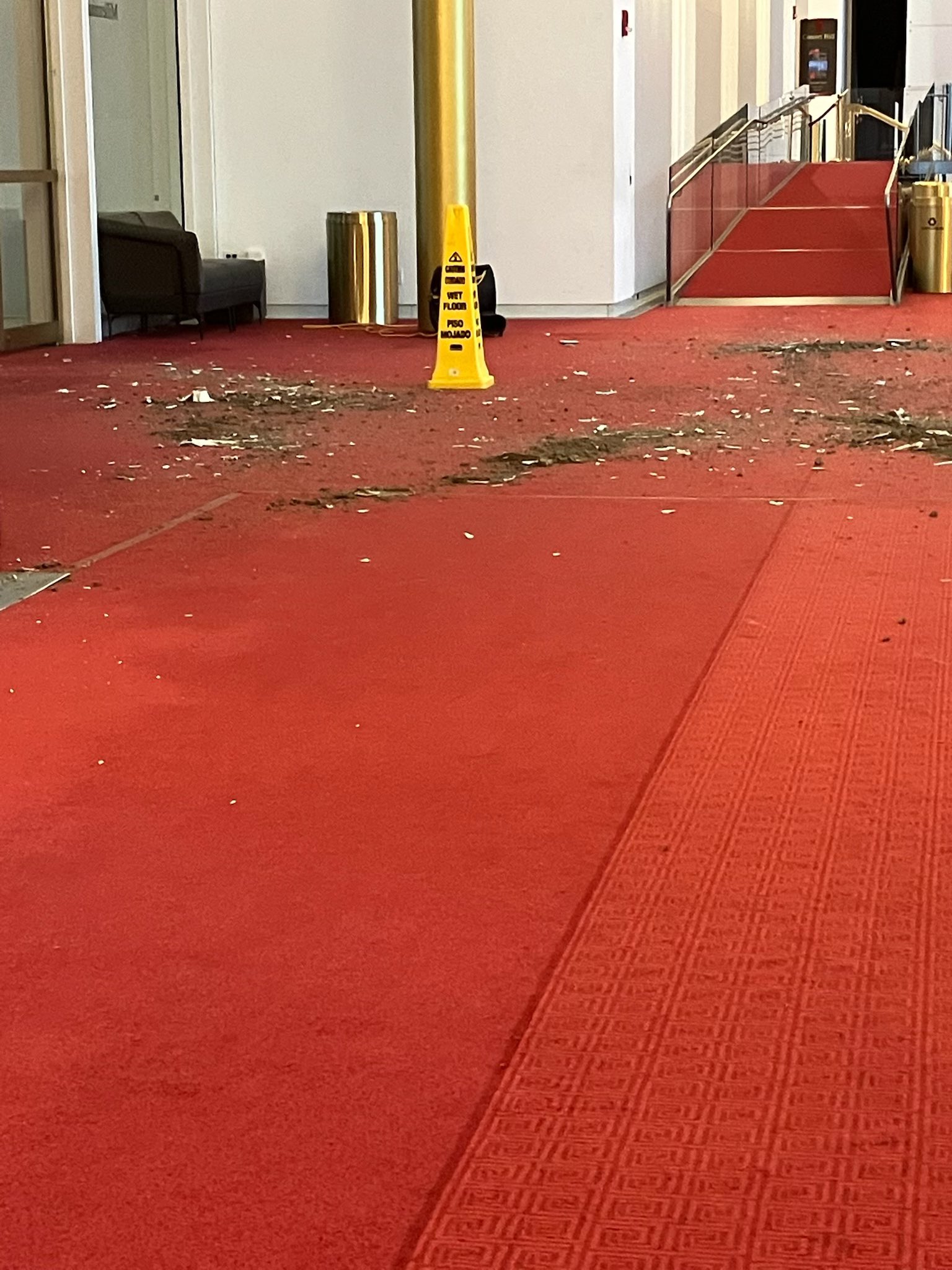
In the wake of violent storms that swept through the Washington, D.C., metropolitan area, structural integrity failed within the Kennedy Center’s majestic Grand Foyer—a space renowned for its red-carpeted floors, massive chandeliers, and sweeping views of the Potomac River.
While the storms battered the region with high winds and heavy rainfall, the internal failure of the ceiling tile and plaster matrix revealed profound vulnerabilities in the building’s core infrastructure. Fortunately, the collapse occurred during a period of low foot traffic in the immediate zone, resulting in zero injuries.
Security and facilities personnel moved swiftly to cordon off the affected area of the Grand Foyer, restricting visitor access indefinitely. However, structural engineers cleared the remainder of the main building, allowing scheduled performances and general public access to resume on Saturday.
Escalation and the Push for Renovation
Following the incident, the Kennedy Center’s official social media channels published an uncompromising assessment of the event:
"Another warning we can’t ignore. A section of the Grand Foyer ceiling collapsed after this week’s storms. Thankfully no one was hurt. Decades of deferred maintenance made this inevitable. Chairman President Trump has been right: America’s cultural center needs to close, renovate, and be restored—now."
This sentiment was amplified by Kennedy Center spokesperson Roma Daravi, who argued that the collapse removes any remaining justification for delaying capital projects. "There is no legitimate reason to further halt the renovations," Daravi stated. "The longer the delay, the worse the infrastructure gets."
The Media Blackout Controversy
The aftermath of the collapse also triggered a blistering critique of the national press corps by center leadership. Daravi publicly lambasted prominent news organizations, including The Washington Post, The New York Times, The Atlantic, Reuters, the Associated Press, and USA Today, for failing to immediately cover the breaking news of the structural failure.
Calling the silence an "absolute insane lack of journalistic integrity," Daravi’s statement accused the mainstream media of ignoring the incident because it conflicted with a perceived narrative that the institution is functioning smoothly. "The reality is, the place is falling apart and Donald Trump wants to fix it," the statement concluded.
Supporting Context & Metrics: Infrastructure, Politics, and Naming Rights
The Trump Administration and the Board’s Vision
The structural crisis unfolds against a backdrop of aggressive repositioning by the Kennedy Center’s leadership and its board of trustees. On August 13, the board voted to implement a series of commemorative changes tied to President Donald J. Trump.
Key elements of this initiative include:
- The Main Inscription: Placing a permanent plaque or inscription below the primary Kennedy Center sign stating that the venue was "Restored and Renovated by President Donald J. Trump."
- Endowment Milestones: Securing provisions to add further references and honors to Trump should specific fundraising endowments reach the $100 million threshold.
- Site Renaming: Pursuing plans to formally rename the physical site and ground upon which the building sits in honor of Trump.
These maneuvers have faced fierce opposition. A federal judge recently intervened to delay the implementation of these sweeping renaming efforts, creating a tense legal standoff between the board and preservationist or institutional stakeholders who argue that such changes dilute the legacy of the late President John F. Kennedy, for whom the center was designated as a living memorial by Congress in 1964.
Speculation on Demolition
Complicating the debate further are recent remarks from high-ranking administration figures. Commerce Secretary Howard Lutnick recently inferred in public discussions that the existing physical structure of the Kennedy Center may be beyond effective rehabilitation, suggesting that the institution could eventually face total demolition to make way for a newly engineered facility.
For architectural historians and cultural preservationists, the prospect of demolition—coupled with the recent ceiling collapse—represents an existential threat to an Edward Durell Stone-designed landmark that has stood as a pillar of the nation’s performing arts capital for over half a century.
Official Statements and Institutional Reactions
The divergence in how various stakeholders view the Kennedy Center crisis highlights the deep polarization surrounding the institution:
- The Kennedy Center Leadership & Board: Maintain that decades of bureaucratic inertia and underfunding have left the facility structurally compromised. They argue that emergency intervention, led by the administration’s blueprint, is the only viable path to prevent catastrophic failure and modernize the facility for the 21st century.
- The Administration: Frames the structural failure as definitive proof that legacy cultural institutions require executive-level disruption and private-sector management techniques to overcome governmental neglect.
- Legal Challengers & Critics: Argue that the emergency narrative surrounding routine maintenance issues is being weaponized to accelerate ideological overhauls, fast-track contentious naming rights, and bypass standard federal oversight and public consultation processes.
Future Outlook: What Lies Ahead for the National Cultural Center?
As engineers complete their forensic assessments of the Grand Foyer and begin remediation work on the collapsed ceiling sections, the broader trajectory of the Kennedy Center remains deeply uncertain.
Immediate milestones to watch in the coming weeks and months include:
- The Reopening and Repairs: Full structural clearance of the Grand Foyer, pending safety sign-offs from municipal and federal inspectors.
- Legal Proceedings: Ongoing courtroom battles regarding the legality of the board’s August 13 vote to incorporate Trump’s name into the facility’s formal signage, inscriptions, and site designation.
- Funding and Renovation Scope: Whether Congress, private donors, or the administration will reach a consensus on a comprehensive funding package for capital improvements, and whether that package will lean toward selective restoration or extensive structural rebuilding.
What is certain is that the ceiling collapse has permanently altered the discourse surrounding the Kennedy Center. No longer viewed simply as a prestigious stage for the performing arts, the institution is now the epicenter of a high-stakes debate over heritage, governance, and the physical preservation of America’s cultural infrastructure.