
Executive Overview
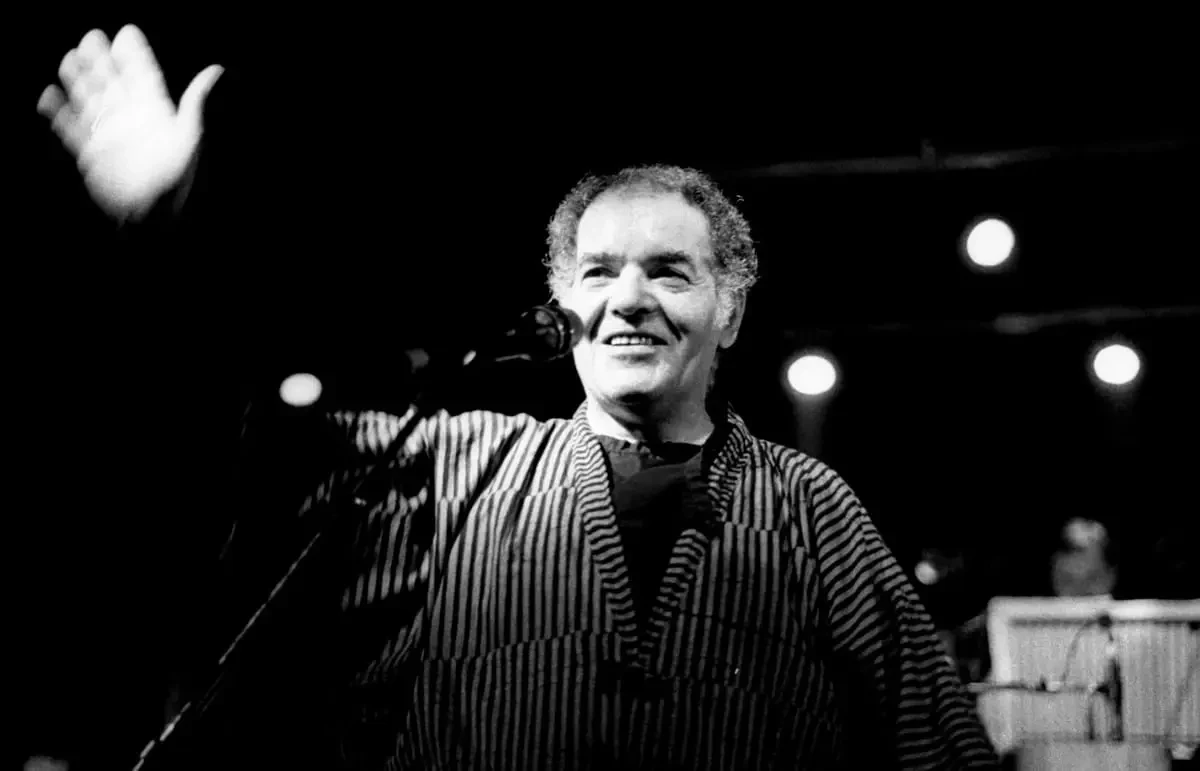
For over four decades, composer, theoretician, and educator George Russell has quietly operated as one of the most profound structural architects in the history of modern jazz. While mainstream audiences often lionize the frontline soloists—the trumpeters and saxophonists who delivered the melodies—it is Russell’s intellectual framework, harmonic breakthroughs, and compositional daring that fundamentally expanded the genre’s theoretical horizons.
Russell’s career trajectory has come full circle with the release of his ambitious, nine-movement masterwork, The African Game, which marks his debut on the prestigious Blue Note label. Recorded live following its American premiere at Boston’s Emmanuel Church and featured prominently on his historic first-ever United Kingdom tour, The African Game represents the culmination of a lifelong search for musical roots.
"It seems to me that the times now require going back," Russell reflects. "Much as how American music went back to discover its roots in gospel and country music, so too now, I feel, my music has to go back to the source. And Africa is that source."
This retrospective examines Russell’s monumental contributions to jazz: from his formative years listening to Ohio Riverboat bands and surviving bouts of tuberculosis, to his groundbreaking formulation of the Lydian Chromatic Concept Of Tonal Organisation, his symbiotic collaborations with jazz royalty like Dizzy Gillespie and Miles Davis, and his innovative mid-career exploration of "vertical form." Through exhaustive historical context, critical analysis, and Russell’s own reflections, this piece traces the journey of a visionary whose theoretical innovations permanently altered the trajectory of twentieth-century music.
Detailed Chronology: The Evolution of a Theoretical Pioneer
Formative Years and the Riverboat Roots (1923–1943)
Born in Cincinnati, Ohio, on June 23, 1923, George Russell’s early auditory landscape was shaped by the paddlewheel steamboats cruising down the Ohio River, carrying bands whose blues-infused syncopations drifted across the water. Russell’s formal entry into music began behind the drum kit as a Boy Scout. By age 15, his proficiency had advanced to the point where he was performing publicly.
However, the path of a young artist was fraught with physical adversity. Dogged by persistent poor health throughout his late teens and early twenties, Russell was admitted to a sanatorium at age 19 after contracting tuberculosis. Rather than stunting his development, confinement became an unexpected crucible for his intellect. Confined to a bed, Russell immersed himself in the rigorous study of musical arranging, producing several charts within his first year for the local A.B. Townsend Orchestra.
The Bebop Vanguard and Benny Carter’s Workshop (1944–1946)
Upon regaining his health, Russell moved into the bustling professional sphere in 1944, briefly holding the drum chair in Benny Carter’s celebrated orchestra before being succeeded by Max Roach. Although his tenure as a touring percussionist was brief, Carter recognized Russell’s formidable intellect and retained him to rehearse the ensemble while actively encouraging his compositional pursuits.
It was during this period that Russell composed New World, an ambitious arrangement he rehearsed with Carter’s band at Chicago’s Downtown Theatre. Though fellow musicians praised the work, many felt it was too harmonically advanced for the era. Nevertheless, Carter purchased the chart, cementing a supportive mentorship.
Remarkably, Carter’s orchestra served as an incubator for future theoretical minds. Alongside Russell sat the enigmatic Bob Graettinger, an alto saxophonist who would later achieve controversial fame for his mathematically and graphically derived compositions for the Stan Kenton orchestra.
Following his time with Carter, Russell spent the mid-forties arranging for Earl Hines’s band. Hines’s encouragement culminated in Russell writing the opening numbers for the maestro’s residency at Chicago’s Eldorado Cafe—work that garnered glowing notices in the Chicago Sun-Times.
The Bronx Sanatorium and the Birth of the Concept (1946–1947)
Drawn to the burgeoning creative epicenter of New York City and the radical sounds of Thelonious Monk, Russell journeyed to the East Coast. He secured a position playing drums in the Charlie Parker Quintet, but tragedy struck once more: a severe recurrence of tuberculosis landed him in St. Joseph’s Hospital in the Bronx for 15 grueling months.
Far from extinguishing his creative fire, this extended period of isolation birthed a paradigm-shifting intellectual breakthrough. Synthesizing his musical insights, Russell formulated the foundational ideas for his Lydian Chromatic Concept Of Tonal Organisation.
Upon his release, Russell immediately applied these principles to his writing. The most immediate fruit of this labor was Cubana Be, Cubana Bop, premiered by Dizzy Gillespie and his Orchestra at Carnegie Hall in December 1947.
Though originally written without Latin percussionist Chano Pozo, the piece was transformed when Russell heard Pozo chanting on a tour bus shortly after the New York concert. Russell urged Gillespie to feature Pozo in the center of the arrangement, creating a masterpiece of cross-cultural synthesis. Recorded on December 22, 1947, the recording pairs a menacing, brooding introduction with soaring trumpet lines and Pozo’s electrifying Afro-Cuban percussion and vocalizations.
The Stravinsky Synthesis and the Macy’s Years (1948–1953)
The late 1940s were characterized by sporadic public output as Russell focused on refining his theoretical manuscript. In April 1949, clarinetist Buddy DeFranco fronted a studio orchestra to record Russell’s A Bird In Igor’s Yard, a brilliant conceptual bridge uniting the harmonic language of Charlie Parker with the rhythmic and structural rigor of Igor Stravinsky. Simultaneously, Parker regularly championed Russell’s composition Ezz-Thetic in his string-group performances—a piece later popularized by the Lee Konitz Sextet (featuring Miles Davis) and Russell’s own 1956 Smalltet recording.
By the early 1950s, Russell temporarily stepped back from the active jazz scene to finalize his text. He completed and published the Lydian Chromatic Concept Of Tonal Organisation in 1953 while working as a sales assistant at Macy’s department store in New York. Representing a decade of rigorous intellectual labor, the text quietly revolutionized contemporary music theory.
Modal Consciousness and the Miles Davis Connection (Mid-1950s)
By the mid-fifties, progressive musicians recognized that traditional chord-sequence improvisation had been pushed to its absolute limits. Further innovation required escaping the confines of standard functional harmony. Russell’s theory provided the ideal exit route.
"Miles [Davis] picked up on the idea first and he popularised it," Russell recalls. "He used it on the piece called Milestones which proved very successful and then came the Kind Of Blue album which really established it."
Russell’s profound influence on Davis is an enduring point of jazz lore. In tribute, Russell frequently closed his own UK concert tours with a brilliant orchestral reimagining of Davis’s famous trumpet solo from So What.
The Sextet Years and European Exile (1960–1969)
Economic realities in the early 1960s made maintaining a big band nearly impossible, prompting Russell to form a sextet. Far from a compromise, this small group functioned as a high-level laboratory for big band concepts. Between 1960 and 1963, this band recorded six remarkable albums: At The Five Spot, In Kansas City, Stratusphunk, Ezz-Thetics, Stratus Seekers, and The Outer View.
The sextet served as a revolving conservatory for pioneering talents, including:
- Don Ellis
- Eric Dolphy
- David Baker
- Steve Swallow
- Vocalist Sheila Jordan
- Carla Bley (who contributed occasional charts)
In 1963, seeking broader artistic appreciation, Russell emigrated to Europe. Settling in Scandinavia, he assembled a European iteration of his sextet that broadcast regularly on national radio and produced two acclaimed albums: At Beethoven Hall (1965, featuring Don Cherry) and Othello Ballet Suite / Electric Sonata No 1 (1968), the latter of which earned a rare five-star rating from Downbeat magazine.
Return to Academia and "Vertical Form" (1969–Present)
Russell returned to the United States in 1969 to join the faculty at the New England Conservatory of Music in Cambridge, Massachusetts, where he remains an influential educator. Through the mid-seventies, he paused major composition to write the second volume of his Lydian Chromatic Concept, completed in 1978.
During the subsequent decade, Russell developed a groundbreaking theory of polyrhythmic organization he terms "vertical form." Moving away from strictly linear or horizontal compositional approaches (such as those associated with Lennie Tristano), Russell began constructing music modeled after African drum choirs.
Supporting Context & Metrics
The Mechanics of "Vertical Form" and The African Game
To understand The African Game, one must understand Russell’s concept of vertical musical architecture.
"I can’t imagine any piece based on African music that didn’t reflect vertical form because the Africans were the innovators of this idea," Russell explains. "In an African drum choir, one drummer is the rhythmic gravity while the others gradually layer sophisticated rhythms on top of this tonal centre. The whole isn’t really evolving in a horizontal way, it’s evolving in complexity and density. It’s vertical energy, getting higher and higher, compounding."
Commissioned jointly by the Massachusetts Council on the Arts and the Swedish Broadcasting System, The African Game was written over six months in 1983. Its American debut took place on June 18, 1983, at Boston’s Emmanuel Church, performed by a 26-piece local orchestra and the African percussion ensemble Olu Bata.
For his UK tour, Russell adapted the work for a 13-piece ensemble billed as the Anglo-American Orchestra (though the inclusion of Danish trumpeter Palle Mikkelborg makes "Euro-American" equally apt). The recorded Blue Note release captures the flawless live energy of this monumental undertaking.
Comprehensive Select Discography
| # | Title / Work | Artist / Ensemble | Year / Label Reference |
|---|---|---|---|
| 1 | The African Game | George Russell | Blue Note (BST 85103) |
| 2 | Cubana Be, Cubana Bop | Dizzy Gillespie & His Orchestra | RCA (Vol. 2, 731068) |
| 3 | A Bird In Igor’s Yard | Buddy De Franco Studio Orchestra | Capitol Jazz Classics (Vol. 14, 5C052 80853) |
| 4 | Ezz-Thetic | Lee Konitz Sextet (with Miles Davis) | Xtra (5004) |
| 5 | Ezz-Thetic / Knights Of The Steamtable | George Russell Smalltet | RCA (PL 42187) |
| 6 | Milestones | Miles Davis | CBS (62308) |
| 7 | Kind Of Blue / So What | Miles Davis | CBS (62066) |
| 8 | At The Five Spot | George Russell Sextet | Decca (DL 9220) |
| 9 | In Kansas City | George Russell Sextet | Decca (DL 4183) |
| 10 | Stratusphunk | George Russell Sextet | Riverside (RLP 341) |
| 11 | Ezz-Thetics | George Russell Sextet | Riverside (RLP 375) |
| 12 | Stratus Seekers | George Russell Sextet | Riverside (RLP 412) |
| 13 | The Outer View | George Russell Sextet | Fontana (688 705ZL) |
| 14 | At Beethoven Hall | George Russell European Orchestra (with Don Cherry) | MPS (MC 25125) |
| 15 | Othello Ballet Suite / Electric Sonata No 1 | George Russell | Soul Note (1014) |
Official Statements & Critical Perspectives
George Russell’s impact on contemporary music theory remains singular. When discussing the genesis and intent of his life’s work, his perspective is both modest and unyielding:
"Well, I don’t like to brag. I think it made contemporary music, and I don’t mean just jazz, conscious of modes. It introduced modal consciousness in terms which no one was thinking about, certainly not jazz musicians nor, as far as I know, symphonic musicians. The Concept simply codified the modes and introduced chord-scale unity. In other words, for every chord there’s a scale of unity and this gives the jazz musician greater resources."
Reflecting on the thematic roots of his Blue Note debut, Russell connects ancient ancestral rhythms with futuristic dynamism:
"Musically, I think The African Game does reflect the earliest beginnings and might also project the ultimate outcome, as reflected in the rather dynamic crescendo at the end of the piece."
Peers and collaborators have long acknowledged his peerless intellect. Dizzy Gillespie noted of their 1947 collaboration: "This was a great creative period in our history, and Cubana Be, Cubana Bop was one of our most adventurous pieces. It was just perfect and it’s still right now."
Future Outlook
Despite decades of academic validation and quiet reverence among the cognoscenti, George Russell’s monumental contributions to the architecture of jazz have occasionally been overlooked by mainstream audiences preoccupied with flashier instrumentalists. Yet history proves that seismic shifts in art originate not always from the performers on the stage, but from the blueprints drawn in quiet rooms, sanatoriums, and academic halls.
With the release of The African Game on Blue Note, Russell has demonstrated that his creative faculties remain as sharp, intellectually rigorous, and rhythmically vital as they were four decades ago when he introduced the world to modal theory and Afro-Cuban jazz fusions. As modern music continues to grapple with the complexities of global rhythms, polyphonic density, and modal exploration, George Russell’s foundational frameworks ensure that his influence will continue to shape the trajectory of jazz well into the twenty-first century and beyond.