
Executive Overview
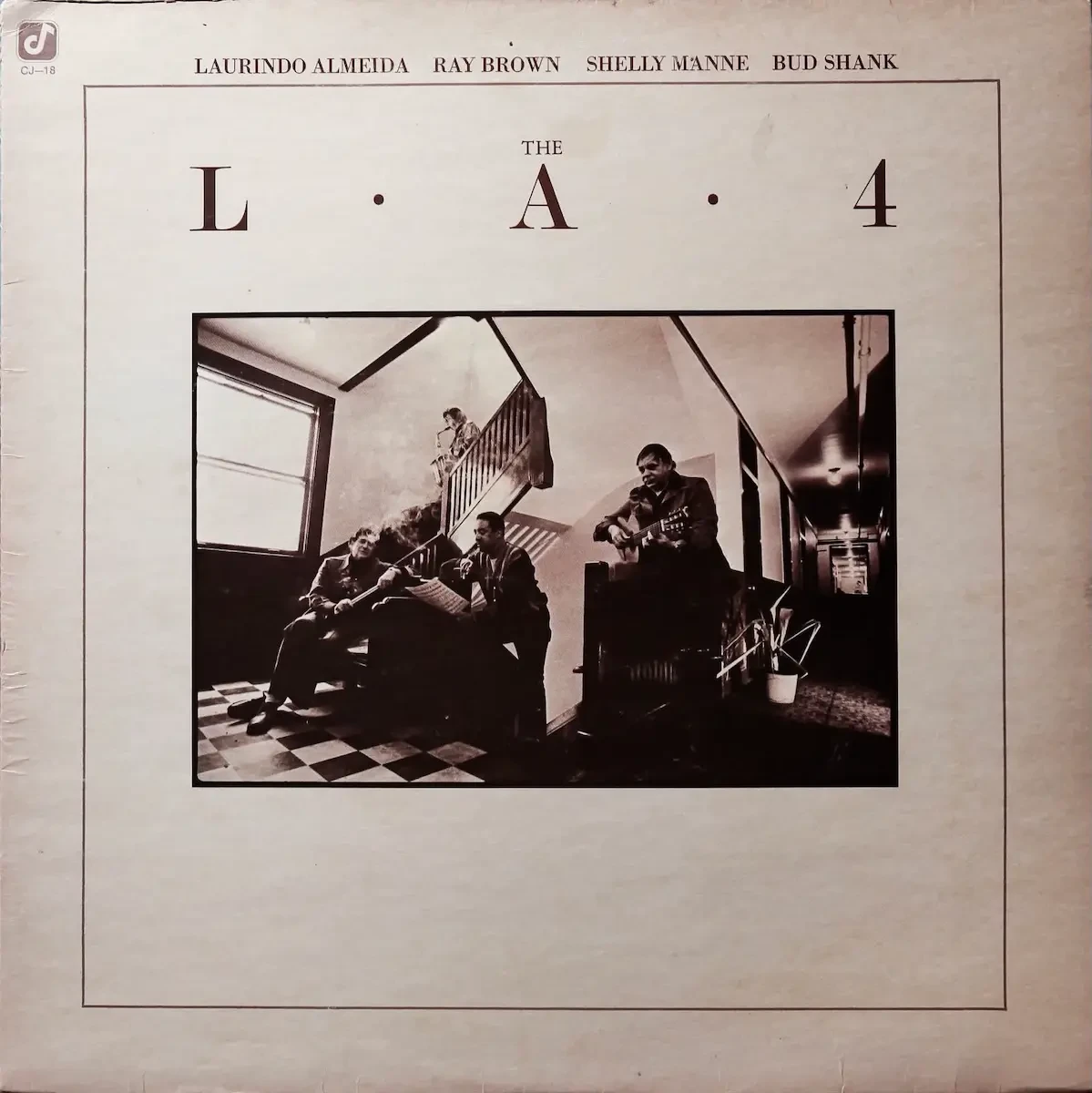
In the expansive landscape of modern recorded music, few ensembles achieve the rare alchemy displayed by The L.A. Four on their sophomore release for Concord Jazz (Concord Jazz CJ-18, retailing at £3.99 via Swift Record Distributors). Recorded in Los Angeles in early 1976, this landmark LP brings together four virtuosos at the absolute zenith of their respective powers: Bud Shank on alto saxophone and flute, Laurindo Almeida on guitar, Ray Brown on double bass, and Shelly Manne on drums.
Far beyond a standard jazz quartet date, this recording represents a masterclass in stylistic synthesis. The group effortlessly traverses centuries and continents, bridging the structural rigor of European classical music, the infectious polyrhythms of Brazilian bossa nova and samba, the hard-swinging pulse of American bebop, and the sophisticated arrangements of chamber jazz.
As legendary bassist Ray Brown succinctly observed of the ensemble’s ethos:
"I love this group because it’s doing jazz, classical, bossa nova, a lot of different things. We don’t have to cater to anything."
This review offers an exhaustive examination of the album’s historical lineage, technical brilliance, individual contributions, and enduring significance within the broader canon of American improvised music.
Detailed Chronology: From World Pacific Beginnings to Concord’s Re-Union
To fully appreciate the artistic triumph of The L.A. Four in 1976, one must trace the evolutionary thread back over two decades to a seminal moment in West Coast jazz history.
The 1953–1954 Genesis
In the early 1950s, the collaborative recordings of Bud Shank and Laurindo Almeida for World Pacific (catalogued variously as World Pacific WP1412 and Vogue LAE12019) quietly laid a foundation that would reshape the global popular music landscape. Long before saxophonist Stan Getz popularized the bossa nova craze in the early 1960s—sparked by his historic collaborations with Brazilian composer Antônio Carlos Jobim and guitarist João Gilberto—Shank and Almeida were already exploring the fertile intersection of sophisticated jazz harmony and Brazilian rhythmic idioms.
Those foundational 1953 and 1954 sides proved that the nylon-string acoustic guitar of Almeida could blend seamlessly with the lithe, cool-school alto saxophone of Shank. Their early experiments created a blueprint for a subtle, highly textured brand of Latin-infused jazz that prioritized nuance over brute force.
The Formation and Second Concord Album
Decades later, the reunion of Shank and Almeida under the banner of The L.A. Four—bolstered by the heavyweight rhythm section of Brown and Manne—signaled a mature continuation of this dialogue. This release marked the group’s second outing for Carl Jefferson’s Concord Jazz label, a company rapidly cementing its reputation as a sanctuary for straight-ahead and mainstream jazz artists dedicated to acoustic purity and uncompromising musicianship.
Captured in pristine sonic fidelity in early 1976, the album’s concise track listing—spanning approximately 45 and a half minutes across two distinct sides—manages to cover staggering stylistic ground:
- Side One (approx. 25 minutes): Dindi, Rainbows, Rondo Espressivo, and Manteca.
- Side Two (approx. 20.5 minutes): St. Thomas and the ambitious Concierto De Aranjuez.
Supporting Context & Metrics: The Anatomy of "Chamber Jazz"
The term "chamber jazz" is frequently invoked by critics, yet it is just as frequently abused to describe anything quiet, polite, or academic. In the context of The L.A. Four, however, the label fits with surgical precision.
The Interplay of Classical Rigor and Jazz Freedom
In classical chamber music, small ensembles perform intricate compositions where every voice is essential, independent, and exposed. There are no safe cushions of dense big band brass or driving, wall-of-sound rhythm sections to hide behind. Every note matters.
The L.A. Four achieves this exact transparency. On tracks like Bach’s Rondo Espressivo, the ensemble treats the Baroque masterwork not as a stiff museum piece, but as a living, breathing vehicle for swing and counterpoint. The transition from the structured elegance of Bach directly into a roaring, highly inventive reading of Dizzy Gillespie’s bebop anthem Manteca highlights the group’s fearless versatility. Manteca opens with a striking, highly inventive bass-and-drums exchange between Brown and Manne that sets a visceral tone before the melody takes flight.
Repertoire and Track Breakdown
- "Dindi": A loving nod to the Brazilian roots shared by Shank and Almeida, rendered with breathtaking lyricism and emotional depth.
- "Rainbows": Composed by Bud Shank himself, this piece showcases his rare ability to pen modern jazz lines that double as lush tonal paintings.
- "St. Thomas": Sonny Rollins’ iconic calypso standard receives an invigorating acoustic makeover, proving that the quartet can swing with immense subterranean power when the charts demand it.
- "Concierto De Aranjuez": Joaquín Rodrigo’s timeless Spanish masterpiece is given a definitive reading. It was Laurindo Almeida who originally transcribed the piece for The L.A. Four, while Bud Shank handles the intricate "orchestral" horn parts, creating a breathtaking tapestry of sound from just two primary melodic instruments.
Official Statements & Critical Perspectives
The Master Class of the Rhythm Section: Brown and Manne
Any discussion of this album must place heavy emphasis on the foundational work provided by Ray Brown and Shelly Manne. To state that they elevate the proceedings is an understatement; they redefine what a rhythm section can achieve in an intimate acoustic setting.
Ray Brown remains the gold standard of jazz bassists. His time-keeping is unshakeable, his intonation flawless, and his walking bass lines possess a forward momentum that could propel a locomotive. He is the kind of rare musician whose presence instantly improves the performance level of every person sharing the stage with him.
Shelly Manne, meanwhile, shatters stereotypes regarding drum soloists. Too often, extended drum breaks are treated as endurance tests or bouts of thunderous noise designed to test audience patience. Manne plays with such melodic intelligence, structural awareness, and textural variety that his solos actively sustain the listener’s interest, proving definitively that drums can be lyrical, highly musical instruments.
The Genius of Bud Shank: An Alto and Flute Titan
Bud Shank’s career is a testament to unyielding artistic excellence. Throughout this recording, Shank alternates between alto saxophone and flute, demonstrating absolute mastery over both. He plays alto on his own composition Rainbows and on the Concierto De Aranjuez, while utilizing the flute for the remainder of the program.
Shank’s reputation among his peers is legendary. A revealing anecdote highlights his standing in the highest echelons of jazz history: following his brilliant work on the soundtrack for the film Assault On A Queen, Duke Ellington offered Bud a permanent position in the legendary Ellington Orchestra.
Recalling the moment, Duke remarked:
"I don’t know how long ago it was since Johnny Hodges was so shook up by another alto player."
Ultimately, Shank had to decline the offer due to his well-established and demanding Los Angeles studio commitments. Yet, hearing him weave through the complex charts of The L.A. Four makes it entirely clear why the Ellington camp sought him out.
Future Outlook & Enduring Legacy
As the music industry continues to fragment into hyper-niche genres and digitally processed pop productions, organic acoustic masterpieces like Concord Jazz CJ-18 serve as vital reminders of what human beings can achieve with wood, steel, breath, and unyielding dedication to craft.
The L.A. Four did not set out to capture commercial pop charts or pander to fleeting radio trends. Instead, they forged an uncompromising middle path where the European classical tradition, the fiery soul of Latin America, and the swinging inventiveness of American jazz met as equals.
For audiophiles, jazz historians, and lovers of transcendent music in general, this album stands as an essential artifact. Available via Swift Record Distributors, The L.A. Four is not merely a historical reissue of a 1976 studio date; it is a timeless blueprint for cross-cultural musical dialogue that will continue to inspire generations of musicians and listeners alike.