
Executive Overview
The landscape of digital audio consumption is undergoing a profound structural shift. As the democratization of generative artificial intelligence lowers the barrier to entry for content creation, music streaming platforms are being flooded by an unprecedented volume of synthetic audio. Amid this digital gold rush—and the accompanying chaos of copyright debates, royalty dilution, and user fatigue—music streaming pioneer Deezer has taken a definitive stance.
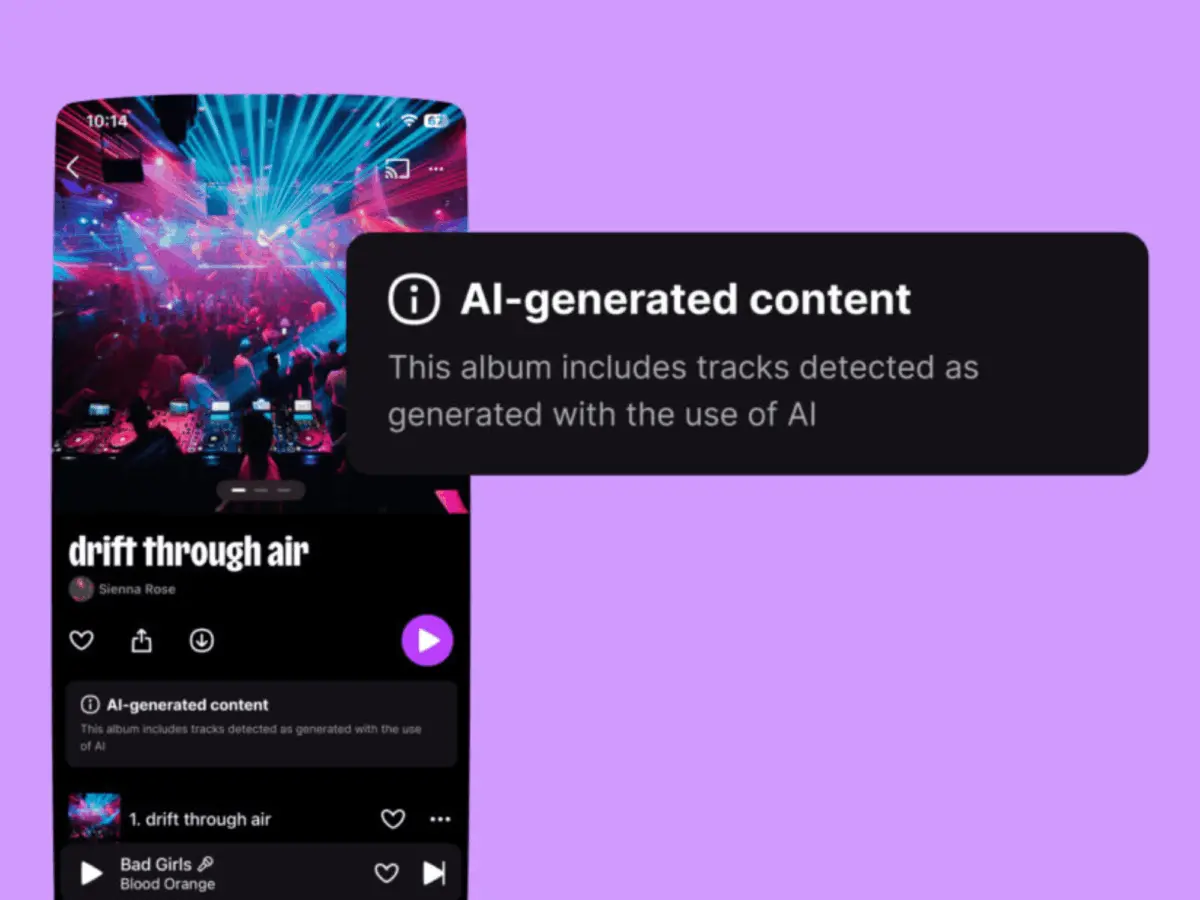
In a move that could redefine platform governance across the entire streaming economy, Deezer has announced the imminent rollout of a dedicated "human-only" filtering system. Set to launch before the end of 2026, this feature will grant listeners the unprecedented ability to completely exclude AI-generated tracks from their search results, daily mixes, and algorithmic recommendations.
This development is far more than a simple user-experience update; it is a watershed moment for the music industry. It highlights a growing consumer demand for authenticity and establishes a technical precedent for how streaming services might manage the coexistence of human artistry and synthetic media. At the same time, the broader audio ecosystem is seeing inventive applications of artificial intelligence that empower—rather than replace—human creators. Technologies like Playhead demonstrate that AI can serve as a sophisticated paintbrush for producers without stepping into the territory of wholesale music generation.
This report examines the motivations behind Deezer’s strategic pivot, the data driving consumer sentiment, the scale of synthetic audio currently infiltrating streaming platforms, and the evolving duality of artificial intelligence within the modern creative workflow.
Detailed Chronology: Deezer’s War on Unfiltered Synthetic Audio
To understand the significance of Deezer’s upcoming human-only filter, one must examine the timeline of how the platform confronted the synthetic audio wave over the past several years. While many competitors adopted a passive "wait-and-see" approach, Deezer positioned itself as an early investigator and gatekeeper.
January 2025: The Escalation of Detection
By the dawn of 2025, the proliferation of automated music generation tools had reached a critical mass. Millions of tracks—many of them lacking any human creative input—were being uploaded to major digital service providers (DSPs) daily, often designed specifically to game recommendation algorithms or siphon streaming royalties through automated bot networks.
In response, Deezer intensified its internal detection protocols. Utilizing proprietary audio-fingerprinting and machine-learning classification models, the platform began aggressively identifying synthetic tracks at the ingestion point. Between January 2025 and late 2026, Deezer’s filtering systems successfully detected and excluded more than 42 million AI-generated tracks from entering user recommendations and algorithmic playlists. This staggering volume underscored the sheer scale of the synthetic music phenomenon—and the urgent need for structural intervention.
November 2025: Validating Consumer Demand with Ipsos
As Deezer’s engineering teams worked behind the scenes to quarantine unauthorized or low-quality synthetic content, the platform sought to understand how everyday listeners felt about this quiet revolution. In partnership with global market research firm Ipsos, Deezer commissioned a comprehensive study to gauge user attitudes toward artificial intelligence in music.
The findings were both unambiguous and striking. The November 2025 Ipsos study revealed that nearly half (45%) of all music streaming consumers actively want the ability to filter out 100% AI-generated music from their streaming experiences. Far from embracing an all-synthetic future, a massive contingent of listeners expressed a desire for guardrails, signaling that the sheer abundance of AI-generated content was beginning to degrade trust in standard algorithmic discovery.
Late 2026 and Beyond: The Human-Only Toggle
Building on its proactive moderation and the insights gained from the Ipsos research, Deezer made its landmark announcement: a user-facing, on/off "human-only" switch slated for deployment before the close of 2026.
Unlike backend content moderation—where platforms remove egregious spam or copyright-infringing clones without user input—this feature hands direct control back to the consumer. When activated, the filter ensures that as users search for music, explore genres, or browse curated spaces, the platform actively purges synthetic content from their view. This development marks the transition from corporate gatekeeping to consumer-empowered curation, establishing a new paradigm for platform accountability.
Supporting Context & Metrics: The Anatomy of the AI Streaming Crisis
The necessity of Deezer’s intervention becomes clear when examining the broader economic and cultural pressures facing the streaming industry. The intersection of generative AI and audio distribution has created a complex web of challenges for artists, labels, and platform operators alike.
The Dilution of the Streaming Economy
The traditional subscription-model streaming economy operates on a pro-rata royalty pool distribution system. In simple terms, total subscription revenues are pooled, and payouts are distributed to rights holders based on their percentage of total platform streams.
The mass injection of AI-generated music—often produced at a rate of hundreds of tracks per day by automated scripts—threatens to destabilize this delicate economic ecosystem. Without robust filtering and detection mechanisms, royalty pools risk being diluted by millions of low-effort, synthetic tracks that consume storage, bandwidth, and listening time, ultimately starving human musicians of their fair share of revenue.
Consumer Trust and Fatigue
Algorithmic fatigue is a growing phenomenon in the digital age. As recommendation engines become increasingly saturated with synthetic sound-alikes, soundscapes, and AI-generated "sleep music," listeners are reporting a distinct sense of alienation.
The 45% figure from the Deezer/Ipsos study is not merely a statistical data point; it is an early warning indicator for the entire tech sector. Consumers do not necessarily object to technology per se, but they deeply value human narrative, emotional vulnerability, and authentic artistic intent. When a listener cannot distinguish between a human songwriter pouring their soul into a lyric and an algorithm churning out a prompt-based audio file in seconds, the emotional contract between artist and fan is strained. Deezer’s filter addresses this fatigue directly by restoring agency to the listener.
Official Statements and Industry Perspectives
Deezer’s leadership has been notably transparent throughout this process, framing their policy updates not as an anti-technology crusade, but as a pro-consumer and pro-artist necessity.
In various public communications accompanying their AI policy announcements, company executives have emphasized that the platform is not banning artificial intelligence outright. Instead, Deezer distinguishes between generative music—tracks entirely synthesized by algorithms without human performance—and AI-assisted tools that enhance human creativity.
"Our goal is to protect the integrity of human art while ensuring our users have complete control over their listening environment," company representatives have noted. By acknowledging that a significant portion of their user base desires a pure, human-centric discovery process, Deezer is positioning itself as an ally to the traditional music community, which has spent years lobbying for clearer attribution, consent, and compensation frameworks.
Industry bodies, independent labels, and artist advocacy groups have cautiously welcomed the announcement. While many legal battles regarding copyright infringement, data scraping, and voice cloning remain unresolved in courts around the world, user-facing tools like Deezer’s filter provide an immediate, practical defense against market saturation.
The Other Side of the Coin: AI as an Artist’s Brush
While the debate over 100% AI-generated music dominates boardrooms and legal briefs, it is crucial to recognize that artificial intelligence in audio is not a monolith. While platforms like Deezer work to give users the power to reject synthetic songs, innovative creators and software developers are simultaneously proving that AI can be a revolutionary force when kept in the hands of human artists.
Enter Playhead: Bespoke Signal Processing for Producers
A prime example of this constructive dichotomy is Playhead, a groundbreaking piece of music production software designed to integrate seamlessly into all major Digital Audio Workstations (DAWs).
Unlike generative AI tools that prompt a model to write a song from scratch, Playhead operates entirely downstream from the human creative process. It does not generate melodies, chords, or lyrics. Instead, it creates bespoke, highly specialized digital signal processing (DSP) chains for audio that the user has already recorded.
How It Works in Practice
The workflow is remarkably intuitive yet technologically sophisticated:
- The Human Foundation: An artist records a track—for example, a clean electric guitar riff, a vocal stem, or a synthesized pad.
- The Vibe Description: Rather than manually tweaking dozens of plugins, equalizers, compressors, and reverbs, the producer describes the desired sonic texture in natural language. In a public demonstration, founder Shelby Stevens asked Playhead to make a standard guitar recording sound like "a choir of angels shattering a crystal chandelier."
- AI Analysis and Execution: Playhead analyzes the source audio stem and translates that poetic, vibe-driven text description into a custom chain of audio effects.
- Human Fine-Tuning: The software generates the processing chain, but the final control remains firmly in the hands of the producer, who can tweak, adjust, and override every parameter to fit their exact artistic vision.
Crucially, Playhead’s AI never touches or trains on copyrighted artist audio databases in a way that exploits external works. It functions purely as an intelligent translator between a creator’s imagination and their DAW’s processing capabilities, solving technical mixing hurdles rather than replacing the human songwriter.
Future Outlook: Navigating the Bifurcated Audio Landscape
As we look toward the remainder of the decade, the music industry is clearly splitting into two distinct, parallel tracks:
- The Synthetic Expansion: Generative audio tools will continue to evolve, enabling hobbyists, enterprise media creators, and algorithmic ventures to produce vast quantities of background tracks, sound effects, and synthetic compositions.
- The Human Authenticity Movement: Simultaneously, platforms, labels, and artists will place a premium on proven human provenance. Technologies like Deezer’s human-only filter will likely become standard features across the streaming landscape, as other DSPs realize they must cater to listeners suffering from algorithm and AI fatigue.
At the same time, tools like Playhead illustrate that the stigma surrounding "AI in music" is maturing into a nuanced understanding. The industry is learning to draw a hard line between replacement (synthetic tracks designed to displace human artists) and augmentation (intelligent tools designed to amplify human potential).
Deezer’s upcoming 2026 filter launch is not the final chapter in the ongoing collision between artificial intelligence and the music business; rather, it is the opening salvo of a new era. By recognizing that consumer choice is paramount and that the market demands a sanctuary for human art, Deezer has set a high bar for accountability, transparency, and respect for the creative community. As other platforms watch closely, the message is unmistakable: in an age where machines can generate endless sound, the ultimate luxury for the listener is the unmistakable heartbeat of human creation.