
Executive Overview
After an excruciating, highly anticipated 13-year wait, Grand Theft Auto VI finally blasted onto the global gaming market on November 19, courtesy of parent company Take-Two Interactive and developer Rockstar Games. As the heavy veil of pre-release non-disclosure agreements (NDAs) has gradually been lifted, an unexpected and fascinating crossover has come to light: the massive open-world life and crime simulator is practically overflowing with top-tier theatrical talent.
While players dive deep into the sun-drenched, neon-lit sprawl of Vice City, Leonida—Rockstar’s satirical, hyper-detailed recreation of Miami and greater Florida—they aren’t just hearing standard voice-over actors. A meticulous audit of the newly revealed, gargantuan cast list, which features well over 1,000 unique credited names, reveals a veritable who’s who of Broadway favorites, Olivier Award winners, and seasoned "stage-door regulars."
From marquee headliners to the background NPCs populating the chaotic sandbox, the intersection of New York theatre and the world’s most lucrative entertainment franchise is deeper, richer, and more expansive than anyone anticipated. This cross-pollination signals a profound shift in how triple-A video game studios approach performance capture and character depth, blending the gritty realism of cinematic storytelling with the powerhouse vocal techniques honed on Broadway stages.
Detailed Chronology: From 2013 to the Neon Streets of Leonida
The Long Silence (2013–2022)
To truly understand the magnitude of Grand Theft Auto VI’s release, one must contextualize the sheer vacuum left by its predecessor. When Grand Theft Auto V launched in September 2013, the cultural landscape of gaming, technology, and entertainment looked fundamentally different. Barack Obama was in his second term as U.S. President, the PlayStation 4 and Xbox One had not yet hit store shelves, and streaming culture was still in its infancy.
For over a decade, fans endured a grueling desert of main-line series entries. While Rockstar supported GTA Online with continuous, massive updates and ported GTA V across three distinct console generations, the demand for a true sequel reached mythic proportions. During these thirteen years, whispers, leaks, and speculative internet sleuthing dominated gaming forums. Through it all, production on GTA VI quietly continued behind closed doors under absolute secrecy.
The Leak and the Slow Burn (2022–2023)
The dam finally broke in September 2022, when a massive security breach resulted in the unauthorized publication of early development footage showcasing the game’s dual protagonists, Jason and Lucia, navigating Vice City. While devastating for the developers at Rockstar, the leak confirmed what fans desperately hoped: the franchise was returning to its iconic 1980s-inspired Miami stomping ground, updated for the modern era.
In December 2023, Rockstar officially dropped the first official trailer. It shattered global internet traffic records, racking up hundreds of millions of views within days and cementing the late 2025 release window.
The November 19 Launch and NDA Lifts (Late 2025)
When Grand Theft Auto VI finally arrived on November 19, it instantly rewrote industry records for sales velocity and concurrent player counts. However, alongside the immediate praise for its physics engine, satirical writing, and stunning graphical fidelity, a secondary narrative began to take over industry circles.
As the game’s ironclad NDAs expired, the digital credits rolled across millions of screens worldwide. Theatre buffs, casting directors, and gaming enthusiasts began cross-referencing names. What emerged was a startling revelation: Rockstar had quietly populated the streets of Leonida with an army of professional stage actors.
Supporting Context & Metrics: The Scale of the Leonida Sandbox
To comprehend why Grand Theft Auto VI required such a massive theatrical ensemble, one must examine the staggering metrics behind Rockstar’s production model.
A Living, Breathing Ecosystem
Unlike linear narrative games, an open-world sandbox of this magnitude demands thousands of distinct personalities to simulate a functioning society. Players can transition seamlessly from high-stakes store robberies, high-speed highway car thefts, and violent cartel shootouts to mundane, atmospheric side activities like bird-watching, fishing, and interacting with eccentric beachgoers.
The cast list features upwards of 1,000 unique credited performers. This is not merely a collection of a dozen principal voice actors reading lines in a sound booth; it is a sprawling repertory company utilizing advanced performance-capture technology. Every grunt, pedestrian confrontation, radio advertisement, and fleeting street-corner argument requires distinct vocal framing, emotional resonance, and comedic timing.
The Stage-to-Screen Pipeline
Why turn to Broadway for a Florida-set crime simulator? The answer lies in the rigorous demands of live theatre. Stage actors possess unmatched vocal stamina, precise diction, and the unique ability to convey complex emotional stakes entirely through voice and physical performance capture without the safety net of multiple cinematic takes.
Among the primary cast members anchoring the narrative of Jason and Lucia are several notable actors with extensive stage credentials. This includes Bobby Moynihan (recognized for both his comedy chops and theatrical work) as Cal, Stephen Root as Brian Heder, Orlagh Cassidy as Lori Heder, Victor Almanzar as Yago Jiménez, Hiram Delgado as Yasmani Cabrera, Barzin Akhavan as Omar Dawoud, Abraham Lim as Kevin Kueh, and Michael Hollick—who famously portrayed Niko Bellic in Grand Theft Auto IV—returning to the franchise as The Hitman.
A Who’s Who of the Supporting Cast
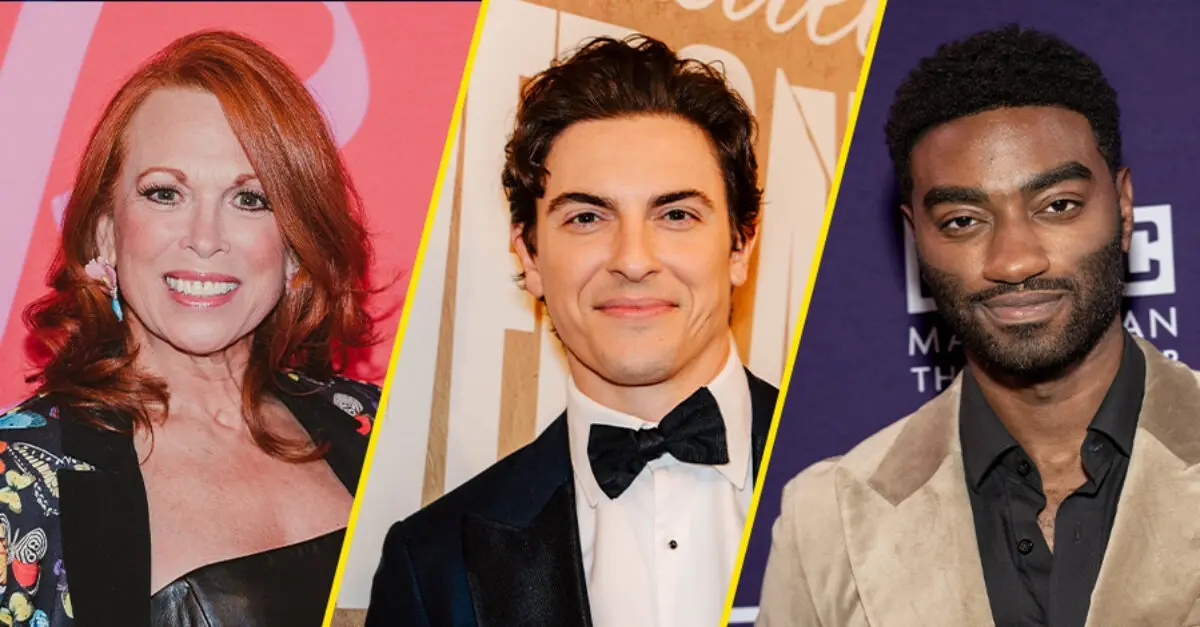
Once you venture past the primary narrative arcs into the supporting cast, the crossover with New York’s theatre community becomes undeniable. The credits read like a Playbill opening night roster:
- Carolee Carmello
- Heather Alicia Simms
- Pooya Mohseni
- Alex Boniello
- Derek Klena
- Donna Lynne Champlin
- Jeff Blumenkrantz
- Jelani Alladin
- Joél Pérez
- John Behlmann
- Jonathan Burke
- Rob McClure
The sheer depth of talent extends even further into the expansive roster of minor characters, street denizens, and ambient voices, featuring stage veterans such as Alex Ellis, Alix Elias, Anna Eilinsfeld, Brian Dykstra, Cheryl Stern, Danny Bolero, David Beach, Eric William Morris, Gene Gabriel, J. Anthony Crane, Jared Canfield, Kit Flanagan, Luigi Sottile, Luis Vega, Tess Marshall, Will Cobbs, Yadira Correa, Aaron Serotsky, Adam Sietz, Alison Jaye, Allison Strong, Amy Keum, Andrew Call, Armand Schultz, Ayana Cymone, Baize Buzan, Barbara Kingsley, Bartley Booz, Beau Baxter, Benny Elledge, Beth Curry, Bill Buell, Bill English, Brandon Ellis, Brian Thomas Abraham, Brianna Gentilella, Carla Renata, Carlos Valdes, Carol Halstead, Chad Carstarphen, Charles Gray, Charlie Thurston, Christine Lin, Clark Thorell, Claudia Mulet, Clinton Brandhagen, Curt Bouril, Daisy Hobbs, Dan Bittner, Daniel Bravo Hernández, Daniel Stewart Sherman, Danny Wolohan, Dashiell Eaves, David Jennings, David Rosenberg, Delaney Williams, De’Lon Grant, Desirée Rodriguez, Devere Rogers, Doron JéPaul, Elizabeth Stahlmann, Emily Kinney, Erick Betancourt, Ezra Knight, Frank Harts, Fred Berman, Gabrielle Nevaeh, Geoffrey Allen Murphy, George Anthony Richardson, Georgia Warner, Gerardo Rodriguez, Gloria Suave, Gregory Connors, Gregory Jones, Henny Russell, Ian Coursey, Ian Unterman, Jack DiFalco, Joey Auzenne, Josh Davis, Juliette Ojeda, Justin Mortelliti, Kalyne Coleman, Karina Arroyave, Kristen Martin, Lamont Walker II, Larry Bull, Lily Ganser, Liv Symone, Laura Jordan, Lori Hammel, Luka Kain, Madison McBride, Mark Zeisler, Matthew Ballinger, Matthew Porretta, Matt Wiercinski, Maurice Jones, Michael Hyatt, Mike McGowan, Natalie Gold, Nathanael Hirst, Nicole Fonarow, Nysli Vega, Patrick J. Clarke, Peggy J. Scott, Peter Van Wagner, Peyton Crim, Ramon Reed, Reggie Talley, Rick Negron, Rob Marnell, Roderick Hill, Rose Portillo, Ryan Duncan, Sabrina Sloan, Sam Clemmett, Sara Kapner, Sarah Bockel, Shannon Tyo, Shawn Randall, Sonya Leslie, Stephen Michael Spencer, Ta’Nika Gibson, Talia Brinson, Ted Koch, Thomas Kopache, Todd Susman, Traci Elaine Lee, and Tudi Roche.
Official Statements & Industry Reception
While Rockstar Games has historically maintained a strict corporate posture regarding their development pipelines—preferring to let the product speak for itself—industry insiders and performers have begun breaking down the unique casting process.
Casting directors working on major interactive entertainment projects have increasingly turned to bi-coastal talent pools, specifically tapping New York theatre actors who are accustomed to working under intense pressure and memorizing vast quantities of text on tight schedules.
"The level of professionalism required to step into a Rockstar production is astronomical," noted one anonymous casting insider familiar with high-end motion-capture protocols. "You aren’t just standing in a booth reading lines into a condenser mic anymore. You are wearing full performance-capture rigs, mapping facial expressions, executing complex physical blocking, and delivering lines that might be slotted into dozens of non-linear gameplay branching paths. Theatre actors excel at this because they understand character consistency across unpredictable live environments."
Future Outlook: The New Standard for Digital Performance
As Grand Theft Auto VI continues to dominate cultural conversations, break sales records, and absorb hundreds of millions of player hours, its legacy is already extending far beyond traditional gaming metrics.
The successful integration of hundreds of Broadway and regional theatre veterans into a mainstream blockbuster proves a vital point for the future of entertainment: the artificial boundaries separating stage acting, cinematic film, and interactive digital media are effectively dissolving.
For the theatre community—often economically volatile and perpetually seeking new avenues for exposure and compensation—large-scale video game productions represent a lucrative, highly respectable frontier. As game engines grow more sophisticated and digital worlds demand richer, more human characters, studios will undoubtedly look toward Broadway’s deep bench of talent to breathe life into their virtual creations.
When players boot up Grand Theft Auto VI to explore the swamps, neon strips, and back alleys of Leonida, they aren’t just playing a video game—they are experiencing a massive, interactive theatrical showcase featuring some of the finest dramatic and comedic voices working in the arts today.