By Ian DeNolfo Executive Director, The Voice Foundation
Executive Overview
Today, we stand at a definitive inflection point in voice science—a historic juncture where artificial intelligence (AI) is fundamentally reshaping how researchers conduct investigations, analyze complex datasets, and deliver patient care. For centuries, the human voice has served as our primary instrument of social connection, emotional expression, and personal identity. It carries the distinct signatures of our humanity, reflecting our emotions, our physiological health, and our deepest psychological states in ways that few other biological signals can replicate.
Yet, for all its profound communicative power, the human voice is governed by neurobiological and physiological complexities so intricate that they have historically defied complete analysis. Today, for the first time in human history, we possess computational tools sophisticated enough to untangle these complexities. Artificial intelligence and machine learning are no longer theoretical concepts on the horizon of medical technology; they are active, transformative forces driving a paradigm shift across the globe.
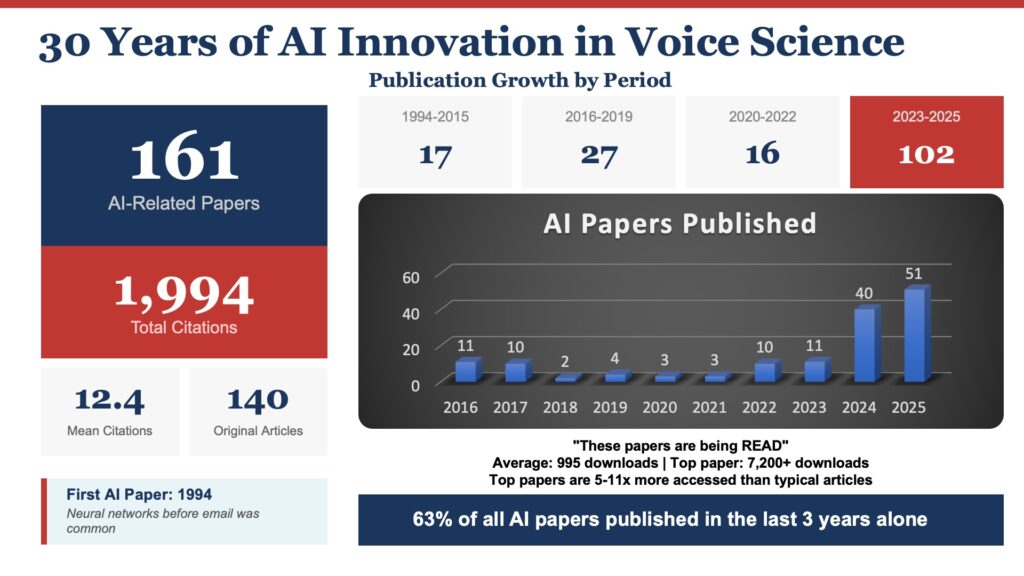
At the center of this revolution is The Voice Foundation and its flagship publication, the Journal of Voice. Long before the mainstreaming of consumer-facing artificial intelligence, our scientific community was actively laying the groundwork for computational voice analysis. Today, we are witnessing an exponential explosion in AI-driven research. More than 60% of all AI-related papers published in the Journal of Voice over the past three decades have appeared in just the last three years. This is not a story of gradual academic growth; it is an exponential transformation that is actively redefining otolaryngology, speech-language pathology, and computational medicine.
A Legacy of Interdisciplinary Innovation
This current wave of technological transformation does not occur in a vacuum. It is built upon a rich, five-decade legacy of pioneering interdisciplinary care, scientific rigor, and academic leadership.
The origins of this movement trace back to 1969, when Dr. Wilbur James Gould founded The Voice Foundation in New York City. At a time when the interdisciplinary care of the human voice was virtually non-existent, Dr. Gould possessed the visionary foresight to bridge silos. He brought together physicians, scientists, speech-language pathologists, performing artists, and educators to share their knowledge and expertise in the holistic care of the professional voice user.
In 1972, the Foundation hosted its first Annual Symposium—Care of the Professional Voice—establishing an annual pilgrimage for international experts. This was followed in 1973 by the first Foundation Gala, later known as the Voices of Summer. For over fifty years, the organization has consistently built bridges between art and science, and between the clinical examining room and the performance stage.
Since 1989, The Voice Foundation has operated under the visionary leadership of Dr. Robert Thayer Sataloff, an internationally renowned otolaryngologist who is simultaneously a professional singer and conductor. A prolific scholar, Dr. Sataloff has authored more than 1,200 publications, including 79 textbooks. Under his stewardship, the Foundation relocated its headquarters to Philadelphia and dramatically expanded its global reach, cementing its status as the premier international hub for voice research and education. Today, the Philadelphia Symposium draws hundreds of medical, scientific, academic, and artistic professionals annually, while the Journal of Voice stands as the undisputed premier peer-reviewed journal dedicated exclusively to voice science and medicine.
Detailed Chronology: Thirty Years of AI Research in Voice Science
To truly appreciate the magnitude of today’s AI boom in voice science, one must look backward. The Journal of Voice has been publishing pioneering artificial intelligence research far longer than most contemporary observers realize—predating the widespread cultural awareness of modern machine learning by decades.
The Pioneering Era (1994–2015)
The journey began thirty-one years ago, in 1994. That landmark year—the exact same period when the World Wide Web was first emerging into public consciousness, and long before most professionals had ever sent an electronic mail message—the Journal of Voice published a paper by Rihkanen and colleagues titled "Spectral Pattern Recognition of Improved Voice Quality." This foundational study utilized early neural networks to analyze voice signals, planting the very first seeds of computational voice diagnostics.
For the next two decades, AI research in the field grew at a steady, incremental pace. Between 1994 and 2015, a total of 17 AI-focused papers were published in the journal. These early works laid essential theoretical groundwork, proving that algorithms could recognize acoustic patterns invisible to the human ear.
The Acceleration and Exponential Surge (2016–Present)
As computational power expanded and machine learning architectures evolved, the volume of published research began to climb. Between 2016 and 2019, the journal published 27 AI-related papers, followed by another 16 papers between 2020 and 2022.
Then came the modern inflection point. Between 2023 and 2025, an astonishing 102 AI-related papers—representing 63 percent of our entire historical archive—were published. In the year 2025 alone, the Journal of Voice published 51 AI-related articles. To put that in perspective, a single year yielded more computational voice research than the first twenty years of the journal’s AI journey combined. This is a clear indicator that artificial intelligence has transitioned from a niche investigative sub-discipline into the beating heart of modern voice science.
Supporting Context and Real-World Impact
Academic output is frequently measured in citation counts, but the true value of scientific literature lies in its real-world application. Usage statistics for AI-related papers in the Journal of Voice reveal an extraordinary, global appetite for these computational insights among clinicians, researchers, and allied health professionals.
On average, an AI-related paper published in our journal is downloaded nearly 1,000 times—substantially outperforming baseline academic engagement metrics. The reach of this research extends directly into clinical workflows and public health responses:
COVID-19 Detection: Our most-accessed AI paper—a landmark study exploring machine learning applications for COVID-19 detection via acoustic features—has been downloaded more than 7,200 times, a figure eleven times higher than the median for articles in its respective issue.
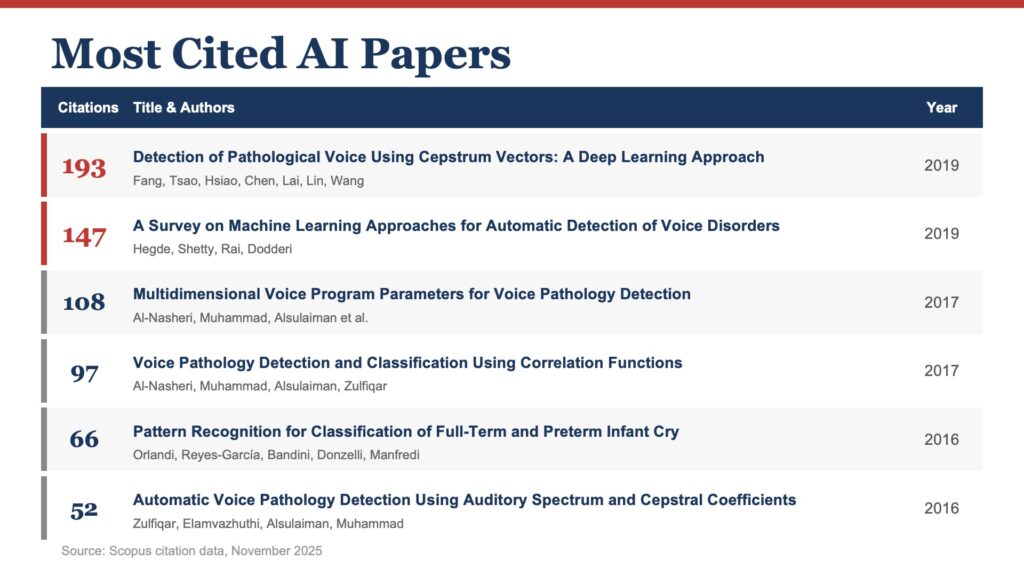
Deep Learning for Pathology: The two most-cited papers in our AI portfolio, authored by Fang and colleagues (193 citations) and Hegde (147 citations), have each been downloaded nearly 5,000 times.
These metrics represent active clinicians, speech-language pathologists, and biomedical engineers turning to peer-reviewed literature for actionable, practical tools to elevate patient outcomes.
Landmark Research Shaping the Field
Deep Learning for Voice Pathology Detection
Published in 2019, Fang and colleagues’ seminal paper, "Detection of Pathological Voice Using Cepstrum Vectors: A Deep Learning Approach," remains the most-cited AI paper in the journal’s history. By demonstrating that deep neural networks can detect vocal fold pathologies with remarkable accuracy using acoustic features imperceptible to the human ear, the study opened entirely new diagnostic horizons.
This was complemented by Hegde’s comprehensive "Survey on Machine Learning Approaches for Automatic Detection of Voice Disorders," which mapped the sprawling landscape of algorithms and established a core reference text for incoming researchers. Subsequent contributions—such as Al-Nasheri’s work on Multidimensional Voice Program parameters, Chen and Chen’s deep neural network classifications, and Cho and Choi’s comparative analyses of convolutional neural networks for laryngoscopic imaging—have continually pushed the envelope of diagnostic precision.
The Voice as a Digital Biomarker
Perhaps the most conceptually transformative frontier in modern medicine is the recognition of the human voice as a digital biomarker—a non-invasive, continuous window into systemic human health.
Recent literature has delivered groundbreaking findings on using voice analysis to detect and monitor neurodegenerative conditions like Parkinson’s disease. For instance, Hemmerling and Wójcik-Pędziwiatr’s 2022 paper on predicting Parkinson’s severity from voice signals quickly amassed substantial citation impact, driving clinical applications closer to point-of-care reality.
Beyond neurology, systematic reviews published in our pages have explored voice quality as a digital biomarker for affective disorders, including clinical depression and bipolar disorder. The societal implications are profound: routine acoustic monitoring could soon allow for the early detection of mental health fluctuations, enabling proactive interventions and alleviating strain on overburdened behavioral health infrastructure. Similar breakthroughs have been documented in respiratory monitoring, establishing the voice as a vital sentinel for overall systemic wellness.
AI Chatbots in Clinical Practice
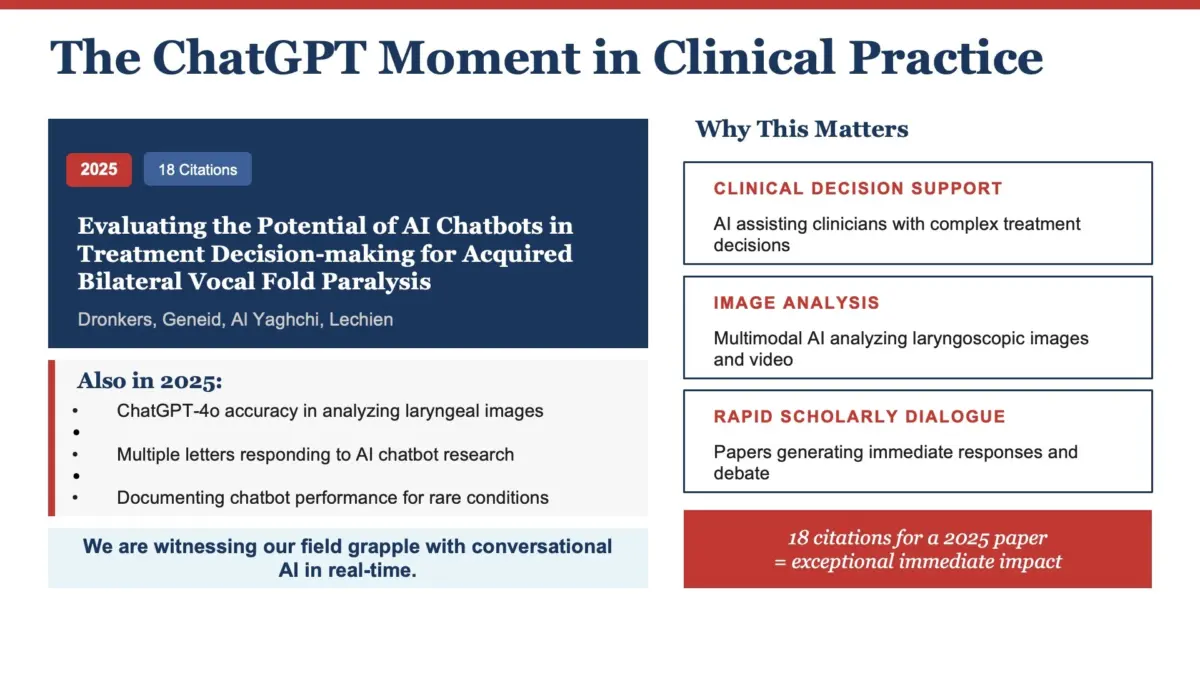
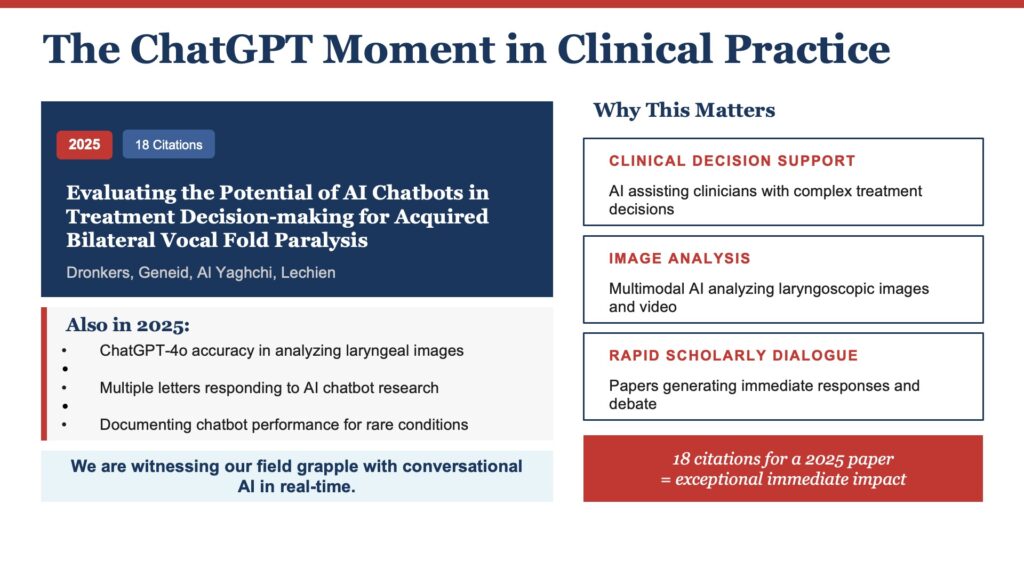
The advent of conversational artificial intelligence has introduced new dimensions to medical ethics and decision-making. In 2025, the Journal of Voice published pioneering studies examining the integration of AI chatbots into clinical workflows. Notably, Dronkers and colleagues’ paper, "Evaluating the Potential of AI Chatbots in Treatment Decision-making for Acquired Bilateral Vocal Fold Paralysis," accumulated rapid citations, triggering robust scholarly discourse, letters to the editor, and subsequent evaluations regarding the accuracy of platforms like ChatGPT-4o in analyzing complex laryngeal imagery.
Official Perspectives: Expert Insights on AI in Voice Science
To navigate this rapidly evolving landscape, the voice science community must rely on multidisciplinary thought leaders who understand both the computational architecture of artificial intelligence and the delicate physiology of human communication.
Dr. Mark Berardi: Managing Complexity and Synthetic Interaction
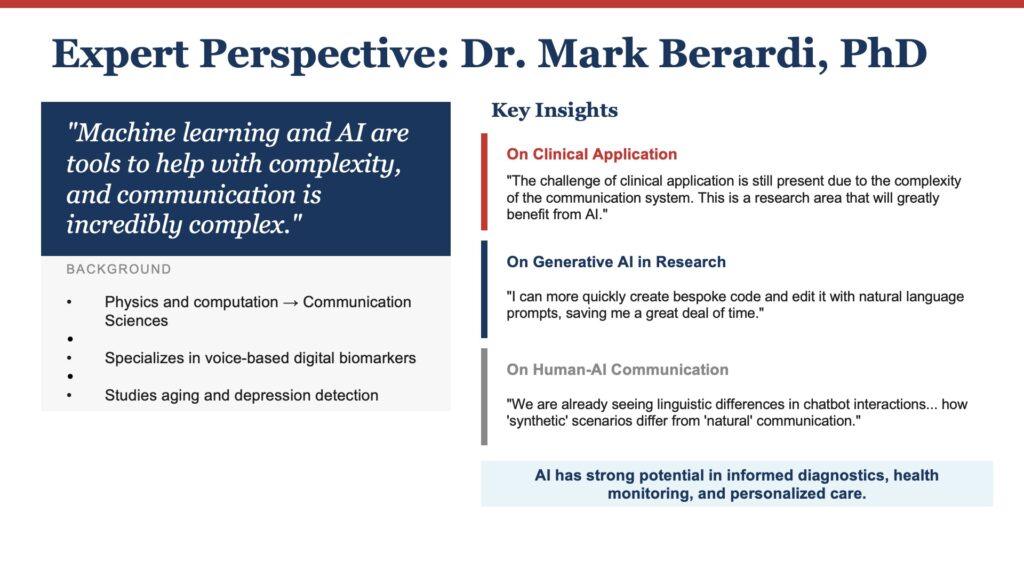
Dr. Mark Berardi brings a rare dual perspective rooted in physics and computation to voice science. He views machine learning and AI not as replacements for human expertise, but as essential mechanisms for managing biological complexity.
"Machine learning and AI are tools to help with complexity, and communication is incredibly complex in its neurobiological and physiological processes. So I think the application is warranted," Dr. Berardi explains.
His current research investigates voice-based digital biomarkers for aging and depression. While acquiring vocal signals has become frictionless, the true hurdle remains the intrinsic complexity of human communication. Furthermore, Dr. Berardi offers a pragmatic take on generative AI tools: while they may not have entirely rewritten the fundamental nature of empirical research yet, they have successfully eliminated systemic research bottlenecks—particularly in data processing and the generation of bespoke code via natural language prompts.
Intriguingly, Dr. Berardi’s work also extends to human-AI communication. He is actively studying how human speech patterns adapt when speaking to conversational agents compared to fellow humans, and how "synthetic" communication formats (such as video conferencing) alter interpersonal dynamics. As conversational agents become ubiquitous, voice science must expand its scope to analyze the human voice not just in isolation, but in continuous dialogue with machines.
Dr. Eric Hunter: Embracing Technological Change with Ethical Clarity
Dr. Eric Hunter emphasizes the profound institutional and professional shifts accompanying the AI revolution.
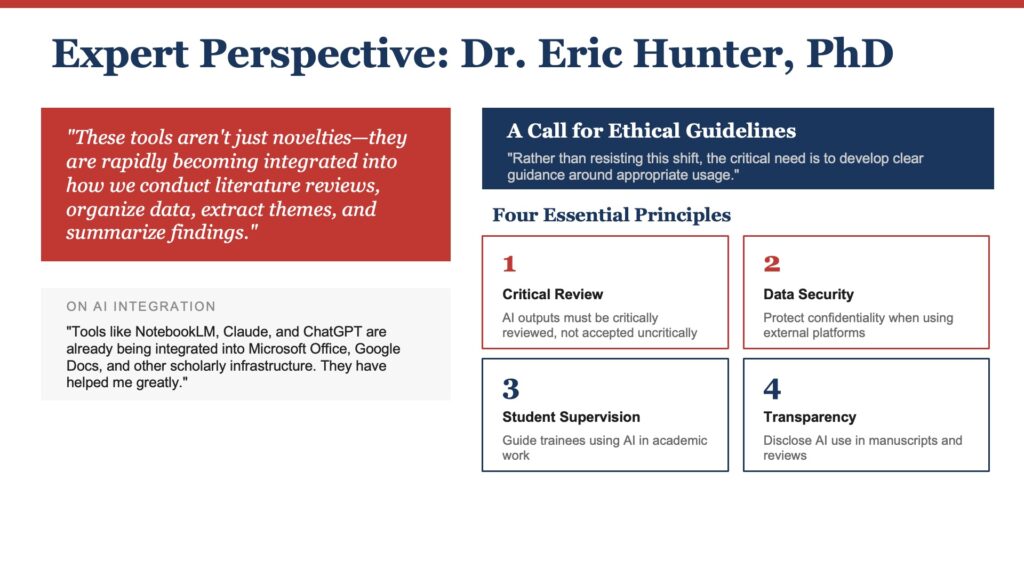
"These tools aren’t just novelties," Dr. Hunter observes. "They are rapidly becoming integrated into how we conduct literature reviews, organize data, extract themes from large bodies of text, and even summarize findings."
Large language models and automated analytical platforms are now deeply embedded within standard academic infrastructure—from manuscript preparation and peer review to collaborative writing environments. Rather than fighting an inevitable technological tide, Dr. Hunter issues a vital call to action for the scientific community: we must develop proactive, transparent guidelines governing appropriate usage.
To ensure scholarly integrity, Dr. Hunter outlines four foundational principles that must guide authors and reviewers moving forward:
Absolute Transparency: Clear disclosure of where and how AI tools were utilized in the research and writing process.
Human Accountability: Uncompromising insistence that human authors retain total responsibility for the factual accuracy, intellectual integrity, and ethical compliance of published work.
Intellectual Stewardship: Guarding against the erosion of critical thinking by ensuring AI assists, rather than replaces, deep human analysis.
Equitable Access: Ensuring that computational advancements benefit international research communities equitably, avoiding digital divides.
"Our field will benefit most," Dr. Hunter concludes, "if we embrace the productivity these tools offer while also building a shared ethical framework for their responsible use."
A Global Research Community
The rapid ascent of AI in voice science is powered by a truly global, interconnected network of laboratories and clinical institutions. The advancement of our field is spearheaded by prolific scholars publishing in the Journal of Voice, including Jérôme René Lechien, Dimitar Deliyski, Stephanie Zacharias, Ahmed Yousef, Paavo Alku, Leonardo Wanderley Lopes, and Maryam Naghibolhosseini, alongside dozens of other investigators spanning every populated continent.
This is not the isolated achievement of a single university or corporate tech laboratory. It is a synchronized, international scientific movement united by a shared commitment to decoding the human voice through the rigorous application of machine learning.
Future Outlook and the Path Forward
As we look toward the next decade, the Journal of Voice remains firmly committed to serving as the premier publishing platform for this evolving frontier. We will continue to champion rigorous, peer-reviewed research that shatters traditional boundaries while upholding the highest standards of scientific integrity and clinical safety.
However, navigating this uncharted territory demands collective action across three distinct pillars:
First, thoughtful engagement: We must learn to master AI tools for what they are—powerful instruments for managing complexity. We must understand their operational parameters, recognize their inherent biases and limitations, and utilize them to amplify human expertise rather than abdicate clinical and scientific judgment.
Second, collaborative ethics: Dr. Hunter’s urgent call for a shared ethical framework cannot be answered by any single editorial board or institution. It requires our entire global community—physicians, speech-language pathologists, engineers, and ethicists—to work in concert.
Third, continuous contribution: The 161 AI papers published to date represent merely the opening chapter. Every clinician, educator, and researcher harbors unique clinical insights capable of enriching our collective understanding.
Conclusion: An Extraordinary Moment
For hundreds of thousands of years, the human voice has served as our ultimate instrument of connection, emotional expression, and personal identity. It carries our joys, our sorrows, our vulnerabilities, and our vital health indicators in ways no other physiological medium can match.
Now, for the first time in human history, we have developed technological instruments sophisticated enough to truly comprehend that complexity—to decode the hidden messages our voices transmit about our brains, our bodies, and our overall wellbeing. We possess the capability to extend the diagnostic reach of expert clinicians, to catch subtle pathological changes before they escalate into debilitating conditions, and to democratize access to high-quality voice care across the globe.
We are living through an extraordinary moment in medical and scientific history, and the Journal of Voice stands proudly at its epicenter. The next decade promises even greater discoveries, deeper clinical integrations, and profound advancements in human health. We look forward to sharing every breakthrough with you.