By Ian DeNolfo Executive Director, The Voice Foundation
Executive Overview
We stand at a profound inflection point in the trajectory of voice science and medicine. For centuries, the human voice has served as our primary medium of art, identity, and personal connection. Yet, despite its central role in the human experience, the underlying neurobiological and physiological systems governing vocalization remain exceptionally complex. Today, that complexity is finally meeting its match. Artificial intelligence and machine learning are fundamentally reshaping how researchers conduct investigations, how clinicians analyze data, and how medical professionals care for patients.
This digital transformation is not an overnight phenomenon; rather, it is the culmination of decades of rigorous, interdisciplinary inquiry. At the epicentre of this evolution is The Voice Foundation and its flagship publication, the Journal of Voice. Long before generative AI entered the public consciousness, our community was exploring the intersection of computation and vocal acoustics.
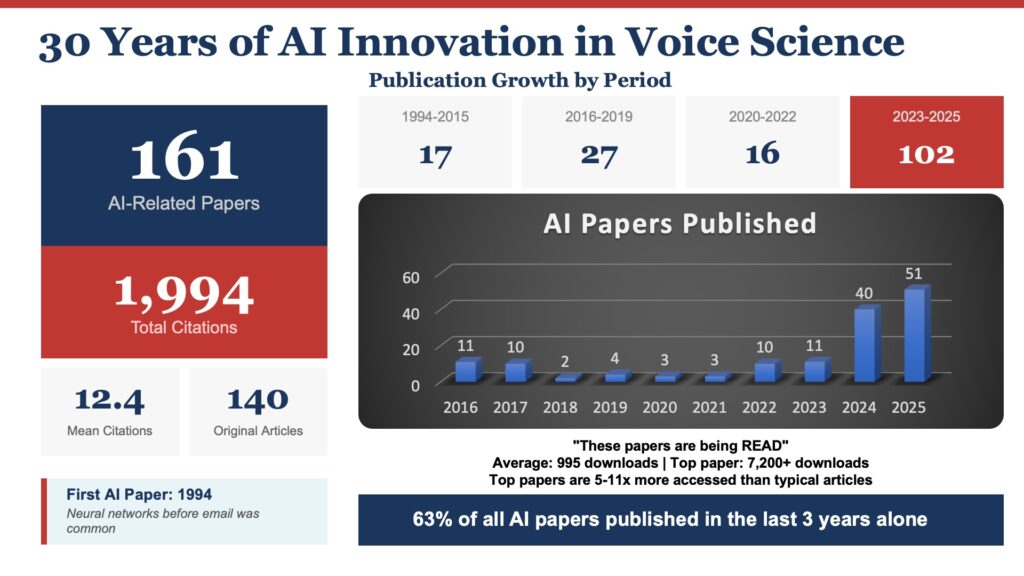
What began as tentative explorations using primitive neural networks in the mid-1990s has erupted into an exponential wave of discovery. In 2025 alone, the Journal of Voice published 51 artificial intelligence-related papers—surpassing the total output of the field’s first two decades combined. From early deep-learning models detecting subtle pathologies to the rise of voice as a digital biomarker for systemic health conditions like Parkinson’s disease and depression, AI is expanding the horizons of medicine. As we navigate this era of acceleration, the imperative before us is clear: we must embrace the profound analytical power of these technologies while collaboratively forging a robust ethical framework for their application.
A Legacy of Interdisciplinary Innovation
To understand the current AI revolution in voice science, one must look back to its foundational roots. In 1969, Dr. Wilbur James Gould established The Voice Foundation in New York City during an era when comprehensive, interdisciplinary care for the human voice was virtually nonexistent. Dr. Gould possessed rare foresight, recognizing that unlocking the mysteries of the vocal mechanism required tearing down traditional academic silos. He brought together otolaryngologists, vocal scientists, speech-language pathologists, performing artists, and master voice teachers to share knowledge and optimize the care of professional voice users.
This spirit of collaboration birthed the Foundation’s Annual Symposium—Care of the Professional Voice—in 1972, followed shortly by its inaugural Gala (later celebrated as Voices of Summer) in 1973. For over five decades, the Foundation has served as a vital bridge connecting art with science, and the clinical consulting room with the performance stage.
Since 1989, this mission has been championed under the leadership of Dr. Robert Thayer Sataloff, an internationally renowned otolaryngologist, professional singer, and conductor. Dr. Sataloff’s prolific contributions include more than 1,200 publications and 79 textbooks. Under his stewardship, the Foundation relocated its headquarters to Philadelphia, where it continues to elevate our global understanding of voice science and education. Today, the annual Philadelphia symposium draws hundreds of international medical specialists, academic researchers, speech-language pathologists, and performing artists, while the Journal of Voice remains the premier peer-reviewed journal dedicated exclusively to voice science and medicine.
Detailed Chronology: Thirty Years of AI in Voice Science
A common misconception in contemporary tech circles is that artificial intelligence in medicine is an entirely recent phenomenon born out of the 2020s generative AI boom. However, the historical record preserved within the Journal of Voice tells a vastly different story.
The Pioneer Era (1994–2015)
Thirty-one years ago, in 1994—the exact same year the World Wide Web began emerging into public consciousness—the Journal of Voice published a pioneering paper by Rihkanen and colleagues entitled “Spectral Pattern Recognition of Improved Voice Quality.” Utilizing early neural network architecture to analyze acoustic voice samples, this research proved that computational models could process vocal data before most academics had ever sent an electronic mail message.
During the initial two decades (1994–2015), progress was steady yet incremental. Researchers laid the theoretical foundations for automated acoustic analysis, publishing 17 foundational papers that tested the limits of early computing power against biological complexity.
The Acceleration and Exponential Surge (2016–2025)
As computational power grew and machine learning algorithms matured, the pace of publication quickened. Between 2016 and 2019, the journal published 27 papers exploring advanced algorithmic applications. Even during the global disruptions of 2020–2022, researchers contributed another 16 specialized studies.
Then came the modern inflection point. Between 2023 and early 2025, the volume of published research skyrocketed. Out of 161 total AI-related papers published historically in the Journal of Voice, 102 papers—an astonishing 63 percent—were published in just the last three years.
The annual breakdown highlights this exponential curve:
1994–2015: 17 papers
2016–2019: 27 papers
2020–2022: 16 papers
2023–2025: 102 papers (with 51 published in 2025 alone)
This is not a story of gradual academic growth; it is an exponential transformation that is actively redefining the boundaries of otolaryngology and speech science.
Supporting Context, Metrics, and Real-World Impact
Academic research is frequently critiqued for remaining locked within ivory towers, measured solely by obscure citation indices. Yet, the impact of AI research within the Journal of Voice is profoundly practical, manifesting in extraordinary real-world utility and global engagement.
Global Readership and High-Engagement Metrics
Statistics tracking digital engagement reveal the immense appetite for computational voice research among clinicians and scientists worldwide:
The average AI-related paper published in the journal has been downloaded nearly 1,000 times.
The most-accessed AI paper—a landmark study examining machine learning applications for COVID-19 detection—has surpassed 7,200 downloads, an astounding eleven times the median rate for standard articles in its issue.
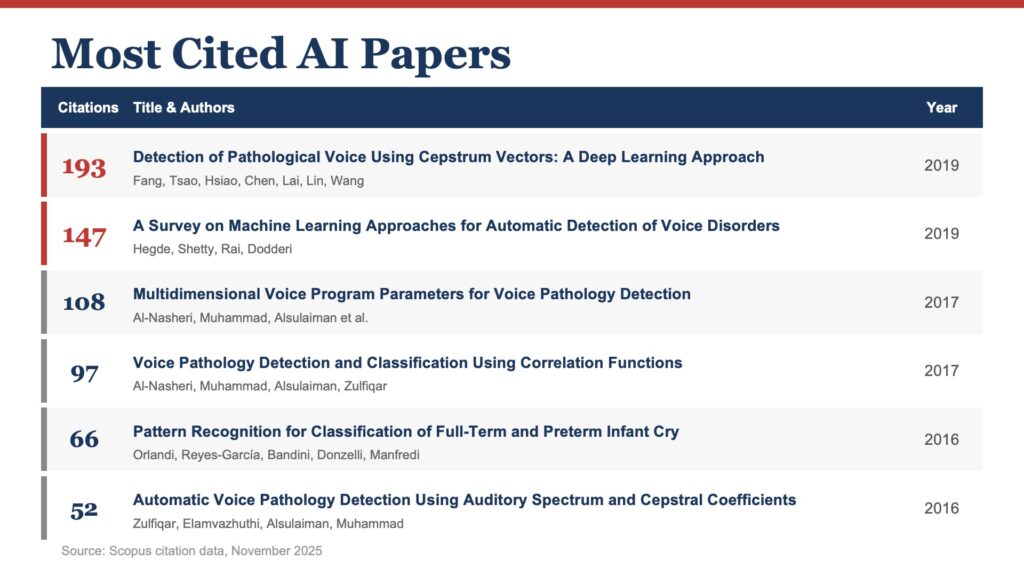
The two most-cited papers in the journal’s AI catalog (Fang et al.’s deep learning study and Hegde’s machine learning survey) have each been downloaded nearly 5,000 times, cementing their status as indispensable references for clinicians and speech-language pathologists seeking practical diagnostic tools.
Landmark Research Reshaping Clinical Frontiers
Deep Learning for Voice Pathology Detection
In 2019, Fang and colleagues published “Detection of Pathological Voice Using Cepstrum Vectors: A Deep Learning Approach,” which has since become the most-cited AI paper in the journal’s history, accumulating 193 citations. This research demonstrated that deep neural networks could identify pathological conditions within the human voice with remarkable accuracy—utilizing acoustic features entirely imperceptible to the human ear.
Complementing this, Hegde’s comprehensive “Survey on Machine Learning Approaches for Automatic Detection of Voice Disorders” (147 citations) provided a definitive roadmap of machine learning landscapes. Subsequent foundational works, such as Al-Nasheri et al.’s studies on Multidimensional Voice Program parameters, Chen and Chen’s deep neural network classifications, and Cho and Choi’s comparative convolutional neural network (CNN) analyses of laryngoscopic images, have continually pushed the envelope of diagnostic precision.
Voice as a Digital Biomarker for Systemic Health
Perhaps the most philosophically profound concept emerging from this body of research is the reimagining of the human voice as a digital biomarker—a non-invasive, continuous window into systemic health.
Recent literature highlights groundbreaking methodologies that use vocal acoustic analysis to detect and monitor neurodegenerative conditions, most notably Parkinson’s disease. For example, Hemmerling and Wójcik-Pędziwiatr’s 2022 paper on predicting Parkinson’s severity from voice signals quickly garnered 29 citations, sparking a wave of clinical application studies.
Beyond neurology, systematic reviews now explore voice quality as a digital biomarker for mental health conditions, including depression and bipolar disorder. The clinical implications are immense: routine vocal screening could theoretically flag early markers of cognitive or psychological shifts, enabling proactive intervention and alleviating strain on overstretched mental healthcare systems. Furthermore, machine learning models evaluating respiratory health from vocal acoustics have proven invaluable in monitoring post-viral syndromes.
AI Chatbots in Clinical Decision-Making
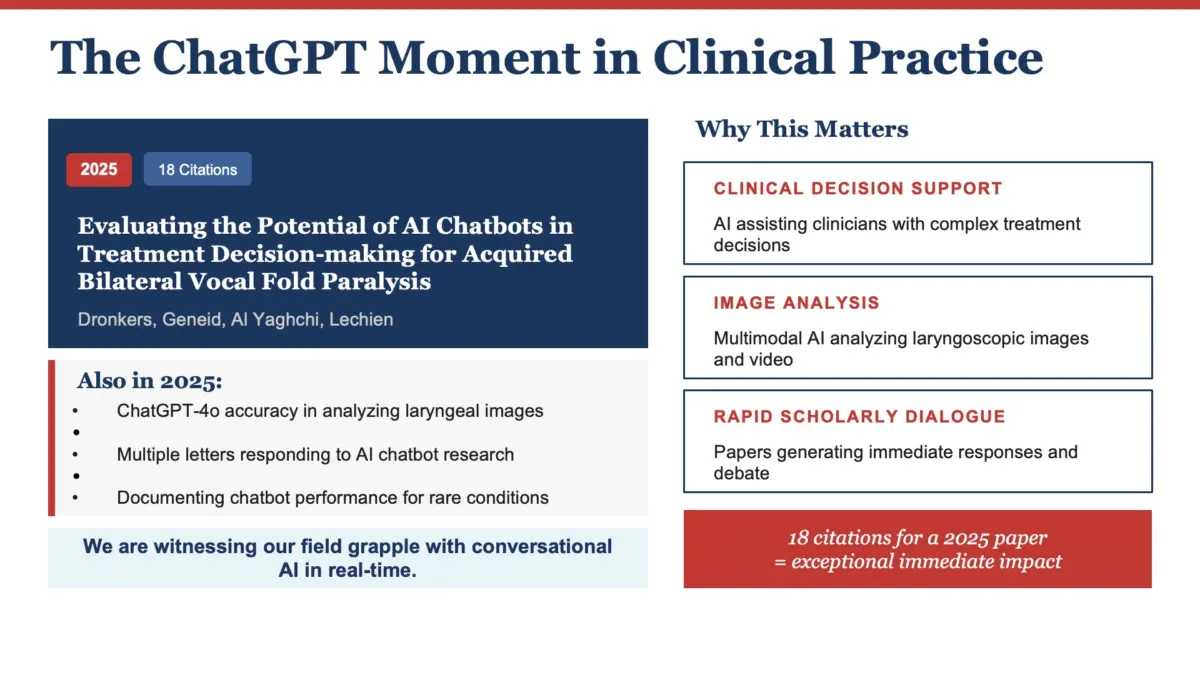
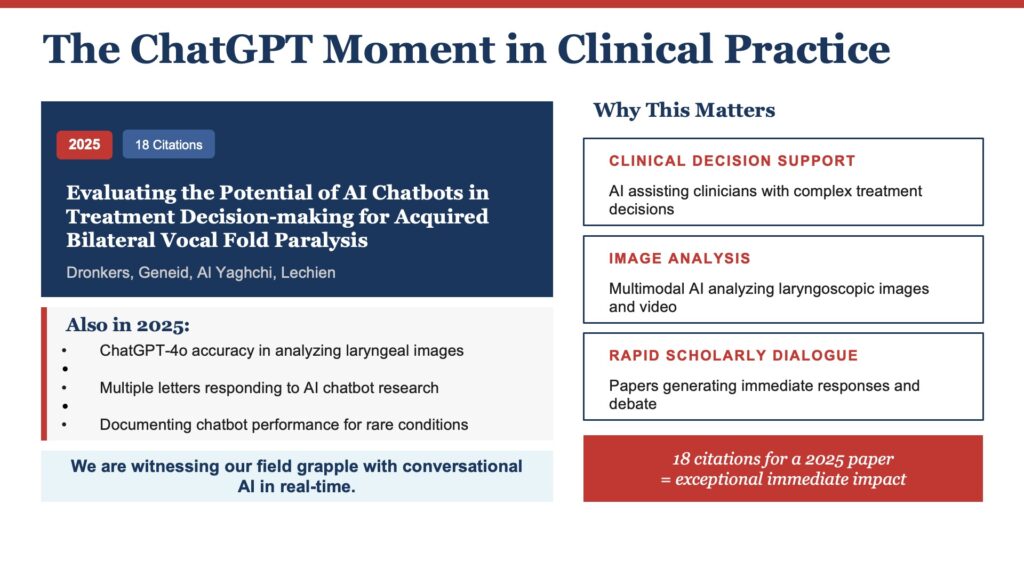
Reflecting the cutting edge of current technology, the journal published a series of papers in 2025 evaluating the integration of conversational AI and large language models into clinical workflows. Notably, Dronkers and colleagues’ study, “Evaluating the Potential of AI Chatbots in Treatment Decision-making for Acquired Bilateral Vocal Fold Paralysis,” accumulated 18 citations almost immediately upon release, sparking vibrant academic correspondence regarding the diagnostic accuracy of platforms like ChatGPT-4o in analyzing complex laryngeal imaging.
Official Statements and Expert Perspectives
To contextualize these computational milestones, two leading voices within the global scientific community offer vital perspectives on the opportunities and responsibilities accompanying this transition.
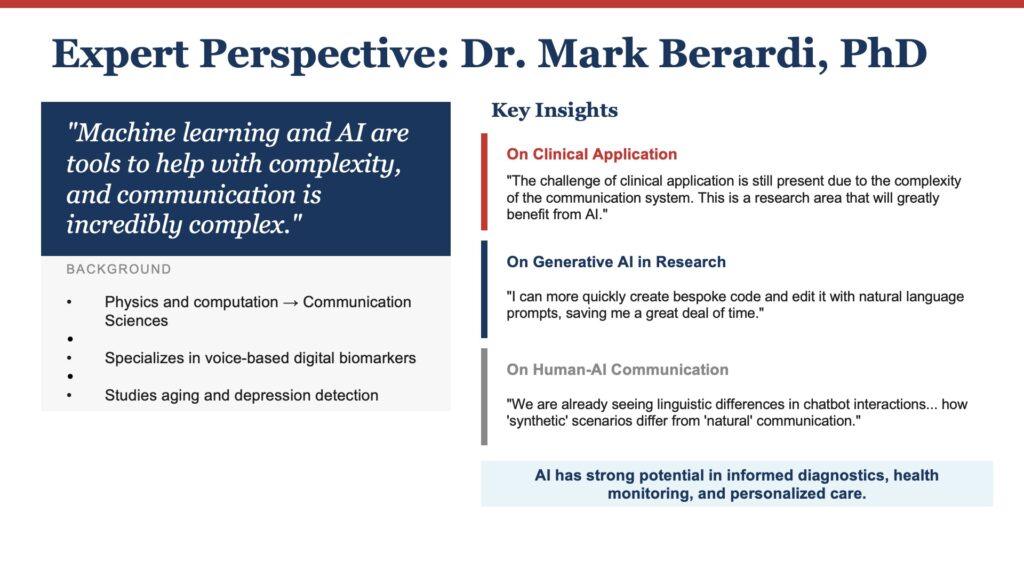
Dr. Mark Berardi: AI as a Tool for Complexity
Coming from a rigorous background in physics and computation, Dr. Mark Berardi views artificial intelligence not as a replacement for human intellect, but as an essential instrument for managing biological complexity.
"Machine learning and AI are tools to help with complexity, and communication is incredibly complex in its neurobiological and physiological processes. So I think the application is warranted," Dr. Berardi notes.
His research focuses on extracting health information from speech and voice signals to identify digital biomarkers for aging and depression. While acknowledging that acquiring voice data has become relatively straightforward, he stresses that the inherent intricacy of human communication remains the primary scientific frontier.
Regarding generative AI, Dr. Berardi offers a pragmatic evaluation. While it may not have entirely rewritten the theoretical foundations of basic research yet, it has successfully broken down traditional workflow bottlenecks—particularly in data processing and custom coding. Researchers can now draft bespoke analytical scripts using natural language prompts. Furthermore, Dr. Berardi is pioneering studies into human-AI communication itself: examining how humans unconsciously alter their linguistic structures, pacing, and pitch when conversing with synthetic entities versus real people.
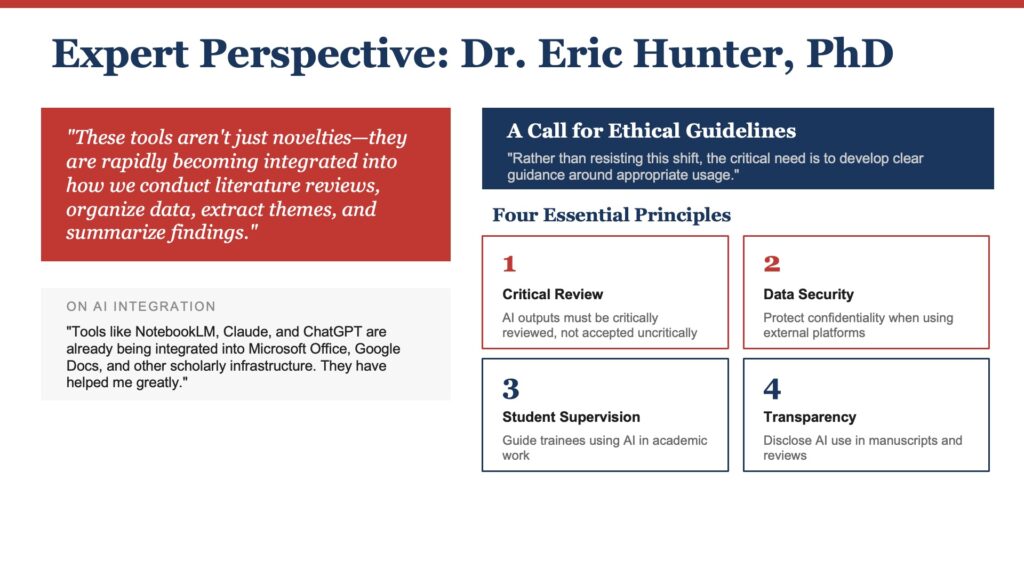
Dr. Eric Hunter: Embracing Change with Ethical Clarity
Dr. Eric Hunter addresses the profound institutional and professional changes required as AI becomes embedded in academic and clinical life.
"These tools aren’t just novelties," Dr. Hunter observes. "They are rapidly becoming integrated into how we conduct literature reviews, organize data, extract themes from large bodies of text, and even summarize findings."
Dr. Hunter issues a call to action for the academic community, noting that large language models and AI-driven platforms are permanently altering manuscript preparation, peer review, and collaborative writing infrastructure. Rather than adopting a stance of resistance, he advocates for proactive adaptation.
To govern this transition responsibly, Dr. Hunter outlines four foundational principles for scholarly integrity:
Absolute Transparency: Clear disclosure of any AI tools utilized during literature synthesis, data coding, or manuscript drafting.
Human Accountability: Maintaining strict human oversight to verify all analytical outputs, citations, and clinical claims.
Data Privacy and Security: Safeguarding sensitive patient audio files and protected health information (PHI) when utilizing cloud-based machine learning models.
Equitable Access: Ensuring that computational advancements benefit diverse patient populations globally rather than widening socio-economic healthcare disparities.
"Our field will benefit most," Dr. Hunter concludes, "if we embrace the productivity these tools offer while also building a shared ethical framework for their responsible use."
A Global Research Community
The rapid expansion of AI in voice science is fueled by an interconnected, global network of dedicated researchers. The vanguard of this movement includes prolific contributors whose multi-paper studies have shaped the pages of the Journal of Voice:
Jérôme René Lechien (6 papers)
Dimitar Deliyski (5 papers)
Stephanie Zacharias (5 papers)
Ahmed Yousef (4 papers as first author)
Paavo Alku, Leonardo Wanderley Lopes, and Maryam Naghibolhosseini (4 papers each)
Supported by international institutions spanning every continent, these researchers are proving that the exploration of vocal artificial intelligence is a collaborative, cross-cultural endeavor bound by a shared commitment to scientific excellence.
Future Outlook and the Path Forward
As the Journal of Voice steps into the next decade, it remains dedicated to publishing rigorous, peer-reviewed research that breaks scientific barriers while upholding uncompromising standards of integrity. However, realizing the full potential of AI in voice science requires addressing three vital community imperatives:
Thoughtful Engagement with Complexity: We must master AI applications as tools designed to augment—not replace—clinical judgment and scientific intuition. Understanding both the extraordinary capabilities and the distinct limitations of algorithms is paramount.
Commitment to Ethical Standards: Building a cohesive ethical framework, as championed by leaders like Dr. Hunter, requires institutional cooperation across global medical and academic societies.
Open Collaboration and Data Sharing: The 161 published papers housed within the journal represent merely the foundation. Clinicians, scientists, and educators must continue sharing their unique insights to enrich our collective understanding of human vocal physiology.
The human voice has accompanied our species for hundreds of thousands of years as the ultimate instrument of emotion, survival, and identity. For the first time in history, we possess computational tools sophisticated enough to truly decode its intricate architecture—uncovering insights into our brains, our bodies, and our overall well-being.
We stand at an extraordinary moment in time, and the Journal of Voice remains proud to stand at its center. The next decade promises discoveries that will reshape healthcare, validate artistic expression, and deepen our appreciation of the human condition.