
Executive Overview
New York City’s vibrant Off-Broadway theatre scene is currently playing host to a masterclass in musical nostalgia, brilliant arrangement, and vocal virtuosity. Going Bacharach: The Songs of an Icon, a critically acclaimed theatrical revue celebrating the legendary songbook of composer Burt Bacharach, is lighting up the Upper West Side. Playing a strictly limited revival engagement at The Marjorie S. Deane Little Theater—nestled within the West Side Y—the production opened its doors on September 9 and is slated to run through November 29.
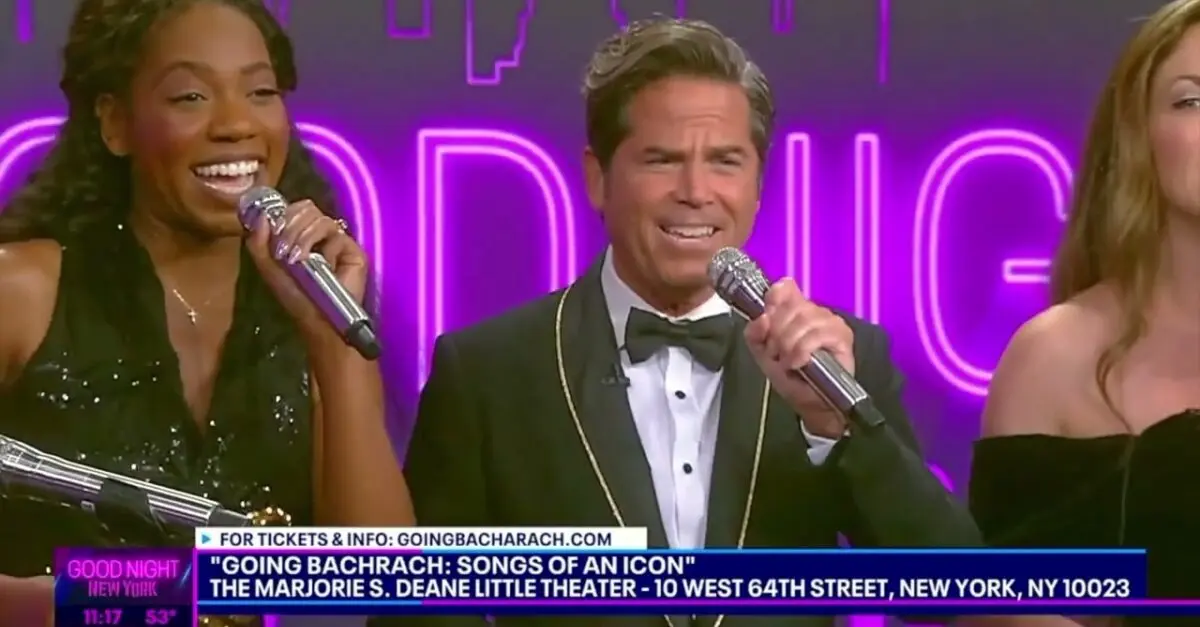
The production’s momentum reached a fever pitch on November 2, when members of the star-studded cast made a high-profile media appearance on Fox 5’s Good Night New York. Delivering a vibrant, jazzy reinvention of the 1969 Academy Award-winning favorite "Raindrops Keep Fallin’ on My Head," the company offered television audiences a tantalizing preview of the sonic sophistication that has been packing houses nightly.
Directed by Tony-winning lyricist David Zippel (City of Angels, Disney’s Hercules), Going Bacharach does not merely trot out a greatest-hits parade. Instead, it recontextualizes Bacharach’s immortal catalog through fresh arrangements, a rotating powerhouse cast of Broadway, jazz, and television veterans, and a theatrical framework that honors the architectural genius of one of popular music’s most celebrated architects. With co-creation, concept, and production design spearheaded by an all-star creative and producing team, this revival has established itself as an essential cultural touchstone of the autumn theatre season, proving that Bacharach’s syncopated rhythms, soaring melodies, and sophisticated harmonic structures remain as vital today as they were during the height of the mid-century pop explosion.
Detailed Chronology: From Concept to the Small Screen
To fully understand the cultural weight of Going Bacharach, one must examine the meticulous journey that brought this revue from initial concept to its current triumphant Off-Broadway incarnation.
Genesis and Development
The project was originally conceived by Jack Lewin, who serves as lead producer via his Lewin Productions banner in association with Amas Musical Theatre. Lewin envisioned a theatrical experience that could bridge the gap between intimate jazz club styling and grand theatrical storytelling. To execute this vision, he assembled a formidable creative team: co-creator and arranger Adrian Galante, renowned jazz pianist and music director Tedd Firth, and cultural historian and writer Will Friedwald.
Together, this collective dug deep into the expansive Bacharach catalog—a treasure trove born from the legendary collaborative partnership between Bacharach and lyricist Hal David, alongside contributions from other notable writers. The goal was simple yet profoundly ambitious: strip away decades of pop radio familiarity and re-examine these songs through a sophisticated, jazz-infused lens that highlights their often-complex time signatures and emotionally resonant lyricism.
The Marjorie S. Deane Little Theater Revival
Following previous iterations and developmental workshops, the current revival officially commenced performances on September 9 at The Marjorie S. Deane Little Theater. Located at the West Side Y, the venue has provided an intimate yet acoustically rich home for the production. The design elements were meticulously put into place by a top-tier creative roster: scenic design by the collaborative team of Christopher and Justin Swader, striking costume design by Frank Cazares, and atmospheric lighting and sound engineering by Matt Berman.
Under the watchful eye of production stage manager Ian McQueen and production supervisor Peter F. Feuchtwanger—with general management handled expertly by Visceral Entertainment—the production quickly established a rhythm of artistic precision. Word-of-mouth spread rapidly through New York’s theater district, turning the revival into one of the season’s most sought-after tickets.
The Fox 5 Breakthrough
The production’s profile expanded exponentially on November 2, when the cast stepped off the stage and into the television studios of Fox 5’s Good Night New York. Performing a dynamic, swinging arrangement of "Raindrops Keep Fallin’ on My Head," the cast demonstrated the improvisational flair and vocal pyrotechnics that define the live show. The television spot served as a brilliant promotional catalyst, driving a fresh surge of ticket sales and introducing Bacharach’s timeless melodies to a wider regional audience. As the engagement barrels toward its November 29 closing date, this media milestone marks the emotional and promotional zenith of the run.
Supporting Context & Metrics: The Talent, The Music, and The Venue
The success of Going Bacharach is anchored by three primary pillars: a virtuosic rotating cast, a legendary musical catalog, and an immersive physical production.
The Ensemble: A Powerhouse Rotating Cast
One of the most unique aspects of Going Bacharach is its rotating cast model, which allows various luminaries from Broadway, the jazz world, and reality television to put their distinct stylistic stamps on the material. Casting is expertly managed by Stephen DeAngelis. The roster features an enviable mix of vocal talent:
- Hilary Kole: A celebrated jazz vocalist and recording artist renowned for her critically acclaimed work in shows like Our Sinatra.
- John Pagano: A seasoned vocal interpreter known for his smooth, rich phrasing and deep affinity for the American Songbook.
- Adrian Galante: Beyond his duties as co-creator, arranger, and music director, Galante frequently steps into the performance spotlight, showcasing his multi-instrumental and vocal prowess.
- Ava Locknar: A rising theatrical talent bringing fresh energy and contemporary vocal agility to the ensemble.
- Meecah: An alumna of Broadway’s cultural phenomenon Hamilton, bringing theatrical gravitas and powerhouse belt capabilities to the stage.
- Julia Danielle Smulson: A versatile performer whose rich tone anchors many of the evening’s complex vocal harmonies.
- Alyssa Wray: A breakout star from American Idol whose soaring, soulful vocals consistently stop the show and bring audiences to their feet.
The Music: Examining the Bacharach-David Canon
Burt Bacharach, who passed away in early 2023 at the age of 94, left behind a musical legacy that reshaped the landscape of pop, soul, and theatre. Working primarily with lyricist Hal David, Bacharach forged a style characterized by unconventional chord progressions, shifting meters, soaring choruses, and lush orchestrations.
In Going Bacharach, audiences are treated to a masterclass in this catalog. The setlist weaves through monumental hits and deep cuts alike, drawing heavily from his classic material as well as his theatrical excursions—most notably the 1968 Broadway musical Promises, Promises (with a book by Neil Simon and lyrics by Hal David). Featured numbers in the revue include:
- "Raindrops Keep Fallin’ on My Head" (featured in the film Butch Cassidy and the Sundance Kid, which earned Bacharach Academy Awards for Best Original Song and Best Original Score).
- "Do You Know the Way to San Jose?" (a Grammy-winning smash popularized by Dionne Warwick).
- "What’s New Pussycat?" (the infectious title track from the 1965 film).
- "That’s What Friends Are For" (the iconic charity single that dominated the charts in the 1980s).
Production Metrics and Venue Specifications
The Marjorie S. Deane Little Theater provides an ideal container for this scale of musical revue. With a seating capacity designed to foster intimacy—allowing every audience member to feel a direct connection to the performers—the space highlights the nuanced arrangements crafted by Galante and musical supervisor Tedd Firth.
The production runs roughly 90 minutes without an intermission, maintaining a brisk, exhilarating pace that mirrors the energetic arrangements of the music. General management by Visceral Entertainment and production backing by Amas Musical Theatre—a non-profit organization dedicated to bringing innovative and culturally diverse musical theatre to New York—ensure that the logistical framework matches the artistic ambition.
Official Statements and Industry Perspectives
While theatrical revues of legacy catalogs are common in New York, Going Bacharach has garnered specific praise from critics and industry insiders for its artistic integrity and avoidance of mere impersonation.
Director David Zippel, whose Tony-winning career spans decades of theatrical innovation, noted in early promotional statements that the production is designed to celebrate the emotional architecture of Bacharach’s writing rather than simply recreating radio tracks. "Burt wrote music that was deceptively complex," Zippel observed during the show’s developmental phases. "Underneath those catchy, hummable hooks are harmonic structures that challenge performers and reward listeners who are willing to listen closely. Our cast doesn’t imitate the original recordings; they inhabit them."
Co-creator Jack Lewin has likewise emphasized the collaborative nature of bringing the project to fruition alongside Amas Musical Theatre. In statements regarding the current revival run, Lewin highlighted the unique chemistry of the rotating cast: "When you bring together artists from the worlds of jazz, Broadway, and television—like Hilary Kole and Alyssa Wray—you create a dynamic where every single performance feels singular. No two nights are entirely alike, and that keeps the music alive and dangerous."
Music supervisor Tedd Firth and arranger Adrian Galante have both spoken extensively about the technical challenges of recasting Bacharach for a live theatre setting. Because Bacharach’s original studio recordings often utilized massive, wall-of-sound orchestration featuring legendary session musicians like the Wrecking Crew, translating that sound to an intimate Off-Broadway stage required ingenious re-imagining. Galante’s arrangements strip the songs down to their rhythmic and harmonic essentials, allowing the vocalists to bend notes, stretch tempos, and explore the jazz idioms that always quietly underpinned Bacharach’s pop masterpieces.
Future Outlook: The Legacy of Bacharach and the Road Beyond November 29
As Going Bacharach approaches its final curtain on November 29 at The Marjorie S. Deane Little Theater, industry analysts and theatrical producers are already looking toward the future of the property.
The tremendous response to the Fox 5 Good Night New York appearance underscores a broader cultural truth: the appetite for sophisticated, vocally driven theatrical revues shows no sign of abating. In an era dominated by jukebox musicals driven by linear biographical narratives (such as Jersey Boys or Beautiful: The Carole King Musical), Going Bacharach proves that there is an equally valid, arguably more musically adventurous space for pure-song revues that treat the material with reverence and modern theatricality.
Potential for Regional and National Touring
Given the flexibility of the production’s rotating cast model and the universal, cross-generational appeal of Burt Bacharach’s music, theatrical insiders suggest that Going Bacharach is primed for a post-Off-Broadway afterlife. Regional theatre houses across the United States—many of which are continually searching for high-quality, cost-effective musical programming that appeals to both traditional subscribers and younger, adventurous demographics—are viewed as prime candidates for subsequent runs. Furthermore, a national tour or a commercial transfer to a larger market remains a distinct possibility as Lewin Productions and Amas Musical Theatre evaluate the metrics of this successful New York engagement.
Preserving the Master’s Voice
Ultimately, the success of Going Bacharach serves as a living monument to a composer who bridged the worlds of Tin Pan Alley pop, jazz improvisation, and Broadway stagecraft. As contemporary artists like Alyssa Wray, Meecah, and Hilary Kole continue to interpret these songs for 21st-century audiences, they ensure that Burt Bacharach’s melodic genius continues to resonate.
For theatregoers looking to experience this celebration firsthand before the limited engagement concludes on November 29, tickets and performance schedules remain available through the official production portal at GoingBacharach.com. As the final notes of "Raindrops Keep Fallin’ on My Head" and "Do You Know the Way to San Jose?" echo off the walls of The Marjorie S. Deane Little Theater for the last time this autumn, one thing is abundantly clear: the music of Burt Bacharach is in exceptionally good hands.