
Executive Overview
In the annals of classical music history, few compositions are as wildly innovative, psychologically revealing, and structurally groundbreaking as Hector Berlioz’s 1830 masterwork, Symphonie Fantastique. Written when the French composer was just 26 years old, the piece stands as a monumental achievement in programmatic orchestral music—music that tells a definite story without the use of sung words. At the heart of this sprawling, five-movement psychological thriller is a revolutionary compositional device that Berlioz termed the idée fixe (French for "fixed idea").
An idée fixe is a recurring musical theme, motif, or melody that represents a specific person, emotion, or obsession throughout a composition. Long before Richard Wagner popularized the concept of the leitmotif in his epic operatic cycles, Berlioz utilized the idée fixe to map out the contours of a mind unraveling. Born out of a real-life, consuming infatuation with Irish actress Harriet Smithson—whom Berlioz pursued relentlessly before ultimately marrying her—the idée fixe serves as the psychological anchor of Symphonie Fantastique.
This article explores the mechanics of the idée fixe, examines how Berlioz brilliantly alters and warps this single melody across three movements of his masterwork, and evaluates the enduring legacy of this technique for modern composers, musicologists, and students of music theory. By tracing the evolution of this recurring motif, we gain profound insight into how raw human emotion can be translated into precise structural orchestration.
Detailed Chronology: The Genesis of an Obsession and a Masterpiece
To understand the idée fixe, one must first understand the man who conceived it and the tumultuous romance that inspired it. The chronology of Symphonie Fantastique is a fascinating intersection of biographical drama and artistic revolution.
The Spark: Paris, 1827
In September 1827, a struggling young composer named Hector Berlioz attended a performance of Shakespeare’s Hamlet at the Odéon Theatre in Paris. Playing the role of Ophelia was a young, critically acclaimed Irish actress named Harriet Smithson. Berlioz was instantly, catastrophically smitten. Though he spoke virtually no English and Smithson was initially entirely unaware of his existence, Berlioz descended into a state of acute, obsessive infatuation.
For years, Berlioz bombarded Smithson with letters, declarations of love, and grand artistic visions. She, viewing him as a volatile and erratic stalker, consistently rejected his advances and avoided him. Consumed by unrequited love, jealousy, and despair, Berlioz channeled his psychological turmoil into his art, deciding to write an autobiographical symphony that would dramatize his inner torment.
The Composition: 1830
By early 1830, Berlioz was hard at work on the score that would become Symphonie Fantastique: Épisode de la vie d’un artiste (Episode in the Life of an Artist). The five-movement symphony was designed to trace the hallucinatory dreams of an artist poisoned by an overdose of opium, driven to despair by his hopeless love for an ideal woman.
When the symphony premiered on December 5, 1830, at the Paris Conservatoire, it sent shockwaves through the European music community. Audiences and critics alike were stunned by its raw emotional power, unconventional orchestration, and the sheer audacity of its narrative structure. At the center of this narrative was the idée fixe—the musical embodiment of Harriet Smithson weaving through every movement of the symphony, mutating as the artist’s mental state deteriorated.
The Resolution: Marriage and Disillusionment
In a bizarre twist of life imitating art, Harriet Smithson eventually heard Symphonie Fantastique performed in Paris in 1832 and finally grasped the depth of Berlioz’s devotion. The two were introduced, began a relationship, and were married in 1833.
However, the reality of marriage proved far more tragic than the romanticized fantasy. Language barriers, financial struggles, alcoholism, and the fading of their initial passions led to a deeply unhappy union, separation, and years of lingering bitterness—mirroring, in a grimly prophetic way, the nightmarish trajectory mapped out in the final movements of Berlioz’s symphony.
Supporting Context & Metrics: Anatomy of the Idée Fixe
In music theory, the idée fixe is categorized as a thematic transformation technique. While it shares conceptual DNA with the Renaissance cantus firmus and anticipates the Wagnerian leitmotif, Berlioz’s execution was uniquely psychological.
Defining the Mechanics
An idée fixe is not merely a catchy tune; it is a malleable structural device. When a composer employs an idée fixe, they establish a primary melody that is instantly recognizable to the listener. As the narrative of the piece unfolds—whether through changing scenes, shifting emotional states, or the passage of time—the melody is systematically warped, fragmented, accelerated, slowed down, or re-orchestrated.
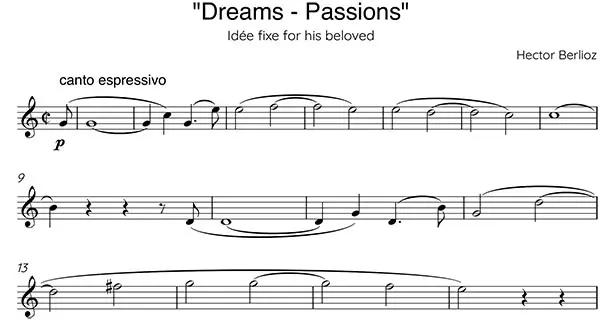
In Symphonie Fantastique, the idée fixe is introduced as a sweeping, passionate theme representing the artist’s idealized vision of his beloved. But as the movements progress, this pristine melody is subjected to grotesque transformations, illustrating the artist’s descent from romantic yearning into feverish delirium and nightmarish obsession.
Reworking the Melody Across Three Movements
To fully appreciate Berlioz’s genius, one must examine how the idée fixe mutates across specific movements of the symphony:

1. First Movement: "Révêries – Passions" (Dreams, Passions)
In the opening movement, the listener is introduced to the artist in a state of melancholy daydreaming before he catches sight of his beloved. Here, the idée fixe makes its initial appearance. It is expansive, lyrical, and soaring, capturing the overwhelming rush of first love, combined with an aching sense of unattainable longing. The melody flows smoothly, outlining the protagonist’s profound emotional vulnerability.
2. Second Movement: "Un bal" (A Ball)
The second movement transports the listener to a glittering, high-society Parisian ball. The atmosphere is meant to be joyous and celebratory, dominated by the swirling cadence of a waltz in 3/8 time. Yet, the artist’s mind remains unsettled. Here, Berlioz alters the idée fixe, weaving it seamlessly into the rhythmic flow of the waltz. The melody is heavily decorated with ornamental flourishes and rapid turns, brilliantly depicting a man caught in a chaotic social setting, frantically searching for his beloved while his internal anxieties rage out of control.
3. Third Movement: "Scène aux champs" (Scene in the Fields)
Seeking solace in nature, the artist finds himself in the countryside. The tempo drops dramatically into a reflective adagio in 6/8 time. The atmosphere is pastoral, characterized by a poignant dialogue between a solo English horn and an offstage oboe simulating a shepherd’s call. When the idée fixe returns, it is radically transformed. Played softly by a solo flute and violins at a sluggish tempo, the melody embodies a complex mixture of lingering hope, profound loneliness, and a creeping, existential fear that he will never win her heart. The reflective, fragile mood underscores the psychological fragility of the protagonist.
Official Statements and Musicological Perspectives
Prominent music theorists, educators, and historians have long lauded Berlioz’s revolutionary approach to orchestral storytelling.
Ben Dunnett LRSM, founder of the Music Theory Academy and an authority on classical composition, emphasizes the enduring pedagogical value of Berlioz’s innovation:
"Whilst this concept is now mainly explored under the title of leitmotifs, Berlioz’s work is extremely valuable to composers who want to develop their craft. The ability to be able to adapt a melodic idea to depict different emotions, moods and places is one that will always be of considerable value."
Musicologists frequently point out that Symphonie Fantastique bridged the gap between Classical restraint and Romantic emotional excess. By binding a massive orchestral score to a precise psychological program, Berlioz proved that instrumental music could possess narrative clarity equal to—or exceeding—that of literature and theater.
Furthermore, historical accounts from the 1830 Paris premiere highlight the sheer astonishment of contemporary critics. François-Joseph Fétis, an influential Belgian music critic and composer who attended the premiere, noted that Berlioz had opened an entirely new frontier in orchestration, utilizing instruments not merely for harmonic backing or melodic delivery, but as actors in a dramatic play.
Future Outlook: The Legacy of the Idée Fixe in Modern Composition
Nearly two centuries after its premiere, the legacy of Berlioz’s idée fixe reverberates far beyond the traditional classical concert hall. The core DNA of the technique lives on in modern media scoring, structural composition, and cross-genre storytelling.
Film Scoring and the Modern Leitmotif
When film composers construct complex cinematic universes—most notably Howard Shore in The Lord of the Rings, John Williams in Star Wars, or Bernard Herrmann in Alfred Hitchcock thrillers—they are utilizing the direct descendants of Berlioz’s idée fixe. The practice of assigning a specific, mutable melodic phrase to a character, psychological state, or plot device allows film scores to sub-textually guide the audience’s emotional interpretation of a scene. Just as Berlioz warped his melody to show Harriet Smithson transforming from an idealized angel into a grotesque witch in the Witches’ Sabbath final movement, modern film composers alter character themes to signal moral corruption, psychological decline, or triumph.
Contemporary Classical and Narrative Instrumental Music
In contemporary concert music, composers continue to look to Symphonie Fantastique as a masterclass in thematic unity. In an era where audiences are inundated with fragmented, non-linear art, the use of a unifying idée fixe provides a powerful cognitive thread that binds disparate musical movements into a cohesive psychological journey.
Educational Implications for Young Composers
For institutions teaching orchestration and music theory, analyzing Berlioz remains a mandatory rite of passage. Students learn that technical proficiency in instrumentation is most powerful when paired with deep narrative intent. The ability to take a single musical line and subject it to metric modulation, re-orchestration, dynamic shifts, and harmonic recontextualization is a master skill taught in top conservatories worldwide—proof that Berlioz’s 1830 experiment remains a cornerstone of modern musical education.
Conclusion
Hector Berlioz’s invention of the idée fixe in Symphonie Fantastique was much more than a clever compositional trick; it was a psychological breakthrough that permanently altered the landscape of Western art music. By anchoring an entire five-movement orchestral score to the shifting, obsessive contours of a single melody representing unrequited love, Berlioz demonstrated how sound could mirror the deepest, darkest recesses of the human mind.
Whether studied through the lens of historical biography, music theory, or its modern incarnation as the cinematic leitmotif, the idée fixe remains a testament to the power of artistic obsession. As listeners continue to marvel at the Orchestre philharmonique de Radio France under conductors like Myung-Whun Chung breathing life into Berlioz’s timeless score, the haunting strains of the idée fixe continue to echo across the centuries—a timeless reminder that the greatest music is born from the most profound human passions.