
Executive Overview
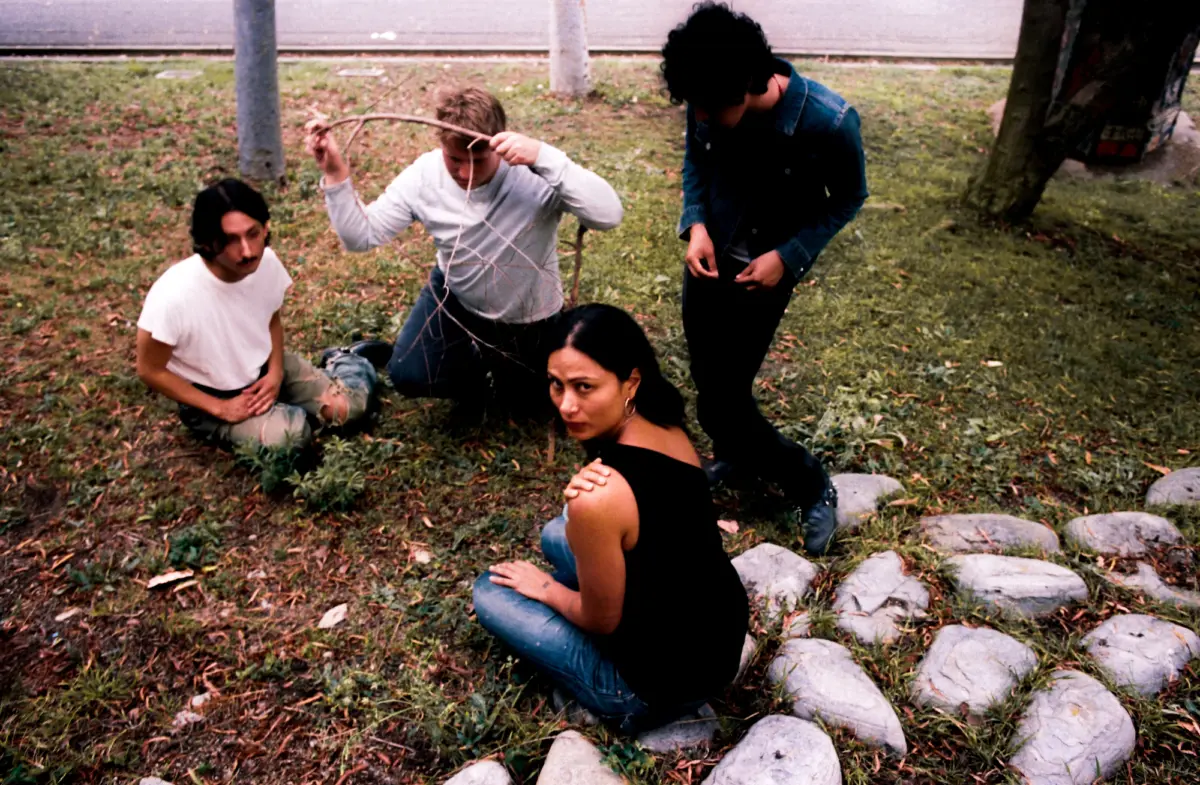
In the contemporary musical landscape, speed and endless content generation frequently overshadow deliberate artistic patience. Yet, the upcoming arrival of Southern California’s (untitled) halo proves that profound statements still emerge from intentionality, fragmentation, and physical degradation. Set to release their self-titled debut LP on November 6 via Dirty Hit, the quartet—comprising drummer and producer Jay Are, vocalist and lyricist Ariana Mamnoon, multi-instrumentalist Jack Dione, and studio wizard Nicholas Noneman—has crafted a record deeply informed by the mechanics of decay.
At the philosophical heart of their creative process lies The Disintegration Loops, the seminal 2002 ambient masterwork by avant-garde composer William Basinski. Recently reflecting on the creation of that defining project during an appearance on the Talkhouse podcast, Basinski noted, “My work had to collapse in front of me for anyone to get what I’d been working on for 20 years.”
For (untitled) halo, this concept of physical and sonic breakdown is not merely a historical footnote, but an active methodology. Their lead single, the hazy and jerk-inflected "aimee lou wood freestyle," serves as both a chaotic introduction to the band and a thesis statement on modern atomisation. Blending the micro-looping techniques of underground rap producers with the ambient philosophy of tape decay, (untitled) halo turns the friction of living in Los Angeles into a disarming, cathartic art form. This feature explores the genesis of their debut album, the unexpected lineages connecting avant-garde sound art to Southern California underground club culture, and how a band built on collaboration is finding strength in the very act of falling apart.
Detailed Chronology: From Tape Decay to the Los Angeles Underground
The Legacy of the Loops
To understand the kinetic, fractured pulse of (untitled) halo’s music, one must trace the lineage of modern sonic degradation back to a sweltering Brooklyn morning in August 2001. William Basinski, then in his 40s and facing mounting financial debt, attempted to digitally archive melodic tape loops he had recorded decades prior. As the decades-old magnetic tape passed through the playback heads, the physical medium began to flake and crumble before his eyes.
Rather than stopping the transfer, Basinski captured the accidental destruction. Over four sweeping LPs of droning, melancholy loops, the listener hears the music slowly erode into silence. Just six weeks after discovering the failing tapes, on the morning of September 11, 2001, Basinski completed the final sequencing. He carried his speakers to his rooftop in Brooklyn and played the disintegration loops out into the smoke-filled Manhattan sky. The project transformed an archival failure into a haunting monument to impermanence.
The Evolution of (untitled) halo
Fast-forward over two decades, and that same ethos of structural collapse has found a new home in the subterranean music scenes of Southern California. Formed by Are, Mamnoon, and Dione, (untitled) halo arrived in 2003 with their debut single "limewire," produced by urika’s bedroom. Over the next two years, the band released two distinct EPs, though they maintained a relatively low profile on streaming platforms.
Instead of oversaturating the digital sphere, the band refined their craft on sweaty, crowded club floors and live stages. They quietly established themselves as vital fixtures of the indie and alternative underground, supporting a diverse roster of critical darlings including bar italia, The Hellp, Alison’s Halo, and DIIV. During this gestation period, non-recording members expanded, eventually welcoming producer and mixing engineer Nicholas Noneman into the formal fold following the completion of their debut album sessions.
The silence between releases was broken in March 2025 with the creation of "aimee lou wood freestyle"—a track born from late nights, rigorous touring, and an immersion in the modern textures of underground rap.
Supporting Context & Metrics: The Architecture of "aimee lou wood freestyle"
The creation of "aimee lou wood freestyle" is a masterclass in cross-genre pollination, drawing equally from avant-garde ambient soundscapes and the frantic rhythms of contemporary jerk music.
Cinematic Catalysts and Jerk Beats
The track’s unusual title was penned by Jack Dione after binge-watching Season 3 of the hit HBO satirical dark comedy series The White Lotus in the spring of 2025, specifically noting English actress Aimee Lou Wood’s memorable television presence. Around this creative window, the band entered the studio to translate their cinematic consumption into a musical statement.
“Originally, it was just gonna be a rap song, which a lot of it still is,” explains Ariana Mamnoon. The instrumental originated from a jerk beat that Dione had been experimenting with, inspired by the hyper-online, looping-heavy sounds of artists like xaviersobased and fakemink. A crucial touchstone for the group during their DJ sets was EsDeeKid’s underground club staple, "LV Sandals."
For Jay Are, spinning that specific track unlocked an entirely new approach to audio construction: “It’s the same sample repeating, but then it switches up just ever so slightly.”
The Physics of Deterioration
This subtle shifting of loops mirrors Basinski’s tape degradation, albeit translated through a digital-age lens. While (untitled) halo’s loops do not physically disintegrate in real-time, they deliberately break down under their own weight.
Jay Are approaches this degradation with both artistic intention and lived irony. Admitting candidly that he hasn’t been wearing earplugs during recent high-volume live performances, he points out a literal parallel: “So there’s that level of deterioration physically.”
Within the mix of "aimee lou wood freestyle," this breakdown creates space for unexpected elements to breach the surface. The track opens not with Dione’s forthcoming rap verses, but with Mamnoon’s ethereal, dream-cadence vocals. Floating above Noneman’s studio wizardry and Are’s driving percussion, she lilts the phrase, “tear it all apart.” It is an introductory mission statement that frames the entire project.
“It’s really a piece of all of us, which is really cool,” Mamnoon reflects, highlighting how the song’s fragmented structure serves as a democratic reflection of each member’s individual strengths.
Official Statements: Perspectives from the Band
The members of (untitled) halo view their music not as a sterile studio construct, but as a living, breathing reaction to the chaotic world they inhabit. Below are key insights gathered from the band regarding their creative symbiosis and geographic influences:
-
On the Los Angeles Backdrop:
“I feel like the way that we make music is always going to be a complete reaction to our lives, emotions and surroundings,” shares Jack Dione. “Especially with LA, specifically, as a backdrop, we interpret that in such a strange way. It just kind of makes sense that it sounds disjointed and upset and angsty.”
-
On Interpersonal Collaboration:
“Learning from each other’s strengths has been one of the most valuable things that I think I’ve ever experienced,” says Nicholas Noneman, reflecting on joining the group. “I haven’t encountered something like this; it’s truly beautiful.”
Drummer Jay Are echoes this sentiment, cutting straight to the core of the band’s operational philosophy: “We’re basically a team. In all ways.”
-
On the Texture of Repetition:
“Whenever you hear something being repeated so many times, it gives it a different texture,” Are notes, bridging the gap between Basinski’s tape loops and modern club loops.
Future Outlook: The Road to November 6 and Beyond
As (untitled) halo prepares for the November 6 release of their self-titled debut LP via Dirty Hit, the music industry is watching closely to see how the band translates their formidable live energy and complex studio ethos into a cohesive full-length statement.
In an era defined by hyper-curated perfection and pristine digital compression, (untitled) halo offers a refreshing alternative: an embrace of friction, angst, and beautiful structural decay. "aimee lou wood freestyle" stands as proof that even as cultural and physical systems break down around us, collective creation remains a profound act of resistance.
Maybe in 20 years, an (untitled) record will be pushed to the absolute brink of digital collapse, mirroring the slow-motion tragedy of Basinski’s rooftop masterpiece. But for now, the quartet is simply thrilled to be getting started—standing fearlessly amidst the noise, tearing it all apart, and building something entirely new from the debris.