
Executive Overview
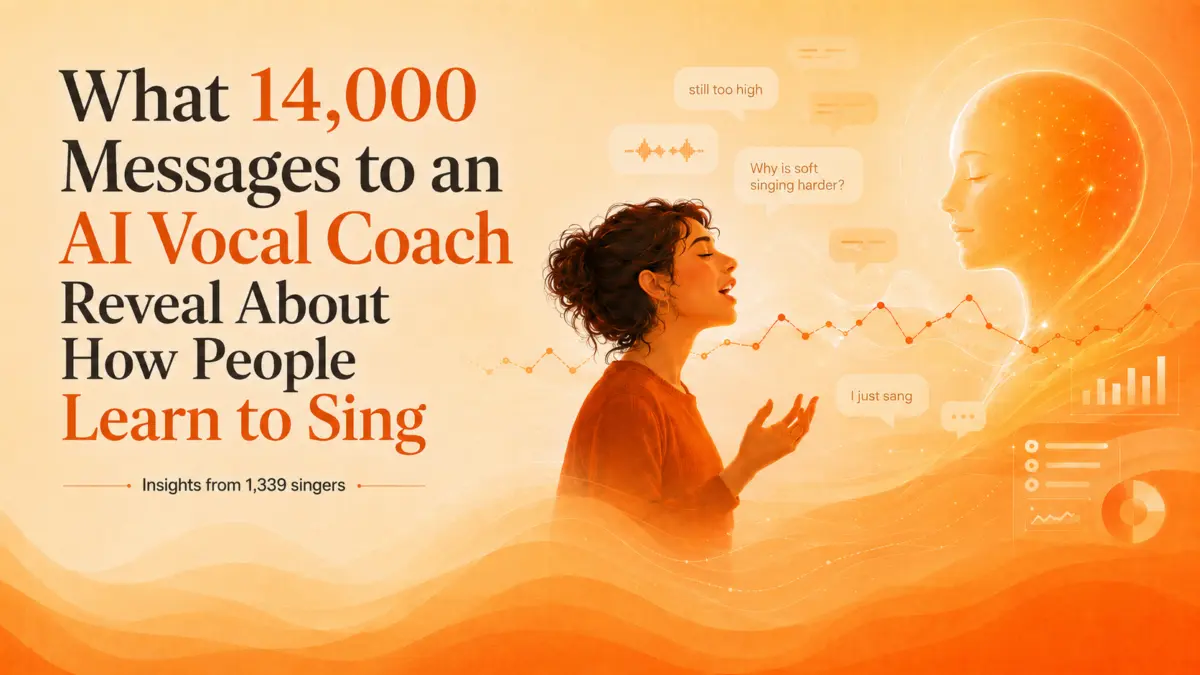
The landscape of music education is undergoing a quiet but profound transformation. In November 2025, the digital vocal training platform Singing Carrots launched an interactive artificial intelligence (AI) vocal coach. By July 2026, the tool had processed 14,091 messages from 1,339 distinct singers practicing in bedrooms, cars, and kitchens across every global time zone.
Anonymized, aggregate analysis of this conversational database offers an unprecedented, unfiltered window into the raw reality of vocal practice. Unlike traditional studio environments, where students often perform a polished version of their progress for a human instructor, the AI coach has become a digital confessional. Here, learners engage in raw negotiations, air technical frustrations, and experiment with artistic identities they would rarely dare to expose to a human teacher.
AI Vocal Coach Interaction Metrics (Nov 2025 – Jul 2026)
Total Messages: 14,091
Distinct Users Analyzed: 1,339
Total Sessions: 13,000+
Total AI Coach Users: 2,000+
The resulting data challenges long-held assumptions about amateur music-making. The research reveals that amateur singers possess highly accurate self-awareness regarding their technical shortcomings, particularly concerning pitch flatness and register transitions.
Furthermore, the data indicates that modern learners do not passively absorb instruction; instead, they aggressively customize, push back against, and even "prompt-engineer" their curriculum. This investigative report analyzes these findings, detailing the technical hurdles, behavioral psychology, and pedagogical shifts defining music education in the AI era.
Detailed Chronology: The Evolution of the Digital Music Studio
The trajectory of the AI vocal coach database spans from its initial deployment on November 26, 2025, through July 15, 2026. This period marks a transition from tentative user experimentation to highly sophisticated, self-directed learning.
[Nov 2025] Launch of AI Vocal Coach
   │
   ├── [Dec 2025 - Jan 2026] Initial Trial Phase
   │   └── Users test basic Q&A; high volume of conversational small talk.
   │
   ├── [Feb - Mar 2026] The Rise of "Pushback"
   │   └── Users begin negotiating difficulty, requesting tempo & key adjustments.
   │
   ├── [Apr - May 2026] Emergence of "Prompt Engineering"
   │   └── Advanced users input custom system prompts and sheet music notation.
   │
   └── [Jun - Jul 2026] Integration & Routine
       └── Practice volume stabilizes evenly across a 7-day weekly flat curve.
Phase 1: The Novelty and Trial Period (November – December 2025)
Immediately following the launch, early interactions were characterized by curiosity and baseline testing. Users sought to understand the boundaries of the technology, asking fundamental setup questions, testing latency, and assessing the AI’s ability to analyze vocal input.
During this phase, the tone was polite but somewhat detached. It was during these initial weeks, however, that the first instances of anthropomorphism occurred—including two documented, written apologies to the software after missed sessions or perceived performance failures.
Phase 2: The Emergence of Collaborative Negotiation (January – March 2026)
By early 2026, a significant behavioral shift occurred. The novelty wore off, and users began integrating the AI into their daily practice routines.
The volume of straightforward questions dropped, replaced by real-time negotiation of lesson parameters. Singers realized they could influence the machine, demanding slower tempos, lower keys, and targeted repetitions. It was during this period that the AI coach evolved from a novel software program into a collaborative practice partner.
Phase 3: The Rise of the "Power User" and Prompt Engineering (April – July 2026)
In the spring and summer of 2026, the database recorded highly advanced interactions. Users began treating the vocal coach not merely as an automated instructor, but as an open-source API for their voice.
Singers began copy-pasting complex system prompts to override the AI’s default pedagogical path, dictating highly specific technical regimens. This period solidified a new paradigm: the rise of the student-designer, where the traditional boundaries between curriculum creator and student completely dissolved.
Supporting Context & Metrics: The Anatomy of Vocal Struggle
To understand what amateur singers experience during practice, we must look at the specific technical and behavioral metrics extracted from the 14,091-message corpus.
Top Technical Struggles Reported by Singers
┌──────────────────────────────┬───────────┐
│ Pitch Accuracy / Flatness    │ 256 users │
├──────────────────────────────┼───────────┤
│ Vocal Range / High Notes     │ 245 users │
├──────────────────────────────┼───────────┤
│ Register Transitions (Mix)   │ 139 users │
└──────────────────────────────┴───────────┘
1. The Pitch Paradox: Self-Awareness vs. Acoustic Reality
Of the 1,339 distinct singers analyzed, 256 explicitly raised pitch accuracy as their primary struggle. This self-reported anxiety aligns with objective acoustic data. In a parallel Singing Carrots study analyzing 632,000 objectively missed notes, researchers discovered that amateur singers miss their target note flat 65.7% of the time, with errors concentrated heavily in their upper register.
This correlation proves that amateur singers are not deaf to their mistakes. They do not suffer from a lack of pitch perception; rather, they suffer from a lack of physical coordination.
One user highlighted a subtle mechanical challenge, asking: "Why does it seem to be harder to hit the pitch when singing soft?" This question points to a core physical challenge in vocal pedagogy: maintaining consistent subglottic air pressure and vocal cord approximation without the brute-force assistance of high volume.
2. The Quest for the High Register
Vocal range was the second most common concern, cited by 245 singers, with 182 focusing specifically on high notes. The tone of these inquiries was rarely boastful or overly ambitious. Instead, the messages revealed a vulnerable awareness of physical limitations:
"I really can’t sing that high yet."
The inclusion of the word "yet" reflects the growth mindset that characterizes self-directed digital learners. The physical strain of the high register often led to humorous, self-deprecating comparisons. Multiple users described their high-register output as sounding like a "dying cat" or a "dying dog," illustrating the frustration of trying to access the head voice without proper breath support.
3. Navigating the Vocal Registers
The physical and conceptual transition between vocal registers—chest voice, head voice, falsetto, and the "mixed voice"—troubled 139 singers. The vocabulary of vocal pedagogy is notoriously abstract, and users frequently expressed confusion about what their bodies were actually doing:
"I think I am singing only in head voice, isn’t that too high?"
This confusion highlights a major gap in traditional self-help vocal training: without real-time feedback, singers struggle to map anatomical terminology onto their actual physical sensations.
Breakdown of Chat Message Types
┌──────────────────────────────┬───────────┐
│ Dialogue, Negotiation, Feedback│ 81%     │
├──────────────────────────────┼───────────┤
│ Direct Questions             │ 19%       │
└──────────────────────────────┴───────────┘
4. The Power of "No": Practice as an Active Negotiation
Perhaps the most surprising metric from the study is that only 19% of the analyzed messages were direct questions. The remaining 81% consisted of dialogue, performance reports, pushback, and active negotiation.
Rather than passively accepting the AI’s exercises, 136 singers actively negotiated the difficulty of their sessions. When an exercise felt out of reach, they didn’t just log off; they commanded the AI to adjust:
- "Still too high."
- "Slow it down by 60%."
Conversely, advanced singers quickly voiced their boredom when the exercises failed to challenge them:
- "This is way too easy and quite boring to be honest."
One highly frustrated user delivered an exceptionally candid critique of the AI’s exercise selection:
- "If you were a human coach, I would say: you are drunk."
This behavior is pedagogically vital. In traditional voice lessons, students often nod politely and attempt exercises that are either too difficult or completely unengaging, simply out of respect for the instructor’s authority. In the private, low-stakes environment of an AI interface, the student takes complete ownership of the learning pace. This active negotiation directly correlates with improved outcomes.
Pedagogical Analysis: The "Freddie Mercury" Effect and the Psychology of Private Practice
The behavioral patterns found in the Singing Carrots database offer deep insights into the psychology of vocal learning. The most notable of these is what researchers have termed "The Freddie Mercury Clause."
Rehearsing the Dream in a Judgment-Free Zone
Throughout the corpus, users regularly asked the AI to engage in roleplay:
- "Okay, let’s pretend I was Freddie Mercury and was singing Bohemian Rhapsody to you — what would you comment on it?"
- "What would you tell me of my voice if I was Adele?"
This roleplay is highly revealing. In a traditional studio, asking a human vocal coach to critique you "as if you were Freddie Mercury" feels too vulnerable, exposing an ambition that many amateur singers feel they haven’t "earned" the right to express. The AI, however, offers a completely judgment-free space.
The Psychology of Private Practice
┌────────────────────────────────────────────────────────┐
│               Traditional Vocal Studio                 │
│  - High social stakes                                  │
│  - Fear of judgment / performance anxiety             │
│  - Polished presentation of progress                   │
└───────────────────────────┬────────────────────────────┘
                            │
                            ▼ Shift to
┌────────────────────────────────────────────────────────┐
│                 AI Vocal Environment                   │
│  - Zero social stakes                                  │
│  - Unfiltered experimentation & roleplay               │
│  - Psychological safety leads to vocal risk-taking     │
└────────────────────────────────────────────────────────┘
Vocal production is deeply tied to emotional state and self-image. Performance anxiety physically constricts the throat, limits breath support, and impairs pitch control. By providing an environment free of social stakes, the AI coach helps eliminate this psychological constriction.
This dynamic is beautifully summarized by one singer mid-session, who described overcoming their anxiety:
"The first time, I let myself be confused by a fear of overshooting the fa. The last time, I just sang."
This transition—from fear-induced hesitation to uninhibited physical execution—is the core goal of vocal pedagogy. The private, digital space of the car or kitchen provides the psychological safety necessary to make that leap.
The Demystification of the "Power User"
Another unexpected finding was the emergence of "prompt engineering" in vocal lessons. Some users bypassed the standard conversational interface entirely, treating the AI coach like a customizable software engine.
One user pasted a highly technical system prompt to completely redesign the AI’s pedagogical approach:
"You are an advanced AI vocal coach. Your role is to run a strict, real-time vocal training session focused on improving first-note accuracy, chord resistance, pitch locking, and onset precision…"
Others pasted sheet music notation directly into the chat, demanding structural breakdowns, or designed comprehensive, multi-step 30-minute lesson plans for the AI to facilitate.
This represents a major shift in the power dynamic of music education. The line between taking a lesson and designing a lesson has blurred. Highly motivated learners are no longer passive consumers of a methodology; they are active architects of their own technical development.
Future Outlook: The Hybridization of Music Education
The data collected by Singing Carrots from November 2025 to July 2026 suggests that AI vocal coaching is not replacing traditional music education, but rather expanding and supporting it.
Integrating Practice Into Daily Life
Before the advent of accessible digital tools, vocal practice was often treated as a formal, scheduled event—a hobby reserved for weekends or specific studio hours.
The Singing Carrots data refutes this model. Message volume remained remarkably steady across all seven days of the week, with only minor peaks on Wednesdays and Sundays.
Weekly Practice Volume Distribution (Mon - Sun)
┌──────────┬──────────┬──────────┬──────────┬──────────┬──────────┬──────────┐
│   Mon    │   Tue    │   Wed    │   Thu    │   Fri    │   Sat    │   Sun    │
│  13.8%   │  14.1%   │  14.9%   │  13.7%   │  13.9%   │  14.2%   │  15.4%   │
└──────────┴──────────┴──────────┴──────────┴──────────┴──────────┴──────────┘
(Showing a highly consistent, flat practice distribution across the entire week)
This flat distribution indicates that singing practice has become woven into the fabric of daily life. Singers practice when they can—in the car during a commute, in the kitchen while preparing dinner, or in the 50-minute window before their local choir rehearsal begins.
The primary value of the AI coach is its constant availability. It is there on a Tuesday night at 11:00 PM, ready to guide a session without requiring a scheduled appointment or travel.
Supporting Existing Musical Communities
The database shows that users are not practicing in a vacuum. They frequently mention real-world commitments:
- Church praise bands
- Local community choirs
- Upcoming musical theater auditions
- Preparation for karaoke nights
The goal for most of these singers is not fame, but competence and contribution. They want to sing their part accurately in their local choir or confidently perform an Adele song for friends. The AI coach acts as a supporting tool for these existing communities, helping singers build the skills and confidence they need to participate fully in real-world music-making.
Conclusion: The Future is Collaborative
As we look ahead, the future of vocal pedagogy lies in a hybrid model. AI tools excel at providing low-stakes, highly repetitive, and technically precise feedback. They offer a safe space for initial experimentation and allow students to build basic skills at their own pace.
Human vocal coaches, however, remain essential for artistic interpretation, emotional connection, and complex physical adjustments that software cannot yet diagnose.
The data from the Singing Carrots AI vocal coach demonstrates that when technology removes the fear of judgment, students practice more consistently, take greater risks, and ultimately find their true voice. By embracing these digital tools, we can make vocal education more accessible, personalized, and effective for singers around the world.