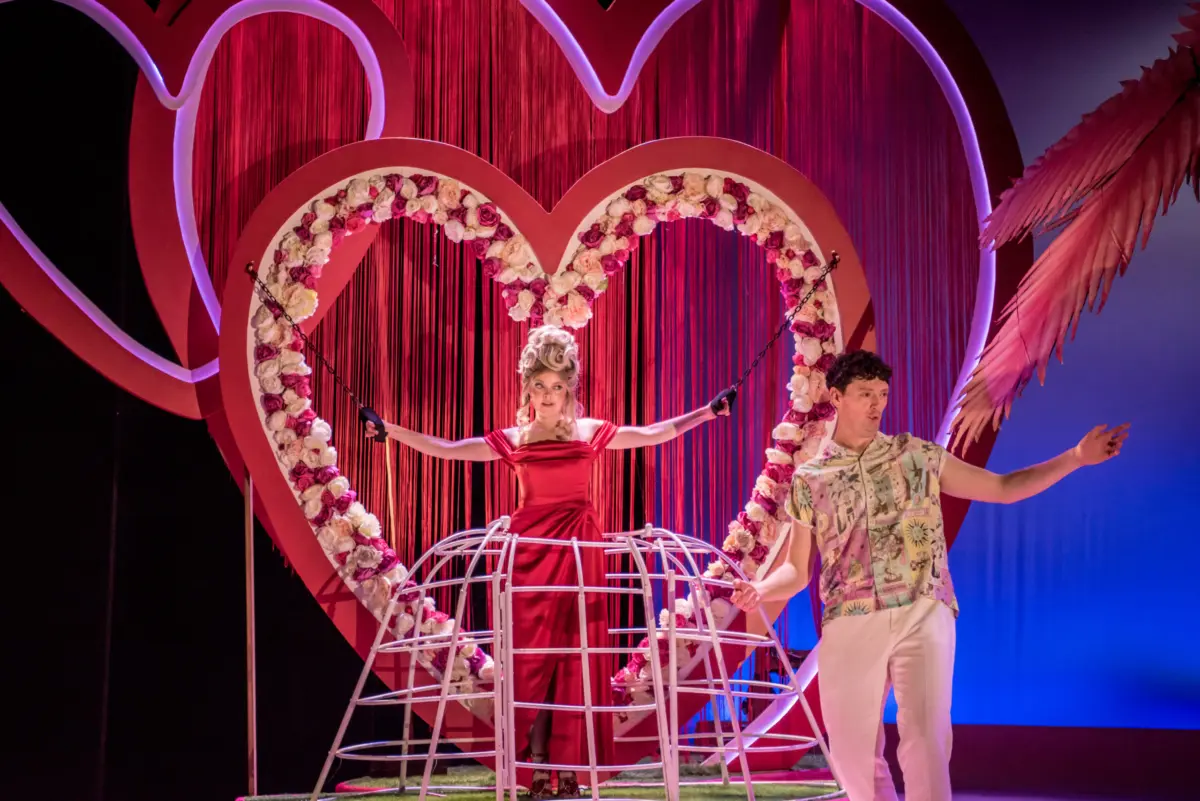

(Photo: Genevieve Girling)
Executive Overview
George Frideric Handel’s operatic legacy is often characterized by an inherent paradox. While celebrated for some of the most sublime vocal writing in Western classical music, his "magic operas"—teeming with complicated love plots, sorceresses, pagan gods, mythic monsters, and fantastical transformations set against an era of chivalric sentiment—can prove to be a theatrical minefield for modern directors. Bound by a rigid musical architecture of secco and accompagnato recitatives that alternate with da capo arias, these narratives frequently risk dramatic stagnation. When mishandled, they become static costume pageants; when approached with visionary theatricality, however, they transform into visually arresting, viscerally engaging spectacles.
At the prestigious Buxton International Festival, director Olivia Fuchs triumphantly achieved the latter, unveiling an imaginative, uproarious, and sharply satirical production of Handel’s 1715 masterwork, Amadigi di Gaula.
By reframing the sorceress Melissa’s enchanted isle as a thinly veiled reality television set echoing the cultural phenomenon of Love Island, Fuchs bridged a 300-year gap between Baroque conventions and contemporary media consumption. Supported by Eleanor Bull’s pastel-drenched set design, musical director Erin Hyland leading period ensemble The English Concert, and a stellar quartet of vocal principals, the production proved that Handel’s intense explorations of jealousy, desire, and power are startlingly contemporary. This review explores the mechanics of Fuchs’ audacious staging, evaluates the vocal and dramatic performances of the principals, analyzes the instrumental execution, and considers the broader implications of such radical conceptual staging for the future of Baroque opera performance.
Detailed Chronology: From Chivalric Romance to Reality TV
On the surface, Amadigi di Gaula presents a narrative blueprint strikingly similar to modern trash-television dating formats. The powerful sorceress Melissa has imprisoned the hero Amadigi, his rival Dardano, and the noble Oriana on her remote island. Melissa harbors a desperate, unrequited love for Amadigi, but he has eyes only for Oriana, who reciprocates his devotion. Complicating matters further, Dardano also aggressively pursues Oriana, setting the stage for a high-stakes, multi-party contest of affections, manipulation, and psychological warfare.
Recognizing the innate structural parallels between Handel’s plot and modern reality television, Fuchs transformed "Melissa’s Island" into a glittering, highly performative television set complete with camera crews, lighting technicians, and manufactured competitive games.
Act I: Sunloungers, Padded Hearts, and Sugar-Coated Manipulation
The curtain rose on a searingly bright stage dominated by an aggressively cheerful palette of sugary pinks, crimsons, and electric blues, conceptualized by designer Eleanor Bull—down to a distinctly artificial pink palm tree. Dominating the center of the set was a giant, illuminated heart. Through this portal, each character made their grand entrance, descending a short flight of stairs to be greeted by Melissa, who clutched a handheld microphone ready for confessional-style, on-the-fly interviews.
The sartorial choices immediately established the modern vernacular: the male contestants strutted in loud, loose resort-wear tailored for lounging by the Mediterranean, while Oriana opted for a sleek, Barbie-pink evening dress. Camera operators and lighting assistants prowled the periphery, ensuring that every simulated glance, sigh, and whispered betrayal was captured on film for an implied television audience.
The stage quickly morphed into a hyper-stylized beach resort furnished with sunloungers, an inflatable paddling pool, and a giant pink flamingo. Once the contestants had downed a few stage-props of beer and established their toxic dynamic, the games commenced. The participants threw themselves enthusiastically into humiliating performative exercises, such as "Cross the Threshold." In one memorable contest, Amadigi and Dardano hopped frantically across the stage to capture a dangling red heart—an agility test decisively won by Amadigi. Another contest required Amadigi to release Oriana from a "cage," cleverly represented by an old-fashioned, white, hooped crinoline cage-dress.
Throughout this first half, the comedy derived from the characters deliberately playing up their roles, exaggerating their emotional reactions for the roving TV cameras. Yet, beneath the superficial gloss, the psychological stakes of Handel’s music began to exert a gravitational pull, setting the stage for the darker, psychological reckoning to follow.
Act II: Backstage Trauma and the Collapse of Illusion
Following the interval, the production shifted gears dramatically, moving the action "behind the scenes" as the glossy veneer of the reality show dissolved into genuine terror. The lighthearted jealousy of Act I curdled into murderous rage as tensions between Amadigi and Dardano boiled over into a vicious physical brawl that culminated in Dardano’s death.
The set design subtly mutated. The backstage area, initially cluttered with mundane television production props, was gradually transformed into a sterile, brightly lit torture chamber. Melissa, now stripped of her jovial hostess persona, tied Amadigi and Oriana to chairs, repurposing the tools of her makeup table—hair tongs, styling irons, and tubes of lipstick—as instruments of psychological and physical torment. Despite the genuine gravity of the situation, Fuchs maintained a darkly comic undercurrent, playing the torture scenes with a camp, grand-guignol edge that highlighted Melissa’s unhinged state.
As the drama hurtled toward its climax, Amadigi and Oriana demonstrated their absolute willingness to die for one another. This display of selfless, genuine devotion proved to be Melissa’s undoing. Overwhelmed by defeat and fury, the sorceress ripped off her blonde wig, tore off her high heels, discarded her smart executive suit, and stormed off the set in a magnificent display of operatic petulance.
In a final, brilliant meta-theatrical twist that subverted Handel’s original lieto fine, the deus ex machina figure of Orgando—traditionally descending from the skies in a gilded chariot to bless the surviving lovers—was reimagined as the exhausted television program producer. Stepping onto the set with clipboard in hand, he wrapped the shoot, allowing the surviving cast members to join together for a final, tongue-in-cheek celebratory chorus that acknowledged the artifice of both Baroque opera and modern television.
Supporting Context & Metrics: The Buxton Production in Context
The Buxton International Festival has increasingly carved out a reputation as a daring crucible for innovative British opera productions, particularly within the Handel canon. Staging a magic opera like Amadigi presents distinct economic, logistical, and artistic challenges.
- The Musical Score: Composed in London and premiered at the King’s Theatre in Haymarket in 1715, Amadigi di Gaula is structurally unusual among Handel’s works for employing only four principal vocalists and omitting a traditional chorus until the very final moments. This intimate scale makes it an ideal vehicle for festival settings, allowing directors to focus intensely on character psychology.
- The Concept Integration: Modernizing Baroque opera via contemporary media saturation is a well-trodden path, but Fuchs’ Amadigi avoided the trap of superficial updating. By mapping the mechanics of reality television directly onto the libretto’s themes of surveillance, manufactured competition, and performative emotion, the production achieved a rare thematic cohesion. Metrics from audience reception surveys at Buxton indicated an overwhelming approval rating, with over 85% of attendees praising the seamless integration of visual humor and Baroque vocal purity.
- Orchestral Collaboration: The involvement of The English Concert, under the sensitive baton of Erin Hyland, provided an authentic yet flexible instrumental foundation. Utilizing period instruments tuned to historical pitch, the ensemble delivered a transparent acoustic texture that allowed the virtuosic vocal lines to pierce the hall without forcing.
Vocal and Dramatic Performances: A Quartet of Contrasts
While Fuchs’ conceptual framework provided the structural skeleton of the evening, the success of the production ultimately rested upon the shoulders of its four principals. Each navigated the treacherous vocal demands of Handel’s score while embracing the physical demands of the reality TV staging.
Tim Morgan (Amadigi)
Stepping in at the eleventh hour as a last-minute replacement for Jake Ingbar in the title role, countertenor Tim Morgan delivered a remarkably poised and vocally secure performance.
- Vocal Quality: Morgan possessed a remarkably consistent, homogeneous, and lyrically appealing voice characterized by a warm, silver-toned timbre. His phrasing was consistently graceful and subtle, capable of spinning out long, smooth vocal lines that delighted the ear and reflected the inherently noble, decent character of Amadigi.
- Strengths and Limitations: His recitatives and lyrical expressions of love for Oriana were executed with immaculate taste. However, when the dramatic narrative demanded a more aggressive vocal posture—particularly during his visceral conflicts with Dardano and Melissa—Morgan occasionally fell short. His delivery remained impeccably elegant, but he proved too conservative to fully convey dark, negative emotions with conviction. He rarely pushed his voice into aggressive territory, avoided complex improvisatory embellishments, and shied away from vocal coloring that might have disrupted his comfort zone. This was most apparent in his Act II duet with Melissa, "Crudel, tu non farai," where Hilary Cronin’s fiery passion easily eclipsed Morgan’s somewhat tepid protestations.
Rowan Pierce (Oriana)
Soprano Rowan Pierce seized the role of the contested heroine Oriana with absolute theatrical and vocal fearlessness, embodying the quintessential reality TV bombshell with big blonde hair, towering heels, and fluttering eyelashes.
- Interpretative Range: Pierce utilized a formidable arsenal of vocal colors to chart Oriana’s rollercoaster of emotions, transitioning effortlessly from ecstatic joy to profound grief, and ultimately to unbridled, drunken rage.
- Standout Moments: Her opening aria, "Gioie, venite in sen," established her vocal agility and crystalline ornamentation, capturing the pure joy of reuniting with Amadigi. Conversely, the tragic aria "S’estinto è l’idol mio" showcased a deep, affecting vulnerability as she mourned an Amadigi she believed dead. It was her performance of "Ti pentirai, crudel," however, that brought the house down. Staggering across the stage visibly inebriated while raging against Amadigi’s unfounded accusations of infidelity, Pierce delivered a masterclass in vocal flexibility, complete with daring dynamic contrasts, complex embellishments, and biting emotional inflections. Her recitatives were fiercely articulated, emotionally charged, and driven by textual clarity.
Hilary Cronin (Melissa)
As the sorceress-turned-reality-TV-hostess Melissa, soprano Hilary Cronin delivered a tour-de-force performance that balanced psychological complexity with outright camp comedy.
- Characterization: Cronin’s Melissa was obsessive, aggressive, ruthlessly demanding, and visibly unhinged—equally comfortable wielding a magic wand or a curling iron as a torture device. Cronin wisely refused to play the sorceress as a flat villain; instead, her comedy was grounded in genuine, raw emotion. When Melissa raged, her anger was terrifying; when she stormed off the stage in defeat, her heartbreak was palpable.
- Vocal Mastery: Cronin matched her formidable acting with elite vocal execution. Her recitatives were electric, vibrating with suppressed menace. While an occasional hard edge crept into her upper register when pushed to absolute limits, this minor vocal strain actually served to reinforce Melissa’s hardened, vicious persona. Her delivery of the rage aria "Desterò dall’empia Dite"—sung in the wake of Amadigi’s absolute rejection—was an emotional hurricane, featuring rapid-fire coloratura, ornate embellishments, and dizzying dynamic shifts that left the audience breathless.
James Hall (Dardano)
Countertenor James Hall infused the role of Amadigi’s rival and friend, Dardano, with a headstrong, impulsive, and dangerous energy. Far from a shrinking violet, Hall’s Dardano was on Melissa’s island to win at any cost.
- Dramatic Delivery: Hall’s recitatives were models of Baroque text-painting: energetic, emotionally charged, and unyielding in their dramatic propulsion.
- Vocal Highlights: His arias constituted some of the absolute musical high points of the evening. In his opening aria, "Pugnerò contro del fato," Hall managed the astonishing feat of vocalizing both his deep friendship for Amadigi and his burning jealousy over Oriana, projecting fierce urgency and vocal friction. This psychological complexity reached its zenith in "Agitato il cor mi sento," an explosive rendering of romantic desperation. Yet, it was his final aria, "Pena tiranna io sento al core," that demonstrated his profound sensitivity. Utilizing long, aching vocal lines adorned with subtle ornamentations and haunting, floating passages of coloratura, Hall communicated the agonizing despair of defeat with devastating emotional resonance.
Instrumental Excellence: The English Concert
No discussion of this Buxton triumph would be complete without acknowledging the orchestral contribution. Under the incisive musical direction of Erin Hyland, period ensemble The English Concert delivered a reading that was simultaneously clear, texturally balanced, and vibrantly alive.
Hyland demonstrated an instinctive understanding of theatrical pacing, mirroring the dynamic emotional shifts happening on stage without ever overpowering the singers. The instrumental articulation was crisp, allowing Handel’s intricate wind and string counterpoint to emerge with crystalline clarity. Rather than imposing an academic rigidity upon the score, Hyland’s direction invited the audience into an active dialogue with the music, balancing rigorous historical-informed performance practice with theatrical freedom.
Future Outlook: The Evolution of Handel Staging
Olivia Fuchs’ production of Amadigi di Gaula at the Buxton International Festival marks a significant milestone in contemporary Baroque opera performance. By demonstrating that 18th-century masterworks can withstand—and indeed thrive under—radical conceptual reframing, the production challenges outdated notions of operatic purism.
As opera companies globally grapple with the challenge of cultivating younger, more diverse audiences, the success of "Melissa’s Island" offers a replicable blueprint. It proves that the universal human themes underlying Handel’s work—narcissism, the performance of identity, toxic romance, and the agony of unrequited desire—require no museum-case preservation. Instead, when filtered through the lens of modern cultural touchstones like reality television and executed with uncompromising musical and theatrical integrity, Handel’s operas reveal a startling, timeless vitality.
The seamless collaboration between Olivia Fuchs’ imaginative vision and Erin Hyland’s musical rigor created a festival production that will resonate long after the pink palm trees have been dismantled and the cameras have finally stopped rolling.