
Executive Overview
For musicians of all calibers, the journey toward professional recognition, academic achievement, and artistic fulfillment is paved with high-stakes evaluations. Whether vying for a coveted chair in a premier symphony orchestra, auditioning for a spot in an elite university conservatory, or advancing through traditional instrumental grading boards, musicians invest countless hours in preparation. They practice scales, analyze phrasing, and meticulously polish prepared repertoire note by note, measure by measure.
Yet, despite this rigorous preparation, countless talented artists stumble at the threshold of their goals. The culprit is rarely a lack of musicality or insufficient dedication to the prepared pieces. Instead, it is the dreaded, unpredictable wildcard of the evaluation process: sight reading.
In musical assessments, human psychology often collides harshly with performance anxiety. We fear the unknown. When an adjudicator hands a candidate a completely unfamiliar piece of sheet music—granting a mere thirty seconds of silent study before demanding an immediate, flawless performance—the body reacts with a surge of adrenaline, and panic frequently sets in.
According to Evan R. Murphy, musician, software engineer, and founder of SightReadingMastery, mastering this specific skill is the ultimate, non-negotiable secret to acing auditions and exams. While prepared pieces are entirely manageable through routine and repetition, sight reading tests a musician’s raw, adaptable fluency. This comprehensive investigative report explores the psychological anatomy of audition fear, breaks down the mechanics of sight reading, analyzes the structural impact of grading gates on musical careers, and offers actionable strategies for turning the fear of the unknown into a celebrated musical asset.
Detailed Chronology: The Anatomy of an Audition and the Sight Reading Shock
To truly understand why sight reading remains the ultimate stumbling block for musicians, one must examine the typical chronology of an audition or exam experience. By mapping out the psychological and physical shifts a candidate undergoes from the weeks leading up to the evaluation to the final moments in the room, the disruptive nature of the sight-reading component becomes glaringly apparent.
Phase 1: The Comfort of the Known (Weeks Prior to the Audition)
The journey begins the moment the audition packet or syllabus arrives. Candidates are presented with a clear objective: a specific piece or a selection of repertoire that they must prepare. This phase is characterized by structure and control.
- Note-by-Note Mastery: The musician breaks the piece down into digestible segments, working through difficult passages slowly and gradually increasing the tempo to meet performance standards.
- The Illusion of Invincibility: Day by day, muscle memory solidifies. The interpretation deepens, and confidence swells. By the time the audition week arrives, the candidate feels utterly prepared. The prepared piece holds no secrets; every dynamic shift, rhythm, and pitch has been tamed.
Phase 2: Entering the Lion’s Den (The Audition Day)
On the day of the evaluation, anxiety naturally spikes. The candidate arrives at the venue, warms up in a designated room, and waits for their name to be called. Even at this stage, the psychological framework is still anchored to the known repertoire. The musician mentally rehearses the opening phrases of their prepared piece, seeking comfort in familiar patterns.
Phase 3: The Pivot and the Panic (Inside the Evaluation Room)
The candidate enters the room, performs the prepared piece, and often experiences a wave of relief. The hard part is seemingly over. But then, the judges drop the second shoe.
In addition to the prepared performance, the judges introduce a brand-new variable: an unseen piece of music. The candidate is handed a score they have never laid eyes on before. The clock starts ticking. They are given thirty seconds to scan the page—thirty seconds to parse rhythm, key signatures, accidentals, tempo markings, and stylistic nuances—all while standing under the scrutinizing gaze of judges they are desperately trying to impress.
This moment induces a visceral stress response. The sudden transition from absolute control (prepared repertoire) to total vulnerability (sight reading) shatters the candidate’s composure. Rhythms become erratic, notes are missed, and the music grinds to a halt. For many, this single component sinks an otherwise stellar audition.
Supporting Context & Metrics: The Psychological and Educational Impact
To contextualize the gravity of sight reading, one must look at how music education institutions and professional boards weight this skill within their broader assessment frameworks. Educational researchers and performance psychologists have long studied the correlation between sight-reading proficiency and overall musical success.
The Psychology of Musical Uncertainty
Performance anxiety is heavily exacerbated by novelty. Cognitive psychologists note that the human brain relies on pattern recognition and predictive processing to execute complex physical tasks. When playing a prepared piece, the brain anticipates what comes next based on hours of rehearsal.
Sight reading, however, strips away this predictive safety net. The brain is forced to process incoming visual data, translate it into motor commands, and monitor auditory feedback in real-time, all without a safety buffer. Without systematic training in sight reading, the brain’s cognitive load capacity is quickly overwhelmed, leading to the "freeze" response commonly observed in audition rooms.
Institutional Weighting in Exams and Auditions
Major examining bodies—such as the Associated Board of the Royal Schools of Music (ABRSM), Trinity College London, and various collegiate music departments—consistently incorporate sight reading as a mandatory component of their grading matrices.
- The Gatekeeper Function: In many graded exams, passing the performance section is insufficient if the candidate fails the sight-reading or aural tests. It serves as a hard institutional gatekeeper designed to ensure that certified musicians possess genuine literacy rather than merely memorizing pieces through rote repetition.
- Professional Rehearsal Culture: In the professional world, particularly for freelance orchestral musicians, pit orchestra players, and session artists, sight reading is a daily bread-and-butter requirement. Orchestras frequently rehearse major symphonic works with minimal notice, and commercial recording sessions often require musicians to sight-read complex charts on the first take. Consequently, artistic directors and contractors view sight-reading ability as a primary indicator of a musician’s employability.
Official Perspectives and Expert Insights
Industry leaders, educators, and software innovators have increasingly turned their attention to closing the gap between traditional instrumental training and sight-reading proficiency. Among them is Evan R. Murphy, whose work with SightReadingMastery offers profound insight into the mindset required to conquer musical evaluations.
Shifting the Narrative: From Fear to Welcome
According to Murphy, the fundamental flaw in how musicians approach auditions lies in their emotional relationship with the unknown.
"We fear the unknown," Murphy observes. "Mastering sight reading prepares us for the unknown. It teaches us how not to fear it, and how to welcome it even. It helps us unlock opportunities, reach our goals and ultimately realize our dreams."
Rather than treating sight reading as a necessary evil or a lottery where one simply hopes for an easy piece, Murphy advocates for treating it as a distinct, trainable language skill. Just as a fluent speaker of a foreign language does not need to memorize a script to converse in real-time, a fluent sight reader does not need weeks of practice to interpret a musical score.
The Pedagogical Blind Spot
Many traditional music teachers focus heavily on repertoire development, spending months on a handful of recital pieces. While this builds deep technical precision, it often leaves sight reading underdeveloped. Students become heavily reliant on muscle memory and auditory imitation rather than cognitive visual analysis.
Expert music educators argue that sight reading must be integrated into daily practice routines. Just as an athlete engages in cross-training to build overall physical resilience, musicians must incorporate short, daily sight-reading sessions involving material well below their current technical level to build mental agility and pattern recognition.

Future Outlook: The Evolution of Sight-Reading Training in the Digital Age
As we look toward the future of music education and performance evaluation, the landscape of how musicians learn to sight-read is undergoing a quiet revolution. Traditional paper-based flashcards and anthologies are increasingly being augmented—and in many cases replaced—by sophisticated digital tools and methodologies.
Technological Innovations in Sight-Reading Education
Platforms founded on the principles of deliberate practice, such as the initiative launched by Murphy in 2011, leverage software engineering to solve a distinctly musical problem. By generating virtually limitless, randomized sight-reading exercises tailored to specific instruments, keys, and difficulty levels, technology ensures that students never accidentally memorize a piece.
This infinite variety mimics the real-world conditions of an audition room, where the element of surprise is guaranteed. Future developments in artificial intelligence and real-time audio analysis promise even greater personalization, allowing software to listen to a musician’s sight-reading attempt, instantly identify rhythmic or pitch inaccuracies, and generate targeted follow-up exercises on the spot.
The Changing Paradigm of Auditions
As remote auditions and digital submissions become increasingly common in the wake of global shifts in education and professional hiring, the nature of sight-reading assessments is also evolving. Software-proctored sight-reading tests, timed digital prompt reveals, and automated scoring systems are beginning to reshape how institutions evaluate candidates.
Despite these technological advancements, the core human challenge remains unchanged: the ability to remain calm, focused, and musically expressive when confronting an unscripted challenge. Musicians who invest the time to master sight reading will find themselves uniquely insulated against the anxieties of the evaluation room.
Conclusion: Unlocking the Gate
Auditions and exams will always remain the formidable gateways to the most exciting opportunities in the musical world. They test not only our technical execution and our capacity for artistic interpretation, but also our mental fortitude under pressure.
While the prepared components of an audition allow us to showcase our meticulousness and dedication, the sight-reading component reveals our true musical fluency. By reframing sight reading from a terrifying unknown into an eagerly anticipated opportunity to make music on the fly, artists can strip away the fear that holds them back.
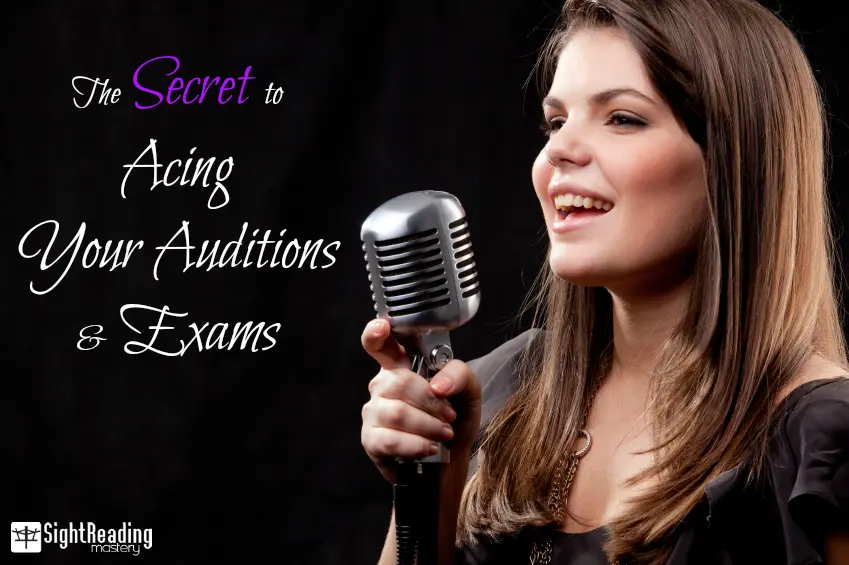
Ultimately, the secret to acing your auditions and exams is not found in luck or last-minute cramming, but in the systematic, daily mastery of the unknown. When you learn to welcome the unfamiliar score, you unlock the gate to your highest musical ambitions and set your true artistry free.