
Executive Overview
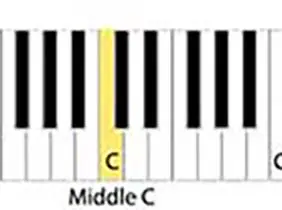
To millions of musicians worldwide, the journey of musical literacy begins at a single, unassuming ivory key. Commonly tuned to 256 Hz, identified scientifically as C4, classified as note number 60 in the MIDI protocol, and located squarely on the first fret of the second string on a guitar, Middle C is the indisputable anchor of Western music theory.
Yet, despite its ubiquitous title, Middle C is paradoxically named. It is not the literal center of an 88-key piano keyboard, nor is it situated mathematically in the middle of standard musical staves. Rather, its significance stems from its role as a master architectural keystone in music notation. It serves as the vital bridge connecting the Treble and Bass clefs, the foundational root note of the C major scale, and the universal starting point for generations of aspiring instrumentalists.
This report provides an authoritative exploration of Middle C. We will examine its acoustic properties, its historical and pedagogical dominance, its indispensable role in the Grand Staff, and its evolution into specialized "C Clefs" designed to accommodate the diverse ranges of orchestral instruments and human voices.
Detailed Chronology & Pedagogical Evolution
The history of Middle C is inextricably linked to the evolution of musical notation and keyboard pedagogy. As Western polyphony grew in complexity during the medieval and Renaissance periods, singers and instrumentalists required a standardized method to interpret pitch relative to a visual reference point.
The Genesis of Keyboard Education
When early keyboard instruments—such as the clavichord, harpsichord, and eventually the modern piano—were standardized, educators sought a logical baseline for teaching novices. The key of C major quickly emerged as the pedagogical gold standard. Because the C major scale contains no sharps or flats, it relies entirely on the white keys of the keyboard, making it the most visually and physically intuitive scale for human hands to navigate.
Consequently, the C located near the physical center of early multi-octave keyboards became the default home base. This conceptual "home" allowed students to orient their hands symmetrically, establishing foundational fingerings (such as the classic C major five-finger position) that persist in nearly every modern piano method book today.
The Standardization of Pitch
As musical eras shifted from the Baroque and Classical periods to the Romantic and Modern eras, the exact frequency of Middle C underwent significant standardization shifts. Today, while concert pitch is frequently anchored to A440 (where A above middle C is 440 Hz), Middle C is commonly calibrated to 256 Hz. This specific frequency is favored by acousticians and theorists because it is a power of two ($2^8$), making it mathematically harmonious and easy to divide across octave intervals.
Supporting Context & Metrics: Anatomy of a Note
To fully appreciate Middle C, one must examine its technical specifications across various musical domains and instrument families.
Technical Specifications Matrix
| Metric Domain | Designation / Location | Acoustic & Technical Details |
|---|---|---|
| Standard Piano Placement | 4th C from the left (5th C from the right) | Out of 8 on a standard 88-key keyboard. |
| Scientific Pitch Notation | C4 | Indicates it resides in the fourth octave of the scientific pitch scale. |
| MIDI Protocol | Note Number 60 | The standard digital integer assigned in electronic music systems. |
| Acoustic Frequency | 256 Hz (commonly tuned) | Aligned closely with mathematical powers of two for theoretical clarity. |
| Guitar Fretboard | 1st fret of the 2nd string (B string) | Produces the exact pitch when fretted. |
The Spatial Paradox: Why Is It Called "Middle"?
A persistent point of confusion for beginners is the physical placement of the note. On a standard 88-key piano, there are eight C notes in total. Therefore, no single C can be the absolute middle key. Furthermore, if one calculates the mathematical center of 88 keys, the midpoint actually falls between the E and F located just above Middle C.
So why maintain the moniker "Middle C"? The answer lies not in the physical geography of the piano, but in the cartography of sheet music: the Grand Staff.

The Grand Staff and the C-Clef Architecture
When looking at music notation in isolation, Middle C appears to defy its own name. On the Treble Clef staff, it is written on a ledger line just below the bottom staff line. On the Bass Clef staff, it sits on a ledger line just above the top staff line. Neither position occupies the five principal lines of either clef.
However, when these two staves are combined to form the Grand Staff—with the Bass Clef placed directly beneath the Treble Clef—the true nature of Middle C is revealed:
- The Crossover Point: The ledger line above the Bass Clef and the ledger line below the Treble Clef refer to the exact same pitch.
- The 11-Line Staff: If one conceptually merges those two ledger lines into a continuous staff, it creates an 11-line system where Middle C occupies the exact 6th line—the dead center of the graphical system.
Instrument Ranges and Clef Selection
Composers select clefs based on the natural tessitura (pitch range) of the instrument or voice they are writing for:
- Treble Clef: Utilized for instruments and voices residing primarily above Middle C (e.g., right hand of the piano, violin, flute, soprano voice).
- Bass Clef: Utilized for ranges residing primarily below Middle C (e.g., left hand of the piano, cello, bassoon, bass voice).
Beyond the Grand Staff: Alto and Tenor Clefs
Not all instruments fit neatly into the binary of "mostly above" or "mostly below" Middle C. Violas, trombones, and cellos often traverse ranges that would require excessive ledger lines if restricted to traditional treble or bass staves.
To solve this, music notation utilizes C Clefs—specifically the Alto and Tenor clefs—whose graphic symbols point directly to Middle C:
- Alto Clef: Positions Middle C on the middle (3rd) line of the staff. This is the primary clef for the modern viola.
- Tenor Clef: Positions Middle C on the 4th line up from the bottom of the staff, providing extended range below the note for instruments like the cello and bassoon.
Expert Perspectives & Pedagogical Insights
According to prominent music educator and author Ben Dunnett LRSM, founder of the Music Theory Academy, the enduring relevance of Middle C cannot be overstated:
"This particular note C is not only an excellent starting point for learning piano or general music theory, but is also a gateway or crossover note between the treble and bass clefs… Its positioning as a gateway note sitting neatly between the Bass and Treble Clefs in the Grand Staff means that it will always be of importance when understanding how to read music."
Music educators universally emphasize that while digital interfaces, tablature, and Nashville number systems continue to evolve, traditional staff notation anchored by C4 remains the lingua franca of formal music composition, orchestration, and academic analysis.
Future Outlook
As music education embraces hybrid models—integrating digital audio workstations (DAWs), MIDI controllers, and interactive learning software—the foundational concepts of music theory are adapting. In digital environments, Middle C retains its status as MIDI Note 60, serving as the default reference point for software synthesizers, hardware keyboards, and step-sequencers.
Looking ahead, the methods by which students encounter Middle C may diversify through virtual reality (VR) sheet music environments and AI-driven pedagogical tools, but the acoustic and visual centrality of the note will remain untouched. As long as humanity continues to notate music using staves and clefs, Middle C will endure as the ultimate navigational beacon—the quiet center around which the vast universe of musical expression revolves.