
Executive Overview
In the canon of modern jazz, few figures command as much reverence—or evoke as much tragic pathos—as pianist Bill Evans. His signature harmonic sophistication, delicate touch, and revolutionary approach to the piano trio format fundamentally reshaped twentieth-century music. Yet, beneath the sublime elegance of his recordings lay a harrowing personal narrative defined by grief, severe addiction, and compounding familial trauma.
Director Grant Gee’s award-winning docudrama, Everybody Digs Bill Evans, strips away the romanticized myths of mid-century cool to present a stark, unflinching portrait of an artist in freefall. Based on Owen Martell’s 2013 non-linear novel Intermission and adapted by screenwriter Mark O’Halloran, the film avoids the conventional cradle-to-grave biopic format. Instead, it zeroes in on the cataclysmic vacuum left by the 1961 death of bassist Scott LaFaro—a loss that plunged Evans into creative paralysis and accelerated a downward spiral of heroin addiction and relational decay.
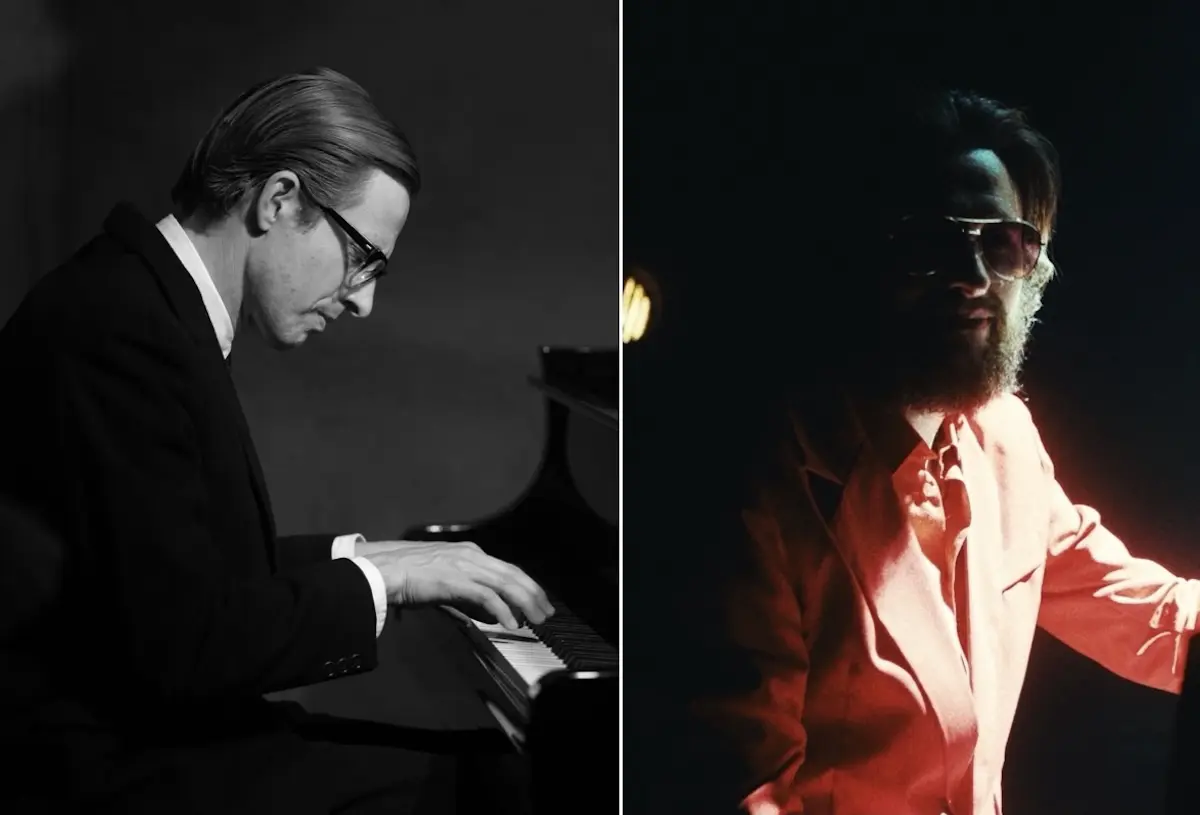
Winner of the Silver Bear for Best Director at the Berlin International Film Festival, Everybody Digs Bill Evans is an artistic triumph that utilizes high-contrast black-and-white cinematography by Piers McGrail, sparse dialogue, and an evocative score by Roger Goula. Rather than relying on a wall-to-wall soundtrack of Evans’s iconic discography, Gee uses silence as a structural motif, mirroring the pianist’s temporary loss of voice and the devastating toll of substance abuse.
With standout performances from Anders Danielsen Lie as Evans, Bill Pullman as Harry Sr., and Barry Ward as Harry Jr., the film transcends the standard music biopic. It emerges as a universal, bleakly poetic meditation on creativity, generational burdens, and the heavy price of genius.
Detailed Chronology: The Anatomy of a Breakdown
To understand the emotional geography of Everybody Digs Bill Evans is to trace a non-linear trajectory of mourning and self-destruction. The film deliberately fractures chronological time, reflecting the psychological fragmentation of its subject following a pivotal inflection point in American jazz history.
1961: The Village Vanguard and the Catalyst of Loss
The narrative anchors itself around a legendary June 1961 residency at New York’s Village Vanguard, featuring the definitive Evans trio lineup: Evans on piano, Scott LaFaro on bass, and Paul Motian on drums. This brief, incandescent moment of musical telepathy yielded two foundational jazz albums: Sunday At The Village Vanguard and Waltz For Debby (the latter named after Evans’s niece, Debby).
However, this creative peak was immediately shattered. Shortly after the Vanguard sessions, twenty-five-year-old Scott LaFaro was killed in a high-speed automobile accident. LaFaro was not merely a sideman; he was the architectural engine driving Evans’s nascent piano-trio revolution, pushing the dialogue between piano, bass, and drums into unprecedented realms of counterpoint. His death fundamentally broke Evans. It was not just the grief of losing a collaborator, but the paralyzing realization that the breakthrough he had fought for could never be replicated. Evans abruptly stopped playing the piano, entering a dark period of dormancy.
The Florida Interlude and Domestic Dissolution
Seeking refuge, a heroin-addicted Evans retreats to his parents’ home in Florida to undergo cold turkey withdrawal. It is here that the film exposes the latent fractures of the Evans family lineage. During a searingly uncomfortable sequence, Evans’s father, Harry Sr. (Bill Pullman), confesses to his recovering son that his own retirement was purchased through a lifetime of obsessive, soul-destroying toil—scrubbing his hands raw so as not to appear "uncouth" to his wife.
This domestic pathology finds echoes in the psychological friction between Bill and his loyal yet deeply envious brother, Harry Jr. (Barry Ward). While Harry Jr. provides brotherly devotion, his mind is warped by schizophrenia and a corrosive, unspoken resentment that Bill received all the artistic grace while he received none. The family dynamic is further illustrated through haunting vignettes: Evans’s mother, herself a talented pianist, abandoned the instrument because Harry Sr. could not resist drunkenly singing over her playing—a tragicomic motif visualized through drunken a cappella renditions of Londonderry Air.
The Flash-Forwards: 1973, 1979, and 1980
Departing from the monochrome texture of the primary narrative, Gee punctuates the film with three garish, technicolor flash-forward episodes that mark the ultimate milestones of the family’s destruction:
- 1973: The definitive break with his long-term partner and fellow addict, Ellaine Schultz (Valene Kane), culminating in her tragic suicide by jumping in front of a New York City subway train.
- 1979: The suicide of his brother Harry Jr., following a lifetime battle with schizophrenia and the suffocating shadow of Bill’s fame.
- 1980: Bill Evans’s own death in a New York hospital at the age of fifty-one, officially attributed to complications of lobar pneumonia, cirrhosis, and hepatitis resulting from decades of intravenous drug use.
Supporting Context & Metrics: Production, Style, and Critical Reception
Everybody Digs Bill Evans represents an unconventional international co-production that deliberately subverts the commercial expectations of music biometrics.
Production Metrics & Funding
- Runtime: 1 hour, 42 minutes.
- Production Entities: Hot Property Films, Cowtown Pictures, Over The Fence Films.
- Institutional Backing: Funded and supported by the British Film Institute (BFI) and Screen Ireland.
- Key Locations: Paradoxically for a story deeply rooted in modern American jazz lore, principal photography was predominantly executed in County Cork, Ireland, capitalizing on regional tax incentives and lending the film an understated, windswept Celtic aesthetic.
Stylistic Innovations
Director Grant Gee and cinematographer Piers McGrail deliberately avoided the stylistic tropes common to music documentaries and dramas. Recognizing that lengthy films about jazz icons frequently lean into sensationalism and romanticized notoriety, the filmmakers adopted a minimalist approach:
- Visual Contrast: The main body of the film is shot in stark, high-contrast black-and-white, evoking the classic photography of the Blue Note jazz era while stripping the scenes of comforting warmth.
- Color as a Disruptor: The three flash-forward sequences explode in garish, artificial color, signaling temporal dislocation and psychological ruptures.
- Acoustic Restraint: Rather than drowning the viewer in Evans’s familiar catalogue, the film exercises severe sonic discipline. Roger Goula’s evocative, modern score underscores the emotional weight without leaning on nostalgic pastiche, allowing the silence between notes to mirror the protagonist’s creative exhaustion.
Critical Acclaim
The film premiered to widespread critical acclaim on the European festival circuit, culminating in its triumph at the Berlin International Film Festival:
| Award / Festival | Category | Recipient / Status |
|---|---|---|
| Berlin International Film Festival | Silver Bear for Best Director | Grant Gee (Won) |
| BFI London Film Festival | Official Selection | Everybody Digs Bill Evans |
| Screen Ireland Showcase | Best Feature Drama | Nominated / Distributed by Screen Ireland |
Official Statements and Artistic Vision
The creative choices behind Everybody Digs Bill Evans reflect a conscious desire to deconstruct the myth of the "tortured genius." In interviews surrounding the film’s festival run, director Grant Gee articulated his intent to focus on the liminal spaces of an artist’s life rather than the public triumphs.
"We weren’t interested in making a Wikipedia entry set to music," Gee noted during a post-screening panel in Berlin. "Bill Evans is universally celebrated for the beauty of his chords, but beauty in art often demands an exorbitant human tax. We wanted to look at the quiet rooms, the sterile hotel stays, the difficult silences between brothers, and the crushing weight of a single moment of loss that stops a man’s universe in its tracks."
Screenwriter Mark O’Halloran, working from Owen Martell’s Welsh-language-adjacent literary sensitivities, emphasized the transnational resonance of the story. Despite being set in New York, Florida, and Paris, the film carries a distinctly Celtic melancholia—a thematic nod not only to the production’s Irish roots and Harry Sr.’s Welsh ancestry, but to a broader cultural tradition of articulating grief through song and self-medication.
Biographers and musicologists have long debated the complex personality of Bill Evans. While publicly perceived as mild-mannered, modest, and intellectually detached, those within his inner circle—including bassist Scott LaFaro—frequently chafed against his self-absorption and the isolating demands of his addiction. As the film illustrates through encounters with fans and family, Evans weaponized his modesty as a shield, deflecting praise for contemporaries like Miles Davis ("He’s a great musician") to avoid emotional intimacy and protect his fragile, chemically sustained equilibrium.
Future Outlook: The Enduring Legacy of the Evans Trio
While Everybody Digs Bill Evans closes on a note of undeniable tragedy—charting the eradication of a family through addiction, mental illness, and suicide—it leaves behind an assessment of artistic immortality.
The death of Scott LaFaro did not merely end a partnership; it fundamentally altered the trajectory of jazz history. Though Evans would eventually form subsequent, critically praised trios featuring bassists like Eddie Gomez and Chuck Israels, the frictionless telepathy achieved with LaFaro and Paul Motian at the Village Vanguard remained an unrepeatable lightning strike.
As the film demonstrates in its poignant coda, the jazz piano trio format was forever bifurcated into two eras: before the Vanguard recordings, and everything that came after, which could only ever measure itself against that brief, luminous standard.
For contemporary audiences, Everybody Digs Bill Evans serves as both a cautionary tale and a restorative masterclass. It reminds us that behind the effortless cascade of modal voicings and crystalline block chords lay a human being crushed by the unbearable weight of his own gifts. Yet, long after the last credits roll and the monochrome frames fade to black, the music—and the ghost of the man who played it—remains hauntingly, brilliantly alive.