
Executive Overview
As the autumn leaves begin to turn and school bells ring across the United States, a familiar ritual sweeps through middle schools, high schools, and collegiate theatre departments: the return of fall musical auditions. For young performers, the autumn semester represents a fresh slate—a chance to secure coveted roles, showcase newly developed vocal talents, and step into the theatrical spotlight. Yet, beneath the surface excitement of choreography workshops and monologue rehearsals lies a high-stakes ecosystem where careers are shaped and roles are won or lost in a matter of minutes.
While students frequently focus their preparation on vocal placement, acting choices, and character development, seasoned theatrical professionals understand that a truly successful audition begins long before a single note is sung. In fact, the trajectory of an audition is often established in the critical window before the performer even opens their mouth: the moment they hand their sheet music to the audition pianist.
Audition pianists are the unsung heroes of the theatrical casting process. Armed with little more than a keen ear, decades of training, and extraordinary sight-reading abilities, these musicians are tasked with interpreting unfamiliar scores on the fly, matching tempos, and supporting nervous performers through high-pressure routines. Earning their respect—and ensuring they have the clearest possible roadmap to guide your performance—is one of the single most effective strategies an aspiring actor can employ.
This comprehensive guide explores the mechanics of successful musical theatre auditions, drawing on firsthand professional experience from the trenches of the music director’s chair. We will examine the best practices for preparing audition cuts, analyze the etiquette of score presentation, address the ongoing debate surrounding digital sheet music versus traditional paper, and provide actionable insights curated from Broadway veterans and collegiate adjudicators. By mastering these foundational elements, young performers can eliminate friction in the audition room, foster a collaborative environment with their accompanist, and free themselves to focus on what truly matters: delivering a captivating performance.
Detailed Chronology: The Evolution of the Audition Room Experience
To fully understand the modern audition dynamic, it is helpful to trace how the interaction between performer, director, and accompanist has evolved over the past several decades. While the fundamental goal—finding the right talent for a role—remains unchanged, the technological and procedural landscapes of the audition room have shifted dramatically.
The Era of the Physical Score
Historically, the audition process was entirely analog. Performers carried bulky, leather-bound binders stuffed with photocopies extracted from vocal scores, anthology books, and handwritten arrangements. These binders—colloquially known as "audition books"—were meticulously organized with plastic sheet protectors, tape loops, and color-coded tabs.
When a performer entered the room, the physical handoff of the book was a ritualistic moment of communication. The actor would approach the piano, open the binder to the exact page, point out specific structural markings (such as starting and stopping points, dynamic shifts, and tempo changes), and establish eye contact. The pianist, scanning pages that had often been photocopied multiple times over, relied on tactile cues and immediate verbal communication to understand the cuts.
The Digital Disruption
In recent years, the proliferation of tablets, digital e-readers, and PDF sheet music libraries has transformed how performers store and transport their repertoires. For many students and young professionals, the iPad has replaced the traditional binder. In theory, digital sheet music offers limitless storage, immediate search capabilities, and the convenience of backlit screens in dimly lit holding areas.
However, the transition to digital in high-speed audition environments introduced a unique set of logistical challenges. Unlike a physical book, which can be instantly placed on any piano music rack and flipped by hand, a tablet requires specific hardware, power management, page-turning pedals, and—most importantly—compatibility with the accompanist’s workflow.
The Modern Hybrid Landscape
Today’s audition rooms operate in a nuanced hybrid space. While directors and casting teams encourage technological efficiency, the live acoustic environment of the piano remains stubbornly traditional. Pianists who are expected to sight-read dozens, sometimes hundreds, of songs in a single afternoon operate under extreme cognitive loads. Consequently, the industry has gravitated toward established best practices that prioritize clarity, ease of reading, and mutual respect between the artist and the accompanist.
Supporting Context & Metrics: Inside the Mind of the Audition Pianist
To appreciate why preparation matters so much, one must understand the unique pressures faced by the person sitting behind the piano.
Having spent years working professionally as a music director and theatrical pianist before transitioning into editorial leadership at Playbill, I have logged countless hours in audition rooms across the country. I know the difficulty of sight-reading audition cuts first-hand—literally.
The Cognitive Load of Sight-Reading
During a typical musical theatre casting call, an accompanist may be presented with up to one hundred different scores over the course of a single afternoon. Many of these scores will be unfamiliar arrangements, heavily edited cuts, or handwritten transpositions. Within a matter of seconds, the pianist must process:
- Key signatures and accidental-heavy passages that deviate from standard tonal expectations.
- Non-standard vocal rhythms created by actors breathing differently than the original recording artist.
- Abrupt cuts, codas, and structural jumps indicated by ambiguous markings on the page.
- The performer’s tempo cues, which are often communicated non-verbally through nervous energy or rushed physical movements.
When a score is poorly prepared—featuring messy handwritten notes, illegible cross-outs, or pages that are difficult to turn—the pianist’s cognitive load spikes. Instead of focusing on supporting the singer’s emotional and dynamic choices, the accompanist is forced to decode the sheet music in real-time. This can lead to missed cues, awkward transitions, and an overall loss of musical cohesion.
Best Practices for Score Preparation
To mitigate these risks and ensure a seamless collaboration, performers should adhere to a set of time-tested preparation standards:
- Keep It Clean and Legible: Ensure that your sheet music is printed clearly on standard white paper (8.5×11 inches). Avoid faint photocopies, faded ink, or pages covered in conflicting handwritten notes from previous coaches.
- Use Sturdy Physical Formatting: Loose papers are the enemy of the audition room. Use three-hole punched paper placed in a clean binder, or back-to-back pages securely taped together so they lay completely flat on the piano rack. Never hand a pianist loose, unclipped sheets of paper that are prone to sliding off the stand or blowing away.
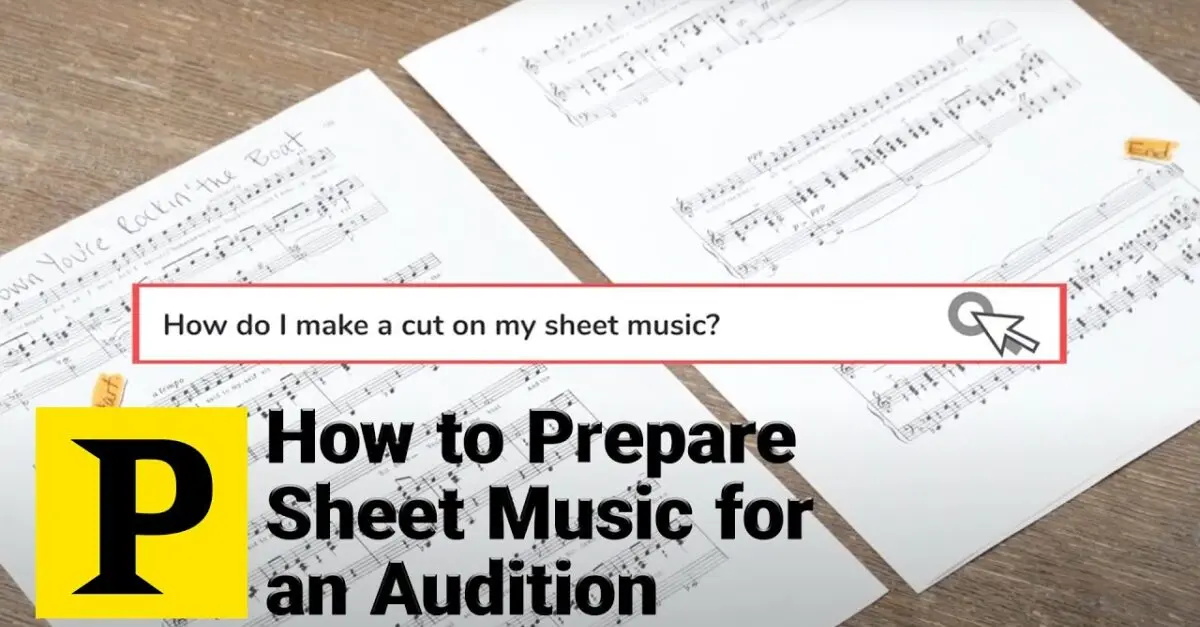
- Clearly Mark Cuts: If you are singing a 16-bar or 32-bar cut, make sure the starting and stopping points are unmistakably clear. Use a thick highlighter to outline the start of the cut and a bold double-bar line or explicit text ("Cut to measure 42") to indicate the end. Do not rely on verbal explanations alone once you reach the piano; point to the page clearly while explaining your intent.
- Provide Usable Transpositions: If you are singing in a key different from the published vocal score, ensure that your transposed sheet music is clean, accurate, and easy to read. Asking a sight-reading pianist to transpose a song on the fly by a third or a fourth while managing all other audition variables is an unnecessary gamble.
Official Guidelines & Expert Insights: Navigating Digital Music and Industry Wisdom
As the theatrical industry continues to evolve, specific protocols have emerged regarding equipment, etiquette, and preparation.
The Digital Dilemma: Why Paper Still Reigns Supreme
One extra tip that has become increasingly relevant in recent years concerns the use of digital devices in the audition room. While iPads and tablets are fantastic e-readers for sheet music in rehearsal settings, the audition room is an entirely different environment.
The process and even the equipment necessary to use digital tablets for auditions can be highly individual to each pianist. Some accompanists utilize Bluetooth page-turner pedals, while others rely on physical taps of the screen; some prefer vertical scrolling, while others require two-page side-by-side spreads. Expecting an audition pianist to adapt to a performer’s specific digital interface on a moment’s notice introduces unnecessary technical friction.
The Golden Rule: Unless an audition notice has explicitly and previously established a way to provide music to your pianist digitally (such as uploading PDFs to a secure casting portal in advance), always stick with physically printed music at auditions. Respecting the pianist’s preference for physical paper demonstrates professionalism and situational awareness.
Wisdom from Broadway Veterans and College Adjudicators
Preparation does not end with the sheet music. To provide young artists with a holistic toolkit for success, industry leaders across the country have shared invaluable insights into the casting process:
- The Broadway Perspective: Broadway’s top performers and music directors emphasize that confidence and adaptability are paramount. Knowing how to communicate your tempo effectively, trusting your accompanist as a collaborative partner rather than an employee, and maintaining composure when unexpected things happen are hallmarks of a seasoned professional. (Explore more insights from Broadway’s best in Playbill’s guide on audition books).
- The Collegiate Adjudicator Perspective: For students eyeing university theatre programs, college audition panels look for distinct qualities beyond raw vocal talent. Adjudicators evaluate coachability, emotional authenticity, and how well a student handles direction during a callback. (Read the definitive secrets to nailing your college audition in Playbill’s educational feature).
Future Outlook: The Next Generation of Musical Theatre Artists
As we look toward the future of theatrical education and professional casting, the standards of preparation and collaboration will only continue to rise. Programs across the United States are increasingly incorporating audition technique, music theory literacy, and accompanist etiquette directly into their curricula.
By teaching young performers to view the audition pianist not merely as a functional necessity, but as their primary musical ally in the room, educators are fostering a culture of mutual respect and artistic collaboration. When a singer steps up to the piano with a pristine, well-marked score, a clear tempo, and a gracious demeanor, they transform the dynamic of the audition room. The anxiety of the unknown dissipates, replaced by the shared joy of live music-making.
Whether you are stepping onto a middle school stage for your very first musical revue or preparing for collegiate showcases that will launch your professional career, remember that excellence lives in the details. Respect the room, master your materials, and let your preparation pave the way for your talent to shine.
For more essential advice, interviews, and features designed to help students and educators kick off the academic year, explore the complete collection of Playbill’s Back to School Week features.