

Executive Overview
For centuries, the classical and contemporary piano traditions have prioritized virtuosity, repertoire memorization, and emotional interpretation. Yet, lurking beneath the polished surface of conservatories, private studios, and living rooms across the globe is a systemic pedagogical failure: musicians who can effortlessly perform complex, multi-movement concertos from memory yet struggle to fluently read a basic, early-level beginner’s piece.
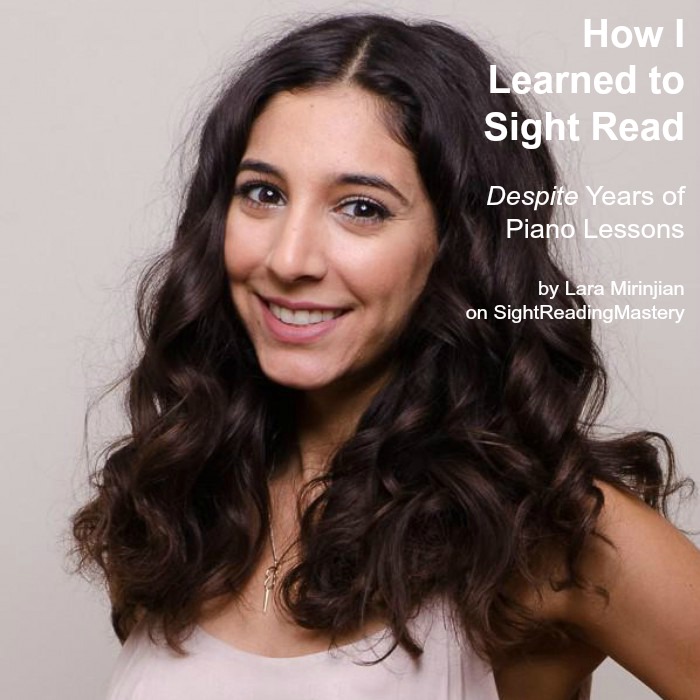
This paradox—where years of rigorous technical instruction fail to yield basic functional literacy at the keyboard—remains one of the most persistent issues in music education. Pianist, instructor, and sight-reading advocate Lara Mirinjian experienced this exact frustration firsthand. Despite dedicating over a decade to formal piano lessons, Mirinjian found herself unable to read fluently from a Level 1 method book. Her experience is far from anomalous; it is emblematic of a broader institutional blind spot.
Recent academic research and industry insights reveal that sight-reading is widely acknowledged as an indispensable musical competency, yet it is conspicuously absent from standard lesson plans. The root cause is twofold: traditional method books rarely provide structured instruction on how to teach sight-reading, and many educators themselves harbor anxieties stemming from their own deficient reading skills.
However, a paradigm shift is underway. By moving away from rigid, ad-hoc "methods" and pivoting toward universal pedagogical principles—such as starting with foundational material, prioritizing rhythm over perfection, and strictly limiting the number of times a piece is read—educators are witnessing exponential growth in their students. This investigative report explores the anatomy of the sight-reading crisis, the psychological and educational barriers keeping students trapped in a cycle of learned helplessness, and the step-by-step principles transforming musical literacy from the ground up.
Detailed Chronology: The Evolution of a Pedagogical Blind Spot
To understand how a student can spend ten years studying an instrument without achieving functional literacy, one must examine the historical trajectory of piano pedagogy.
The Era of Memorization and Rote Learning (Mid-to-Late 20th Century)
Historically, the democratization of piano lessons in the post-war era prioritized performance milestones. Parents and teachers measured progress by recital pieces mastered, competition ribbons won, and examinations passed. Consequently, piano instruction leaned heavily into rote learning and prolonged muscle memory acquisition.
Students would spend months polishing three or four pieces for an annual recital. While this produced exceptional technical execution for specific repertoire, it short-circuited the brain’s ability to process novel visual stimuli in real-time. Reading music became secondary to memorizing it. A student could play a Chopin nocturne through sheer tactile repetition, but place a simple, unfamiliar folk tune in front of them, and the cognitive machinery would grind to a halt.
The Realization of the Literacy Gap (The 2000s)
As music education entered the digital age, educators began comparing notes on student retention and autonomy. A troubling trend emerged: adult amateurs and advanced teens alike reported feeling paralyzed by new sheet music. They were dependent on recordings, video tutorials, or exhaustive, painstaking months of measure-by-measure decoding to learn a single piece.
It was during this period that pianists like Lara Mirinjian began publicly vocalizing the absurdity of the status quo. The realization that elite training programs were churning out musically illiterate instrumentalists sparked an internal reckoning within the private teaching community. Teachers began asking: Why are we treating sight-reading as an innate talent rather than a trainable, systemic skill?
The Methodological Awakening (Present Day)
In recent years, the emphasis has shifted from simply assigning repertoire to deconstructing the cognitive process of visual-to-auditory translation. Pioneers in the space—supported by digital learning platforms and specialized curricula like SightReadingMastery—began establishing empirical frameworks. Sight-reading was no longer viewed as a mysterious byproduct of playing the piano for a long time, but as a distinct, deliberate discipline requiring its own dedicated daily protocols.
Supporting Context & Metrics: What the Data and Experts Reveal
The crisis of sight-reading is not merely anecdotal; it is heavily documented by music education researchers who have surveyed the landscape of private and institutional instruction.
The Dickinson State University Study
A landmark study conducted by Dr. Dianne Hardy, Assistant Professor of Music Education and Piano at Dickinson State University, shed glaring light on why sight-reading instruction remains neglected. Dr. Hardy’s research investigated the methodologies—or lack thereof—employed by piano teachers regarding sight-reading development.
The findings were illuminating and sobering:
- Pedagogical Ignorance: The majority of teachers surveyed admitted that sight-reading was intentionally excluded from their core curricula simply because they did not know how to teach it.
- Deficient Method Books: Many instructors cited the absence of instructional frameworks within their chosen method book series. Traditional books often treat sight-reading as an afterthought—a quick, optional exercise at the bottom of a page rather than a progressive, foundational track.
- The "Osmosis" Fallacy: A significant portion of educators did not recognize sight-reading as an independent skill. They operated under the assumption that sight-reading would magically improve as a natural side effect of learning standard repertoire ("students will get better with more years of lessons").
- The Teacher’s Own Insecurities: Perhaps most revealingly, a subset of teachers confessed they avoided sight-reading instruction because they were inadequate sight-readers themselves, creating a multi-generational cycle of avoidance and anxiety.
The Psychological Barriers: ADD, Intimidation, and Overwhelm
For the student, trying to break through these barriers often triggers psychological roadblocks. Many learners struggle with focus issues, such as Attention Deficit Disorder (ADD), which makes the meticulous, slow-motion decoding of notation feel agonizing. Others are deeply intimidated by complex scores, leading to performance anxiety and the impostor syndrome common among adult learners who feel they "should" be further along.

When a student spends years staring at a page of music without unlocking its code, a sense of learned helplessness sets in. They begin to believe that sight-reading is an exclusive genetic gift—that you either "have the eye for it" or you don’t.
Official Statements and Pedagogical Principles: Shifting from Methods to Principles
As educational frameworks evolve, industry leaders emphasize that chasing endless, disjointed teaching "methods" is a trap. In the words of philosopher Ralph Waldo Emerson:
"As to methods there may be a million and then some, but principles are few. The man who grasps principles can successfully select his own methods. The man who tries methods, ignoring principles, is sure to have trouble."
Lara Mirinjian’s breakthrough occurred when she finally encountered a mentor who taught through universal principles rather than arbitrary routines. These principles are designed to strip away ego, eliminate the pressure of perfectionism, and retrain the brain’s visual-motor pathways.
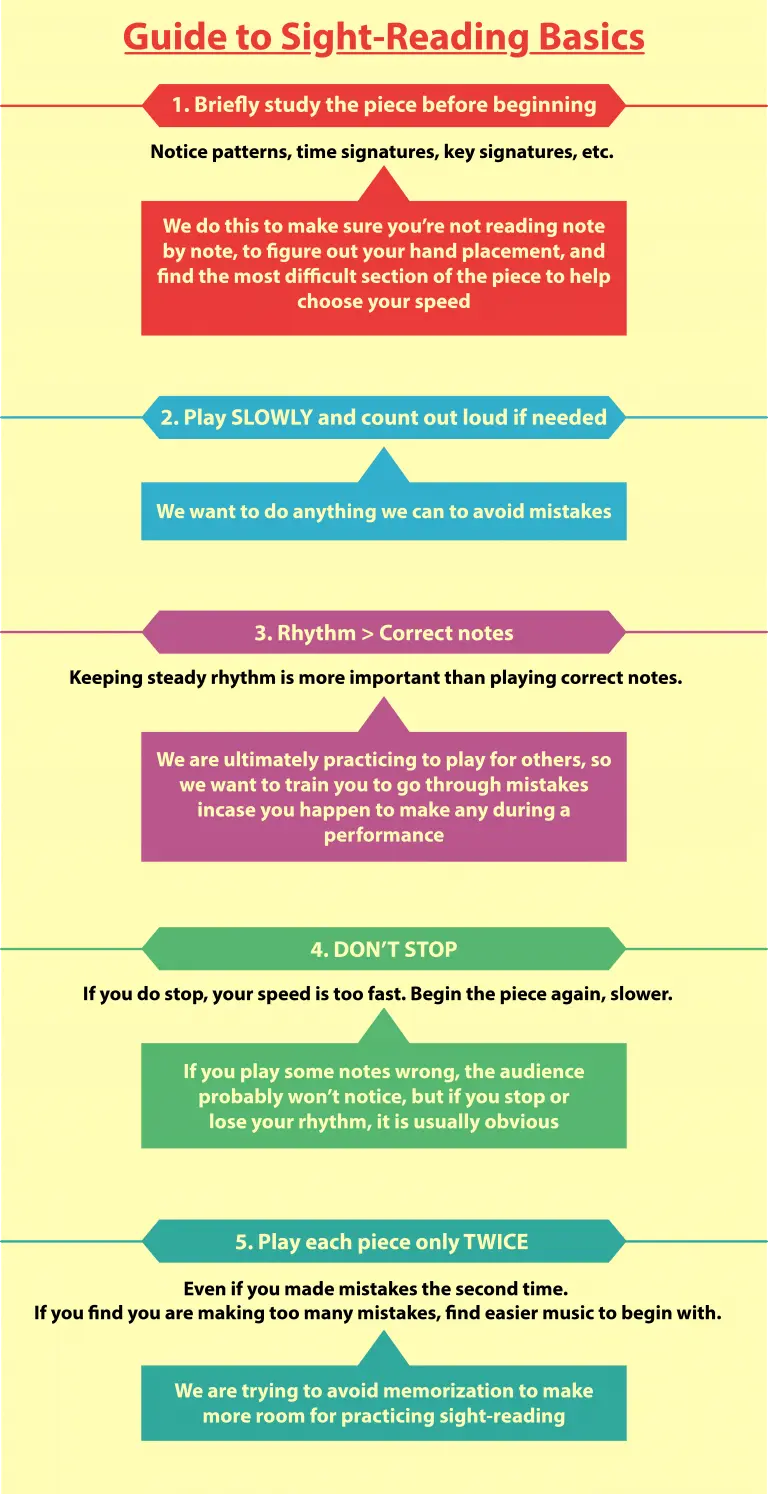
Core Principle 1: Drop Back to the Simplest Music
Whether a student is a raw beginner or an advanced diploma-holder preparing for concertos, true sight-reading development must begin with material that feels insultingly easy. If a player is stumbling over notes or rhythms, the music is too difficult for sight-reading practice. The brain cannot process new reading strategies if it is simultaneously bogged down by complex physical coordination.
Core Principle 2: The "Read-Twice" Rule
One of the most radical and essential rules of effective sight-reading practice is that a piece must be read only twice.
- First Read: The student surveys the patterns, establishes the tempo, counts out loud, and plays through the piece at an agonizingly slow, continuous pace. Mistakes are expected; stopping is forbidden.
- Second Read: The student plays the piece one final time, incorporating adjustments for any glaring errors made during the first run-through.
- Retirement: Once the second read is complete, the piece is retired. It is never practiced again. Returning to the same piece turns the exercise into a memory and repertoire drill, defeating the entire purpose of training the brain to process unfamiliar visual information.
Core Principle 3: Rhythm Reigns Supreme
In sight-reading, maintaining a steady pulse is infinitely more important than hitting every single correct note. Stopping to fix a wrong note breaks the temporal flow, teaching the brain that stuttering and hesitation are acceptable behaviors. The goal is an unbroken, albeit slow, rhythmic stream.

What This Looks Like in Practice: A Step-by-Step Methodology
To demystify how these principles translate to the bench, Mirinjian outlines a practical framework applicable to any instrument, utilizing an elementary "Middle C" exercise as a baseline model.
- Setup and Selection (Step 1): Place a piece of music well below your current technical level on the music stand or tablet. We begin with a foundational piece, such as a simple five-note pattern.
- Pattern Recognition (Step 2): Before playing a single note, scan the visual landscape. Identify repetitions, steps, and leaps. For instance, note if a pitch repeats three times, steps up to an adjacent line, or jumps across the staff. Recognizing geometric patterns on the page primes the brain for physical execution.
- Establish the Meter (Step 3): Identify the time signature and commit to counting aloud (e.g., 1, 2, 3, 4). Vocalizing the beat externalizes the rhythm and prevents the internal clock from collapsing during difficult transitions.
- Hand Placement (Step 4): Position your hands calmly over the keys corresponding to the starting notes without rushing into motion.
- Prepare for Uninterrupted Flow (Step 5): Cement the golden rule in your mind: Do not stop. If a note is missed, keep moving. If the reading speed makes the next note impossible to catch, abort, slow down the internal metronome, and return to the beginning of the piece at a reduced tempo.
- The First Execution (Step 6): Begin playing at an extreme, deliberate crawl, matching every note strictly to the counted beat ("One… Two… Three… Four…").
- The Magic Second Pass (Step 7): Play the exact same piece one final time. Integrate the visual feedback from the first run, correct micro-mistakes, and maintain the slow, steady pulse.
- Progression (Step 8): Move immediately to the next piece in your simplified collection, repeating the cycle.
For advanced players, this protocol shifts slightly: instead of struggling with basic note identification, the challenge becomes flawless execution of dynamics, articulation, phrasing, and stylistic nuances within micro-repertoire that requires zero technical strain.
Future Outlook: The Digital Frontier of Musical Literacy
As we look to the future of music education, the integration of technology and evidence-based pedagogy promises to dismantle the historic barriers surrounding sight-reading.
Platforms dedicated to progressive, bite-sized reading exercises are changing how students interact with sheet music. By gamifying the process and providing an endless supply of fresh, level-appropriate material, digital tools are helping students bypass the temptation to memorize and encouraging the discipline of the "read-twice" rule.
Furthermore, as higher education institutions begin to scrutinize the findings of researchers like Dr. Dianne Hardy, teacher training programs are slowly beginning to incorporate explicit sight-reading pedagogy into their curricula. The days of telling a struggling student that they will "just get better with time" are giving way to accountable, methodical, and empowering instructional frameworks.
For the millions of pianists who have stared at a score with a feeling of inadequacy, the message is clear: musical illiteracy at the keyboard is not a personal moral failing or an immutable genetic trait. It is a symptom of broken instructional habits. By embracing foundational principles, shedding the ego of advanced repertoire, and committing to the slow, steady, uninterrupted processing of simple music, any pianist can finally unlock the full, fluid language of the page.