
Executive Overview
In the fast-paced, high-stakes ecosystem of mid-1960s jazz, few pairings seemed as commercially and artistically inevitable—or as fraught with the pressures of overexposure—as the union of pianist Wynton Kelly and guitarist Wes Montgomery. Both stalwarts of the Verve Records stable, Kelly and Montgomery represented a formidable convergence of hard bop swing and accessible, soulful improvisation. When Verve paired them alongside the legendary rhythm section of bassist Paul Chambers and drummer Jimmy Cobb, expectations were stratospheric.
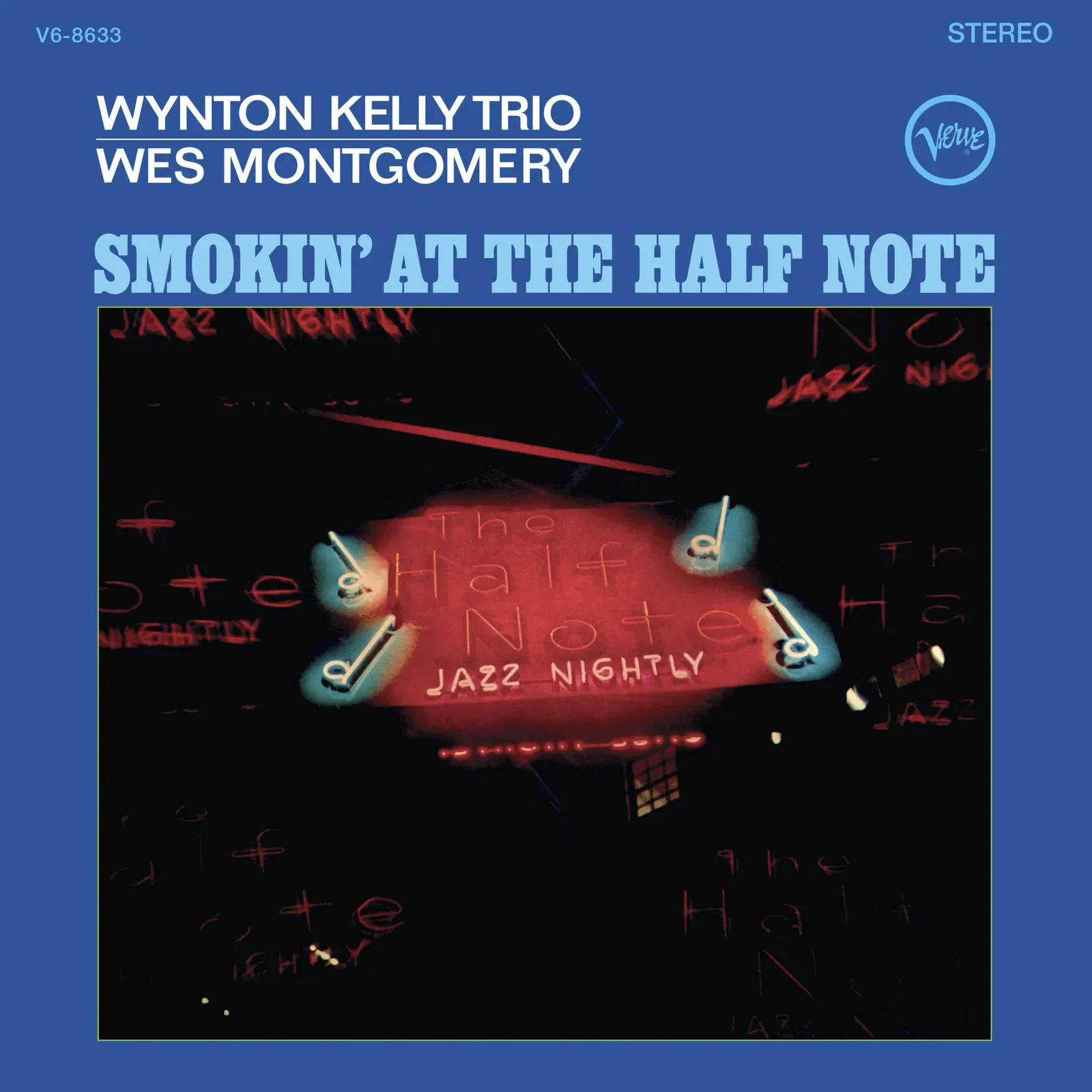
The resulting release, Smokin’ at the Half Note (Verve VLP 9118), has since cemented its place in jazz lore as a vital document of a powerhouse ensemble operating in a live club environment. However, a closer look at contemporary critical reception reveals a landscape far more complex than the hagiography that surrounds the album today. Contemporary critics wrestled with a profound paradox: while the musicianship was undeniably relaxed, unpretentious, and swinging, the material frequently suffered from a lack of genuine invention, reliance on well-worn clichés, and the creeping fatigue of artists caught in the relentless grind of the recording industry.
This retrospective and analytical review examines the anatomy of Smokin’ at the Half Note, exploring the dichotomy between its celebrated live pedigree and the reality of its studio-augmented tracklist. By dissecting the performances of Kelly, Montgomery, Chambers, and Cobb, we uncover how a combination of excessive touring, contractual obligations, and recycled repertoire threatened to dilute the brilliance of two generational talents. Yet, even amidst the repetitive phrasing and structural missteps, the record captures fleeting moments of combustible brilliance that continue to demand critical attention.
Detailed Chronology & Track Analysis
To understand Smokin’ at the Half Note is to understand its geography—or rather, the misleading nature of it. Despite the album title’s clear implication that the listener is receiving an uninterrupted snapshot of a live performance at New York City’s premier Greenwich Village jazz venue, the reality is a studio-and-live hybrid that highlights the era’s opportunistic production practices.
+-----------------------------------------------------------------------------------+
|                        ALBUM RECORDING TIMELINE & GEOGRAPHY                       |
+-----------------------------------------------------------------------------------+
|                                                                                   |
|  [ JUNE 1965 ]                                                                    |
|  Location: The Half Note Club, New York City, NY                                  |
|  Tracks Recorded: 'No Blues' (Miles Davis), 'If You Could See Me Now' (Tadd Dameron)|
|  Total Duration: Approx. 21.5 minutes (Side One)                                  |
|                                                                                   |
|                                       VS.                                         |
|                                                                                   |
|  [ SEPTEMBER 22, 1965 ]                                                           |
|  Location: Rudy Van Gelder Studios, Englewood Cliffs, NJ                          |
|  Tracks Recorded: 'Unit 7' (Sam Jones), 'Four On Six' (Wes Montgomery),           |
|                   'What’s New?' (Johnny Burke/Bob Haggart)                        |
|  Total Duration: Approx. 20.5 minutes (Side Two)                                  |
|                                                                                   |
+-----------------------------------------------------------------------------------+
Side One: The Half Note Residency (June 1965)
The album’s first side originates from the smoky confines of the Half Note Club in New York City, captured in June 1965. Here, the quartet—featuring the rhythm section that famously backed Miles Davis through his definitive mid-50s and early-60s period—attempts to capture the spontaneous electricity of a live club date.
The centerpiece of this side is Miles Davis’s modal blues composition, No Blues. Clocking in at nearly 13 minutes, the track is an ambitious undertaking that ultimately reveals the structural pitfalls of extended live jamming during this period. Rather than building toward a compelling climax, the marathon runtime forces both Wynton Kelly and Wes Montgomery to fall back upon stringing together predictable clichés. The momentum flags, and the listener is left navigating stretches of playing that feel more like endurance tests than inspired dialogues.
Following No Blues is Tadd Dameron’s gorgeous ballad, If You Could See Me Now. Wynton Kelly’s treatment of the material bears a striking and uncomfortable resemblance to his recording of the same tune on his previous solo effort, It’s All Right! (Verve VLP 9103). Including the identical tremolo introduction, Kelly’s arrangement feels less like a fresh interpretation and more like a carbon copy of a recent studio date. For jazz purists seeking spontaneous reinvention, the duplication raises troubling questions about the preservation of originality in an era of rapid-fire album production.
Side Two: The Van Gelder Studio Sessions (September 22, 1965)
Paradoxically, the album’s superior improvisational moments emerge not from the sweaty humidity of the Half Note, but from the sterile, acoustically pristine confines of Rudy Van Gelder’s legendary studio in Englewood Cliffs, New Jersey, recorded three months later in September.
Freed from the ambient noise and structural exhaustion of a late-night club set, the quartet sounds more focused. The standout performance of the entire package occurs on Wes Montgomery’s rhythm-changes vehicle, Four On Six. Here, Montgomery’s signature thumb-picked octave lines weave seamlessly through Kelly’s sparkling, blues-drenched comping, creating a dynamic interplay that justifies the album’s existence.
However, even the studio session is not without its eccentricities and miscalculations. Sam Jones’s Unit 7 attempts an awkward stylistic fusion, combining modal jazz frameworks with a bossa nova rhythmic undercurrent, while the front-line improvisations remain resolutely rooted in hard bop. The resulting stylistic friction feels like a strange, unresolved mixture.
Furthermore, the standard What’s New? suffers from a treatment that, even by 1965 standards, felt thoroughly antiquated. As critics of the era observed, the arrangement is distinctly "old hat," lacking the forward-looking vision that was beginning to redefine the jazz avant-garde.
Perhaps the most jarring misstep on Side Two occurs during Montgomery’s solo on If You Could See Me Now (recorded in the studio or embedded within the suite of performances), where drummer Jimmy Cobb unexpectedly shifts into a heavy chopping groove. This abrupt change in mood shatters the atmospheric tension built by the guitarist, utilizing a rhythmic device that had arguably worn out its welcome long before the mid-sixties.
Supporting Context & Metrics: The Verve Era and the Trap of Overexposure
To contextualize the artistic compromises found on Smokin’ at the Half Note, one must examine the macro-economic and industrial realities of the American jazz recording industry in the mid-1960s. Under the corporate umbrella of Verve Records (then presided over by Creed Taylor), artists were frequently subjected to a grueling cycle of production, touring, and cross-pollination.
+-----------------------------------------------------------------------------------+
|                           THE VERVE PRODUCTION PIPELINE                           |
+-----------------------------------------------------------------------------------+
|                                                                                   |
|   [ CONTRACTUAL OBLIGATION ] ---> [ RAPID RELEASE SCHEDULE ]                      |
|                 |                                                                 |
|                 v                                                                 |
|   [ ROUTINE COLLABORATIONS ] <-- [ CONSTANT CLUB TOURING ]                        |
|                 |                                                                 |
|                 v                                                                 |
|   [ CRITICAL SATURATION ]  ---> [ RECYCLED LICKS & CLICHÉS ]                      |
|                                                                                   |
+-----------------------------------------------------------------------------------+
During this period, both Kelly and Montgomery were locked into long-term recording contracts that demanded a steady stream of releases to satisfy a growing, yet fickle, consumer market. This relentless demand for product fostered an environment of overexposure. When jazz artists are thrust into the studio and onto the bandstand with relentless frequency, the well of immediate inspiration inevitably runs dry.
Even jazz royalty was not immune to this phenomenon. Thelonious Monk, a towering architect of modern harmony, had by 1965 reached a point in his career where his solos and compositions occasionally fell back on safe, highly self-referential patterns of repetition. If an iconoclast like Monk could be worn down by the machinery of the industry, it is little wonder that sideman-turned-leader Wynton Kelly and pop-jazz crossover specialist Wes Montgomery occasionally succumbed to formulaic playing.
Moreover, a critical examination of their respective discographies reveals that Smokin’ at the Half Note does not represent either artist operating at the absolute peak of their creative powers. True jazz aficionados of the era recognized a distinct bifurcation in quality:
- Wynton Kelly’s Definitive Work: The pianist’s most transcendent, pearls-of-wisdom recordings were captured during his tenure with Vee-Jay Records, where his trio work possessed an unmatched, effervescent vitality.
- Wes Montgomery’s Definitive Work: The guitarist’s most revolutionary, earth-shattering contributions to the instrument were forged under his seminal contract with Riverside Records, prior to his commercial pivot into smooth, orchestral-backed Verve pop-jazz productions.
When viewed through this lens, Smokin’ at the Half Note emerges as a transitional artifact—a snapshot of two masters caught in the crosshairs of commercial packaging, contractual duty, and the inevitable fatigue of the jazz life.
Official Statements and Critical Perspectives
The release of Verve VLP 9118 sparked a fascinating debate among contemporary jazz critics, illuminating the tension between commercial accessibility and critical artistic standards.
In a review published in the January 1965 issue of Jazz Journal, critic Gerald Lascelles astutely noted the repetitive tendencies bleeding into Kelly’s work, comparing his live performances unfavorably to his recent studio output:
"Admittedly Montgomery was not part of that performance, but Kelly’s treatment, including the tremolo introduction, is too close for comfort… Such results are inevitable when artists of limited ability are ridiculously over-exposed."
While labeling artists of Kelly and Montgomery’s stature as having "limited ability" was undeniably a harsh, polemical stroke reflective of the fierce critical gatekeeping of the era, it pointed to a broader truth recognized by observers: technical virtuosity alone cannot indefinitely sustain creative momentum in the absence of genuine compositional and improvisational risk-taking.
Subsequent evaluations from liner notes and retrospective retrospectives often frame the album through rose-tinted glasses, emphasizing the undeniable chemistry between the rhythm section and Montgomery’s thumb-driven pyrotechnics. Yet, honest appraisals continue to concede that the album is an uneven affair.
Prominent jazz historians have frequently pointed out that while the rhythm section of Paul Chambers and Jimmy Cobb provided arguably the most elastic, swinging heartbeat in jazz history—having driven the Miles Davis Quintet through its legendary 1958-1963 configurations—their familiarity with one another could occasionally breed a form of complacent autopilot. On Smokin’ at the Half Note, this telepathic communication sometimes manifested as a reliance on well-worn tropes rather than adventurous exploration.
Future Outlook: Legacy, Re-evaluation, and Archival Preservation
Decades after its initial pressing in 1965, Smokin’ at the Half Note occupies a curious, multi-layered position in the jazz canon. On one hand, it remains a beloved artifact for guitar enthusiasts and piano-trio aficionados who revere the warm, inviting tones of Montgomery and the buoyant, gospel-inflected touch of Kelly. On the other hand, it serves as a cautionary tale regarding the industrial commodification of improvised music.
As archival labels continue to dig deeper into the vaults of jazz history, releasing unedited club residencies and raw soundboard recordings, the mythos surrounding constructed live albums like Smokin’ at the Half Note is undergoing a profound evolution. Modern listeners and scholars are increasingly equipped to parse the difference between genuine, lightning-in-a-bottle club dates and studio-stitched marketing exercises.
+-----------------------------------------------------------------------------------+
|                        THE EVolution OF ARCHIVAL RECEPTION                        |
+-----------------------------------------------------------------------------------+
|                                                                                   |
|  1965: Commercial Release        --> Marketed as an authentic, continuous          |
|                                     live club experience at the Half Note.        |
|                                                                                   |
|  Late 20th Century: Canonization --> Hailed universally as a hard bop masterwork,   |
|                                     ignoring structural and geographic seams.     |
|                                                                                   |
|  Contemporary Era: Critical Nuance --> Viewed as a brilliant yet deeply uneven      |
|                                      hybrid shaped by commercial pressures.       |
|                                                                                   |
+-----------------------------------------------------------------------------------+
Looking forward, the legacy of this record invites a more sophisticated approach to jazz historiography—one that refuses to choose between uncritical celebration and outright dismissal. Instead, contemporary scholarship embraces the contradictions:
- Acknowledging the Flaws: Recognizing that prolonged tracks like No Blues suffer from structural bloat and clichéd resolutions.
- Celebrating the Sparks: Isolating and elevating the moments—such as Montgomery’s searing solo turns on Four On Six—where the playing genuinely catches fire.
- Contextualizing the Era: Understanding how corporate record labels, grueling tour schedules, and market saturation shaped the artistic output of mid-century masters.
Ultimately, Smokin’ at the Half Note stands as a mirror reflecting the triumphs and the trials of the jazz life in 1965. It reminds us that even when titans stumble, rely on old habits, or find themselves hamstrung by the assembly line of production, the residual glow of their genius is bright enough to cut through the smoke.