
DATELINE: PRAGUE / DRESDEN / ROME — JULY 22, 2026
Executive Overview
In a landmark contribution to early music scholarship and performance, the Czech-German period-instrument ensemble Ensemble Rýnský has released the first-ever complete recording of Ignazio Albertini’s Sonatinae XII Violino Solo. Published posthumously in Vienna in 1692—five years after the composer’s violent and mysterious death—this sole surviving collection represents the sum of Albertini’s known musical legacy. Released by the Italian boutique label Da Vinci Classics, the double-album project bridges a vital musicological gap, bringing long-neglected Baroque repertoire out of historical obscurity and into the contemporary concert hall.
Led by Baroque violin virtuoso Vojtěch Jakl, Ensemble Rýnský approaches the Sonatinae not as dusty antiquarian relics, but as intensely dramatic, emotionally volatile masterworks. Supported by a flexible, richly textured basso continuo section, Jakl and his colleagues illuminate the unique crossroads of Albertini’s art: the dazzling, pyrotechnic freedom of the seventeenth-century Italian violin school colliding head-on with the rigorous, intellectual counterpoint of Central Europe.
Available worldwide as a physical compact disc and across major digital streaming platforms—supplemented by an exhaustive digital booklet featuring scholarly essays and archival notes—this release marks a watershed moment for seventeenth-century violin performance practice. It invites modern listeners to reconsider the rapid evolution of solo string writing in the decades immediately preceding the era of Corelli and Vivaldi.
Detailed Chronology
To understand the significance of the Sonatinae XII Violino Solo, one must retrace a timeline spanning more than three centuries, punctuated by geopolitical upheaval, mysterious violence, and painstaking musicological detective work.
The Seventeenth Century: Vienna and the Imperial Court
- c. 1644: Ignazio Albertini is born, likely in or near Milan, Italy, immersing himself in the burgeoning virtuoso violin traditions championed by pioneering Lombard and Venetian masters.
- 1670s: Albertini relocates north of the Alps, establishing himself within the vibrant musical ecosystem of Vienna. During the reign of Emperor Leopold I—an enthusiastic composer and patron of the arts—the Habsburg imperial court serves as a magnetic focal point for Italian musicians seeking lucrative posts.
- 1680s: Albertini secures a prestigious position in Vienna, though his volatile temperament and professional rivalries occasionally draw him into dangerous social circles.
- September 22, 1685: Albertini meets a tragic and untimely end. While walking in Vienna, he is assassinated under mysterious circumstances. Historical records hint at personal vendettas or court intrigue, cutting short a brilliant creative trajectory at roughly forty-one years of age.
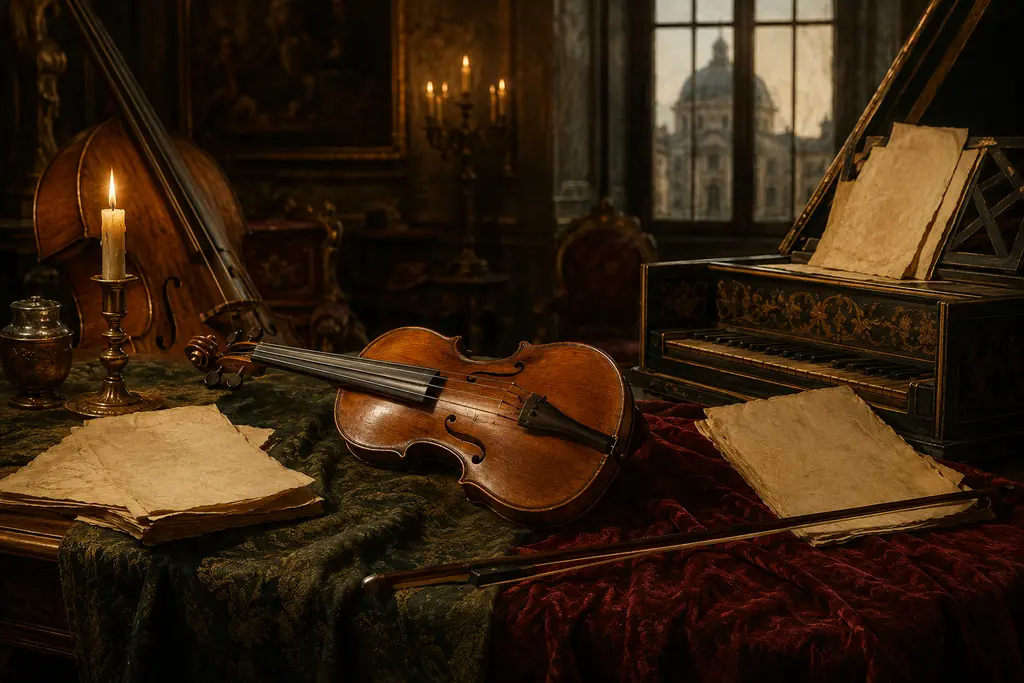
- 1692: Recognizing the value of his fallen colleague’s musical literary remains, an unknown editor or surviving family member oversees the publication of Albertini’s Sonatinae XII Violino Solo in Vienna. Printed posthumously, this collection becomes the solitary monument to his compositional voice.
The Modern Revival: From Archive to Ensemble
- Late 20th Century: Musicologists studying seventeenth-century Austrian court music recognize Albertini’s twelve sonatas as crucial missing links in the evolution of the unaccompanied and lightly accompanied violin. However, performance remains sporadic, hindered by the lack of a definitive, modern performing edition and the immense technical demands of the writing.
- Early 2020s: Vojtěch Jakl and members of Ensemble Rýnský begin conceptualizing a comprehensive recording project. Recognizing that previous recordings have only sampled a few sonatas from the set, they resolve to record all twelve, aiming to capture the structural arc and emotional range of the complete cycle.
- 2024–2025: Extensive rehearsals take place across cultural hubs in the Czech Republic and Germany. The ensemble experiments with various configurations of the basso continuo—incorporating theorbo, harpsichord, baroque cello, and violone—to provide rich harmonic coloration that reacts dynamically to Jakl’s solo lines.
- July 22, 2026: Da Vinci Classics officially releases Sonatinae XII Violino Solo globally on CD and digital formats, accompanied by a comprehensive multimedia release strategy.
Supporting Context & Metrics
The survival of Albertini’s music against the odds of history is a statistical and cultural anomaly. Most instrumental music from the pre-Corellian Habsburg court was lost to fire, war, or the natural degradation of paper. That a complete set of twelve solo violin sonatas survived intact makes the Sonatinae a priceless artifact for music historians.
Structural Anatomy of the Sonatinae XII
Albertini’s collection defies simple categorization. Unlike the standardized four-movement sonata da chiesa (church sonata) or sonata da camera (chamber sonata) that would dominate the late Baroque, Albertini’s twelve works are multi-sectional mosaics.
| Metric / Feature | Description within the Album |
|---|---|
| Total Sonatas | 12 distinct works, each exhibiting a unique character profile. |
| Instrumentation | 1 Baroque Violin; variable basso continuo (harpsichord, theorbo, baroque cello). |
| Stylistic Fusion | Synthesis of Italian improvisatory brilliance (scordatura hints, rapid shifts) and German/Austrian polyphony. |
| Form | Multi-sectional (often 4 to 7 continuous contrasting tempos and meters per sonata). |
| Aural Scope | Ranging from introspective, brooding laments to exuberant, dance-infused allegros. |
The Geographic and Cultural Bridge
Albertini’s career exemplifies the "Italian migration" into Central Europe—a cultural phenomenon that fundamentally shaped the soundworlds of Vienna, Salzburg, and Prague. While masters like Heinrich Ignaz Franz Biber (himself of Bohemian birth, deeply influenced by Italian trends) explored the extreme expressive boundaries of the violin, Albertini brought an authentic southern European warmth, vocal lyricism, and rhetorical eloquence to the Austrian capital.
The Sonatinae showcase a violin language on the cusp of transformation. Double-stops, shifting harmonic tensions, and recitative-like vocal declamations demand an instrumentalist who is not merely technically proficient, but deeply versed in seventeenth-century rhetorical performance practice—a challenge met head-on by Vojtěch Jakl.
Official Statements
The release of Sonatinae XII Violino Solo has generated significant commentary within the international early music community. Representatives from Da Vinci Classics, alongside artistic leads from Ensemble Rýnský, have shared insights into the conceptualization and execution of this monumental recording project.
Vojtěch Jakl, Baroque Violinist and Artistic Director of Ensemble Rýnský, reflected on the physical and emotional journey of mastering the score:
"Playing Albertini is like walking a tightrope across a seventeenth-century abyss. You have moments of breathtaking, unbridled Italian freedom where the violin sings like an opera soprano, instantly followed by dense, labyrinthine counterpoint that requires the intellectual rigor of a German organist. Recording all twelve sonatas in sequence wasn’t just an exercise in endurance; it was an act of archaeological excavation. We had to let the architecture of each piece dictate our continuo realization, ensuring that every shift in mood—from playful buoyancy to profound, existential melancholy—resonated with absolute authenticity."
A spokesperson for Da Vinci Classics issued a statement regarding the label’s commitment to rescuing neglected masterpieces:
"At Da Vinci Classics, our mission has always been to look beyond the standard, well-trodden repertoire and shine a light on historical blind spots. Ignazio Albertini represents one of the most compelling ‘what-ifs’ in music history. His life was cut tragically short, but his music burns with an intensity that rivals any of his more famous contemporaries. In releasing this complete recording by Ensemble Rýnský, we are proud to restore a missing cornerstone to the Baroque violin discography, offering listeners a chance to experience a brilliant voice that refused to be silenced by time."
Musicological consultants involved in the digital booklet production emphasized the historical weight of the 1692 publication:
"To hold a copy of the 1692 print is to touch a ghost. Albertini was murdered in the prime of his life, and had it not been for the dedication of those who collected his papers after his death, his entire creative output would have vanished into the archives of oblivion. Ensemble Rýnský’s recording honors that fragile legacy with rare intelligence, precision, and visceral power."
Future Outlook
The launch of Sonatinae XII Violino Solo is expected to catalyze a broader reassessment of pre-Corellian violin repertoire in European and North American concert programming. For decades, violinists seeking to explore seventeenth-century literature gravitated almost exclusively toward Biber, Johann Heinrich Schmelzer, and Arcangelo Corelli. With Ensemble Rýnský bringing Albertini’s complete cycle into the digital and physical marketplace, programmers and performers now have an authoritative, highly polished reference recording to draw from.
Upcoming Initiatives
- Live Concert Series: Ensemble Rýnský has announced plans for a European tour through late 2026 and 2027, bringing the Sonatinae to historic churches and concert halls in Prague, Vienna, Dresden, and Milan.
- Educational Outreach & Masterclasses: Vojtěch Jakl will lead a series of masterclasses focusing on seventeenth-century ornamentation, rhetoric, and basso continuo realization at select European conservatories, utilizing the new Da Vinci release as core curriculum.
- Future Recordings: Buoyed by the success of the Albertini project, Ensemble Rýnský is currently exploring other neglected Central European manuscript collections from the late seventeenth century, with announcements regarding future Da Vinci Classics collaborations anticipated in early 2027.
As early music ensembles continue to push the boundaries of historical awareness, the rediscovery of Ignazio Albertini serves as a powerful reminder that the narrative of classical music is vast, multifaceted, and still capable of delivering profound surprises. Through the combined vision of Da Vinci Classics and Ensemble Rýnský, a voice silenced in Vienna over three centuries ago now rings clear across the modern world.