
Executive Overview
The transatlantic theatrical pipeline has delivered countless hits to New York stages over the decades, but few recent imports arrive with the sheer acoustic momentum, critical acclaim, and structural uniqueness of The Curious Case of Benjamin Button. Following a triumphant run in London’s West End that culminated in a prestigious Laurence Olivier Award for Best New Musical in 2025, the critically lauded production is poised to make its highly anticipated North American premiere.
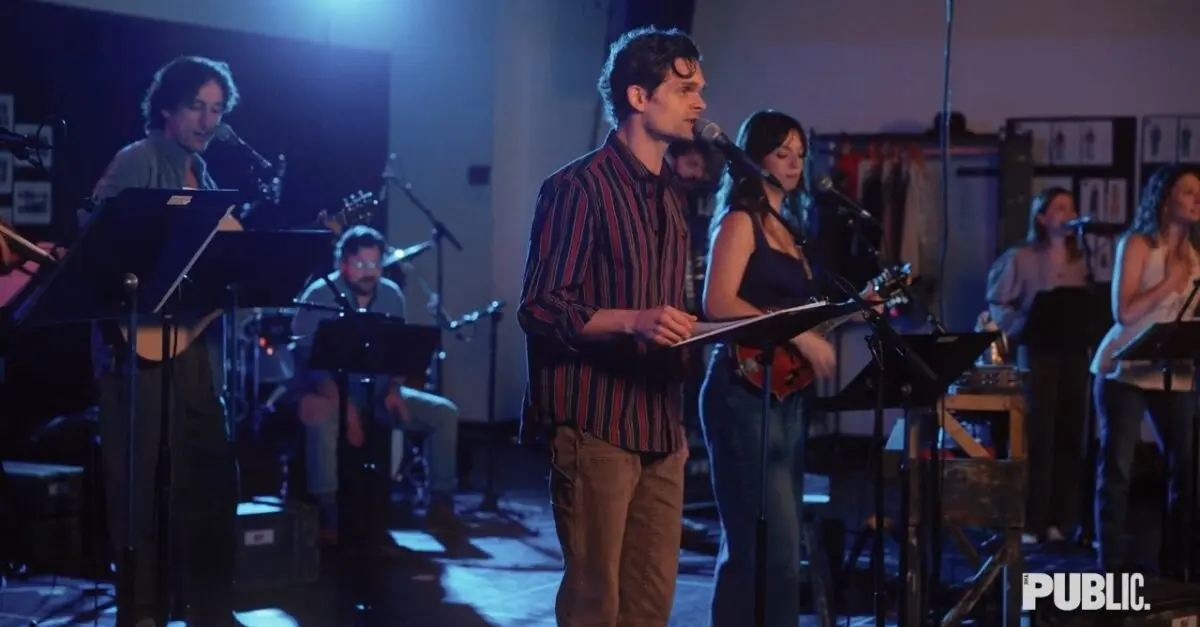
Ahead of its first public performance, the creative and performing company has offered a tantalizing glimpse into the rehearsal room. In a newly released video produced by Fly’s Eye Films—with pristine audio engineering provided by Silver Sound and Front Stage Sound—the actor-musician ensemble performs a four-song medley that captures the earthy, folk-infused sonic landscape of the show. This exclusive preview highlights not only the vocal prowess of the cast but also their instrumental versatility, a cornerstone of the production’s distinctive aesthetic.
Set to begin performances on October 8 ahead of an official opening night on October 21, the limited engagement will occupy the Public Theater’s Newman Theater. Due to overwhelming early demand, the run has already been extended through November 22, signaling a robust appetite among New York theatergoers for daring, original musical storytelling.
At the helm of this sprawling, century-spanning narrative is Tony Award nominee Andrew Durand (Dead Outlaw), who steps into the titular role of Benjamin Button alongside Reverthi. He is joined by an exceptionally talented ensemble of actor-musicians, including Kelsee Kimmel as Elowen Keene and Sterenow, Britney Coleman as Gwyns, and a dynamic supporting company that blurs the lines between traditional performance and live instrumental execution.
Adapted from F. Scott Fitzgerald’s legendary 1922 short story, the musical relocates the surreal premise of a man aging in reverse from Baltimore to a moody, coastal Cornish fishing village. With a book by Jethro Compton, and a score featuring music by Darren Clark and lyrics by Clark and Compton, this Olivier-winning triumph promises to challenge, move, and captivate New York audiences. As rehearsals enter their final, feverish weeks, the production stands as one of the most compelling theatrical events of the autumn season.
Detailed Chronology: From Fitzgerald’s Pen to the West End and Beyond
To understand the magnitude of The Curious Case of Benjamin Button arriving at the Public Theater, one must trace a theatrical journey that spans over a century of literary history and nearly a decade of developmental grit.
The Literary Genesis and Cinematic Precedent
F. Scott Fitzgerald published The Curious Case of Benjamin Button in Collier’s magazine on May 27, 1922, later including it in his short story collection Tales of the Jazz Age. Inspired by a remark from Mark Twain—who once quipped that it is a pity the best part of life comes at the beginning and the worst at the end—Fitzgerald crafted a satirical, melancholy fable about a man born in 1860 with the physical constitution of an 70-year-old man, who progressively grows younger as the decades roll by.
For decades, the property was deemed notoriously unadaptable for the stage. While David Fincher’s celebrated 2008 film adaptation starring Brad Pitt utilized cutting-edge digital effects to tell the story on a cinematic canvas, the theatrical creators chose a vastly different, more organic route: human ingenuity, acoustic instrumentation, and theatrical metaphor.
The Southwark Playhouse Incubator (2019)
The musical adaptation was born out of a desire to strip away Hollywood gloss and return to the raw, communal roots of storytelling. Conceived by writer-director Jethro Compton and composer-lyricist Darren Clark, the show premiered in 2019 at London’s Southwark Playhouse. Operating on an intimate scale, the production immediately turned heads. Critics praised its ability to evoke profound emotional resonance through simple theatrical devices, utilizing a cast of actor-musicians who doubled as the show’s physical orchestra.
The Pandemic Pause and West End Triumph (2024)
Like much of the global performing arts sector, the production’s momentum was temporarily halted by the COVID-19 pandemic. However, Compton and Clark used the downtime to refine the book, expand the score, and deepen the character arcs.
When the production returned in an expanded, reimagined form, it transferred directly to London’s West End, opening at the Ambassadors Theatre in 2024. The West End transfer was an unmitigated triumph, winning over critics and audiences alike with its sweeping melodies, Celtic-infused folk arrangements, and breathtaking stagecraft. The journey culminated at the 2025 Laurence Olivier Awards, where The Curious Case of Benjamin Button captured the coveted prize for Best New Musical, cementing its status as a modern British classic and setting the stage for its inevitable international export.
Supporting Context & Metrics: The Anatomy of a Transatlantic Transfer
Bringing a sprawling actor-musician musical across the Atlantic is a logistical and artistic feat. The production metrics and creative choices underpinning the Public Theater staging reveal a meticulous dedication to preserving the soul of the original London production while adapting it for a discerning New York audience.
The Creative Engine Room
Jethro Compton returns not only as the show’s book writer and director but also as its scenic designer. By retaining creative control over both the visual world and the narrative pacing, Compton ensures that the Cornish coastal atmosphere remains palpable. He has reassembled his entire core London creative team for the U.S. bow:
- Choreography: Chi-San Howard, whose movement direction seamlessly blends period-specific folk dance with the physical manifestations of aging in reverse.
- Music Supervision & Orchestrations: Mark Aspinall, who shares orchestration duties with Darren Clark, ensuring that the actor-musicians navigate the complex score with acoustic clarity.
- Costume Design: Anna Kelsey, tasked with the dizzying challenge of outfitting characters across nearly a century of shifting historical eras.
- Lighting Design: Zoe Spurr, who evokes the moody, shifting light of the Cornish coast and the passage of decades.
- Sound Design: Luke Swaffield for Autograph Sound, a critical component given that every note, stomp, and acoustic strum on stage must be balanced with absolute precision.
The Ensemble Cast of Actor-Musicians
Unlike conventional musicals where actors sing over a hidden pit orchestra, The Curious Case of Benjamin Button relies on its ensemble to double as its musical accompaniment. Guiding this talented troupe is Tony nominee Andrew Durand, fresh off his acclaimed work in Dead Outlaw. Durand takes on the physically and emotionally demanding dual role of Benjamin Button and Reverthi, anchoring the narrative spine of a man watching his life unfold backward while everyone he loves moves forward in linear time.
He is joined by Kelsee Kimmel as Elowen Keene and Sterenow, playing the emotional anchor against whom Benjamin’s reverse aging plays out. The company is rounded out by a stellar roster of performers who seamlessly transition between dramatic acting, vocal harmony, and instrumental execution:
- Britney Coleman as Gwyns
- Trevor Lindley Craft as Morlan
- Brandon J. Ellis as Tewes
- Katie Horner as Treth
- Sachiko Mae as Avoryow
- Morgan Morse as Tonnow
- Kris Saint-Louis as Lanow
- Claire-Frances Sullivan as Ebron
- Matt Wolpe as Tir
- Swings: Jo Brook, Casey Martin Klein, Lauren Jeanne Thomas, and Spiff Wiegand
Production Timeline & Venue Metrics
- Venue: The Newman Theater at The Public Theater (New York City).
- First Performance: October 8.
- Official Opening Night: October 21.
- Initial Closing Date: November 22 (following a pre-opening extension due to high ticket demand).
- Ticketing: Available exclusively via PublicTheater.org.
Official Statements & Rehearsal Room Insights
The release of the rehearsal room footage—captured by Fly’s Eye Films with audio production by Silver Sound and Front Stage Sound—offers a rare window into the rigorous preparation required for an actor-musician-heavy show. In the preview video, the cast gathers around microphones in a sunlit New York rehearsal studio, stripped of period costumes and elaborate scenic elements, yet radiating palpable chemistry.
Darren Clark’s score, heavily influenced by traditional British folk music, sea shanties, and soaring theatrical anthems, fills the room with rich acoustic layers. Fiddles, accordions, guitars, and percussion instruments are handled fluidly by the actors themselves, reinforcing the central thesis of the production: that music, much like memory, is something we carry within our own bodies.
Speaking on the transition from London to New York, director and writer Jethro Compton has emphasized the Public Theater’s alignment with the show’s artistic ethos. "The Public has a storied history of housing bold, formally adventurous works that refuse to neatly fit into commercial boxes," production insiders note. "Bringing Benjamin Button to this institution feels like a homecoming for a piece that values storytelling craftsmanship above all else."
Andrew Durand, preparing to take on one of the most physically demanding roles in contemporary musical theater, approaches the character not as a special effect, but as a deeply human exploration of time’s paradox. "Benjamin’s curse is that he remembers the future and is blind to the past," Durand has shared in early discussions regarding the rehearsal process. "Finding the emotional truth of a man who is getting younger while his world gets older requires us to lean entirely into the live, acoustic vulnerability of this company."
Future Outlook: What the North American Premiere Signals for Broadway and Beyond
As The Curious Case of Benjamin Button prepares to take its first bows at the Public Theater on October 8, the broader theatrical landscape is watching closely. Transatlantic transfers are notoriously unpredictable; properties that capture the specific cultural zeitgeist of London’s West End do not always effortlessly translate to the sensibilities of New York audiences.
However, several factors position this production for sustained success. First, the pre-opening extension through November 22 demonstrates that institutional subscribers and individual ticket buyers are already voting with their wallets. Second, the actor-musician genre—while historically more common in Off-Broadway and regional venues—has experienced a wave of enthusiastic reception in recent years, as audiences increasingly crave transparent, unpretentious musicianship over synthesized backing tracks.
Furthermore, the show’s Olivier Award win provides undeniable institutional momentum. It enters the New York market not as an untested experiment, but as a proven critical darling equipped with the hardware to back up its ambitions.
Should the Public Theater run resonate as deeply with New York critics as it did with their London counterparts, industry speculators will inevitably begin whispering about a subsequent commercial Broadway transfer. For now, however, the focus remains squarely within the Newman Theater, where a Cornish fishing village brought to life by actor-musicians awaits its American audience.
Tickets and information for the strictly limited engagement can be accessed directly at PublicTheater.org. As the leaves turn in New York and the opening night countdown reaches its final days, The Curious Case of Benjamin Button stands ready to remind theatergoers that time may march in only one direction, but art can bend it entirely to its will.