
This investigative report, originally published on September 17 at 1:00 PM, has been comprehensively updated as of 4:25 PM following subsequent legal interventions, court filings, and escalating public demonstrations.
Executive Overview
The iconic John F. Kennedy Center for the Performing Arts—long celebrated as the living national memorial to the 35th president and a premier hub for American culture—has become the epicenter of an extraordinary constitutional and physical showdown. At the heart of the crisis is a high-stakes standoff between the federal judiciary, congressional oversight, and a relentless campaign by President Donald Trump to affix his name and legacy to the historic institution.
What began as a contentious administrative takeover has swiftly devolved into an unprecedented clash involving federal court injunctions, withheld Congressional appropriations, threats of total demolition, and sudden facility closures that have locked out the public and silenced performances.
Following a series of incendiary remarks in which President Trump warned that the landmark building would be "ripped down" unless his demands for prominent administrative recognition were met, federal judges have stepped in to curb executive overreach. Yet, despite mounting judicial pushback and emergency legal motions filed by lawmakers, the future of the nation’s cultural capital remains perilously uncertain.
This report provides an exhaustive examination of the escalating crisis, detailing the chronology of events, the legal battles unfolding in the U.S. District Court for the District of Columbia, the financial levers being pulled by the executive branch, and the broader implications for the arts community nationwide.
Detailed Chronology: From Boardroom Takeover to Courthouse Injunctions
The Trump Administration Takeover and Initial Modifications
The roots of the current crisis trace back to last year, when the Trump administration executed a sweeping reorganization of the Kennedy Center’s leadership, appointing a slate of loyalists to the institution’s Board of Trustees. With President Trump installing himself as chairman of the board, the newly reconstituted leadership moved swiftly to reshape the physical and symbolic identity of the memorial.
In December 2025, workers erected signage placing President Trump’s name prominently on the Kennedy Center facade—directly above the name of President John F. Kennedy. Concurrently, the board announced plans to shutter the institution for a two-year renovation period starting in July 2026.
These moves immediately triggered fierce legal opposition. U.S. Representative Joyce Beatty, a former Kennedy Center Board Member, spearheaded a lawsuit alongside advocacy groups to challenge the legitimacy of the closure and demand the removal of the unauthorized signage.
Judicial Intervention and the Battle Over Signage
In subsequent rulings, U.S. District Judge Christopher Cooper intervened decisively, ruling that the Center "cannot install memorials for President Trump or anyone or anything else at the Kennedy Center without Congress’s blessing." Judge Cooper ordered the removal of Trump’s name from the primary facade.
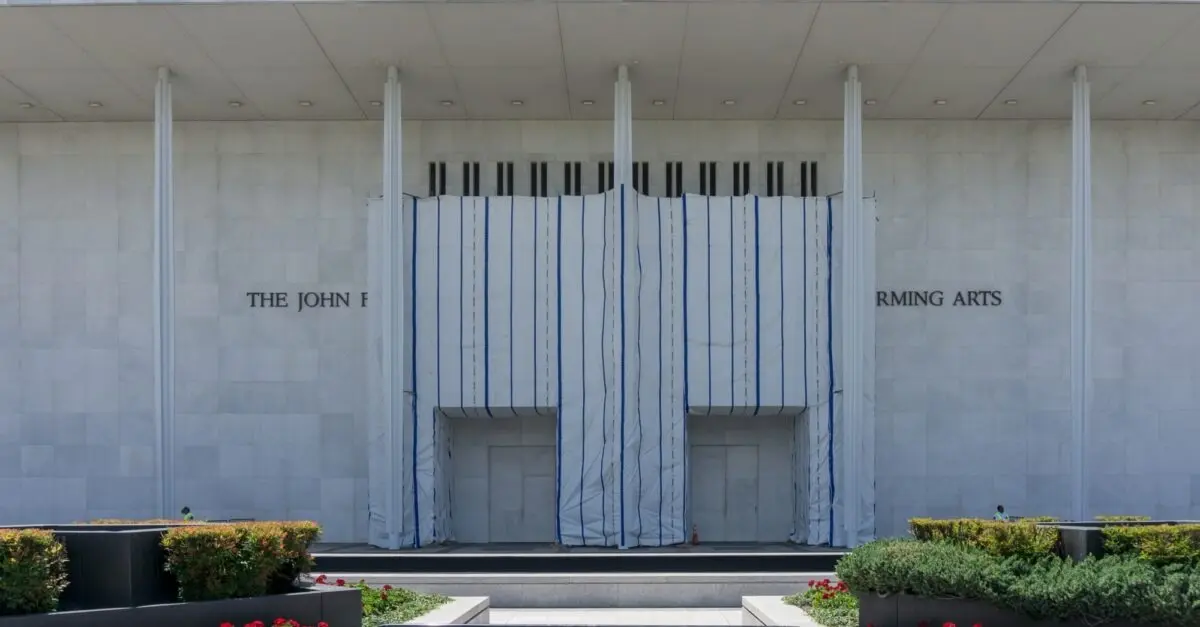
Complying with the order necessitated the erection of a large tarp over the building’s exterior. Undeterred, the board countered in August by submitting a revised proposal: they sought to place Trump’s name beneath President Kennedy’s, reading: "The John F. Kennedy Center for the Performing Arts Restored and Renovated By President Donald J. Trump." Furthermore, the board proposed renaming the surrounding grounds "The President Donald J. Trump Plaza."
The Escalation: Threats of Demolition and Sudden Closures
The conflict dramatically escalated mid-September. On Tuesday, September 16, President Trump took to Truth Social to issue an ultimatum, declaring that unless his name was permanently integrated into the building, he would actively block the release of $257 million in congressionally allocated renovation funds.
Later that same day, speaking to reporters aboard Air Force One, Trump ratcheted up the rhetoric further. Brandishing a large poster bearing the words "Kennedy Center Demolish," the President issued a stark warning:
"I think that the Trump administration should certainly have recognition. Because frankly, if we don’t do that, it’s going to close. It’ll end up being ripped down."
The rhetoric was swiftly matched by physical actions on the ground. On September 15, the Trump-handpicked board voted to shutter the Center entirely. By midweek, public access was completely cut off. Heavy security fencing was erected around the perimeter of the main structure, backed by stationed guards turning away visitors, artists, and staff.
Emergency Legal Motions and Thursday’s Rulings
In response to the sudden lockdown, legal representatives for U.S. Representative Joyce Beatty filed a motion on Thursday, September 17, demanding an emergency court hearing. The filing characterized the closure as "unlawful" and a direct violation of Judge Cooper’s prior injunction, which explicitly mandated that the Center remain operational while ongoing litigation was processed.
By Thursday afternoon, Judge Cooper issued a critical new ruling. He ordered that the Kennedy Center board must provide formal written notice at least 30 days prior to executing any physical alterations or demolition plans at the facility.
Concurrently, court filings submitted by Kennedy Center Executive Director Charles Matthew Floca attempted to frame the closure as an emergency health and safety measure rather than a political maneuver. In a filing submitted on September 17, Floca wrote:
"On September 16, 2026, I came to the conclusion that acute risks to public safety resulting from continued structural deterioration at the Center necessitated a temporary closure of most public spaces in the main building of the Center to general public access."
Floca cited an isolated incident on September 4, when a piece of plaster fell from the ceiling, as evidence of structural decay. However, internal communications leaked to the press revealed discrepancies, with Floca initially informing staff via email that the facility would face a routine seven-day closure, contrasting sharply with the expansive, fortified lockdown observed by the public.
Supporting Context & Metrics: Financial Leverage and Institutional Decline
Financial Brinkmanship: The $257 Million Question
At the core of the administrative struggle is federal funding. Congress previously earmarked $257 million specifically designated for the ongoing maintenance, restoration, and modernization of the Kennedy Center infrastructure.
By threatening to withhold these funds via executive obstruction, the Trump administration has leveraged the financial stability of a national cultural landmark to force compliance with its naming demands. Legal experts note that while the executive branch possesses administrative duties in executing Congressional budgets, intentionally freezing appropriated funds to coerce private-like naming rights sets a dangerous constitutional precedent regarding the separation of powers.
The Human and Artistic Toll
The administrative turmoil has taken a devastating toll on the Center’s core mission. The institution has not hosted a single public performance since June. Following the administration’s takeover last year, a chilling effect swept through the artistic community. Numerous performing arts troupes, resident companies, and headlining artists proactively distanced themselves from the venue, resulting in a precipitous drop in ticket sales and earned revenue.
Furthermore, the Kennedy Center operates far beyond its physical stage in Washington, D.C. It serves as a national nexus for arts education, designing curricula, teacher training programs, and youth engagement initiatives deployed in communities across all fifty states. The administrative paralysis and facility shutdown threaten to sever these pipelines, impacting educators and students nationwide who rely on the Center’s programmatic grants and resources.
Official Statements and Political Reactions
The standoff has drawn sharp rebukes from lawmakers, administration officials, and civil society leaders alike.
During an interview on MSNBC, Representative Joyce Beatty offered a firsthand account of a volatile meeting held on Tuesday between congressional stakeholders, President Trump, and members of the Kennedy Center board:
"He threw a tantrum… He didn’t get his vanity project, he didn’t get his name on it for the second time, and now he’s attacking folks."
Conversely, executive defenders and board loyalists maintain that the modifications and structural interventions are essential for modernizing an aging facility. They argue that the previous governance structure failed to adequately address deferred maintenance, making executive-level intervention necessary to prevent long-term decay—a narrative underscored by executive director Charles Floca’s references to falling plaster and safety vulnerabilities.
Civil society organizations have mobilized in fierce opposition to the administration’s actions. The local activist coalition Hands Off the Arts issued a scathing public statement announcing a major demonstration at the Center:
"The Board of Trustees, under the chairman’s leadership, have failed in their duty to the institution. The Center, a formerly dynamic and lively arts hub, sits nearly dormant. The impact is felt beyond the empty stages—as a top provider of arts education across the country, the impact of the Board’s mismanagement will be felt in communities nationwide. In our local communities, the livelihoods of local artists and staff members remain under threat."
Future Outlook: What Lies Ahead for the Cultural Monument?
As the legal battles in the U.S. District Court for the District of Columbia press forward, several pivotal questions remain unresolved:
- Enforceability of Injunctions: With Judge Cooper requiring a 30-day notice for any structural modifications, it remains to be seen whether the Trump-aligned board will respect judicial boundaries or pursue further appeals to higher courts.
- The Fate of Congressional Funding: The standoff over the $257 million appropriation will likely require legislative intervention or additional judicial clarification to determine whether the executive branch can legally withhold funds approved by Congress for infrastructure renewal.
- Public and Artistic Resurgence: Even if legal hurdles are cleared and the physical barriers are dismantled, restoring the institutional reputation of the Kennedy Center will present a monumental challenge. Rebuilding trust with alienated artists, resident companies, and patrons who have boycotted the venue will take years of stable, non-partisan governance.
For now, the Kennedy Center stands shuttered behind temporary fencing and heavy security—a stark physical manifestation of a polarized political climate encroaching upon the sanctuaries of American arts and culture. As demonstrations unfold and courtroom skirmishes continue, the nation watches to see whether its premier memorial to John F. Kennedy can preserve its integrity or succumb to the pressures of political transformation.