
LONDON — In a milestone development for the British classical music landscape, Sinfonia Smith Square has announced a crucial £200,000 capital grant from the prestigious Wolfson Foundation. The substantial award is earmarked for the comprehensive restoration and modernization of its Grade I listed Westminster home, Smith Square Hall.
This financial endorsement serves as a cornerstone for "Doors Open: Transforming Lives Through Music," the most ambitious architectural and infrastructural overhaul the historic building has undergone since its reincarnation as a dedicated concert hall in 1969. Designed to bridge centuries of architectural heritage with 21st-century community needs, the multi-million-pound redevelopment seeks to preserve a masterpiece of English Baroque architecture while future-proofing it as a dynamic hub for performance, education, and artistic incubation.
Executive Overview: Preserving Heritage While Empowering the Future
At its core, the "Doors Open" initiative is an exercise in delicate balance: safeguarding the irreplaceable fabric of a designated national landmark while radically improving its spatial utility, acoustic integrity, and accessibility. Smith Square Hall—historically known as St John’s Smith Square—has stood as an architectural beacon in the heart of political and cultural London since the early 18th century. However, decades of continuous use as a bustling performance venue have taken their toll, necessitating a visionary intervention.
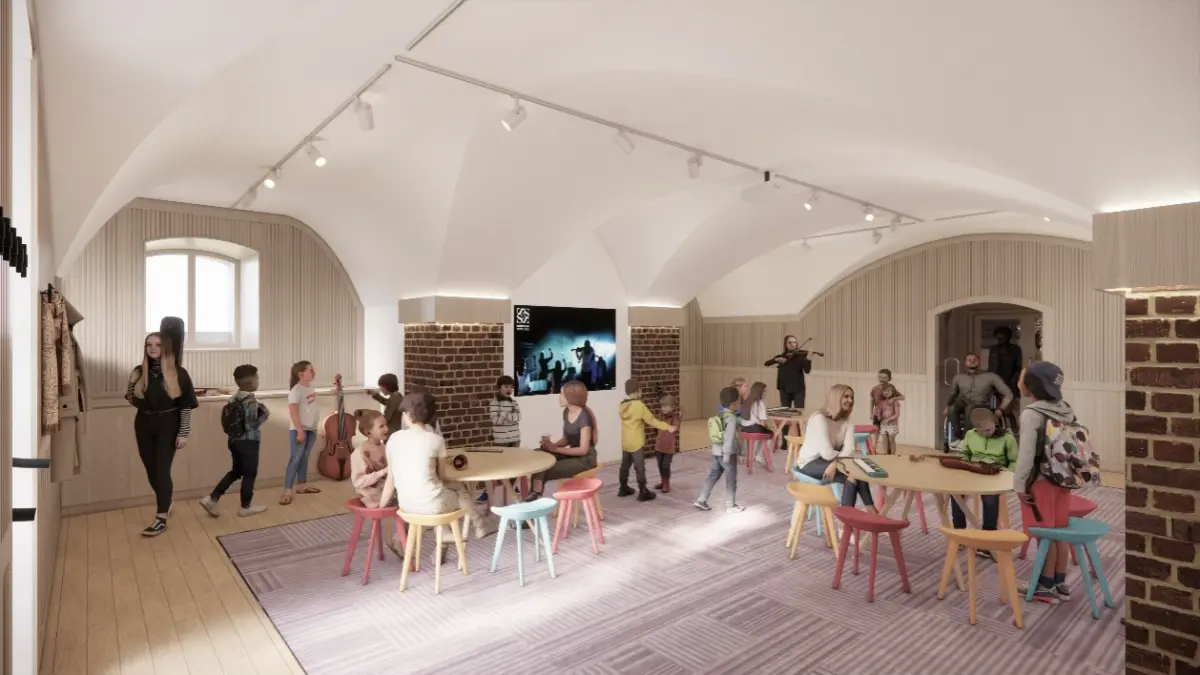
The £200,000 injection from the Wolfson Foundation directly targets the structural and functional revitalization of the building. More than a simple cosmetic facelift, the project is engineered to untap the latent potential of underutilized spaces within the historic envelope. Most notably, the transformation will breathe new life into the building’s atmospheric crypt, converting it from a secondary storage and support area into a state-of-the-art educational and community sanctuary.
Furthermore, the redevelopment addresses long-standing challenges regarding physical accessibility, environmental sustainability, and backstage infrastructure. By the time the hall reopens its doors in 2029, it aims to emerge not merely as a repaired heritage asset, but as a reimagined cultural engine capable of welcoming upward of 90,000 visitors annually. The project is designed to cement Sinfonia Smith Square’s dual identity: a world-class orchestral training ground and an open, civic-minded cultural living room for the local community and international audiences alike.
Detailed Chronology: From Baroque Masterpiece to Modern Cultural Hub
To understand the magnitude of the upcoming transformation, one must trace the extraordinary historical trajectory of the building itself, charting its path from a contentious 18th-century commission to its modern incarnation as a premier classical music destination.
The Baroque Genesis (1710–1728)
Designed by the brilliant yet eccentric architect Thomas Archer, St John’s Smith Square was constructed between 1710 and 1728 as one of the ambitious "Fifty New Churches" commissioned by an Act of Parliament. Archer’s design broke sharply from the austere classical traditions popularized by Sir Christopher Wren and Nicholas Hawksmoor, introducing a dynamic, continental Baroque style characterized by its monumental massing and distinctive corner towers—affectionately dubbed "Queen Anne’s feet" due to their resemblance to an upturned table.
Destruction and Resilience (1941–1969)
The building’s fortunes changed dramatically during the Blitz of World War II. In May 1941, an incendiary bomb struck the church, gutting the interior and leaving only the monumental stone shell standing as a charred, roofless ruin. For decades, the structure languished as a romantic yet desolate urban landmark.
It was not until the late 1960s that salvation arrived through the vision of Lady Parker of Waddington and a dedicated group of classical music enthusiasts. Spearheaded by a painstaking architectural restoration led by architects Marshall Sisson, the ruined shell was transformed into a magnificent concert hall, officially opening its doors in 1969. Renowned for its exceptionally warm acoustic properties—largely attributed to its wooden barrel-vaulted ceiling and dense stone interior—the hall quickly established itself as a beloved fixture of London’s musical ecosystem, playing host to generations of legendary soloists, chamber ensembles, and orchestras.
The Modern Era and the "Doors Open" Horizon (2002–Present)
In recent years, the venue became the permanent home of Sinfonia Smith Square (formerly known as Southbank Sinfonia), an internationally acclaimed orchestral fellowship programme. Recognizing that the building’s infrastructure had begun to lag behind the demands of a modern, inclusive arts organization, leadership conceived the "Doors Open" masterplan.
Following years of feasibility studies, fundraising, and architectural consultations, the project has now reached a decisive inflection point. With the Wolfson Foundation grant secured, the timeline is firmly established: construction and capital works are scheduled to commence in late 2027, culminating in a grand reopening slated for 2029.
Supporting Context & Metrics: Transforming Spaces and Sustaining Talent
The financial backing from the Wolfson Foundation is critical not only for bricks-and-mortar preservation but for the programmatic expansion that the renovated building will enable. A closer look at the metrics reveals the profound scope of the "Doors Open" project.
Eradicating Heritage Risk
One of the most significant external milestones targeted by the redevelopment is the removal of Smith Square Hall from Historic England’s Heritage at Risk Register. Inclusion on this register signifies that a historic asset is vulnerable to neglect, decay, or structural obsolescence. Successfully executing the capital works will ensure that this Grade I listed masterpiece is officially safeguarded for future generations, meeting the stringent conservation standards mandated by national heritage bodies.
Revitalizing the Crypt: A New Epicenter for Learning
The architectural centerpiece of the interior redesign is the conversion of the historic crypt. Historically constrained by low clearance, limited lighting, and awkward partitioning, the crypt will undergo a radical structural adaptation. When completed, it will house:
- A Dedicated Educational Suite: Purpose-built classrooms and flexible workshop spaces designed to host school groups, introducing children from diverse socioeconomic backgrounds to orchestral music and creative arts.
- Community Music Labs: Acoustic-treated spaces capable of hosting participatory music-making sessions, health and wellbeing music workshops for elderly residents, and grassroots artistic collaborations.
- Creative Incubators: Meeting zones and informal breakout spaces for community organizers, local artists, and educational partners.
Nurturing Next-Generation Talent
Beyond community outreach, the redevelopment directly empowers the orchestral fellowship programme managed by Sinfonia Smith Square. Founded in 2002, this flagship initiative has served as a vital professional bridge for more than 700 early-career musicians, equipping them with the performance experience, artistic autonomy, and industry connections necessary to thrive in the professional world.
The "Doors Open" project includes the creation of vastly improved, purpose-built rehearsal and coaching facilities within the complex. These upgrades will provide fellows with access to high-specification acoustic rehearsal rooms, digital recording capabilities, and specialized spaces for sectional coaching—ensuring that the training environment matches the world-class caliber of the musicians it produces.
Economic and Cultural Footprint
Upon its reopening in 2029, the modernized hall is projected to draw in excess of 90,000 visitors annually. This influx of foot traffic will not only secure the financial self-sufficiency of the venue but will also inject vital economic activity into the local Westminster business district, reinforcing the cultural tourism sector in central London.
Official Statements and Industry Perspectives
The announcement of the Wolfson Foundation grant has elicited widespread acclaim from leaders across the cultural, architectural, and philanthropic sectors, underscoring the national significance of the Smith Square Hall regeneration.
A spokesperson for the Wolfson Foundation highlighted the alignment between the charity’s mission and the aims of the redevelopment:
"The Wolfson Foundation is delighted to support Sinfonia Smith Square in this visionary project. Smith Square Hall is an architectural treasure of international importance, yet what makes ‘Doors Open’ so compelling is its deep commitment to the future. By transforming the crypt into a vibrant learning space and enhancing the facilities for early-career orchestral fellows, this project ensures that a historic building will continually pulse with new life, creativity, and community engagement."
Representatives from Sinfonia Smith Square emphasized the transformative nature of the capital award, framing it as a catalyst for a new era of civic and artistic accessibility:
"Securing this grant from the Wolfson Foundation is a monumental vote of confidence in our vision for Smith Square Hall. For decades, this building has resonated with sublime music. With the ‘Doors Open’ project, we are opening those doors wider than ever before—welcoming schools, local communities, and the brightest emerging musical talents into a fully accessible, state-of-the-art home. We are deeply grateful to the Wolfson Foundation for helping us take this decisive step toward 2029."
Heritage conservation experts have similarly praised the meticulous planning involved in the structural interventions, noting that the project sets a benchmark for how historic ecclesiastical architecture can be sensitively adapted to serve contemporary social functions without compromising its aesthetic integrity.
Future Outlook: A 2029 Vision for Music and Community
As Sinfonia Smith Square looks toward the commencement of construction in late 2027, the organization faces a period of both logistical transition and immense anticipation. While details regarding temporary performance residencies during the closure period are set to be announced in due course, the overarching gaze of the classical music community remains fixed on the horizon of 2029.
The completed Smith Square Hall will stand as a multi-layered cultural ecosystem: a pristine example of English Baroque architecture rescued from the threat of decay; a cutting-edge incubator for the next generation of orchestral talent; and an inclusive, welcoming community center where music serves as a vehicle for social transformation.
Through the partnership of visionary philanthropy—typified by the Wolfson Foundation’s foundational investment—and institutional ambition, Smith Square Hall is poised to enter its third century not merely as a monument to the past, but as a living, breathing testament to the enduring power of music to transform lives.