
Executive Overview
Richard Wagner’s Parsifal has always possessed the capacity to provoke, polarize, and transcend. Conceived as a Bühnenweihfestspiel (Festival Play for the Consecration of the Stage) and the composer’s final artistic testament, the opera leans heavily into Christian allegories, themes of divine grace, redemption, and sacred purification. However, when a director opts to strip away the sunlit, tranquil forests and holy lakes of Arthurian legend, the results are bound to test the limits of traditionalist sensibilities.
At The Royal Opera, director Evgeny Titov and set designer Etienne Plüss have done precisely that. Their audacious, fiercely provocative 2026 staging reimagines the Knights of the Grail not as noble protectors of a sacred relic, but as a brooding, paranoid cult of institutionalized inmates within a brutalist, high-tech mental health facility. King Amfortas is no longer merely suffering from a mystical wound by a lake; he is a captive, tormented figure trapped in a dystopian asylum where his blood is harvested in gruesome rituals, watched over by banks of CCTV cameras and pseudo-Hazmat-suited orderlies.
While Titov’s production—designed as an aggressive deconstruction of religious fundamentalism, misogyny, and authoritarianism—drew audible boos from pockets of the audience during the curtain call, the musical execution told an entirely different story. Under the masterful baton of conductor Jakub Hrůša, leading the peerless Royal Opera Orchestra and an extraordinarily gifted principal cast, the performance scaled breathtaking artistic heights. Bolstered by transcendent vocal performances from Christian Gerhaher, Stanislas de Barbeyrac, Ekaterina Gubanova, Mark Stone, and Brindley Sherratt, alongside the world-class Royal Opera Chorus, the evening proved to be a staggering sonic triumph that managed to eclipse the polarizing shock value of its visual conceit.
Detailed Chronology: A Descent into Titov’s Asylm
Act I: The Hunt, the Inmate, and the Bleeding King
The opera opens with the titular innocent, Parsifal, bursting onto the stage chased by an unruly, hostile mob. He proudly carries the spoils of his hunt—a convincingly crafted, lifeless swan. Interrogated by the elder knight Gurnemanz, the youth reveals a total vacuum of identity: he knows neither his origins, his past, nor his own name, offering only a bewildered "Ich weiß nicht" ("I don’t know") in response. In Titov’s psychiatric ward environment, however, this profound ignorance feels strangely appropriate; the newcomer has arrived at a place where reality itself has disintegrated.
Etienne Plüss’s monumental set features sliding granite blocks and an ever-present bank of CCTV screens reflecting the paranoia of the enclave. Gone is Wagner’s sacred grove. Instead, walls part to reveal a decontamination and shower area reminiscent of a survival horror video game. Here, the perpetually ailing King Amfortas—played with gut-wrenching vulnerability by Christian Gerhaher—does not bathe in a healing lake. Instead, his unceasing wounds are aggressively scrubbed by Knights clad in pseudo-Hazmat suits and rebreather masks.
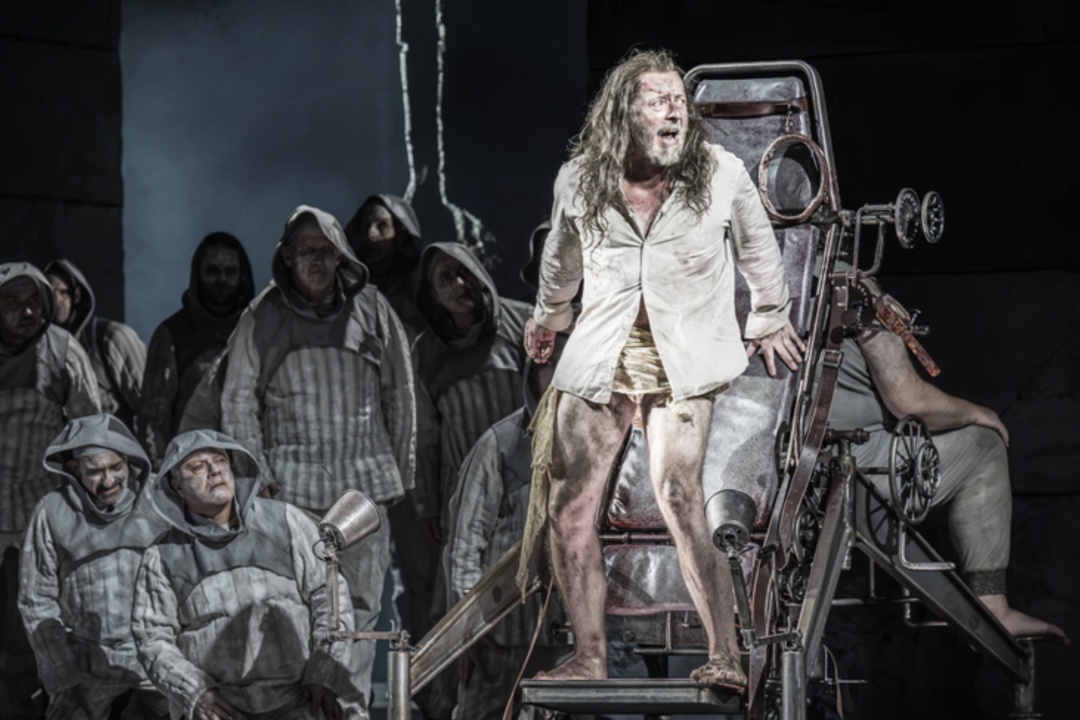
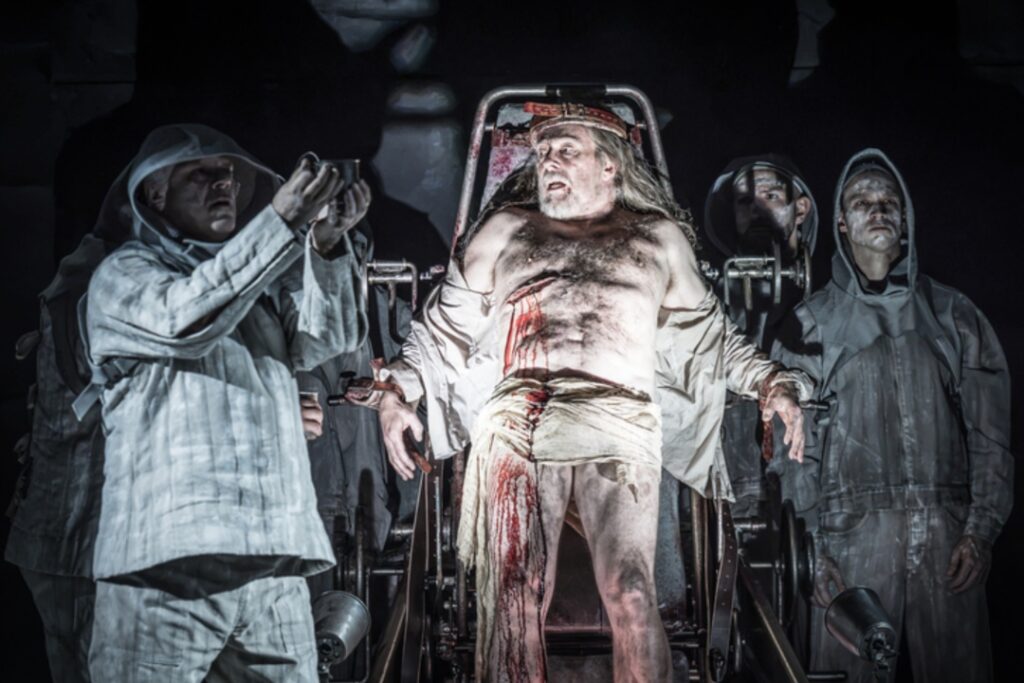
In a striking visual progression, Amfortas staggers forward in rags, dragging a metal hospital bed behind him as if breaking free from physical restraint. The Knights, dressed in striped, padded pajama-straitjackets with hoods, strip him and harvest his oozing blood into small metal cups, consuming it in a macabre parody of communion.
Amid this bleak, clinical squalor, Brindley Sherratt’s Gurnemanz serves as the moral and narrative anchor. His towering, treacle-rich bass voice provides the production’s emotional core, grounding the surreal dystopia in tangible human suffering.
Act II: Klingsor’s Surveillance State and the Freudian Trap
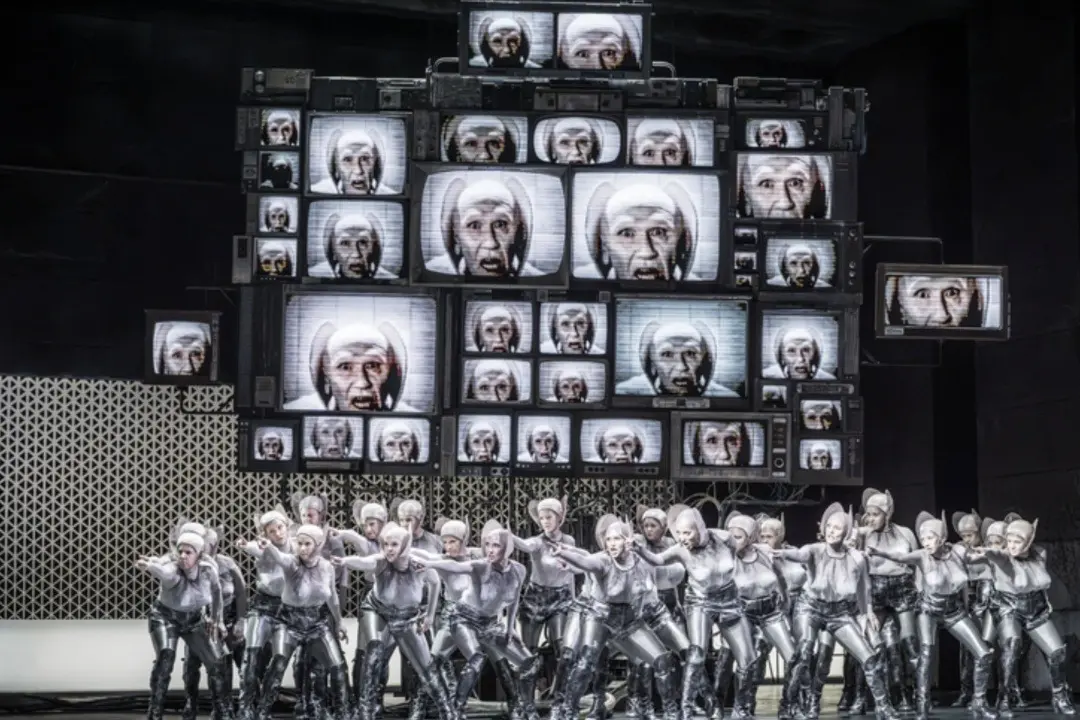
Act II shifts the action to the realm of the antagonist, Klingsor. Eschewing Wagner’s magical southern Italian gardens, Titov transforms the domain into a sterile, high-tech surveillance center and museum dominated by multiplexed video walls. Mark Stone’s Klingsor is a smarmy, shiny-suited corporate predator, more akin to a modern tech oligarch or a chillingly modern Lex Luthor than a traditional sorcerer. He croons menacingly to young ballerina trainees—the embryonic Flowermaidens—introducing a deeply unsettling layer of institutional grooming.
When Parsifal (portrayed with steel-toned brilliance by Stanislas de Barbeyrac) breaches the compound, he is confronted by the adult Flowermaidens. Outfitted in silver mesh tops, robotic winged hats, and exaggerated prosthetics that evoke an X-rated sci-fi spin-off, they manage to strip the hero down before he successfully breaks away.
Denied his initial line of defense, Klingsor deploys his ultimate weapon: the coerced, shapeshifting Kundry (mezzosoprano Ekaterina Gubanova). Utilizing psychological manipulation, Kundry forces Parsifal to confront his true identity and past. This leads to the production’s most shocking, Freudian-inflected pivot: during the seduction, Kundry bares her breast, inviting Parsifal to suckle in a regressive display of maternal adoration.
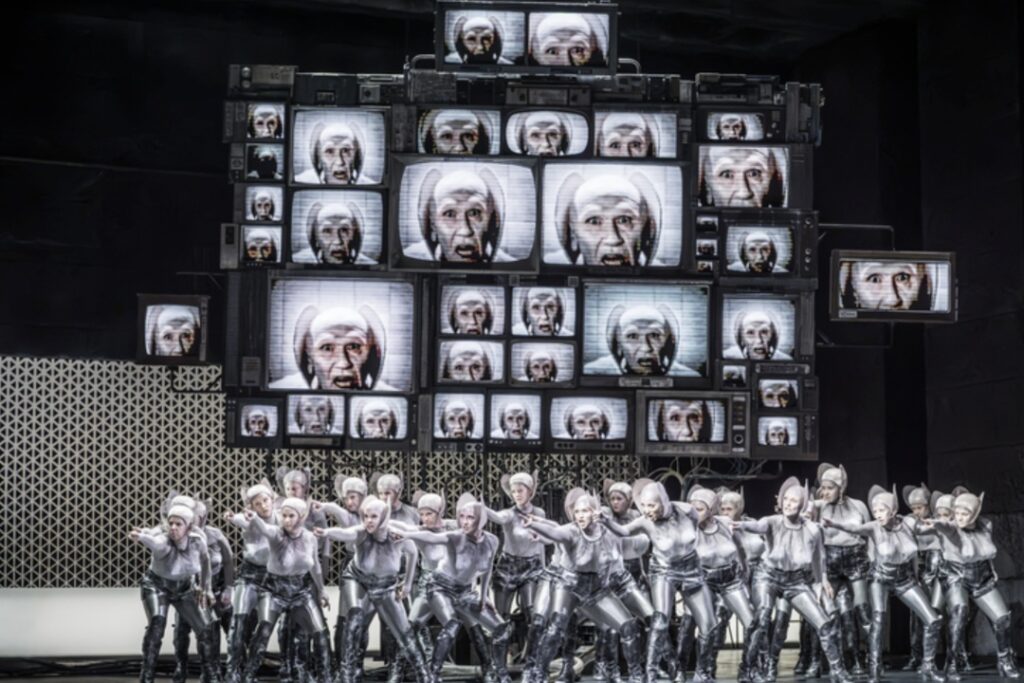
The shock catalyzes Parsifal’s awakening. He viscerally absorbs Amfortas’s pain into his own chest, shedding his simpleton persona to emerge as an enlightened warrior-savior. Wielding the Holy Spear, he shatters Klingsor’s surveillance monitors, instantly dismantling the tyrant’s digital panopticon.
Act III: The Redemption and the Tarantino Twist
Decades pass before the final Act brings Parsifal back to the realm of the Knights. In a rare moment of tenderness, Parsifal baptizes Kundry, releasing her from her tormentous cycle of rebirths. Titurel, the aged father of Amfortas, has passed away, and a battered Amfortas—who has long resisted the gruesome blood-letting rituals—consents to submit to the Grail one final time. In Wagner’s original vision, Parsifal touches the king’s wounds with the spear, initiating a miraculous, divine healing.
Titov, however, opts for a conclusion that leans less toward spiritual grace and more toward cinematic thriller territory—a grim intersection of Quentin Tarantino and Alfred Hitchcock. While the shock-value ending alienated purists, the musical resolution under conductor Jakub Hrůša soared. Gurnemanz delivers his celebrated Good Friday spell ("Das ist Karfreitagszauber") with breathtaking, tear-inducing emotional resonance, while the final chords ring out with monumental, redemptive clarity.
Supporting Context & Metrics: Vocal Splendor Amid Conceptual Friction
| Production Element | Creative / Cast Member | Artistic Assessment |
|---|---|---|
| Conductor | Jakub Hrůša | Symbiotic connection with the Royal Opera Orchestra; profound, overwhelming command of Wagner’s score. |
| Amfortas | Christian Gerhaher | Beguiling, sonorous baritone; peerless dramatic acting embodying physical agony and moral torment. |
| Parsifal | Stanislas de Barbeyrac | Gleaming, steel-powered tenor; commanding vocal agility and athletic physical presence. |
| Kundry | Ekaterina Gubanova | Nuanced portrayal navigating abuse, seduction, and vulnerability with exquisite vocal control. |
| Klingsor | Mark Stone | Dark, rich, controlled baritone; masterfully portrayed a predatory, modern corporate villain. |
| Gurnemanz | Brindley Sherratt | Radiant, treacle-rich bass; served as the human and narrative anchor of the entire production. |
| Chorus Master | William Spaulding / Royal Opera Chorus | Achieved transcendental, weep-inducing vocal beauty; arguably the standout feature of the evening. |
Official Statements & Critical Reception
The production has ignited fierce debate among critics and audiences alike, highlighting the ongoing tension between conceptual regieoper (director’s opera) and sacred musical reverence.
Director Evgeny Titov has defended his deconstructionist approach in pre-show interviews, stating that Parsifal must be interrogated through the lens of modern socio-political anxieties. Titov aimed to dismantle what he views as unpalatable romanticizations of religious fundamentalism, systemic misogyny, and blind authoritarianism embedded within the original libretto.
Reaction within the house, however, was visibly divided. While the orchestral and vocal performances received unanimous, thunderous ovations—culminating in career-best accolades for Gerhaher, Sherratt, and the Royal Opera Chorus—the creative team faced notable, audible boos from sections of the auditorium during the final curtain call. Critics have argued that while Titov’s intellectual ambitions are clear, several moments of shock-value staging crossed the line from insightful critique into gratuitous sensationalism.
Future Outlook
As The Royal Opera’s run of Parsifal continues to draw packed houses, the production stands as a definitive watershed moment for the company’s 2026 season. It proves that even the most sacred cows of the nineteenth-century canon can be violently uprooted, interrogated, and re-contextualized for a modern, cynical age.
For operatic purists, the staging serves as a warning: first-time attendees might be well-advised to close their eyes during the more disturbing visual sequences, allowing Wagner’s divine, transcendent score to wash over them unhindered. Yet, for adventurous theatergoers willing to engage with Titov’s dark, psychiatric labyrinth, the sheer caliber of the musical performance—anchored by Jakub Hrůša’s visionary conducting and a masterclass in vocal acting from a world-class cast—ensures that this Parsifal will remain a major talking point in the international opera world for years to come.