
Executive Overview
In an era where houses of worship strive to foster environments of radical inclusion, the acoustic experience of a service remains a cornerstone of spiritual engagement. Yet, for millions of congregants dealing with hearing loss, standard architectural acoustics and amplification systems often fall short. The spoken word—whether delivered through a deeply personal sermon, scriptural readings, or communal prayer—can easily become muddled by reverberation, ambient noise, and distance. To bridge this communication gap, modern religious institutions are increasingly turning to advanced Assistive Listening Systems (ALS).
However, the procurement and deployment of an ALS involve far more than simply purchasing hardware and plugging it into a soundboard. A successful rollout requires a methodical, community-centric strategy that encompasses audience assessment, budgetary forecasting, comprehensive staff training, and aggressive promotional awareness.
This report provides an authoritative, step-by-step framework for religious leaders, facility managers, and audio-visual ministry teams. Drawing on industry insights and operational standards—such as those outlined in specialized guides like the Listen Technologies Church Assistive Listening Toolkit—this article explores how houses of worship can transform their acoustic environments into spaces of absolute accessibility. By understanding audience needs, budgeting strategically, empowering "Listening Ambassadors," and broadcasting availability, churches can ensure that no member of their flock is left on the acoustic sidelines.
Detailed Chronology: The Four-Step Implementation Roadmap
Transitioning a house of worship into an acoustically inclusive environment requires a structured, multi-phase approach. Rushing the deployment of an Assistive Listening System without adequate preparation often leads to underutilization, equipment mishandling, and a failure to reach the target demographic. Below is the definitive chronological roadmap for executing an ALS project successfully.
Phase 1: Assess and Understand Your Congregation’s Unique Needs
The foundational error many facilities make is purchasing audio equipment based on generalized assumptions rather than empirical data. Every congregation has a distinct demographic makeup, and acoustic challenges vary wildly between a sprawling contemporary auditorium and a traditional, high-vaulted cathedral.
- Deploying Congregational Surveys: The most effective initial step is to survey the community directly. These surveys should go beyond a simple "Do you have trouble hearing?" Instead, they must capture nuanced experiential data:
- What is the individual’s subjective experience during standard worship services?
- Do they currently utilize hearing aids?
- If so, are those hearing aids equipped with telecoils (t-coils), which allow them to interface directly with loop systems or neck loops?
- Analyzing Physical and Acoustic Barriers: Beyond surveys, ministry teams must evaluate where hearing-impaired members typically sit and how architectural features impact sound propagation. Understanding whether the congregation leans toward traditional hearing aids or relies on dedicated personal receivers dictates the precise hardware infrastructure required.
Phase 2: Explore Options and Establish Financial Parameters
Once the congregation’s specific needs are mapped, the leadership team must align these requirements with a realistic financial strategy. Navigating the myriad of technological options—ranging from FM and Infrared (IR) systems to cutting-edge Wi-Fi audio streaming and Audio Frequency Induction Loops (AFIL)—demands careful cost-benefit analysis.
- Consultation and Budgeting: Estimating the total cost of ownership involves looking at transmitters, receivers, charging stations, and sanitary accessories. Professional audio integrators, such as CCI Solutions, offer specialized assistance and complimentary consultations to help facilities navigate these financial waters without overspending.
- Creative Funding Mechanisms: Because house of worship budgets are frequently constrained, capital improvement projects like an ALS often benefit from targeted fundraising campaigns. Communicating the profound impact of the initiative—framing it not as a technical upgrade, but as a moral imperative of inclusion—regularly inspires donors to underwrite the costs partially or entirely.
Phase 3: Operational Readiness and Staff Training
The finest audio technology in the world is rendered useless if staff and volunteers do not know how to operate, maintain, and distribute it. The operational phase focuses heavily on transforming church personnel into proactive advocates for accessibility.
- Appointing "Listening Ambassadors": Staff, ushers, and welcoming volunteers should be designated as Assisted Listening Ambassadors. These individuals must receive rigorous, hands-on training regarding the operation of every device in the inventory.
- High-Touch Distribution Protocols: When a congregant requests a device, the interaction should not be a silent handoff. Ambassadors should take the time to briefly instruct users on volume controls, neck-loop positioning, and device maintenance.
- Mitigating Friction with Visual Aids: To prevent operational bottlenecks at the welcome desk—especially during high-traffic Sunday mornings—facilities should keep laminated, easy-to-read troubleshooting cards and Frequently Asked Questions (FAQs) posted at the distribution counter.
Phase 4: Cultivating Awareness and Community Outreach
An invisible system is an unused system. Even the most sophisticated ALS will gather dust if the congregation and the surrounding neighborhood are unaware of its existence.
- Universal Signage: Clear, standardized international symbols indicating the availability of Assisted Listening Devices (ALDs) must be prominently displayed at entrances, welcome desks, and sanctuary doors.
- Multi-Channel Promotion: Awareness campaigns must be relentless and multi-faceted. Reminders should be embedded in weekly printed bulletins, digital slide presentations before services, and church websites.
- Live Demonstrations and Community Advertising: Hosting a dedicated live training session allows hesitant congregants to test the technology in a low-pressure environment. Furthermore, advertising these accessibility efforts to the broader geographical community signals an open, welcoming culture that actively draws in visitors seeking a truly accommodating spiritual home.
Supporting Context & Metrics: The Imperative of Acoustic Inclusion
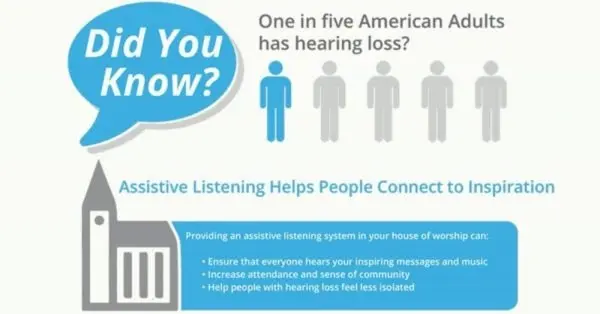
To fully appreciate the urgency of deploying Assistive Listening Systems, one must examine the broader socio-acoustic context of modern houses of worship. Hearing loss is one of the most prevalent chronic conditions affecting adults globally, yet it is frequently referred to as the "invisible disability."
The Demographics of Hearing Loss in Worship Spaces
According to public health data, millions of individuals experience hearing loss that significantly impacts their daily communication. In the context of a weekly religious service, this impairment introduces severe social and spiritual isolation. When congregants cannot understand the spoken word, they miss out on scripture readings, homilies, pastoral prayers, and the communal fellowship that follows. Over time, this disconnect frequently leads to absenteeism, as individuals feel that attending services is no longer a life-giving experience.
[Traditional Sound System]
       │
       ▼ (Reverberation, Distance, Background Noise)
[Muffled Audio Experience] ──> [Congregant Frustration / Disconnection]
       │
       ▼ (Deployment of Assistive Listening System)
[Direct, Crystal-Clear Audio] ──> [Full Inclusion & Spiritual Engagement]
Technological Evolution: Meeting Modern Standards
Modern houses of worship face unique acoustic challenges. Contemporary worship styles often feature high-energy musical arrangements alongside spoken-word elements, requiring dynamic sound mixing. Conversely, historic sanctuaries built with stone, stained glass, and timber naturally create high reverberation times, which smear speech intelligibility.
Assistive Listening Systems bypass these environmental obstacles entirely. By transmitting the audio signal directly from the soundboard to the user’s ear—via a dedicated receiver, personal headphones, or a telecoil-enabled hearing aid—the system eliminates the destructive interference of room acoustics and distance.

Furthermore, regulatory frameworks, such as the Americans with Disabilities Act (ADA) in the United States, set explicit compliance standards regarding the provision of assistive listening devices in places of assembly based on seating capacity. Adopting an ALS is therefore not only a moral and pastoral duty but also a vital component of institutional compliance and risk management.
Official Statements and Industry Insights
Industry leaders and pastoral advocates consistently emphasize that audio accessibility is a vital metric of a church’s health and genuine compassion.
On the Pastoral Imperative of Inclusion:
"Reaching out to those who feel disconnected from your community due to hearing loss is central to sharing the message of inclusion. Genuinely compassionate service involves being aware of and caring for the needs of everyone, especially those dealing with impairments. Make sure they are able to hear the beauty and emotion of the spoken word in your church by providing them with the equipment they need to stay connected."
— Ministry and AV Integration Consensus
On the Mechanics of Technological Deployment:
Audio-visual engineering experts stress that technology must serve human connection rather than complicate it. System integrators note that the failure of historic listening installations was rarely technological; rather, it stemmed from poor staff training and a lack of marketing. By treating assistive listening as a guest-services priority rather than an afterthought, churches routinely see exponential increases in device utilization and positive visitor feedback.
Resources for Further Implementation:
Organizations specializing in church audio solutions provide extensive toolkits to streamline this transition. For instance, comprehensive assets such as the Listen Technologies Church Assistive Listening Toolkit offer invaluable downloadable resources, including:
- Sample congregational surveys to evaluate acoustic needs.
- Standardized, high-contrast signage templates for facility placement.
- Bulletin announcement templates to maintain ongoing awareness.
Future Outlook: The Next Horizon in Accessible Worship
As audio-visual technology continues its rapid advancement, the future of Assistive Listening Systems in houses of worship points toward even greater integration, personalization, and seamless user experiences.
The Shift Toward Personal Device Integration
Historically, assistive listening relied exclusively on dedicated, church-owned receivers and cumbersome headset tethering. Looking forward, the industry is shifting rapidly toward Bring Your Own Device (BYOD) architectures. Leveraging modern Wi-Fi streaming protocols, contemporary ALS platforms allow congregants to stream pristine, low-latency audio directly to their own smartphones or tablets via a downloadable application. Users can then route the audio straight to their Bluetooth-enabled hearing aids, cochlear implants, or personal wireless earbuds.
This technological leap radically reduces hardware management overhead for church staff, eliminates the need for extensive sanitary cleaning protocols between services, and empowers users with familiar, personalized interfaces to adjust volume and tone profiles to their exact clinical requirements.
Artificial Intelligence and Adaptive Acoustics
Looking further down the horizon, artificial intelligence (AI) is beginning to intersect with church audio engineering. Future assistive listening platforms will likely incorporate real-time noise cancellation and automated speech enhancement algorithms. These systems will dynamically isolate the speaker’s voice from ambient sanctuary noise—such as crying infants, HVAC hums, or shuffling feet—before transmitting the signal to the listener.
Conclusion: A Permanent Mandate for Connection
Ultimately, the integration of an Assistive Listening System is far more than an itemized capital expense on a church balance sheet. It is a profound declaration of pastoral intent. It asserts that every individual—regardless of physical ability—is a valued, essential member of the body of believers.
By following a disciplined implementation framework—understanding needs through direct engagement, budgeting wisely with expert consultation, training staff to act as compassionate ambassadors, and aggressively promoting accessibility—houses of worship can dismantle invisible barriers. In doing so, they ensure that the beauty, nuance, and transformative power of the spoken word resonate clearly in the hearts and minds of every person in the pews.