
Executive Overview
Voice science stands at a profound historical inflection point. For millennia, the human voice has served as our most intimate instrument of connection, emotional resonance, and personal identity—carrying the signatures of our health, psychological state, and humanity in ways no other physiological signal can replicate. Today, however, we are witnessing a fundamental transformation in how this intricate biological medium is researched, analyzed, and integrated into clinical care. Artificial intelligence (AI) and machine learning are no longer fringe technologies or speculative concepts whispered about in computing laboratories; they have become central pillars driving an exponential revolution across voice medicine, pathology detection, and acoustic research.
At the epicenter of this renaissance is The Voice Foundation and its flagship publication, the Journal of Voice. For over five decades, the Foundation has operated as the premier global bridge connecting the worlds of art and science, clinic and stage. Founded in 1969 by Dr. Wilbur James Gould in New York City and subsequently guided through decades of unprecedented expansion by world-renowned otolaryngologist Dr. Robert Thayer Sataloff, the organization has consistently championed interdisciplinary collaboration.
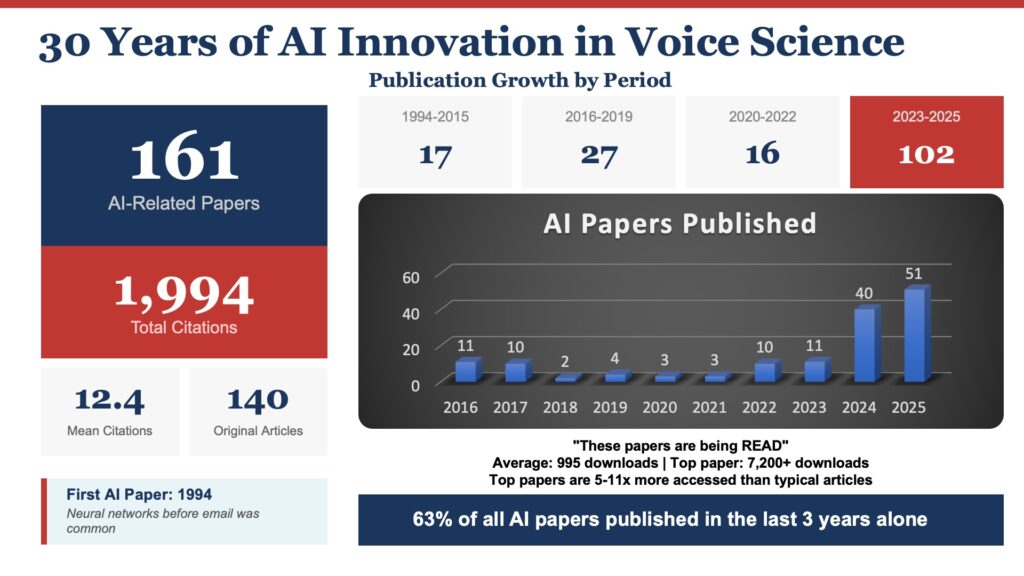
Yet, even against a backdrop of legendary historical milestones, the recent trajectory of artificial intelligence within voice science defies traditional paradigms. Data from the Journal of Voice reveals a striking phenomenon: of the 161 AI-related papers published in the journal’s history, an astounding 63 percent (102 papers) have been published in just the last three years. In 2025 alone, the journal published 51 artificial intelligence papers—surpassing the total output of the field’s entire first two decades combined. This report examines the evolution, real-world impact, landmark studies, expert perspectives, and future roadmap governing the integration of artificial intelligence into the science and medicine of the human voice.
Detailed Chronology: Three Decades of AI Integration in Voice Science
To understand the sudden, explosive growth of artificial intelligence in voice research today, one must look backward to an era when the digital landscape looked vastly different. Most observers assume that AI in healthcare is a recent post-pandemic phenomenon driven by generative text models and deep learning frameworks. In reality, the Journal of Voice was publishing pioneering AI research before the general public had even conceptualized modern internet connectivity.
The Genesis: 1994 and the First Neural Networks
In 1994—a full thirty-one years ago, during the absolute infancy of the World Wide Web—the Journal of Voice published a landmark paper by Rihkanen and colleagues titled "Spectral Pattern Recognition of Improved Voice Quality." Utilizing rudimentary artificial neural networks to analyze acoustic spectra, this study laid the foundational brick for computational voice analysis. Researchers and clinicians were exploring machine-driven pattern recognition before the vast majority of professionals had ever sent an electronic mail message.
The Slow Burn: 1995 to 2015
For the next two decades, AI research in voice science progressed at a measured, incremental pace. Between 1995 and 2015, the field saw the publication of just 17 AI-focused papers in the journal. These foundational years were characterized by feature engineering, traditional statistical modeling, and early attempts to classify pathological versus healthy voices using support vector machines and basic linear algorithms. The computing power was limited, the datasets were small, and clinical integration remained largely theoretical.
The Acceleration Phase: 2016 to 2022
As computational power surged, cloud infrastructure matured, and deep learning architectures emerged, the pace of publication began to quicken.
- 2016–2019: The journal published 27 AI-related papers, marked by the arrival of deep convolutional neural networks capable of handling raw acoustic vectors and complex cepstrum coefficients.
- 2020–2022: Despite global disruptions, 16 papers were published during this window, bridging the gap between theoretical acoustic modeling and applied machine learning in clinical diagnostics—including early explorations into pandemic-era respiratory monitoring.
The Exponential Explosion: 2023 to Present
The post-2022 era represents a radical departure from historical publishing trends. Between 2023 and 2025, the Journal of Voice released 102 artificial intelligence papers. This vertical ascent culminated in 2025 with 51 papers published in a single twelve-month span. This is not gradual academic growth; it is an exponential transformation that mirrors the broader societal revolution in machine intelligence, shifting the field from experimental curiosity to clinical necessity.
Supporting Context and Metrics: Real-World Impact and Global Reach
Academic citations are often viewed as isolated metrics confined to ivory towers. However, an analysis of how these AI voice papers are utilized reveals a profound, real-world hunger among frontline medical practitioners, speech-language pathologists (SLPs), and researchers for practical, data-driven tools.
Extraordinary Download Statistics
The average AI-focused paper published in the Journal of Voice commands nearly 1,000 downloads, a testament to the high-demand nature of computational voice diagnostics. More importantly, specialized studies routinely shatter standard readership baselines:
- A study investigating machine learning methodologies for COVID-19 detection via voice characteristics has been downloaded over 7,200 times—representing eleven times the median readership for articles in its respective issue.
- Landmark review and deep-learning papers by Fang and colleagues (193 citations) and Hegde and colleagues (147 citations) have each achieved nearly 5,000 individual downloads, placing them consistently among the top-accessed literature in voice science.
These metrics signify that clinicians around the globe are actively turning to peer-reviewed computational literature to solve complex diagnostic challenges in real-time patient care.
Key Research Milestones and Landmark Studies
The explosion in literature is supported by several foundational studies that have fundamentally shifted clinical capabilities:
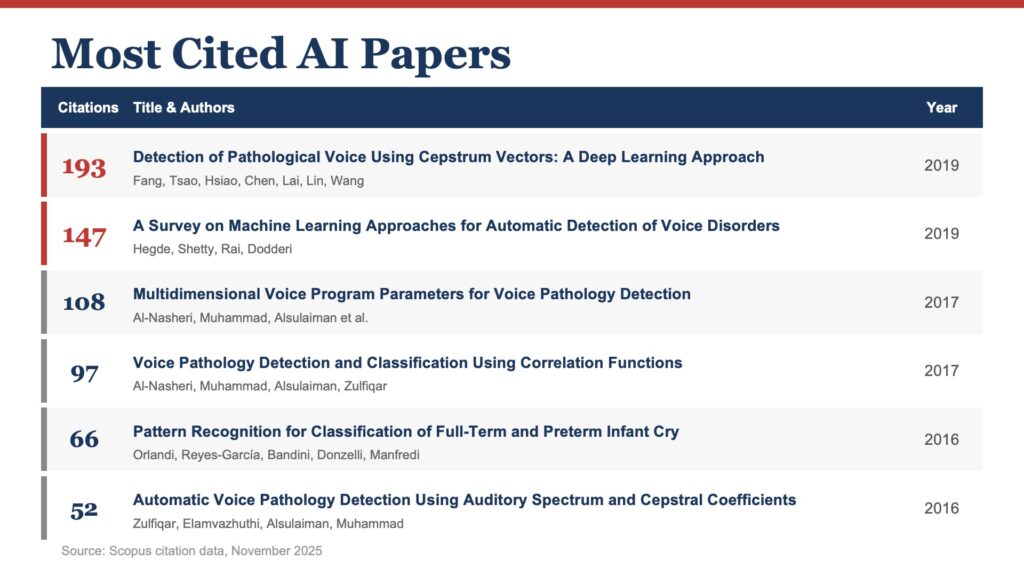
- Deep Learning for Pathological Voice Detection: Fang et al. (2019), "Detection of Pathological Voice Using Cepstrum Vectors: A Deep Learning Approach," stands as the most-cited AI paper in the journal’s history (193 citations). This work proved conclusively that deep neural networks can detect laryngeal pathologies using acoustic features entirely imperceptible to the unassisted human ear.
- Comprehensive Frameworks: Hegde’s expansive “Survey on Machine Learning Approaches for Automatic Detection of Voice Disorders” (147 citations) provided the definitive roadmap for researchers entering the computational voice space.
- Multidimensional Parameters: Al-Nasheri et al. (2017) contributed vital methodologies regarding Multidimensional Voice Program parameters (108 citations) and correlation functions (97 citations).
- Advanced Neural Architectures: More recent investigations—such as Chen and Chen’s 2022 deep neural network voice classification framework, Fujimura’s work with one-dimensional convolutional neural networks, and Cho and Choi’s comparative analysis of CNN models for laryngoscopic images—demonstrate a rapid evolution toward sophisticated, multi-layered diagnostic networks.
The Voice as a Digital Biomarker
Perhaps the most transcendent paradigm shift in modern medicine is the conceptualization of the human voice as a digital biomarker—a non-invasive, continuous window into systemic neurological, psychological, and physiological health.
- Neurological Monitoring: Groundbreaking research published in the journal details the use of voice analysis to track and predict the severity of Parkinson’s disease. For instance, Hemmerling and Wójcik-Pędziwiatr’s 2022 paper has garnered 29 citations in three years, paving the way for remote patient monitoring.
- Mental Health Diagnostics: Systematic reviews exploring voice quality as a digital biomarker for depression and bipolar disorder open extraordinary clinical horizons. The potential to screen for mental health fluctuations through routine vocal interactions could radically reduce the burden on overstretched psychiatric healthcare systems.
- Respiratory Health: Machine learning models trained on acoustic respiratory features have proven effective as sentinels for pulmonary conditions, offering scalable screening tools during public health crises.
Conversational AI in Clinical Decision-Making
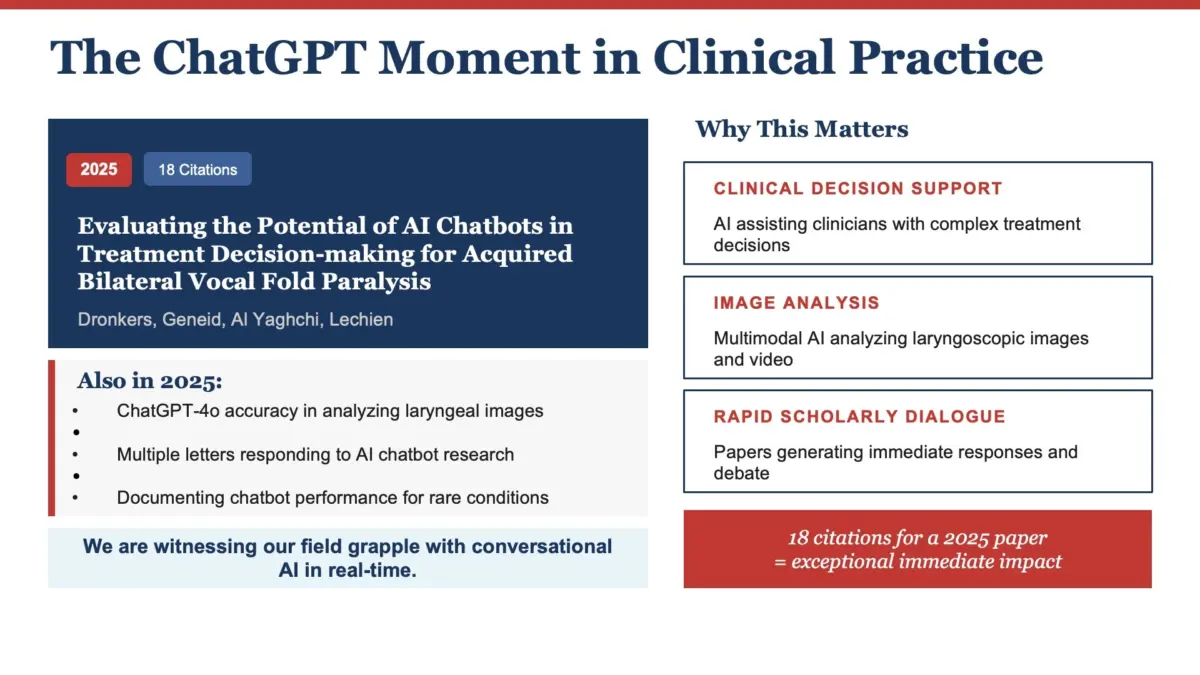
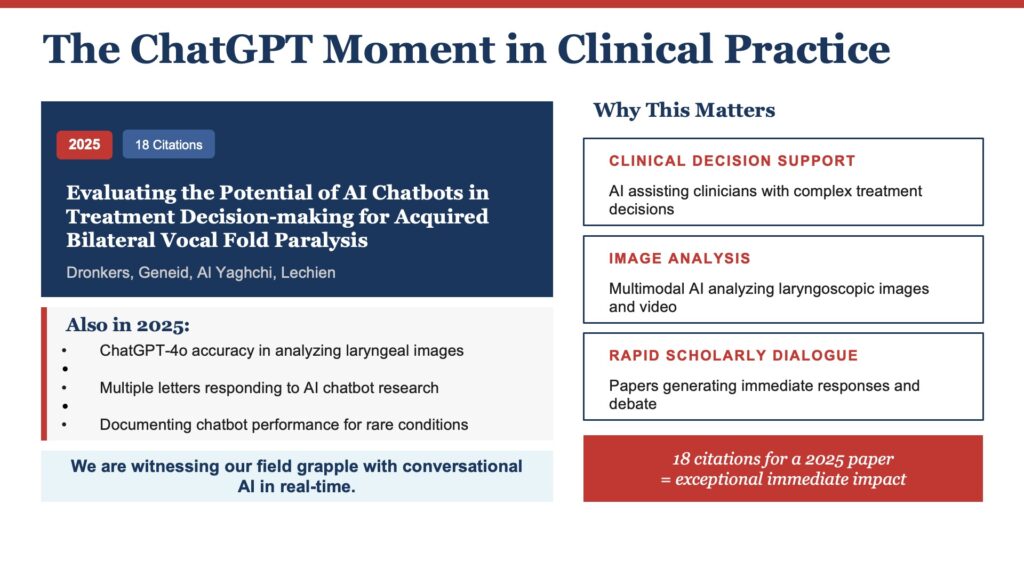
Entering 2025, the Journal of Voice expanded its scope to evaluate generative artificial intelligence and large language models (LLMs) in clinical workflows. Dronkers and colleagues’ 2025 study, "Evaluating the Potential of AI Chatbots in Treatment Decision-making for Acquired Bilateral Vocal Fold Paralysis," rapidly accumulated 18 citations—an exceptional velocity for a newly released paper. This work sparked robust peer correspondence, including investigations into ChatGPT-4o’s accuracy when parsing complex laryngeal images, illustrating a medical community actively grappling with conversational AI in real-time.
Official Statements and Expert Perspectives
To contextualize these metrics, prominent leaders within voice science and academic publishing offer essential insights regarding the philosophical, technical, and ethical dimensions of artificial intelligence integration.
Dr. Mark Berardi: Managing Complexity and Synthetic Communication
Drawing from a rich background in physics and computational science, Dr. Mark Berardi views artificial intelligence not as a replacement for human intellect, but as an indispensable engine for managing biological complexity.

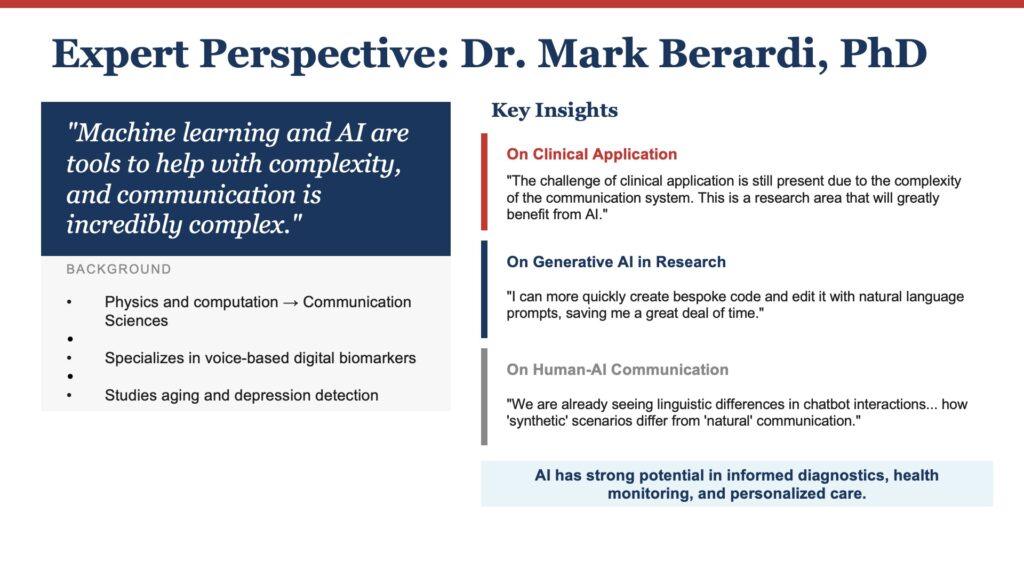
"Machine learning and AI are tools to help with complexity, and communication is incredibly complex in its neurobiological and physiological processes. So I think the application is warranted," Dr. Berardi explains.
His current research focuses on voice-based digital biomarkers for aging and depressive states. While noting that acquiring vocal audio is easier than ever, he highlights that the true hurdle remains the intrinsic intricacy of the human communication apparatus—an area where machine learning naturally excels.
Addressing generative AI, Dr. Berardi maintains a balanced outlook. While he notes it has not yet completely upended theoretical research paradigms, it successfully eliminates administrative and technical bottlenecks. "I can now quickly create bespoke code and edit it with natural language prompts," he notes.
Intriguingly, Dr. Berardi’s work extends into human-AI communication dynamics—investigating how human linguistic patterns shift when conversing with chatbots versus real people, and how synthetic environments like video conferencing modify baseline vocal behavior. "We are already seeing linguistic differences in chatbot interactions," he observes, suggesting that future voice scientists must analyze not only human-to-human vocalization, but human-to-machine discourse as well.
Dr. Eric Hunter: Embracing Change with Ethical Clarity
Dr. Eric Hunter focuses on the institutional and academic realities of widespread AI adoption. He issues a clear directive to the academic community: artificial intelligence is an permanent fixture of modern scholarship.
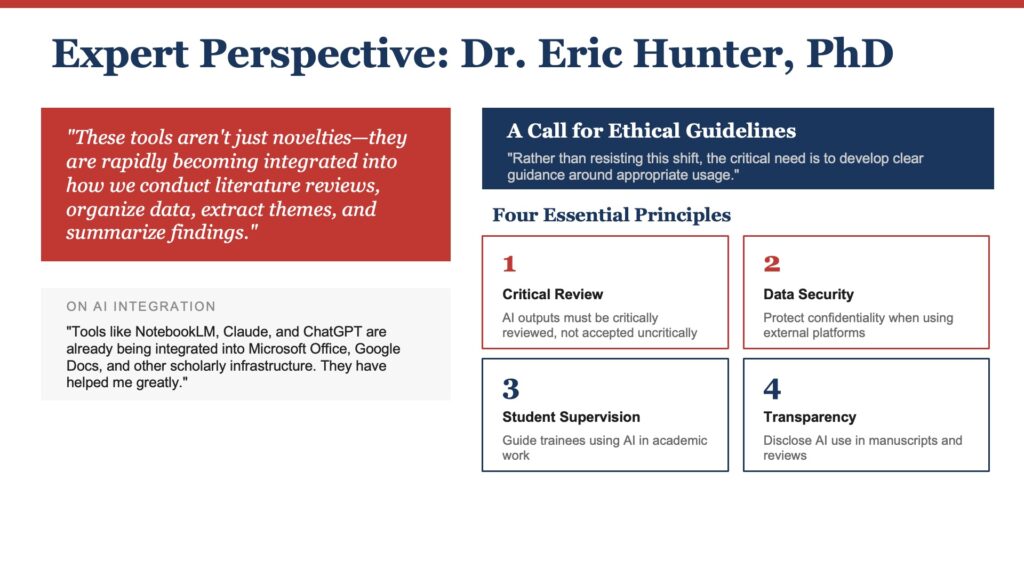
"These tools aren’t just novelties," Dr. Hunter observes. "They are rapidly becoming integrated into how we conduct literature reviews, organize data, extract themes from large bodies of text, and even summarize findings."
With tools like NotebookLM, Claude, and ChatGPT embedding directly into standard academic software infrastructures (such as Microsoft Office and Google Docs), Dr. Hunter stresses that resistance is futile and counterproductive. Instead, the imperative of the modern era is the establishment of rigorous, transparent usage guidelines for authors, researchers, and peer reviewers.
Dr. Hunter outlines four foundational pillars required for ethical scholarly integration:
- Absolute Transparency: Full disclosure regarding the use of AI tools in drafting, data analysis, or manuscript preparation.
- Human Accountability: Researchers must maintain absolute responsibility for the factual accuracy, citations, and analytical integrity of published works.
- Data Privacy and Security: Protecting sensitive patient voice data and medical records from unsecure third-party model training loops.
- Equitable Access: Ensuring that computational advancements benefit international research communities equitably without generating technological divides.
"Our field will benefit most," Dr. Hunter concludes, "if we embrace the productivity these tools offer while also building a shared ethical framework for their responsible use."
A Global Research Community
The rapid ascent of computational voice science is not the product of isolated laboratories working in silos. It is powered by a deeply interconnected, global network of multidisciplinary experts spanning every continent.
Leading contributors driving publication metrics in the Journal of Voice include international authorities such as Jérôme René Lechien, Dimitar Deliyski, Stephanie Zacharias, Ahmed Yousef, Paavo Alku, Leonardo Wanderley Lopes, and Maryam Naghibolhosseini. These researchers—alongside hundreds of clinicians, otolaryngologists, computer scientists, and speech-language pathologists worldwide—demonstrate that the revolution in AI voice science is truly universal, united by a shared commitment to decoding the human voice through advanced mathematics.
Future Outlook: The Path Forward
As The Voice Foundation looks toward the next fifty years of innovation, the roadmap for the Journal of Voice and the broader scientific community is anchored in three strategic imperatives:
- First, Thoughtful Engagement: Researchers and clinicians must engage with AI tools consciously. Artificial intelligence is an amplifier of human expertise, designed to manage high-dimensional data complexity. It is built to augment clinical judgment, never to replace the empathetic, nuanced ear of an experienced physician or speech therapist.
- Second, Collaborative Ethical Frameworks: As Dr. Hunter emphasizes, establishing ethical boundaries cannot be achieved by a single institution or journal. The entire medical, scientific, and artistic community must unite to establish transparent standards governing algorithmic bias, data sovereignty, and generative attribution.
- Third, Continued Scholarly Output: The 161 AI-related papers published to date represent merely the dawn of a new scientific epoch. Every clinician, researcher, and educator possesses clinical insights that can refine machine learning models and improve patient outcomes globally.
An Extraordinary Moment in Time
For hundreds of thousands of years, the human voice has stood as the ultimate vessel of human experience. It bridges silence and emotion, conveying our deepest vulnerabilities and physical vitality.
Now, for the first time in human history, we possess computational instruments sophisticated enough to truly decode that complexity. We have tools capable of extending the diagnostic reach of clinical experts, detecting subtle neurodegenerative or psychological shifts years before clinical symptoms manifest, and democratizing access to specialized voice healthcare across the globe.
We stand at an extraordinary crossroads. With the Journal of Voice serving as its intellectual anchor, the voice science community is poised to decode the next frontier of human health, ensuring that the next decade yields discoveries as profound as the voice itself.
About the Author
Ian DeNolfo is Executive Director of The Voice Foundation, which publishes the Journal of Voice. A graduate of The Juilliard School and The Curtis Institute of Music, he formerly performed as a leading tenor at opera houses worldwide before transitioning to executive leadership at The Voice Foundation.