By Ian DeNolfo, Executive Director, The Voice Foundation
Executive Overview
Today, the scientific community stands at a profound inflection point in voice science—a historic juncture where artificial intelligence (AI) is fundamentally reshaping research methodologies, accelerating data analytics, and revolutionizing clinical patient care. The human voice has served as our fundamental instrument of connection, emotional expression, and identity for hundreds of thousands of years. It carries the intimate signatures of our emotions, our physical vitality, and our holistic health in ways that no other physiological signal can match.
Now, for the first time in human history, we possess computational tools sophisticated enough to decode that biological complexity. Advanced machine learning models can extract insights from acoustic signals that escape even the most trained human ear, extending the reach of expert clinicians, detecting pathology before symptoms manifest physically, and democratizing access to high-tier voice care globally. At the epicentre of this digital transformation is The Journal of Voice, the premier peer-reviewed publication dedicated to voice science and medicine, which has quietly pioneered the intersection of computing and vocal acoustics for more than three decades.
A Legacy of Innovation: Bridging Art and Science
To understand the magnitude of today’s technological leap, one must examine the rich interdisciplinary legacy that paved the way. In 1969, Dr. Wilbur James Gould founded The Voice Foundation in New York City. At a time when the comprehensive, interdisciplinary care of the human voice was virtually nonexistent, Dr. Gould exhibited groundbreaking foresight. He united physicians, vocal scientists, speech-language pathologists, performing artists, and master teachers into a single collaborative ecosystem dedicated to preserving and treating the professional voice.
The Foundation convened its inaugural Annual Symposium—Care of the Professional Voice—in 1972, followed closely by its first Gala (later christened Voices of Summer) in 1973. For over half a century, the organization has successfully built bridges between the artistic stage and the clinical laboratory.
Since 1989, The Voice Foundation has operated under the visionary leadership of Dr. Robert Thayer Sataloff, an internationally renowned otolaryngologist, master clinician, professional singer, and conductor. Dr. Sataloff’s staggering academic output includes more than 1,200 publications and 79 textbooks. Under his stewardship, the Foundation relocated its headquarters to Philadelphia and dramatically expanded its global impact through continuous scientific inquiry and rigorous educational initiatives.
Today, the annual Philadelphia Symposium draws hundreds of medical doctors, researchers, academics, speech-language pathologists, and performing artists from every corner of the globe. Alongside this vibrant physical community, the Foundation publishes the Journal of Voice, maintaining an unyielding commitment to the highest standards of academic excellence and clinical utility.
Detailed Chronology: Thirty Years of AI Research in Voice Science
While mainstream society has only recently awakened to the possibilities of generative artificial intelligence, the pages of the Journal of Voice have championed computational methodologies for over thirty years.
The Pre-Web Pioneer Years (1994–2015)
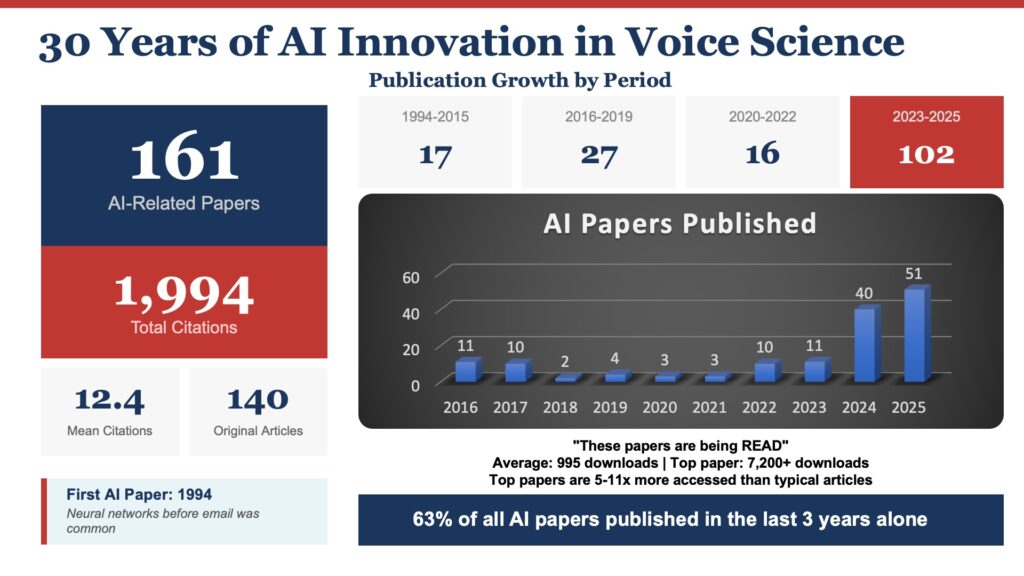
The journey began in 1994—a full thirty-one years ago—when the journal published a landmark paper by Rihkanen and colleagues titled "Spectral Pattern Recognition of Improved Voice Quality." Published during the literal infancy of the World Wide Web, before electronic mail was ubiquitous in academic offices, this research utilized rudimentary neural networks to analyze voice profiles.
During the initial two-decade phase spanning 1994 to 2015, the integration of AI was slow, methodical, and exploratory. Researchers laid foundational frameworks, publishing 17 papers that tested the waters of automated spectral analysis and early machine learning algorithms.
The Acceleration and Exponential Curve (2016–2025)
As computational power surged, the volume of AI-related research expanded exponentially. Between 2016 and 2019, the journal published 27 AI papers. The subsequent period from 2020 to 2022 yielded 16 papers, navigating the disruptions of the global pandemic while refining deep learning architectures.
Then came the modern paradigm shift. Of the 161 AI-focused papers published in the journal’s history, an astounding 102 papers—63 percent—were published in the brief three-year window between 2023 and 2025.
In the single year of 2025, the Journal of Voice published 51 AI-related articles—surpassing the cumulative total of the entire first two decades combined. This is not mere incremental growth; it represents an exponential transformation of the discipline.
Supporting Context and Metrics: Real-World Academic and Clinical Impact
Academic relevance is frequently measured in citations, but the true measure of a medical journal’s worth lies in its real-world utility among practitioners. Usage statistics for the Journal of Voice demonstrate extraordinary global reach.
The average AI-related paper published in the journal has been downloaded nearly 1,000 times. However, standout papers have achieved viral academic distribution. For instance, a pioneering study investigating machine learning methodologies for COVID-19 detection via voice analysis has been downloaded over 7,200 times—eleven times the median accessibility rate for articles within its issue.
Furthermore, the journal’s top-cited works have fundamentally guided the field:
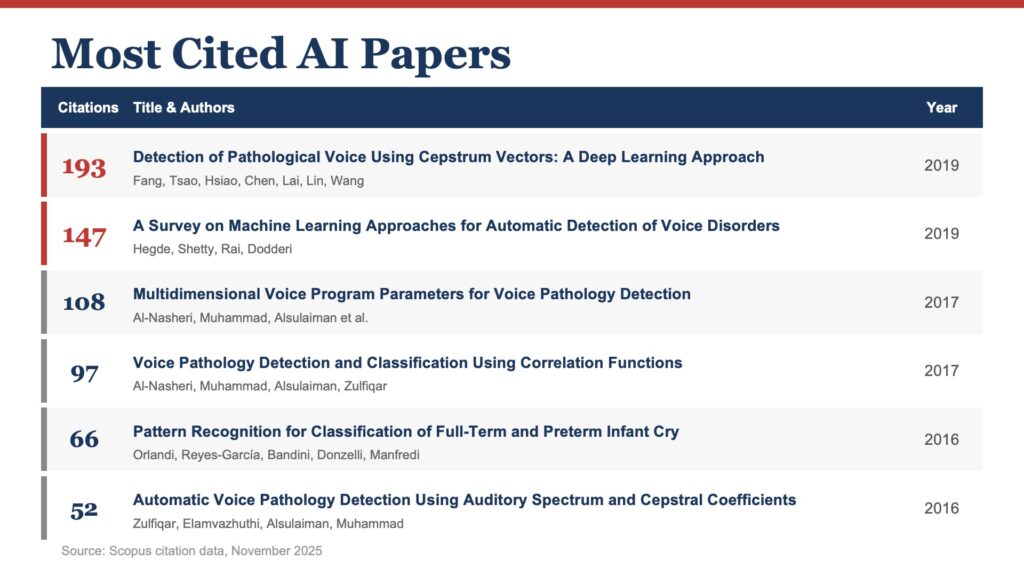
Fang and colleagues (2019): A deep learning study examining cepstrum vectors for voice pathology detection has amassed 193 citations and nearly 5,000 downloads.
Hegde and colleagues: A comprehensive survey on machine learning approaches for the automatic detection of voice disorders has secured 147 citations and close to 5,000 downloads.
These staggering figures confirm that clinicians, researchers, and speech-language pathologists are not merely archiving these studies; they are actively seeking them out as practical blueprints to elevate patient outcomes.
Landmark Research Reshaping the Field
Deep Learning for Voice Pathology Detection
The aforementioned 2019 study by Fang et al. proved that deep neural networks could identify pathological conditions within the vocal folds with remarkable precision by evaluating acoustic features completely imperceptible to the unaided human ear. This work catalyzed a wave of innovation. Subsequent studies, such as Chen and Chen’s work on deep neural networks for voice classification, Fujimura’s research utilizing one-dimensional convolutional neural networks, and Cho and Choi’s comparative analyses of CNN models applied to laryngoscopic imaging, continuously push the boundaries of diagnostic accuracy.
Voice as a Digital Biomarker
Perhaps the most transformative conceptual leap in contemporary medicine is the recognition of the human voice as a non-invasive digital biomarker—a window into systemic neurological, psychological, and respiratory health.
Research published in the Journal of Voice has broken new ground in using automated acoustic analysis to detect and monitor Parkinson’s disease. A 2022 paper by Hemmerling and Wójcik-Pędziwiatr focusing on predicting Parkinson’s severity from voice signals quickly garnered 29 citations within three years, accelerating the transition from theoretical computer science to bedside clinical application.
Beyond neurology, systematic reviews now explore vocal quality as an indicator of clinical depression and bipolar disorder. The societal implications are profound: routine, automated voice screening could flag mental health shifts early, enabling preventative interventions and easing the crushing burdens carried by traditional mental healthcare systems.
AI Chatbots in Clinical Decision-Making
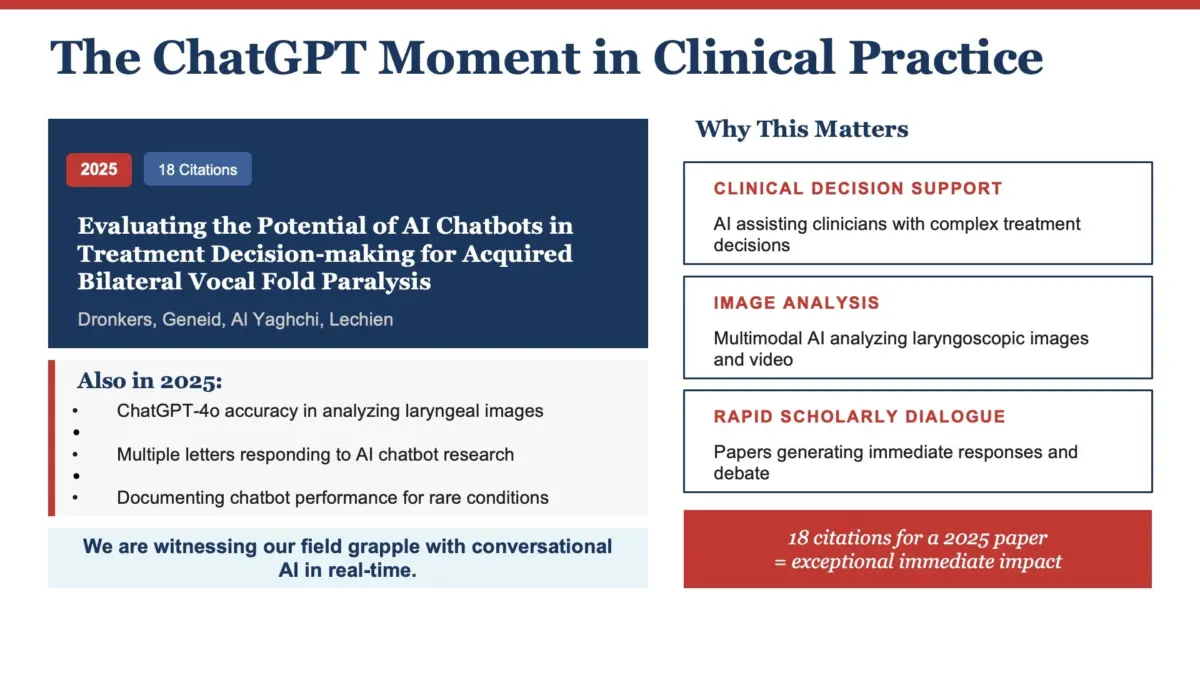
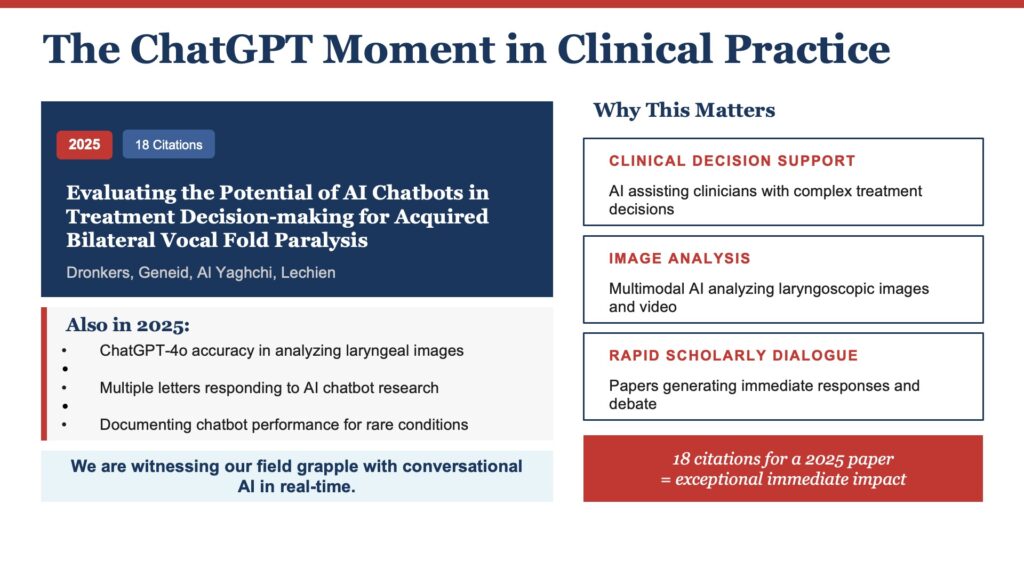
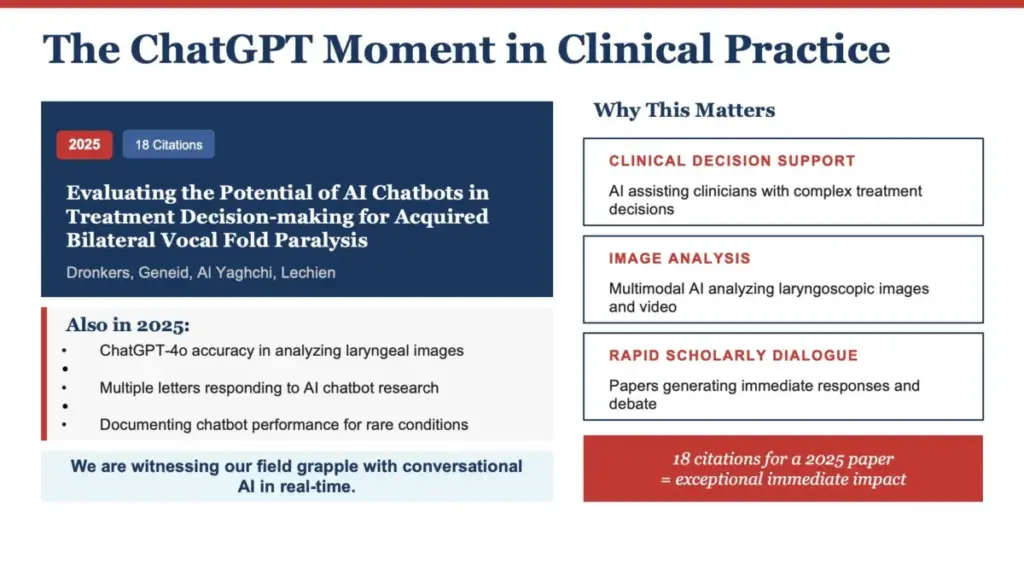
The year 2025 marked another milestone with the publication of rigorous inquiries into conversational AI and large language models within clinical workflows. Dronkers and colleagues published a study titled "Evaluating the Potential of AI Chatbots in Treatment Decision-making for Acquired Bilateral Vocal Fold Paralysis," which rapidly accumulated 18 citations. This paper provoked vibrant academic discourse, including responsive correspondence regarding ChatGPT-4o’s diagnostic accuracy in parsing laryngeal images. The field is actively and transparently grappling with the integration of conversational AI in real-time medical environments.
Official Statements and Expert Perspectives
To navigate this technological frontier responsibly, The Voice Foundation relies on the deep insights of interdisciplinary leaders who bridge computation, medicine, and academia.
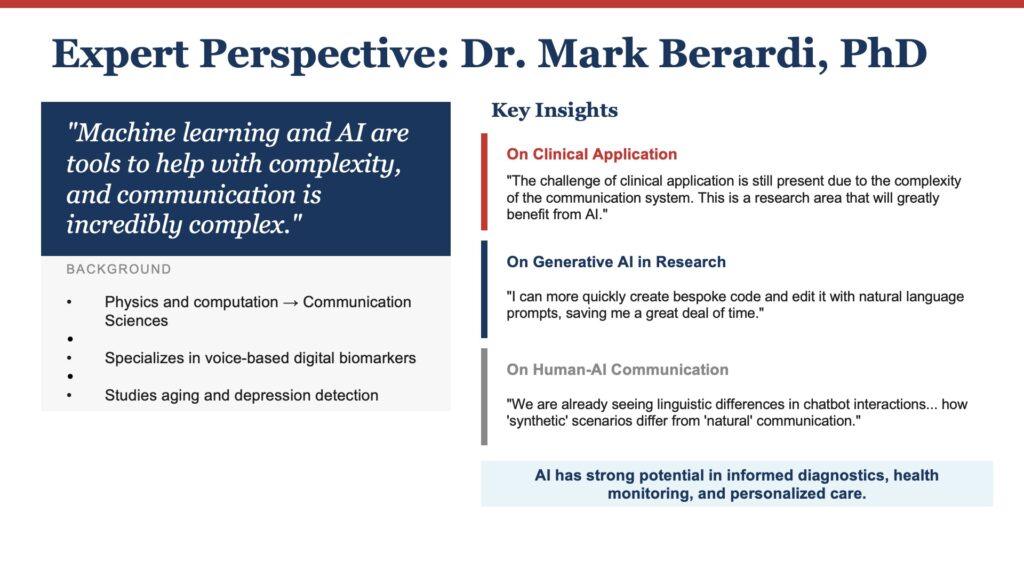
Dr. Mark Berardi: Managing Complexity and Synthetic Communication
Dr. Mark Berardi brings a rare, dual perspective rooted in physics and computation. He views artificial intelligence primarily as an indispensable instrument for managing structural complexity.
"Machine learning and AI are tools to help with complexity, and communication is incredibly complex in its neurobiological and physiological processes. So I think the application is warranted," Dr. Berardi explains.
Focusing his research on voice-based digital biomarkers for aging and depression, Dr. Berardi notes that while acquiring clean vocal signals has become straightforward, deciphering the underlying biological complexity remains challenging—making AI the ideal partner. On generative AI, he offers a pragmatic assessment, praising its ability to eliminate research bottlenecks, particularly in writing bespoke data-processing code through natural language prompts.
Intriguingly, Dr. Berardi’s lab is also investigating human-AI communication itself: how human speech patterns adapt when conversing with chatbots versus real humans, and how "synthetic" communication environments like video conferencing alter interpersonal dynamics.
"We are already seeing linguistic differences in chatbot interactions," he observes, suggesting that voice science must soon expand its scope to analyze human speech in direct conversation with machines.
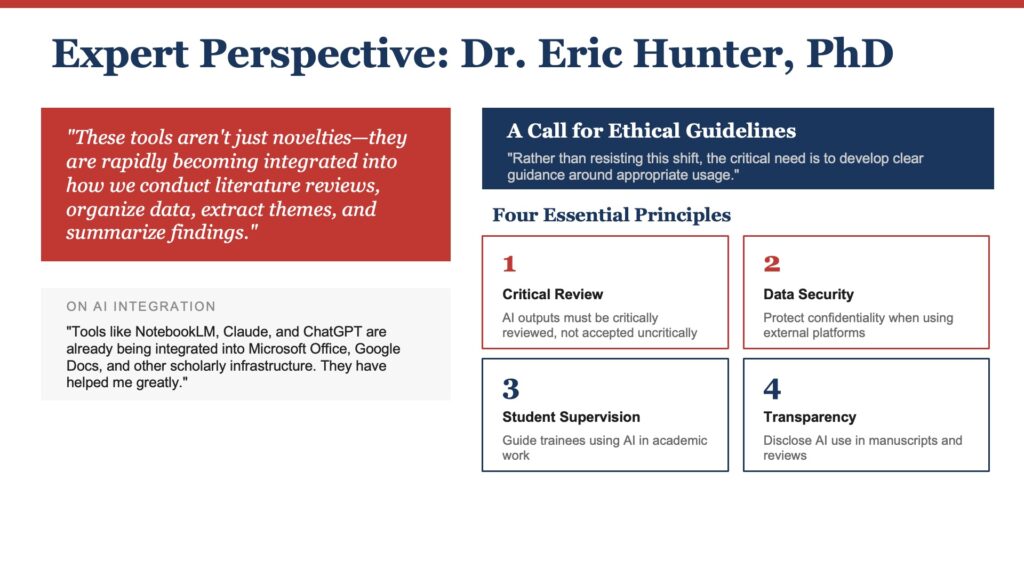
Dr. Eric Hunter: Embracing Change with Ethical Clarity
Dr. Eric Hunter focuses heavily on the institutional and academic implications of widespread AI adoption. He stresses that computational models are no longer peripheral novelties.
"These tools aren’t just novelties. They are rapidly becoming integrated into how we conduct literature reviews, organize data, extract themes from large bodies of text, and even summarize findings," Dr. Hunter asserts.
Acknowledging that large language models are permanently embedded within standard scholarly infrastructure (such as word processors and reference managers), Dr. Hunter issues a vital call to action for the scientific community: rather than resisting technological shifts, the academic sector must construct transparent guidelines for appropriate usage by authors and peer reviewers.
To achieve this, Dr. Hunter outlines four foundational principles:
Absolute Transparency: Clear disclosure of where and how generative tools were utilized in manuscript preparation.
Human Accountability: Maintaining strict authorial responsibility for the factual accuracy, intellectual integrity, and final content of published works.
Data Security and Privacy: Safeguarding patient data and proprietary recordings when utilizing third-party cloud-based AI engines.
Editorial Integrity: Training peer reviewers to identify and evaluate AI-assisted outputs without compromising rigorous scientific standards.
"Our field will benefit most," Dr. Hunter concludes, "if we embrace the productivity these tools offer while also building a shared ethical framework for their responsible use."
A Global Research Community
This computational renaissance is sustained by a vibrant, decentralized global network of scholars. Key contributors shaping the pages of the Journal of Voice include Jérôme René Lechien, Dimitar Deliyski, Stephanie Zacharias, Ahmed Yousef, Paavo Alku, Leonardo Wanderley Lopes, and Maryam Naghibolhosseini. Supported by researchers across every inhabited continent, this global collective is united by a shared dedication to demystifying the human voice through advanced mathematics.
Future Outlook and the Path Forward
As the Journal of Voice looks toward the coming decades, it remains unswervingly committed to publishing rigorous research that pushes technological boundaries while upholding uncompromising standards of scientific integrity. However, realizing this potential requires a coordinated, community-wide strategy built on three core pillars:
Thoughtful Engagement: Researchers and clinicians must master AI instruments not as autonomous decision-makers, but as sophisticated tools designed to manage complexity, amplify human expertise, and augment clinical judgment.
Collective Ethical Frameworks: The establishment of ethical guidelines—championed by leaders like Dr. Hunter—cannot be achieved by isolated institutions. It demands international collaboration across medical boards, academic journals, and technology developers.
Continuous Knowledge Sharing: The 161 AI papers archived in the journal represent merely the foundation. Clinicians, educators, and data scientists must continue sharing their unique insights to enrich our collective understanding of vocal health.
We are living through an extraordinary moment in medical history. Tools once relegated to science fiction are now empowering clinicians to decode the subtle, hidden markers of human health buried deep within acoustic waveforms. The Journal of Voice stands proudly at the center of this revolution, eager to chronicle the breakthroughs that will define the next chapter of human voice science.