
EXECUTIVE OVERVIEW
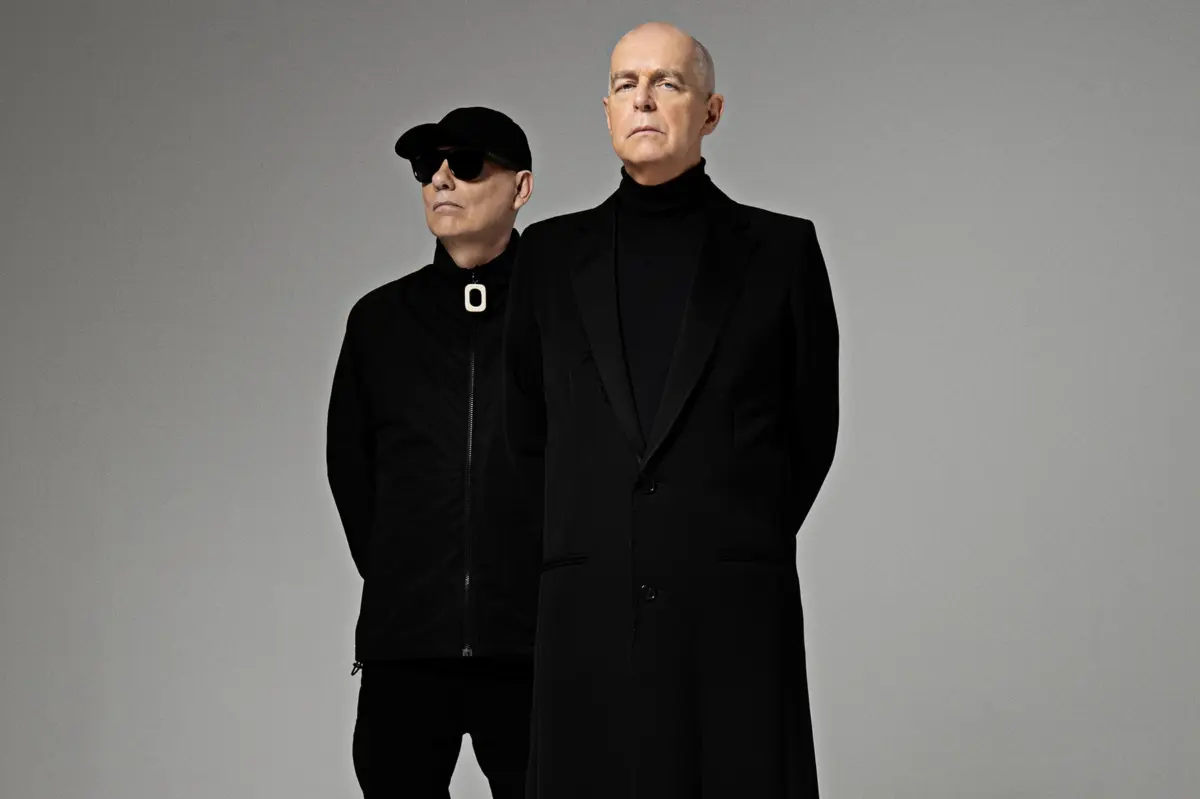
In their latest high-concept masterwork, the legendary British electro-pop duo Pet Shop Boys—comprising vocalist Neil Tennant and keyboardist/programmer Chris Lowe—have officially unveiled A Man from the Future. Released at midnight via Parlophone Records, the album serves as a profound, sweeping tribute to Alan Turing, the pioneering English mathematician, logician, cryptanalyst, and theoretical biologist widely acknowledged as the father of modern computing.
More than a decade in the making, the project is far from a standard retrospective. Instead, it is an extensively updated, reworked, and rearranged conceptual piece blending cutting-edge electronic soundscapes with lush, cinematic string arrangements by Sven Helbig, performed by the Manchester Camerata Octet. Further elevating the work’s historical gravity, acclaimed British actress Juliet Stevenson contributes stirring spoken-word passages adapted from Andrew Hodges’ definitive biography, Alan Turing: the Enigma.
Coming on the heels of their critically acclaimed 2024 album Nonetheless—which peaked at No. 2 on the Official U.K. Albums Chart—A Man from the Future demonstrates Pet Shop Boys’ enduring commitment to pushing the boundaries of pop music into high art. By chronicling Turing’s triumphs, persecutions, and tragic demise through an avant-garde prism of synthesizers and classical instrumentation, the duo has crafted both a vital musical memorial and an urgent commentary on prejudice, innovation, and the march of technology.
DETAILED CHRONOLOGY: TRACING TURING’S LIFE THROUGH EIGHT MOVEMENTS
Structured chronologically, A Man from the Future unfolds across eight distinct movements, each capturing a critical chapter in the extraordinary, turbulent life and untimely death of Alan Turing. Rather than merely setting historical facts to a beat, the Pet Shop Boys have designed an immersive auditory journey that mirrors the acceleration of Turing’s intellect and the societal friction he continually encountered.
1. Formative Years and the Awakening of Intellect
The concept album begins in Turing’s early school days, establishing an atmosphere of wide-eyed curiosity. Tennant and Lowe utilize minimalist electronic pulses interwoven with delicate string textures to evoke a young mind beginning to decipher the hidden codes of the natural world. This opening movement captures not only Turing’s early, obsessive fascination with mathematics and science but also the quiet, profound realization of his own sexuality—an intrinsic part of his identity that would ultimately bring him into direct conflict with the British establishment.
2. Cambridge and the Birth of Theoretical Logic
Moving into Turing’s university years at Cambridge, the sonic landscape expands. The arrangements grow more complex, reflecting the rigorous intellectual environment that shaped his groundbreaking 1936 paper on computable numbers. This phase of the album highlights the conceptual genesis of the "Turing machine," the theoretical foundation upon which all modern digital computers are built. The Manchester Camerata Octet’s string lines race against rhythmic, arpeggiated synthesizer lines, symbolizing the dizzying speed of abstract mathematical thought.
3. Bletchley Park and the Enigma of War
Perhaps the most historically consequential chapter of Turing’s life occupies the core of the album: his pivotal role at Bletchley Park during World War II. Working in absolute secrecy alongside fellow cryptanalysts, Turing led the effort to design the Bombe, an electromechanical machine used to successfully decrypt intercepted German Enigma messages.
Juliet Stevenson’s spoken-word contributions, drawn directly from Andrew Hodges’ text, slice through the driving electronic rhythms with chilling clarity, capturing the immense psychological pressure and high-stakes urgency of wartime intelligence. The music here is tense, industrial, and relentless—a sonic representation of gears turning, wires crossing, and humanity striving to outwit mechanized destruction.
4. The Architecture of the Digital Age and AI
As the war concludes, Turing’s vision pivots from decryption to creation. The album explores his revolutionary work in the late 1940s and early 1950s, where he laid out the blueprint for stored-program computers and theorized what would eventually become Artificial Intelligence. Tennant and Lowe lean heavily into futuristic electronic elements, evoking a mid-century vision of tomorrow that feels both optimistic and hauntingly prescient. Turing did not merely build calculating machines; he dared to ask whether machines could think.
5. Persecution, Trial, and Conviction
The mood of A Man from the Future darkens sharply as the narrative reaches the post-war social climate of 1950s Britain. In 1952, Turing was criminally prosecuted for his homosexual relationship with Arnold Murray—homosexuality then being classified as a criminal offense under British law. To avoid a prison sentence, Turing accepted court-mandated chemical castration (estrogen injections), a brutal physical and psychological ordeal.
The orchestrations by Sven Helbig turn dissonant and mournful during this movement. The juxtaposition of cold, rigid electronic sequencing with weeping, desolate strings brilliantly captures the clinical cruelty of a state turning its most brilliant mind into a criminal through systemic bigotry.

6. Final Days and Legacy
The album culminates in Turing’s tragic suicide on June 8, 1954, at the age of 41, following cyanide poisoning. Rather than ending on a note of absolute defeat, the final movements of the work pivot toward an eternalized legacy. The electronic arrangements soften into ambient, cathedral-like pads, allowing the string octet to sustain a lingering, elegiac note of remembrance. It is a musical translation of a life cut devastatingly short, yet one whose echoes continue to shape every facet of contemporary digital existence.
SUPPORTING CONTEXT & GENESIS: FROM PROMS TO PARLOPHONE
The journey of A Man from the Future to a formal commercial release is a decade-long evolution. The project was initially conceived between 2012 and 2013, a period when public awareness of Alan Turing was experiencing a renaissance, running parallel to the development of the Academy Award-winning film The Imitation Game, which famously starred Benedict Cumberbatch as the mathematician.
Seeking a profound way to honor Turing’s legacy, Neil Tennant and Chris Lowe collaborated with biographer Andrew Hodges to craft a musical narrative. In July 2014, the Pet Shop Boys gave the world its first taste of the work during a special BBC Prom at London’s iconic Royal Albert Hall, where they performed select pieces alongside orchestrations that stunned both classical purists and pop fans alike.
However, rather than rushing a studio recording to capitalize on the moment, the duo opted for patience. Over the intervening years, the project was systematically updated, reworked, and rearranged. Working closely with composer and arranger Sven Helbig, Tennant and Lowe integrated a new generation of electronic production techniques, fresh textual elements, and revitalized orchestrations performed by the Manchester Camerata Octet. The result is a work that bridges the gap between its 2014 theatrical genesis and the sonic palette of the mid-2020s.
OFFICIAL STATEMENTS: A MUSICAL MEMORIAL
The motivations behind A Man from the Future are deeply personal for the artists, who view the album not merely as an educational chronicle, but as a long-overdue cultural reckoning. In an official statement accompanying the release, Pet Shop Boys articulated the moral imperative of the project:
"Our motive in creating this work was to make a musical memorial to Alan Turing who gave so much to his country and the world and was rewarded for it by being prosecuted for his sexuality," the duo shared.
"Alan made a massive contribution to the defeat of Germany in World War II and was a pioneer of computing, imagining a world with intelligent computers. He also looked forward to a time when being gay would be accepted as normal. In both his professional and private lives, he was ahead of his time."
By framing Turing’s persecution not as an isolated historical footnote, but as a catastrophic failure of institutional imagination, the Pet Shop Boys connect the struggles of the mid-20th century to ongoing dialogues surrounding civil rights, technological ethics, and state overreach.
FUTURE OUTLOOK: COMMERCIAL STANDING & CULTURAL IMPACT
A Man from the Future arrives at a time of exceptional creative vigor for Pet Shop Boys. The album acts as the direct successor to Nonetheless (2024), which proved that the duo’s knack for crafting intelligent, melodically rich synth-pop remains entirely undiminished as it reached No. 2 on the Official U.K. Albums Chart.
Over a storied career spanning four decades, Pet Shop Boys have cemented themselves as titans of British music. In their homeland alone, they have amassed an astonishing 22 top 10 hit singles—including four chart-topping anthems—and ten top 10 albums, highlighted by their 1993 masterpiece Very. Their global footprint is equally formidable, boasting 12 appearances on the U.S. Billboard Hot 100, five top 10 hits, and the immortal 1986 dance-pop hymn "West End Girls," which climbed to No. 1.
With A Man from the Future, Tennant and Lowe have bypassed commercial safety in favor of artistic ambition, delivering a concept album that demands active listening and emotional investment. As streams pour in globally following its midnight release, the record is poised to resonate deeply with both longtime devotees of the duo’s electronic wizardry and new audiences discovering the tragic, triumphant history of Alan Turing.
In an era dominated by algorithmic conformity, Pet Shop Boys have once again proven that electronic pop music can possess historical depth, political urgency, and timeless human soul.