By Ian DeNolfo Executive Director, The Voice Foundation
Executive Overview
We stand at a profound inflection point in the history of voice science—a historic juncture where artificial intelligence (AI) has moved past the periphery to fundamentally reshape how researchers conduct experiments, analyze complex physiological datasets, and care for patients. For over half a century, the human voice has been studied at the intersection of high art and rigorous science. Today, machine learning, deep neural networks, and generative language models are serving as decryption keys, unlocking hidden layers of biological and clinical information that have long eluded the human ear.
This technological renaissance is not occurring in a vacuum. It represents the natural evolution of decades of interdisciplinary pursuit pioneered by institutions like The Voice Foundation and its flagship peer-reviewed publication, the Journal of Voice. Long before generative AI entered the public consciousness, voice scientists were leveraging computational models to recognize acoustic patterns. However, the velocity of innovation has recently gone hyper-exponential.
With over 60% of all AI-related papers in the Journal of Voice published within the last three years alone, the field is undergoing a paradigm shift. Voice is no longer viewed merely as a medium for speech and song; it is increasingly recognized as a sophisticated digital biomarker—a non-invasive, highly sensitive indicator of systemic health, neurological function, and psychological well-being. As we navigate this new frontier, the mandate for the scientific community is clear: we must embrace the unprecedented analytical power of AI while deliberately forging a shared ethical framework to govern its application.
A Legacy of Innovation: Bridging Art and Science
To understand the magnitude of today’s computational revolution, one must first look to the bedrock upon which modern voice science was built. In 1969, at a time when interdisciplinary care for the human voice was virtually non-existent, Dr. Wilbur James Gould founded The Voice Foundation in New York City. Dr. Gould possessed the visionary foresight to bring together a diverse coalition of physicians, scientists, speech-language pathologists, performing artists, and vocal pedagogues. His goal was simple yet revolutionary: pool collective expertise to improve the diagnosis, treatment, and preservation of the professional voice user.
The Foundation rapidly institutionalized this collaborative spirit, hosting its inaugural Annual Symposium—Care of the Professional Voice—in 1972, followed by its first Gala (later christened Voices of Summer) in 1973. These gatherings systematically bridged the once-impenetrable gap between the rigorous demands of the clinic and the expressive artistry of the stage.
Since 1989, the Foundation has been steered by Dr. Robert Thayer Sataloff, an internationally renowned otolaryngologist, professional singer, and conductor. Under Dr. Sataloff’s stewardship—marked by the authorship of more than 1,200 publications and 79 textbooks—the Foundation relocated its operations to Philadelphia. It has since expanded its global footprint, anchoring its mission through the annual Philadelphia Symposium and the Journal of Voice, widely recognized as the premier peer-reviewed journal dedicated exclusively to voice science and medicine.
Chronology of Computation: 30 Years of AI Research in Voice Science
A common misconception in the academic community is that artificial intelligence in medicine is an entirely novel phenomenon born out of the recent generative AI boom. In reality, the Journal of Voice has been publishing AI and machine learning research for more than three decades.
The historical timeline of computational voice analysis reveals a fascinating trajectory:
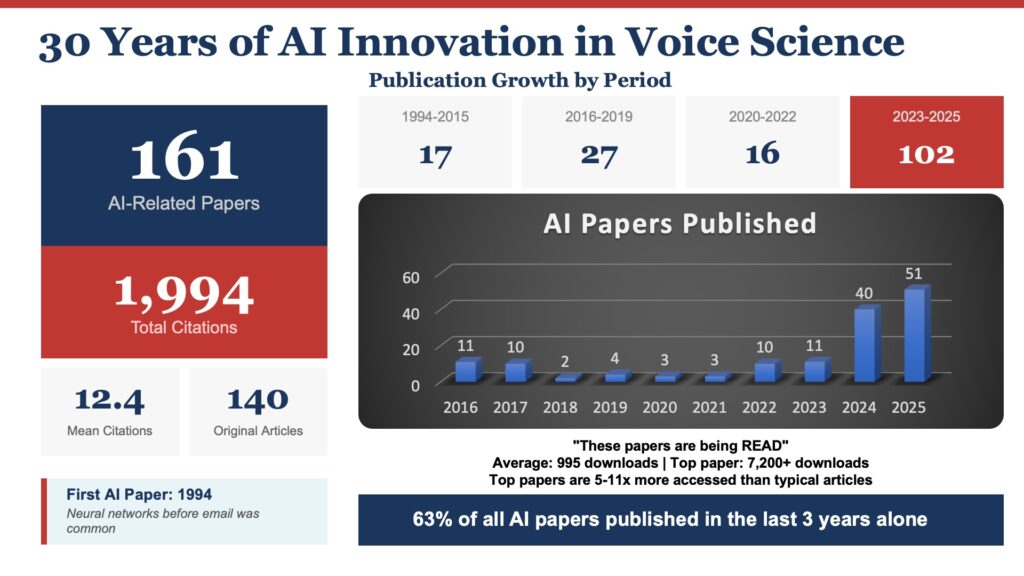
The Genesis (1994): Thirty-one years ago, the Journal of Voice published a seminal paper by Rihkanen and colleagues titled "Spectral Pattern Recognition of Improved Voice Quality." Utilizing early neural networks to analyze acoustic signals, this paper was published during the exact same year the World Wide Web was emerging into public consciousness—meaning the voice science community was applying neural networks to acoustic data before the vast majority of professionals had ever sent an electronic mail.
The Gestation Period (1994–2015): For the first two decades, AI applications in the journal grew steadily but incrementally, accounting for 17 foundational papers that established the mathematical viability of automated voice classification.
The Acceleration Phase (2016–2022): As computational processing power surged and machine learning frameworks matured, publications climbed to 27 papers between 2016 and 2019, followed by another 16 papers from 2020 through 2022.
The Exponential Explosion (2023–2025): The current era represents a staggering vertical takeoff. Out of 161 total AI-related papers published in the journal’s history, 102 papers—63 percent—have been published in just the last three years. In the year 2025 alone, the journal published 51 AI-related papers, eclipsing the total volume of the entire first two decades combined.
Supporting Context and Metrics: Real-World Impact and Global Reach
Academic citations are often treated as insulated metrics of prestige, but in the case of AI research within the Journal of Voice, citation counts tell a story of immediate, real-world clinical utility. Clinicians, researchers, and speech-language pathologists around the globe are actively downloading and applying these computational frameworks to solve complex diagnostic challenges.
Usage and Citation Milestones
High Download Velocity: The average AI-focused paper published in the journal is downloaded nearly 1,000 times, a testament to the high demand for actionable computational tools in clinical environments.
The Pandemic Sentinel: The most-accessed AI paper in the journal’s history—a groundbreaking study examining machine learning algorithms for COVID-19 detection via acoustic features—has surpassed 7,200 downloads, performing at eleven times the median rate for articles in its issue.
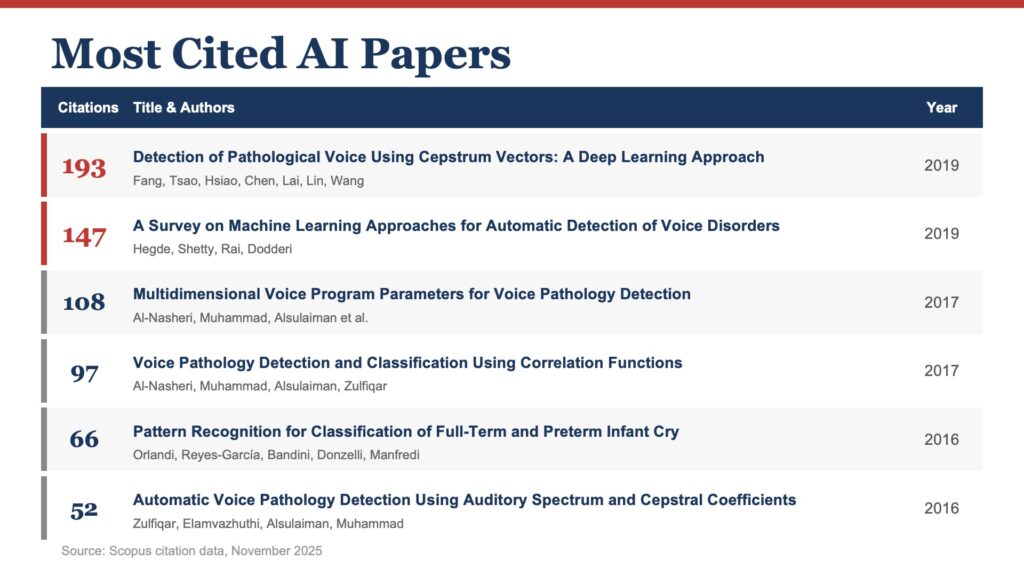
Pioneering Literature: The two most-cited papers—Fang and colleagues’ deep learning study on pathology detection (193 citations) and Hegde’s comprehensive machine learning survey (147 citations)—have each been downloaded nearly 5,000 times, anchoring contemporary clinical workflows.
Global Collaborative Networks
This intellectual momentum is powered by a truly global research ecosystem. Leading contributors to AI voice research span multiple continents, featuring prominent work from scholars such as Jérôme René Lechien (6 papers), Dimitar Deliyski (5 papers), Stephanie Zacharias (5 papers), and Ahmed Yousef (4 papers as first author), alongside foundational contributions from Paavo Alku, Leonardo Wanderley Lopes, and Maryam Naghibolhosseini.
Landmark Research Reshaping the Field
The technological applications published in the Journal of Voice generally fall into three transformative categories: pathology detection, digital biomarkers, and clinical decision support.
1. Deep Learning for Voice Pathology Detection
The human ear is an extraordinary instrument, yet it possesses inherent physiological limits. In 2019, Fang and colleagues published "Detection of Pathological Voice Using Cepstrum Vectors: A Deep Learning Approach," which currently stands as the most-cited AI paper in the journal’s history (193 citations). This work proved that deep neural networks could identify subtle laryngeal pathologies with remarkable precision by evaluating acoustic features completely imperceptible to human auditory perception.
This study built upon earlier taxonomies, such as Hegde’s survey on automated voice disorder detection (147 citations) and Al-Nasheri’s multidimensional parameter analyses. In recent years, the discipline has progressed toward sophisticated architectures, including Chen and Chen’s deep neural network classifications, Fujimura’s one-dimensional convolutional neural networks (CNNs), and Cho and Choi’s comparative analyses of CNN models applied to laryngoscopic imagery.
2. Voice as a Digital Biomarker
Perhaps the most paradigm-shifting development in modern medicine is the conceptualization of the human voice as a non-invasive digital biomarker—a window into systemic, neurological, and mental health.
Researchers have made massive strides in utilizing acoustic analysis to monitor neurodegenerative conditions. For instance, Hemmerling and Wójcik-Pędziwiatr’s 2022 paper on predicting the severity of Parkinson’s disease from voice signals quickly garnered significant academic attention, laying the groundwork for continuous remote patient monitoring. Beyond neurology, systematic reviews published in the journal have begun exploring voice quality as a sentinel metric for depression, bipolar disorder, and acute respiratory illnesses like COVID-19. The clinical implications are profound: routine, automated voice screening could soon enable early behavioral health interventions, significantly easing the burden on overstretched healthcare systems.
3. AI Chatbots and Clinical Decision-Making
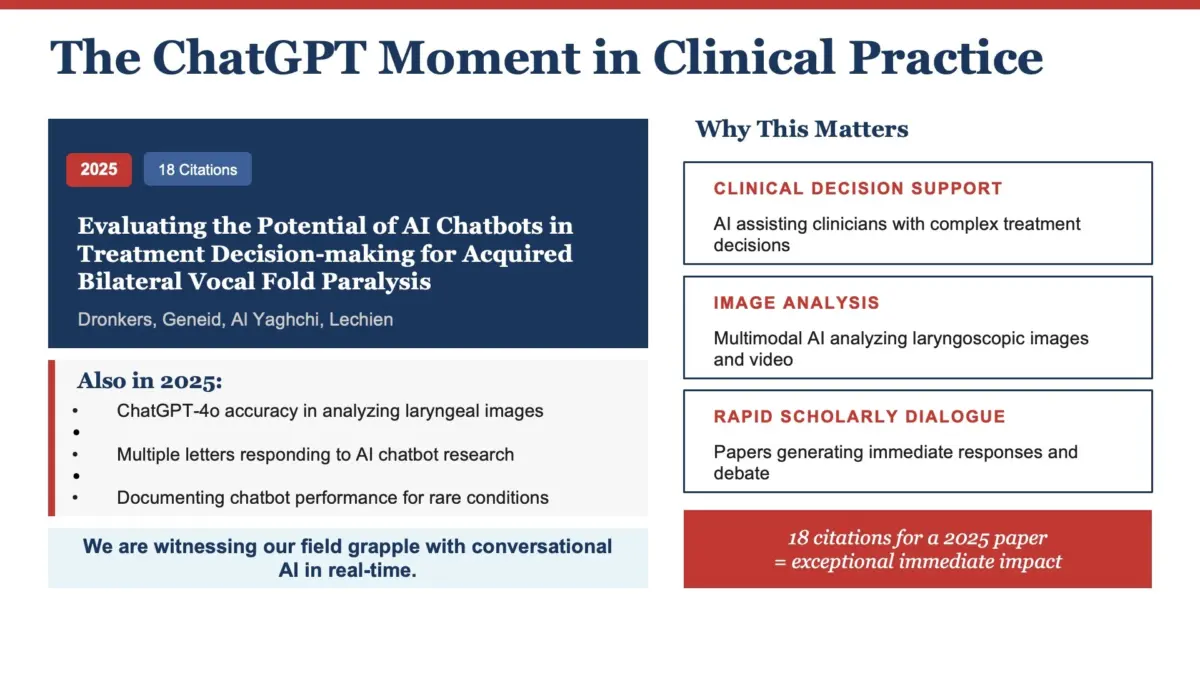
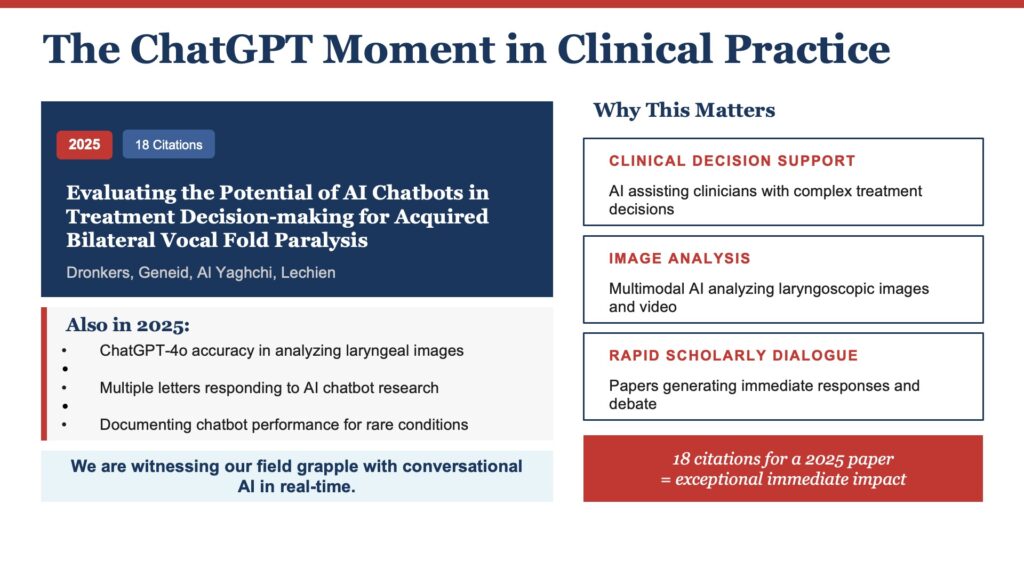
The year 2025 marked the advent of conversational AI integration within clinical literature. A prominent paper by Dronkers and colleagues, "Evaluating the Potential of AI Chatbots in Treatment Decision-making for Acquired Bilateral Vocal Fold Paralysis," accumulated immediate citations and sparked rigorous debate through letters to the editor. Subsequent investigations evaluated large language models (such as ChatGPT-4o) on their precision in interpreting complex laryngeal images, forcing the medical community to confront the realities—and limitations—of conversational AI in patient care.
Expert Perspectives on AI in Voice Science
To unpack the cultural and operational shifts accompanying this technological surge, two prominent voices in the field offer vital institutional and philosophical perspectives.
Dr. Mark Berardi: Managing Complexity and Synthetic Communication
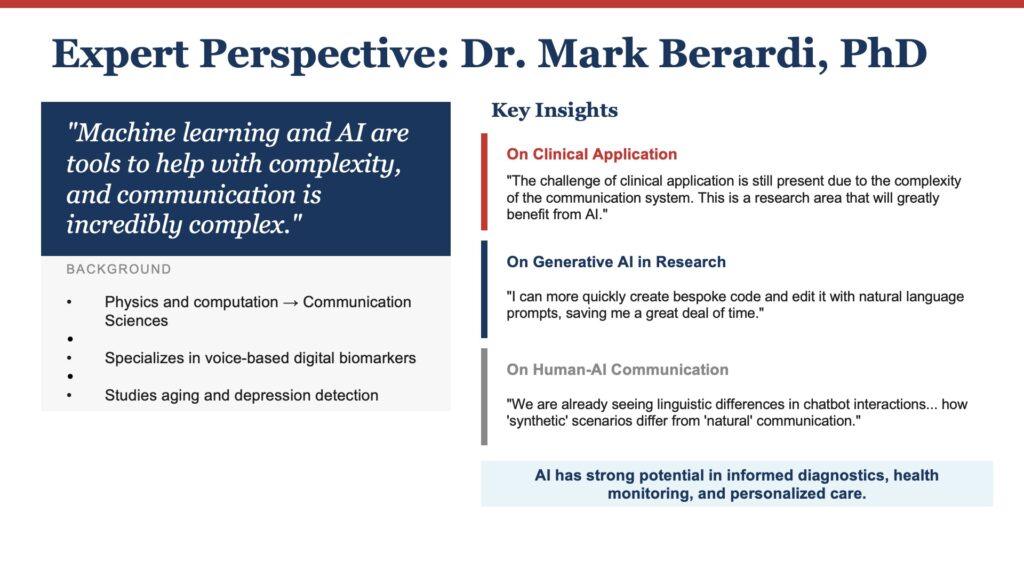
Drawing from a background in physics and computation, Dr. Mark Berardi views artificial intelligence primarily as an indispensable tool for managing multidimensional complexity.
"Machine learning and AI are tools to help with complexity, and communication is incredibly complex in its neurobiological and physiological processes. So I think the application is warranted," Dr. Berardi explains.
His current research centers on extracting health insights—such as aging and depression markers—from easily acquired speech signals. While he notes that generative AI has not entirely rewritten the foundational laws of scientific discovery, it has revolutionized daily execution: "It helps us address some of the bottlenecks we have in research—particularly in coding and data processing. I can now quickly create bespoke code and edit it with natural language prompts."
Intriguingly, Dr. Berardi’s work also examines the sociology of human-computer interaction. He investigates how human linguistic patterns adapt when speaking to conversational chatbots versus human interlocutors, and how synthetic environments like Zoom alter interpersonal communication. As he notes, the scientific community may soon need to expand its purview beyond the natural human voice to study human vocal behavior in direct conversation with machines.
Dr. Eric Hunter: Embracing Change with Ethical Clarity
Dr. Eric Hunter focuses heavily on the structural and institutional integration of AI into academic and clinical workflows.
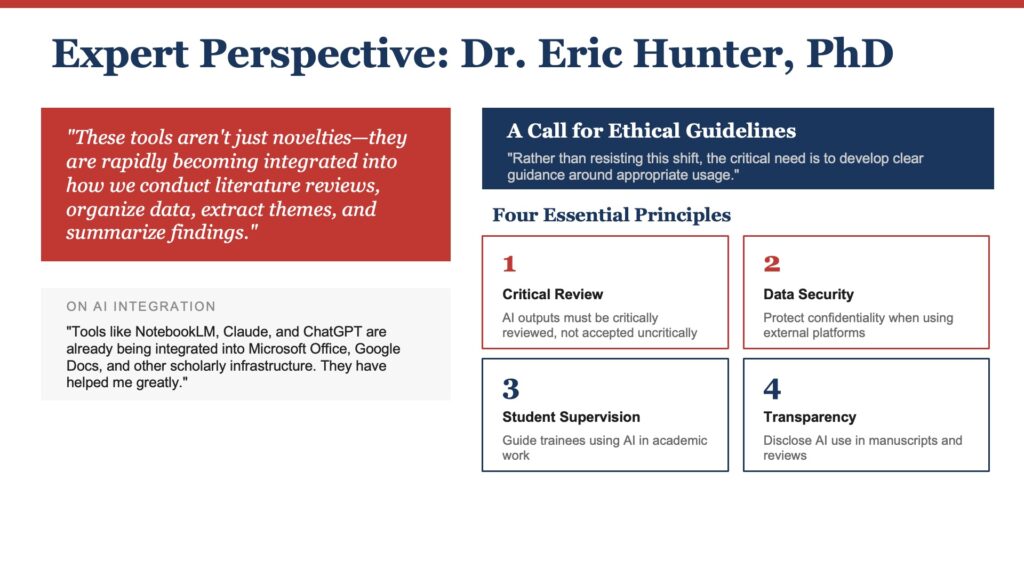
"These tools aren’t just novelties," Dr. Hunter observes. "They are rapidly becoming integrated into how we conduct literature reviews, organize data, extract themes from large bodies of text, and even summarize findings."
Dr. Hunter issues an essential call to action regarding the inevitability of large language models in scholarly infrastructure. Rather than fighting an ideological rearguard action against automation, he advocates for proactive clarity: "Our field will benefit most if we embrace the productivity these tools offer while also building a shared ethical framework for their responsible use." He outlines the necessity for transparent guidelines governing data privacy, algorithmic accountability, manuscript generation, and peer-review integrity.
Future Outlook and Strategic Imperatives
As we look toward the next decade, the Journal of Voice and The Voice Foundation remain dedicated to publishing rigorous, boundary-pushing research while safeguarding the highest standards of scientific integrity. However, this transition requires a coordinated, community-wide strategy built upon three fundamental pillars:
Thoughtful Engagement with Complexity: Researchers and clinicians must treat AI algorithms as cognitive amplifiers rather than infallible oracles. We must master their capabilities while maintaining strict clinical and scientific oversight.
The Establishment of Ethical Frameworks: As Dr. Hunter emphasizes, the development of ethical boundaries regarding AI-assisted writing, data processing, and clinical decision support cannot be achieved by isolated labs. It requires a unified, international consensus across all medical and artistic disciplines.
Open Scientific Collaboration: The 161 AI papers published to date represent only the opening chapter of a much larger story. Every clinician, educator, and vocal artist possesses unique insights that can enrich our collective understanding of the human instrument.
Conclusion
For hundreds of thousands of years, the human voice has served as our ultimate instrument of connection, emotional expression, and personal identity. It carries the nuances of our spirit, our health, and our deepest vulnerabilities in ways that no other biological signal can replicate.
Now, for the first time in human history, we possess analytical tools sophisticated enough to truly decode that complexity—tools that can extend the reach of expert clinicians, catch subtle physiological pathologies before they escalate into crises, and democratize access to high-quality voice care across the globe.
We are living through a truly extraordinary moment, and The Voice Foundation alongside the Journal of Voice stands proudly at its epicenter. The next decade promises discoveries we are only just beginning to imagine, and we look forward to charting that sonic frontier together.