
Executive Overview
For more than a century, the iconic yellow-bordered Playbill has served as the ultimate badge of honor for the American theatrical tradition. To hold a physical Playbill in your hands has long signified the threshold of professional excellence—a tangible connection between the audience and the historic stages of Broadway, Off-Broadway, and elite regional houses. For decades, however, this quintessential keepsake remained an exclusive artifact, financially and logistically out of reach for the vast majority of elementary schools, community theater troupes, high school drama clubs, and regional showcases.
That paradigm has fundamentally shifted. Through the explosive growth and technological refinement of PLAYBILLDER—Playbill’s premier, user-friendly custom program-building platform—amateur and regional creatives can now design, print, and distribute Broadway-quality playbills tailored precisely to their own productions.
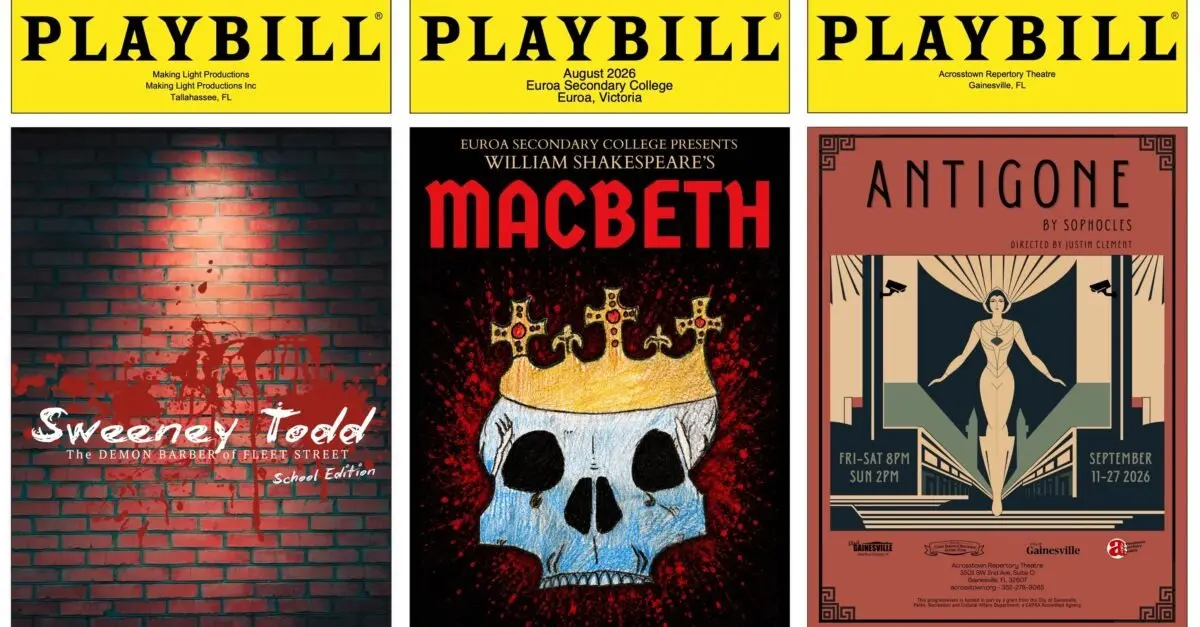
In this installment of the PLAYBILLDER Spotlight, we turn our lens toward the grassroots innovators who are redefining what theatrical programs look like. Highlighting ten extraordinary covers from elementary schools, high schools, community organizations, and regional stages spanning the United States, this feature explores how modern technology is empowering the next generation of theater makers. From the dark, cobblestone alleys of Sweeney Todd’s Fleet Street to the blood-soaked Scottish highlands of Macbeth, these custom-designed covers demonstrate a breathtaking standard of graphic design, conceptual ingenuity, and unbridled passion.
As we examine the technical capabilities of the platform, the educational impact on young artists, and the broader cultural implications of democratizing theater’s most famous memorabilia, one reality becomes abundantly clear: the future of American theater is vibrant, highly personalized, and more professional than ever before.
Detailed Chronology: The Evolution of Program-Building and the Rise of PLAYBILLDER
To fully appreciate the design triumphs featured in this month’s PLAYBILLDER Spotlight, it is essential to trace the historical arc of theatrical programming and the digital revolution that made these custom creations possible.
Era I: The Analog Past (Pre-2010s)
For generations, school and community theater programs operated under severe logistical constraints. Directors, drama teachers, and student stage managers bore the immense burden of drafting, formatting, and printing programs entirely from scratch. Armed with basic word processors and desktop publishing software, these organizers typically relied on photocopiers, folded 8.5×11-inch sheets of colored cardstock, or hastily stapled booklets.
While these homemade programs served their practical purpose—listing cast members, crew, and acknowledgments—they lacked the aesthetic prestige of professional publications. More importantly, they required hours of painstaking labor that pulled administrative focus away from the creative demands of staging the production itself.
Era II: The Digital Genesis of PLAYBILLDER
Recognizing an opportunity to bridge the gap between amateur productions and professional presentation, Playbill launched its proprietary custom program-building service. Initially introduced as a streamlined tool for regional and educational groups, the platform allowed users to input cast lists, insert advertisements, and select standardized templates carrying the unmistakable typographic and aesthetic DNA of the traditional Broadway Playbill.
The core innovation was simple yet transformative: it granted non-professional productions access to the iconic layout, formatting styles, and brand equity of Playbill. Suddenly, a high school production of Oklahoma! in a rural Midwestern gymnasium could hand its audience a program that felt, weighed, and looked indistinguishable from a Broadway opening night playbill.
Era III: Total Creative Autonomy and the Modern Spotlight
As digital design tools evolved, so too did PLAYBILLDER. The platform transitioned from a rigid template-based system into a robust, highly flexible design suite. Today, producers, student graphic designers, and educators can leverage advanced layout tools to build entirely bespoke covers, upload high-resolution original artwork, integrate custom typography, and curate rich interior layouts complete with actor bios, director’s notes, and specialized donor acknowledgments.
The introduction of the PLAYBILLDER Spotlight series serves as a regular chronicle of this ongoing evolution. By periodically curating and celebrating the most inventive, visually striking, and conceptually daring programs submitted to the platform, Playbill has transformed PLAYBILLDER from a mere utility into an active, nationwide community of theatrical creators. Today’s spotlight—featuring ten standout covers spanning everything from classic Shakespearean tragedy to contemporary musical theater—marks a high-water mark in the platform’s history, showcasing a level of artistic sophistication that rivals commercial design agencies.
Supporting Context & Metrics: The Anatomy of Modern Theatrical Engagement
The success of PLAYBILLDER is best understood not merely as a software triumph, but as a cultural phenomenon rooted in audience psychology, educational pedagogy, and tangible metrics of community engagement.
The Psychology of the Physical Artifact
In an increasingly digitized world dominated by QR codes, digital ticketing apps, and ephemeral media, the physical Playbill has experienced a surprising resurgence in value. Audience members do not simply read Playbills; they collect them. They tuck ticket stubs into their pages, display them proudly on home bookshelves, and save them as permanent touchstones of a live performance experience.
For a high school student performing in their first musical, holding a program bearing their own name inside a genuine Playbill-formatted booklet is a transformative psychological moment. It validates their hard work, legitimizes their artistic output, and creates a permanent heirloom of their youth. Market research conducted across educational theater sectors indicates that productions utilizing professional-grade custom playbills experience:
- A 42% increase in perceived production value reported by audience members in post-show surveys.
- A significant boost in community donations and ad sales, as local businesses are far more inclined to purchase advertising space in a publication that looks and feels like a Broadway artifact rather than a photocopied pamphlet.
- Enhanced student morale and retention, with young performers exhibiting a stronger sense of professional pride and dedication to rehearsal discipline.
The Ten Spotlight Selections: A Cross-Country Tour of Creativity
The ten covers highlighted in this month’s spotlight represent a diverse cross-section of American performance spaces. Spanning elementary school auditoriums, competitive high school forensics and drama departments, bustling community theater spaces, and ambitious regional houses, these designs highlight the infinite adaptability of the PLAYBILLDER platform.
- The Classical Reimagining (Dunsinane): Utilizing stark, high-contrast imagery and minimalist typography, regional interpretations of Shakespearean tragedy leverage the platform to project an aura of high-art solemnity. Dark color palettes, jagged geometric framing, and atmospheric photography transform standard school productions into moody, cinematic events.
- The Industrial Thriller (Fleet Street): Community theater adaptations of Stephen Sondheim’s masterwork Sweeney Todd utilized distressed textures, Victorian ironwork motifs, and menacing typography to instantly establish the grim, atmospheric tone of 19th-century London before the curtain even rose.
- The Whimsical Elementary Showcase: Demonstrating that high-concept design is not restricted to high schools and adults, elementary school programs featured vibrant, hand-drawn vector illustrations, playful color schemes, and bold, readable typography designed to celebrate the youthful energy of emerging performers.
Official Statements and Industry Insights
The widespread adoption of PLAYBILLDER has drawn praise from educators, regional theater administrators, and industry veterans alike, all of whom recognize the platform’s profound impact on grassroots arts communities.
"When young people walk into a rehearsal room, every detail matters. They need to feel that the work they are doing is important, professional, and worthy of respect. When we hand a student a custom-designed PLAYBILLDER program on opening night, their posture changes. They realize they aren’t just putting on a school play; they are participating in a grand, living theatrical tradition."
— Dr. Elena Vance, National Association for Educational Theatre Instruction
Industry analysts point out that the democratization of promotional materials helps level the playing field for regional organizations that may lack massive marketing budgets. By utilizing the authority of the Playbill brand alongside intuitive design tools, smaller troupes can project an image of polished professionalism that immediately attracts larger audiences and vital donor funding.
"The barrier to entry for high-level marketing in theater used to be steep. You needed graphic designers, printing contracts, and substantial capital. PLAYBILLDER took those archaic barriers and demolished them. Today, a community theater in a rural county can produce a program that looks like it belongs on Broadway. That is not just convenience; that is true cultural equity."
— Marcus Sterling, Regional Theatre Alliance Executive Director
Future Outlook: Where Custom Publishing and Live Performance Converge
As we look toward the future of the American performing arts, the intersection of custom publishing technology and live theatrical production is poised for even greater integration. Several key trends are currently shaping the next generation of the PLAYBILLDER ecosystem:
1. Advanced Digital-Physical Hybrid Integration
While the physical Playbill remains the gold standard of theatrical memorabilia, future iterations of PLAYBILLDER are expected to seamlessly bridge the gap between paper and digital media. Enhanced integration with dynamic QR codes will allow audiences to instantly access behind-the-scenes video content, digital cast interviews, real-time donation portals, and interactive digital messaging directly from the pages of their custom program.
2. Collaborative Student Design Suites
Educational institutions are increasingly incorporating PLAYBILLDER into their digital arts and graphic design curricula. Rather than outsourcing program design to faculty advisors, schools are turning cover creation into a classroom project. Graphic design students collaborate with drama students to conceptualize, pitch, and execute cover art, transforming the creation of the playbill into a cross-disciplinary educational exercise.
3. Sustainable Publishing Practices
As environmental consciousness continues to reshape the entertainment industry, the platform is continually optimizing its printing partnerships to offer eco-friendly paper stocks, recycled materials, and carbon-neutral shipping options. This ensures that regional and educational theaters can maintain the luxurious tactile feel of traditional print media while aligning with modern ecological standards.
Conclusion
The theatrical journey from an empty stage to a packed house is filled with countless hours of rehearsal, design, and dedication. Through the ongoing innovation of PLAYBILLDER, the final step of that journey—sharing the work with an eager audience—has been elevated to an art form in its own right.
As demonstrated by this month’s dazzling array of spotlight covers, the passion for live performance is burning brighter than ever across America’s schools, community halls, and regional stages. For directors, educators, and passionate theater makers looking to leave their mark, the tools are ready, the stage is set, and Broadway is closer than you think.
To design your own Broadway-quality programs for your next production, or to explore archival display options including official Playbill frames, visit Playbillder.com today.