For decades, the global music industry has operated on a high-stakes, high-velocity treadmill of hyper-commodification, rapid technological disruption, and corporate consolidation. From the algorithmic black boxes of streaming giants to the creeping shadow of generative artificial intelligence (AI), creators and independent stakeholders have found themselves increasingly navigating uncharted waters with fewer footholds.
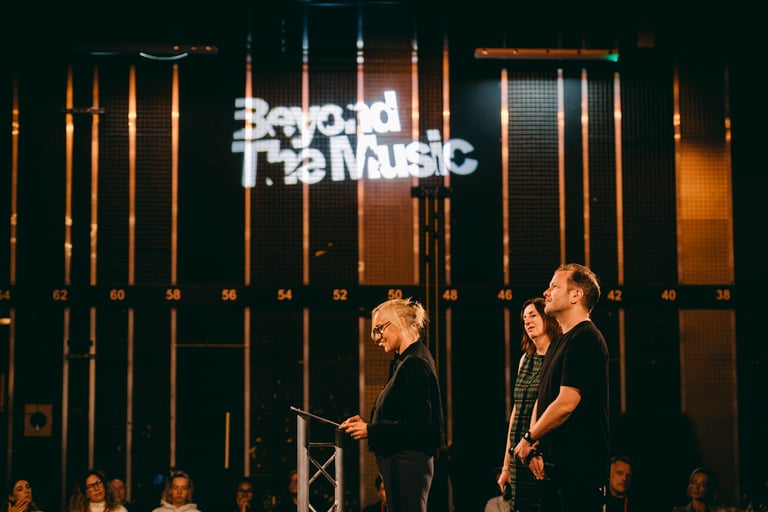
Yet, in October, the answer to this modern crisis did not emerge from the corporate boardrooms of London, Los Angeles, or New York. Instead, it surfaced from the industrial hearth of Greater Manchester—specifically Salford’s MediaCity—during the third annual Beyond the Music summit.
Founded in 2023 by a coalition of northern visionaries including Oli Wilson, Rose Marley, and Sarah Pearson, the event was designed to be more than a standard music showcase. It has rapidly evolved into an insurgent policy-and-practice conference. Notably absent from this year’s proceedings was Andy Burnham, the newly appointed Prime Minister and co-convenor of the summit’s inaugural AI discussions. But Burnham’s absence was not felt as a vacuum; rather, it served as proof of a thriving local pipeline. The decentralized ethos, grassroots organizing, and policy frameworks championed by Manchester were successfully graduating to a national level.
In a week defined by urgent panels, blistering live performances, and critical debates, the summit culminated in the historic unveiling of The Manchester Principles—a five-point manifesto designed to safeguard creators against the perils of the unfolding AI-driven industrial revolution.
Detailed Chronology: A Week of Reckoning in Greater Manchester
Day One: Opening Salvos and the Ghost of Factory Records
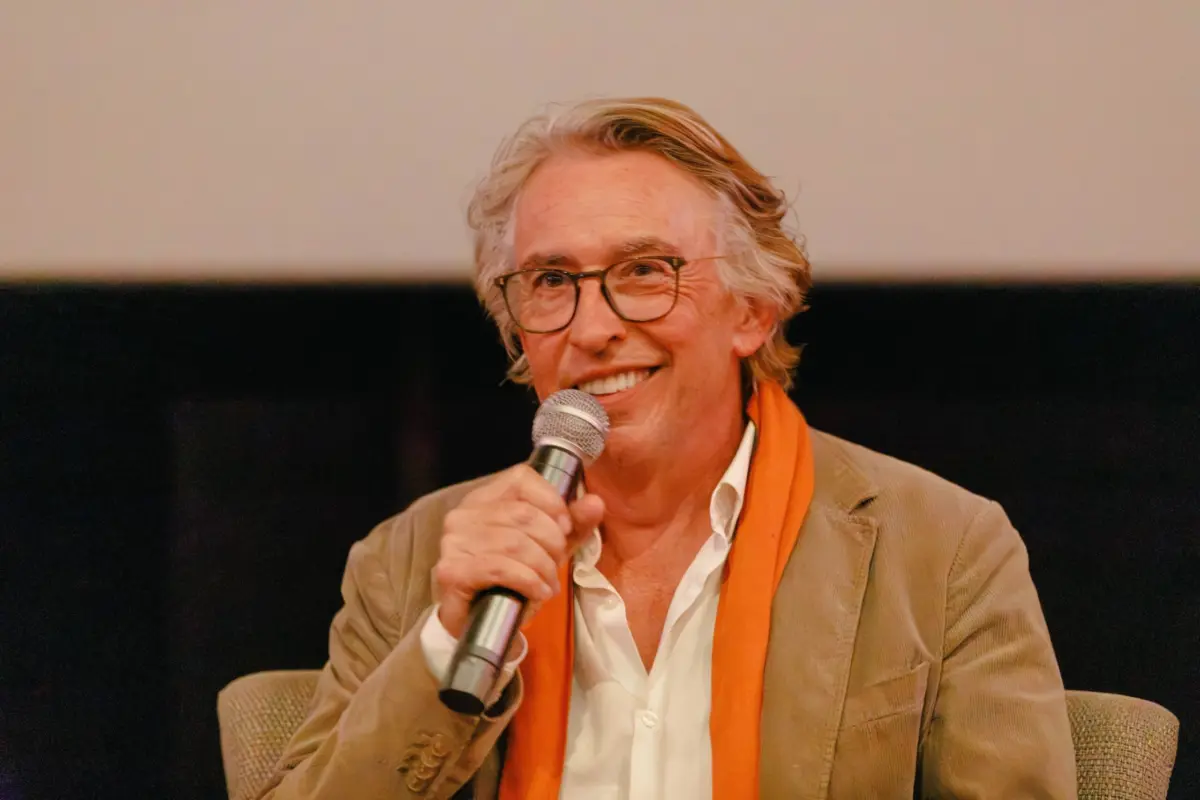
The tone for the blustery October week was set on opening night at Dock10 studios in MediaCity. Before a 24th-anniversary screening of Michael Winterbottom’s iconic 24 Hour Party People, actor Steve Coogan delivered a sharp, anchoring keynote. Coogan famously portrayed Tony Wilson—the visionary force behind Factory Records and the late father of summit co-founder Oli Wilson—in the 2002 film.
"He’d probably take a bit of a dim view of all this self-congratulatory back-patting that we’re all doing, although he’d secretly like it as well," Coogan remarked, addressing the gathered industry leaders, artists, and activists. "He was always looking forwards. What’s next? Be creative. Move on. Don’t look backwards. And in that way, he set the bar."
Coogan’s invocation of Wilson’s forward-thinking, anti-establishment mantra established an immediate baseline: resting on past laurels is how empires fall.
Day Two: The State of Independence and the Power of Fandom
The momentum shifted on Thursday to the "State of Independence" summit, where delegates interrogated the modern realities of breaking artists outside the traditional major-label pipeline. Katherine Cantwell, social media manager for Heavenly Recordings, offered a compelling case study through her work with the fiercely independent, Irish-language rap group Kneecap.
Despite an appeal that might traditionally be considered esoteric, Kneecap has drawn crowds of 10,000 screaming fans across Australia. Cantwell noted that the band’s explosive international resonance tapped into a deep, cross-cultural youth sentiment rooted in anti-colonialism. However, Cantwell did not shy away from industry contradictions, openly addressing Heavenly’s recent distribution deal with PIAS and its subsequent alignment with Universal.
"It kind of goes against the ethos of what Heavenly is," Cantwell admitted. "Artists are saying to us, ‘we’re not sure about that Universal bit.’" This radical transparency mirrors the foundational Factory Records philosophy that artists must retain the autonomy to forge their own paths—a sentiment echoed by modern breakout stars like RAYE, who famously fought her way out of a restrictive major-label contract to sweep the 2024 BRIT Awards.
Day Three: Music as a Catalyst for Global Change
Perhaps the most conceptually challenging yet practically grounded panel of the week was "How Music Can Save The World," featuring author Shain Shapiro and climate advocate Tori Tsui. Moderated by Sean Adams, the discussion examined music’s untapped capacity to provoke un-musical actions—such as writing to a Member of Parliament, purchasing sustainable goods, or investing in community green energy.
"Music has the power to get people to do stuff that’s not musical: buy a T-shirt, write to an MP—none of that would happen without the music," Shapiro argued, emphasizing the deep emotional architecture underpinning fan communities.
Tori Tsui reinforced this, noting the unparalleled influence wielded by artists like Billie Eilish, whose uncompromising stance on climate advocacy mobilizes millions of devoted followers. The panel transitioned from theoretical high-mindedness to concrete action by highlighting the pioneering work of Heidi Lenffer, vocalist for Australian rock band Cloud Control and co-founder of FEAT. Lenffer redirected tour profits into a local solar farm, ultimately scaling the initiative into a multi-million-dollar program funding sustainable battery technology for live events and restoring an Indigenous bioreserve in Tasmania.
Supporting Context & Metrics: Echoes of the 1844 Rochdale Pioneers
To truly understand the gravity of Beyond the Music, one must look beyond the immediate challenges of the modern music business and examine historical parallels.
During her opening remarks, Rose Marley—dubbed the "Queen of the North"—drew a direct line from the current technological watershed to the year 1844. At the height of the first Industrial Revolution, the quality of life for working-class Britons was nosediving due to unchecked technological advancement, adulterated goods (such as arsenic-laced sugar and rat-feces-contaminated flour), and crushing poverty.
In response, 28 weavers and artisans in Rochdale, Greater Manchester, pooled their meager resources—contributing £1 per person—to open their own cooperative store selling pure, fairly priced goods. The resulting Rochdale Society of Equitable Pioneers established the foundational tenets of the modern cooperative movement: open membership, democratic one-member-one-vote governance, and political neutrality.
Generative AI impersonation, streaming monopolies, algorithmic disenfranchisement.
Power Imbalance
Industrial factory owners holding absolute economic leverage over laborers.
Streaming monoliths (Spotify) and the "Big Three" major labels centralizing profit and distribution.
The Grassroots Response
The Rochdale Pioneers founding the cooperative movement (£1 per share).
Beyond the Music and the establishment of The Manchester Principles.
Core Philosophy
Fair value, mutual aid, democratic ownership, and radical autonomy.
Equitable compensation, creator consent, cross-sector solidarity, and open access.
Just as the 19th-century pioneers erected guardrails against the excesses of early industrialization, today’s creative community in Salford is drawing a line in the sand against algorithmic exploitation and unchecked corporate consolidation.
Official Statements and the Unveiling of the Manchester Principles
The definitive highlight of the summit arrived on Friday with the official unveiling of The Manchester Principles. Drafted after intensive, multi-day roundtables involving independent creators, major label representatives, technologists, and activists, these five guidelines serve as an ethical compass for navigating an industry increasingly dominated by AI and hyper-consolidation:
Working Together: We start from what we share, and talk in good faith.
Fair Value: If your work makes the money, you get a fair share, big or small.
Respect for Creators and Their Works: Ask first, give credit, treat people and what they’ve made properly.
Investing in the Next Generation: Skills and chances for those coming through.
Open to All: Everybody’s welcome; you don’t need to agree on every detail to have a seat.
Molly Neuman, President of CD Baby and a foundational figure in the 1990s Washington D.C. riot grrrl movement (having drummed in Bratmobile), served as a vital bridge between boardrooms and DIY counterculture. Reflecting on the summit’s collaborative spirit, Neuman noted:
"Any opportunity to come together as a music community, no matter how experienced or early in your career you are, creates a chance for learning and connecting, which is crucial in our increasingly siloed and digital lives. It’s important to think critically about what’s presented, to listen between the lines and know when things are talking points—even from me!—or when they are valuable and insightful."
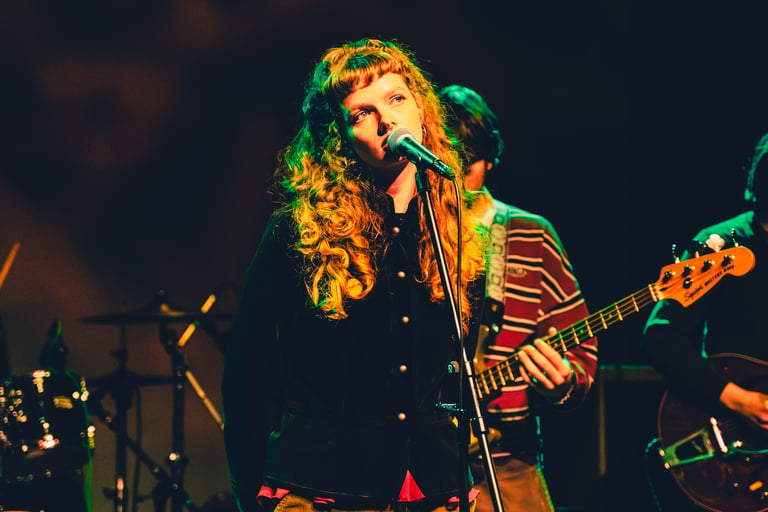
This sentiment was echoed by a diverse array of stakeholders. High-profile attendees ranged from Salford City Mayor Bev Craig and Creative Industries Minister Ian Murray (representing government engagement) to boundary-pushing artists like Imogen Heap, who demonstrated cutting-edge vocal protection technologies, and grassroots acts like Amber Warren of grunge-pop outfit Cruush.
While artists like Cruush voiced mild nostalgia for the historic, gritty venues of Manchester’s Northern Quarter—where the festival was hosted in 2023 and 2024 prior to its move to MediaCity’s Dock10 studios—the collective consensus remained overwhelmingly optimistic about the city’s fertile, hyper-connected local ecosystem.
Future Outlook: Taking It From Here
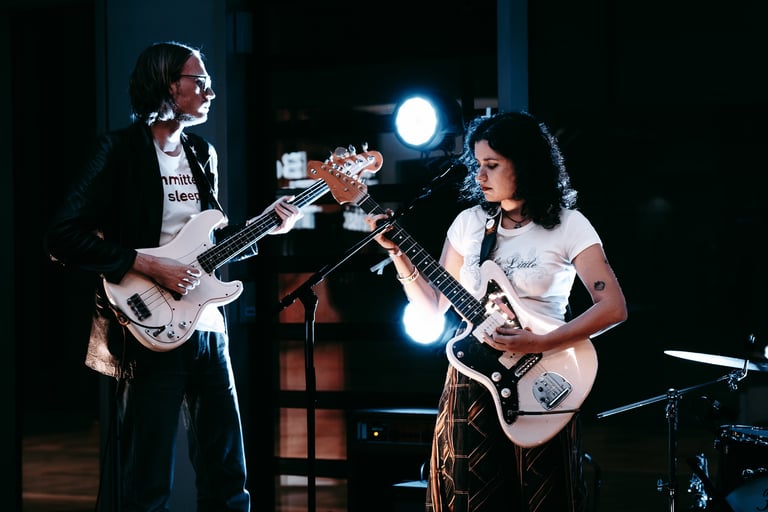
As the dust settled on a week characterized by blistering live sets from the likes of The K’s, Tom A. Smith, Georgian, and BEX, a profound realization hung over Salford Quays.
The price of bread was not permanently lowered over the course of four days, and the systemic inequalities plaguing the modern creative economy—from predatory streaming payouts to unregulated voice-cloning AI—have not vanished overnight. Rat droppings still occasionally taint the flour of the modern digital marketplace.
However, Beyond the Music achieved something far more vital than immediate legislative reform: it got the right people into the same room, stripped away corporate pretense, and forged a unified ethical blueprint. By anchoring future survival in the time-tested cooperative traditions of Greater Manchester, the summit proved that when institutional leaders step aside, creators, independent thinkers, and local communities possess the vision and grit to take it from here.