
By Ian DeNolfo, Executive Director, The Voice Foundation
Today, the scientific study of the human voice stands at a profound and irrevocable inflection point. Artificial intelligence is no longer an experimental auxiliary or an abstract technological curiosity whispered about in speculative tech circles; it is a foundational pillar actively reshaping how we conduct research, analyze complex acoustic data, and deliver cutting-edge patient care.
This moment of monumental transformation does not emerge in a vacuum. It rests squarely upon a rich, half-century-long legacy of interdisciplinary innovation pioneered by The Voice Foundation. As we look at the breathtaking acceleration of artificial intelligence in voice science—where over 60 percent of all AI-related papers in our flagship publication have been published in just the last three years—we are witnessing a rare convergence where ancient human expression meets the bleeding edge of computational power.
Executive Overview: A Paradigm Shift in Acoustic Medicine
For centuries, the human voice has served as our most fundamental instrument of connection, emotion, and identity. It is a carrier of profound physiological and psychological data, capable of telegraphing inner states long before physical symptoms manifest outwardly. Yet, for all its communicative richness, the underlying neurobiological and physiological architecture of the voice is staggeringly complex—so intricate that the human ear and conventional analytical tools have historically captured only a fraction of its secrets.

Enter artificial intelligence. By leveraging machine learning, deep neural networks, and natural language processing, researchers can now parse acoustic features imperceptible to human perception. From tracking the progression of neurodegenerative disorders and identifying mental health markers to utilizing conversational AI in clinical decision-making, the intersection of AI and voice science is redefining the boundaries of medicine.
The Journal of Voice, the premier peer-reviewed journal dedicated to voice science and medicine, has captured this exponential trajectory. Publishing pioneering neural network research as early as 1994, the journal has evolved from an early adopter into the central global archive for digital biomarkers, deep learning pathology detection, and ethical frameworks in computational voice care.
A Legacy of Innovation: From Gould and Sataloff to the Digital Age
To understand the magnitude of today’s technological leap, one must retrace the historical milestones that laid its groundwork. In 1969, Dr. Wilbur James Gould founded The Voice Foundation in New York City. At a time when the interdisciplinary care of the human voice was practically nonexistent, Dr. Gould possessed the visionary foresight to bring together a diverse coalition of physicians, scientists, speech-language pathologists, performing artists, and educators. His mission was simple yet radical: to pool multidisciplinary expertise for the betterment of the professional voice user.
The momentum quickly catalyzed into landmark institutions. In 1972, the Foundation hosted its first Annual Symposium on the Care of the Professional Voice, followed a year later by its inaugural Gala (later celebrated as the Voices of Summer). For more than five decades, the Foundation has successfully bridged the often-disparate worlds of art and science, clinic and stage.
Since 1989, this vital mission has been steered by Dr. Robert Thayer Sataloff, an internationally renowned otolaryngologist, professional singer, and conductor. Having authored more than 1,200 publications—including 79 textbooks—Dr. Sataloff transitioned the Foundation to its current home in Philadelphia. Under his visionary leadership, the organization expanded its international footprint, cemented the annual Symposium as a global nexus for medical and artistic professionals, and propelled the Journal of Voice to the zenith of academic publishing.
Detailed Chronology: Thirty Years of AI Research in Voice Science
A common misconception in academic circles is that artificial intelligence in medicine is a post-2020 phenomenon catalyzed by modern generative chatbots. In the realm of voice science, however, the foundational groundwork was laid over thirty years ago.
The Pioneering Era (1994–2015)
In 1994—the exact same year the World Wide Web began entering the public consciousness and long before most professionals had ever sent a digital email—the Journal of Voice published a paper by Rihkanen and colleagues titled "Spectral Pattern Recognition of Improved Voice Quality." This landmark study utilized early neural networks to analyze voice patterns, signaling the very first intersection of machine learning and acoustic pathology.
For the next two decades, progress was steady yet incremental. Between 1994 and 2015, the journal published 17 foundational papers exploring computational acoustics and early algorithmic modeling. These early works served as proof-of-concept studies, testing whether machines could reliably categorize acoustic variations associated with laryngeal disorders.
The Acceleration and Explosion (2016–Present)
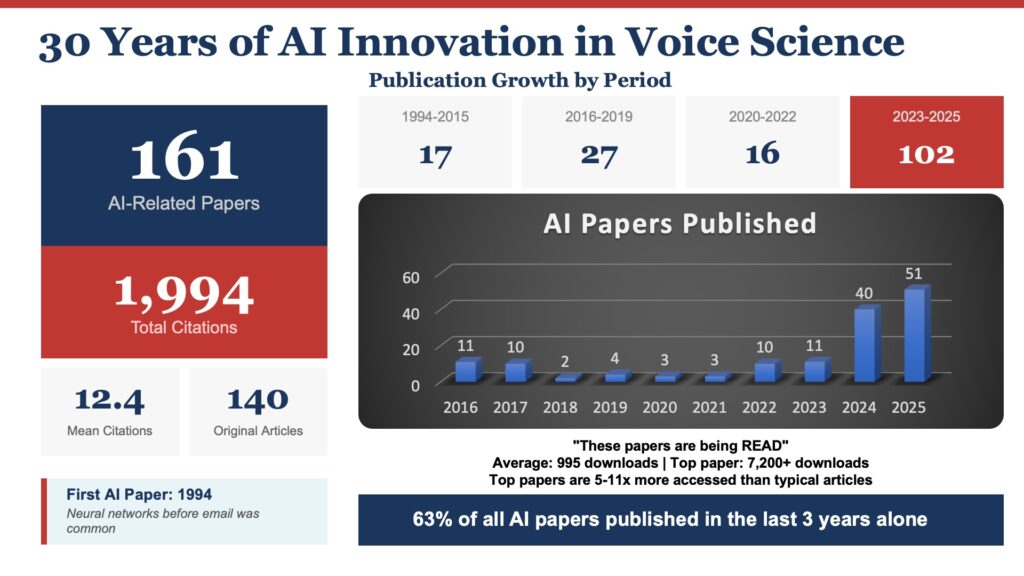
The timeline of AI publications in the Journal of Voice tells a dramatic story of exponential growth:
- 1994–2015: 17 papers
- 2016–2019: 27 papers
- 2020–2022: 16 papers
- 2023–2025: 102 papers
The inflection point is unmistakable. Of the 161 total AI-related papers published in the journal’s history, 102—or 63 percent—were published in just the last three years (2023–2025). In the year 2025 alone, the journal published 51 AI-related papers. That single year surpassed the output of the field’s entire first two decades combined. This is no longer gradual scientific progression; it is an exponential transformation.
Supporting Context & Metrics: Beyond Citations to Real-World Impact
Academic publication metrics can sometimes feel sterile, detached from the clinical realities of the examination room. However, the usage statistics surrounding AI research in the Journal of Voice reveal a profound, real-world appetite among clinicians, speech-language pathologists, and researchers for practical computational tools.
The average AI-focused paper published in the journal has been downloaded nearly 1,000 times. More striking are the outlier publications that have captured the global scientific imagination:

- COVID-19 Detection: A pioneering study exploring machine learning for the detection of COVID-19 through voice characteristics has been downloaded over 7,200 times—eleven times the median download rate for articles in its respective issue.
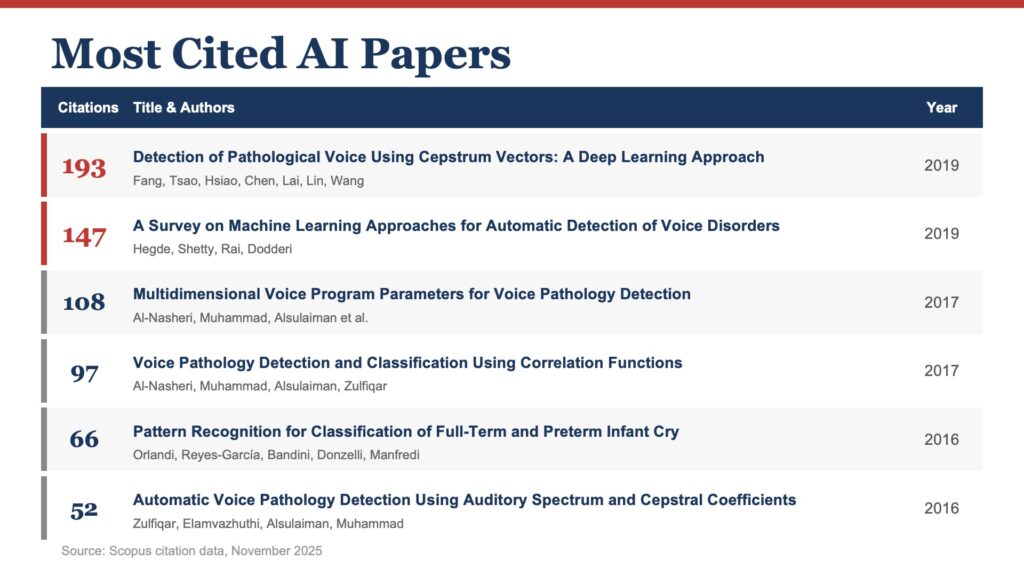
- Deep Learning Milestones: Fang and colleagues’ 2019 study on deep learning for pathological voice detection has garnered 193 citations and nearly 5,000 downloads.
- Comprehensive Surveys: Hegde’s machine learning survey paper has secured 147 citations and a comparable 5,000 downloads, serving as essential primer reading for incoming researchers.
These figures represent busy clinicians, exhausted hospital researchers, and dedicated speech therapists actively seeking actionable tools to elevate patient care.
Landmark Research Reshaping Clinical Boundaries
The academic literature has systematically conquered increasingly complex diagnostic frontiers:
- Voice Pathology Detection: Fang et al. proved that deep neural networks could identify pathological voices using cepstrum vectors with accuracies surpassing human auditory perception. Subsequent studies by Al-Nasheri (2017), Chen and Chen (2022), and Fujimura leveraged convolutional neural networks (CNNs) to classify laryngeal disorders from imaging and audio data.
- The Voice as a Digital Biomarker: Perhaps the most paradigm-shifting concept is the utilization of the voice as a non-invasive window into systemic health. Hemmerling and Wójcik-Pędziwiatr’s 2022 research on predicting Parkinson’s disease severity from voice signals has gained rapid traction. Beyond neurology, systematic reviews now position vocal quality as a digital biomarker for depression, bipolar disorder, and respiratory compromise.
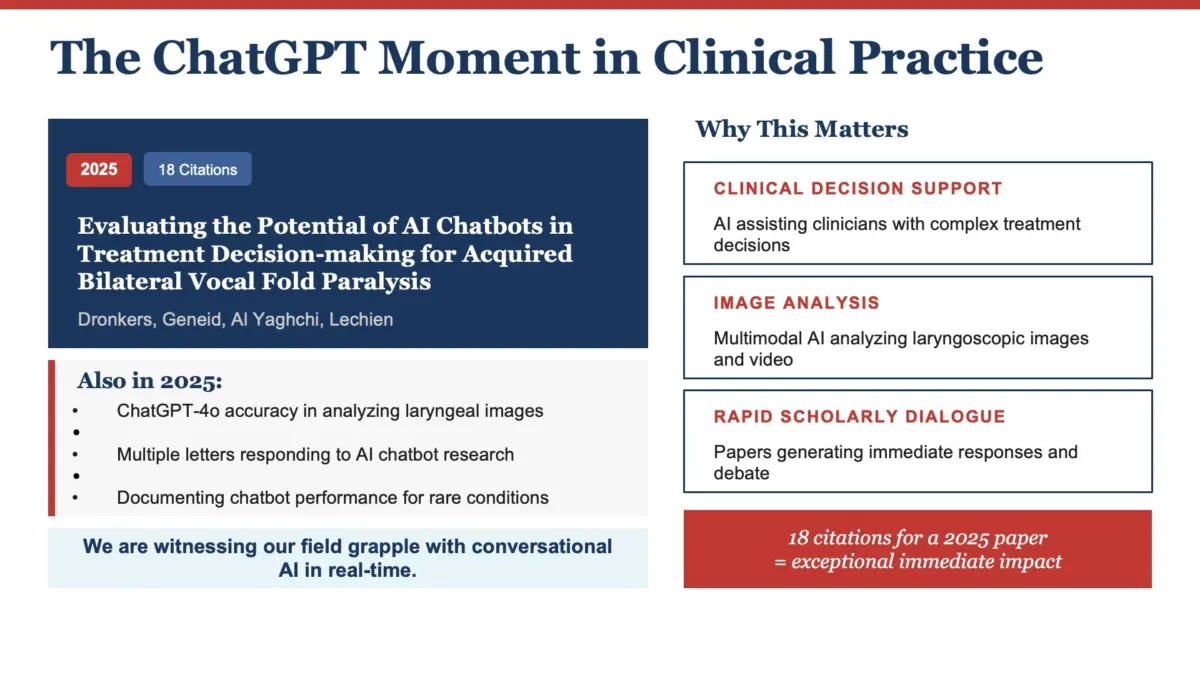
- Conversational AI in Clinical Settings: Entering 2025, the journal expanded into clinical decision-making applications. Dronkers and colleagues published work evaluating AI chatbots in treatment decision-making for acquired bilateral vocal fold paralysis, sparking vibrant scholarly debates and responses regarding ChatGPT-4o’s diagnostic precision with laryngeal images.
Official Statements and Expert Perspectives
To capture the soul of this technological revolution, we turn to leading minds within our community who straddle the line between computational science and clinical practice.
Dr. Mark Berardi: Managing Complexity and Synthetic Communication
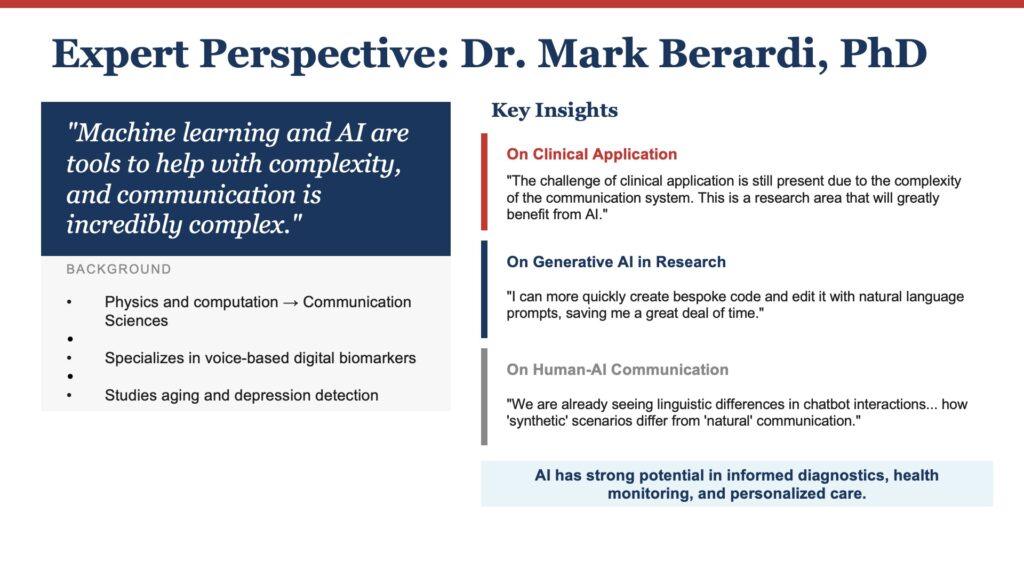
Dr. Mark Berardi brings a rare duality of perspective, having transitioned from physics and computation into voice science. For Dr. Berardi, artificial intelligence is, at its core, a sophisticated engine for managing complexity.
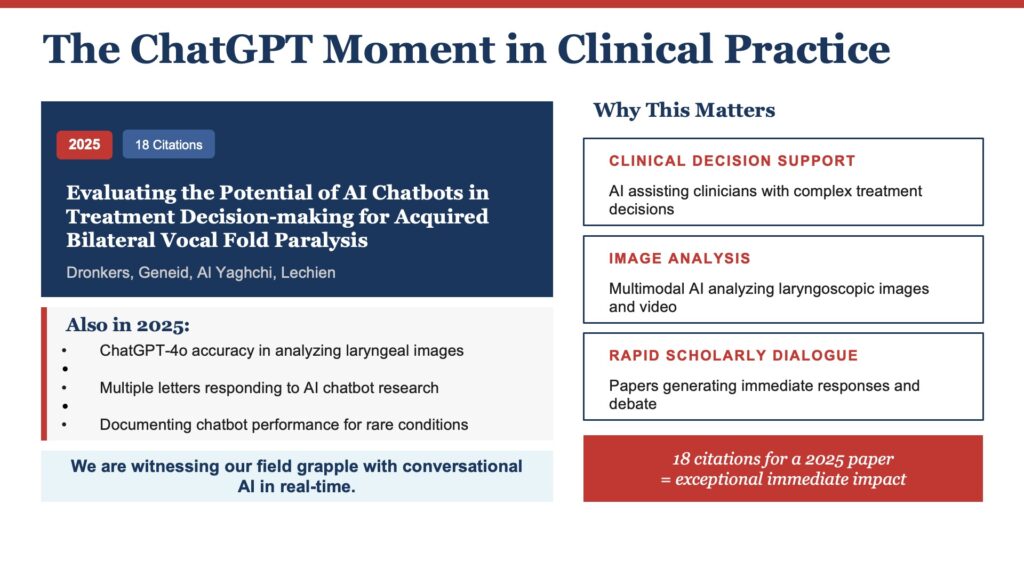
"Machine learning and AI are tools to help with complexity, and communication is incredibly complex in its neurobiological and physiological processes. So I think the application is warranted," Dr. Berardi notes.
Focusing his research on voice-based digital biomarkers for aging and depression, he emphasizes that while acquiring voice signals is increasingly frictionless, interpreting the underlying communicative matrix requires advanced computational architecture.
Regarding generative AI, Dr. Berardi maintains a pragmatic outlook. While it may not yet have revolutionized every facet of clinical experimentation, it has obliterated traditional research bottlenecks—particularly in coding and data processing. Researchers can now draft bespoke analytical code using natural language prompts.
Intriguingly, Dr. Berardi’s work also explores human-AI communication dynamics. As society increasingly shifts toward "synthetic" interaction modalities—from Zoom conferences to conversational chatbots—linguistic adaptations are occurring. Voice science, he suggests, must now expand its mandate to understand not just the human voice in isolation, but the human voice in direct conversation with machines.
Dr. Eric Hunter: Embracing Change with Ethical Clarity
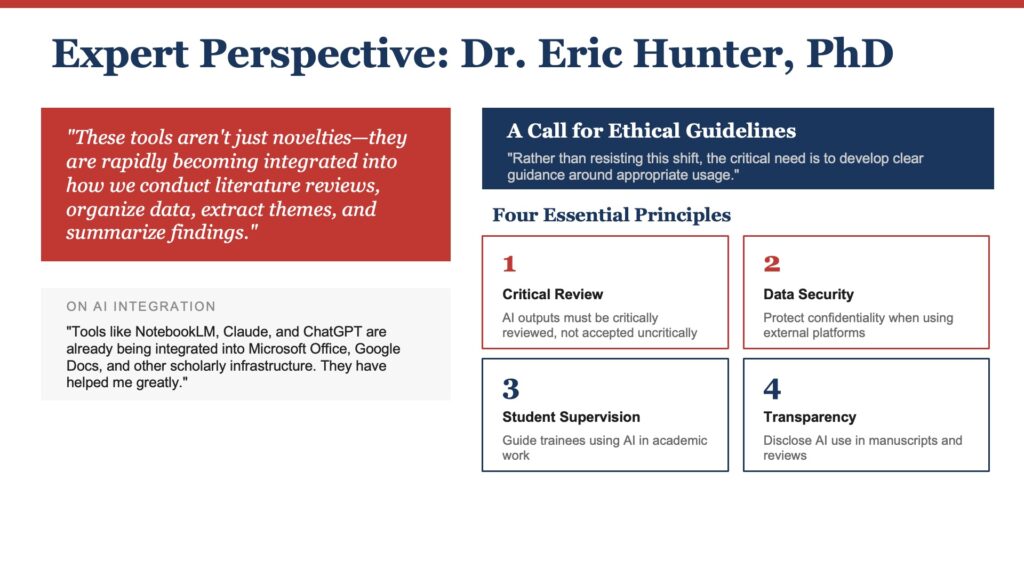
Dr. Eric Hunter focuses his lens on the institutional integration of large language models and academic workflows. He issues a clear and urgent reminder to the scholarly community: these tools are permanent fixtures of modern research.
"These tools aren’t just novelties," observes Dr. Hunter. "They are rapidly becoming integrated into how we conduct literature reviews, organize data, extract themes from large bodies of text, and even summarize findings."
From automated manuscript assistance to data analysis platforms like NotebookLM and Claude, academic infrastructure is undergoing a permanent upgrade. Rather than adopting a posture of resistance, Dr. Hunter champions proactive adaptation anchored by ethical clarity. He outlines four foundational pillars for responsible AI integration in scholarly publishing:
- Transparency: Full disclosure of AI assistance in literature gathering, coding, and structural drafting.
- Accountability: Absolute human oversight; authors remain entirely responsible for the factual and analytical integrity of their work.
- Data Integrity: Ensuring patient privacy and avoiding algorithmic bias when training models on sensitive voice databases.
- Editorial Guidelines: Establishing standardized peer-review policies regarding AI-generated manuscript submissions.
“Our field will benefit most,” Dr. Hunter concludes, “if we embrace the productivity these tools offer while also building a shared ethical framework for their responsible use.”
A Global Research Community
The rapid evolution of AI-driven voice science is not the isolated experiment of a single laboratory or elite university medical center. It is powered by a robust, interconnected global research ecosystem.
Leading contributors to the Journal of Voice hail from every corner of the globe. Scholars such as Jérôme René Lechien, Dimitar Deliyski, Stephanie Zacharias, Ahmed Yousef, Paavo Alku, Leonardo Wanderley Lopes, and Maryam Naghibolhosseini—alongside dozens of international collaborators spanning Europe, the Americas, Asia, and the Middle East—are actively forging the parameters of computational voice medicine. This collective brain trust is united by a single, unwavering commitment: decoding the mysteries of the human voice through the rigorous application of machine learning.
Future Outlook: The Path Forward for Voice Science
As we chart the course for the next decade, the Journal of Voice and The Voice Foundation remain unshakeable in our commitment to publishing pioneering research that pushes intellectual boundaries while upholding the highest standards of scientific integrity.
However, embracing this future requires collective, coordinated action across three critical fronts:

- First, thoughtful engagement: We must view AI tools for what they truly are—engines designed to manage complexity. We must master their capabilities, respect their limitations, and deploy them to amplify human expertise rather than replace clinical judgment.
- Second, collaborative ethics: Dr. Hunter’s call for a shared ethical framework cannot be answered in isolation. Journals, academic institutions, clinicians, and ethicists must forge universal guidelines that protect patient privacy, ensure diagnostic transparency, and prevent algorithmic bias.
- Third, continuous contribution: The 161 AI papers published to date represent merely the foundation. Every clinician, researcher, and educator possesses frontline insights that can enrich our collective understanding.
An Extraordinary Moment in Human History
The human voice has served as our primary instrument of connection, emotional release, and personal identity for hundreds of thousands of years. It carries the subtle signatures of our health, our psychology, and our very souls in ways that no other biological signal can replicate.
Now, for the first time in human history, we possess technological tools sophisticated enough to truly decode that complexity. We have algorithms capable of extending the reach of expert clinicians, sentinel diagnostic models that can detect subtle pathologies long before symptoms become critical, and digital frameworks that promise to democratize access to high-quality voice care across the globe.
We are living through an extraordinary moment in time, and The Voice Foundation and the Journal of Voice stand proudly at its epicenter. The next decade promises discoveries that will dwarf our current achievements. We look forward to pioneering that future—and sharing every breakthrough—with you.
About the Author
Ian DeNolfo is Executive Director of The Voice Foundation, which publishes the Journal of Voice. A graduate of The Juilliard School and The Curtis Institute of Music, he formerly performed as a leading tenor at major opera houses worldwide before transitioning his career to arts administration, academic publishing, and health science leadership at The Voice Foundation.