
Executive Overview
In an era where modern houses of worship heavily invest in architectural acoustics, line-array speaker systems, and immersive multimedia presentations, a significant segment of the congregation often remains entirely disconnected from the message. Hearing loss is one of the most prevalent yet frequently overlooked barriers in communal gatherings. For millions of aging adults and individuals with auditory impairments, Sunday services, midweek studies, and special events can quickly become exercises in frustration rather than spiritual communion.
To bridge this profound communication gap, religious organizations are increasingly turning to advanced Assistive Listening Systems (ALS). However, purchasing and installing audio hardware is merely the first step in a much larger journey toward true inclusivity. Successfully integrating these technologies requires a methodical, strategic approach that encompasses congregation assessment, financial planning, comprehensive staff and volunteer training, and proactive community outreach.
This comprehensive report examines the four foundational pillars of implementing an Assistive Listening System within a house of worship. Drawing on industry best practices and insights from audio-visual integration experts, this guide provides faith leaders, facility managers, and AV technicians with an authoritative roadmap to ensure that every spoken word, musical arrangement, and emotional nuance reaches every ear in the sanctuary.
Detailed Chronology: The Four-Step Implementation Roadmap
Transitioning a house of worship into an accessible, audibly inclusive environment requires careful, step-by-step execution. Ryping into a project without a structured framework often leads to underutilized equipment, wasted financial resources, and continued frustration among congregants who need support the most. Below is the chronological blueprint for successful ALS deployment.
[Phase 1: Needs Assessment] ➔ [Phase 2: Technical & Financial Planning] ➔ [Phase 3: Operational Readiness] ➔ [Phase 4: Awareness & Community Outreach]Phase 1: Understand Your Needs
The foundation of any successful technological upgrade in a house of worship must begin with data, not assumptions. Before contacting hardware vendors or evaluating pricing structures, leadership must determine the precise scope of auditory need within their congregation.
The most effective and direct method to accomplish this is to conduct a comprehensive congregation-wide survey. This survey should be distributed in multiple formats—both physical printouts tucked inside Sunday bulletins and digital versions sent via email newsletters or church mobile apps—to ensure high participation rates across all demographics.
Key data points to collect during this initial phase include:
- Subjective Service Experience: Ask respondents to rate the clarity of the audio during various parts of the service (e.g., spoken sermons, soft-spoken prayers, choir performances, and contemporary band setups).
- Hearing Aid Utilization: Inquire whether congregants currently wear hearing aids or cochlear implants.
- Telecoil (T-Coil) Integration: Crucially, ask if their hearing devices are equipped with a telecoil. Understanding the percentage of the congregation using t-coil-compatible devices will directly dictate whether an induction loop system, an FM system, or an infrared system is the most appropriate technological fit.
- Demographic Projections: Factor in aging local populations. Even if current survey numbers for hearing loss are low, a proactive approach ensures the facility remains prepared for the future.
Phase 2: Fully Understand Your Options
Once the congregation’s specific needs have been mapped out, the next phase involves translating those requirements into a concrete technical and financial strategy. Navigating the myriad of available assistive listening technologies—ranging from traditional radio frequency (RF) and infrared (IR) systems to cutting-edge Wi-Fi audio streaming and audio induction loops—can be daunting for non-technical church boards.
During this stage, leadership must estimate the total cost of ownership, which includes transmitters, receivers, neck loops, sanitary accessories, signage, and ongoing maintenance. Partnering with specialized AV integration and church solutions providers can streamline this process significantly. Many trusted industry partners offer complimentary consultations specifically tailored to expense analysis, spatial acoustic assessments, and long-term budgeting.
Because houses of worship often operate under strict, mission-driven budgets, capital expenditures for accessibility upgrades can sometimes stall. To overcome financial hurdles, leadership should simultaneously explore dedicated fundraising campaigns, accessibility grants, and designated memorial funds. Framing the ALS project as an essential component of the church’s pastoral care ministry often inspires generous donor participation.
Phase 3: Prepare for Success
Investing in state-of-the-art assistive listening hardware is meaningless if the equipment sits idle in a storage closet due to operational friction. The success of an ALS relies heavily on the human element—specifically, the staff members and hospitality volunteers tasked with managing the equipment week in and week out.
To ensure seamless deployment, leadership must establish a culture of "Assisted Listening Ambassadors." Volunteers stationed at welcome desks, information booths, and AV mixing positions must receive comprehensive, hands-on training covering:
- Device Operation: How to power on receivers, adjust volume levels, and sync devices with neck loops or hearing aids.
- Hygiene and Maintenance: Proper sanitization protocols for ear-buds and receivers after every use, along with routine battery charging schedules.
- Troubleshooting: Quick identification of common issues, such as dead batteries, loose connections, or signal interference.
Operational friction can be drastically reduced by institutionalizing best practices at the distribution desk. For example, maintaining a clearly laminated, highly visible "Frequently Asked Questions" (FAQ) sheet directly at the welcome counter ensures that volunteers can answer questions quickly and confidently, even during the frantic minutes before a service begins.
Phase 4: Create Awareness
Building the best listening environment in the city yields little benefit if the intended recipients do not know the technology exists. The final phase of implementation centers on aggressive internal and external communication.
- Signage: Install ADA-compliant, highly visible signage at all primary entrances, welcome centers, and sanctuary doors. These signs should clearly indicate that Assisted Listening Devices (ALDs) are available and direct guests to where they can be acquired.
- Print and Digital Prompts: Embed gentle, inviting reminders in every weekly bulletin, digital newsletter, and pre-service multi-media slide loop.
- Live Demonstrations: Consider hosting a dedicated live training session or a special "accessibility Sunday" where congregants can physically handle the equipment, test the audio clarity, and familiarize themselves with the technology in a low-pressure environment.
- Community Outreach: Do not limit marketing efforts to the existing membership. Broadcast the availability of the new system to local senior centers, retirement communities, and audiologist clinics in the surrounding area. Many individuals with hearing loss have stopped attending public gatherings entirely because they assume venues cannot accommodate them; advertising genuine accessibility can successfully draw new visitors through the doors.
Supporting Context & Metrics: The Hidden Reality of Hearing Loss
To fully grasp the urgency of implementing Assistive Listening Systems, one must examine the broader demographic and psychological data surrounding auditory impairment. Hearing loss is rarely just a physical ailment; it is a profound social isolator that quietly erodes community bonds.

The Demographics of Auditory Impairment
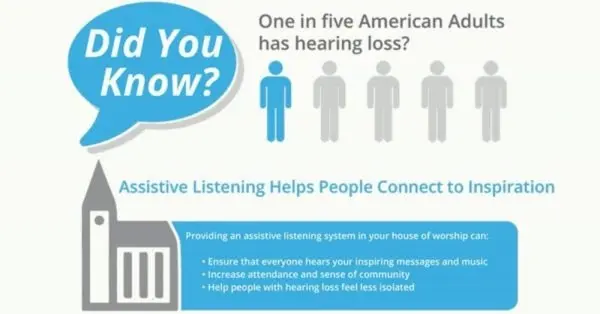
According to statistical tracking by public health organizations and audiological associations, hearing loss affects roughly one in eight people in the United States aged 12 years or older (an estimated 30 million Americans). Among adults aged 65 and older, that prevalence jumps dramatically to approximately one in three, and nearly half of those aged 75 and older experience disabling hearing loss.
Because the demographic core of many traditional and contemporary congregations leans heavily toward older adults, the statistical likelihood of untreated hearing loss sitting in any given church pew on a Sunday morning is extraordinarily high.
The Psychological Toll of "Pew Isolation"
When an individual with hearing loss enters a cavernous sanctuary with reverberant acoustics, background hums from HVAC systems, and competing audio frequencies from modern musical instruments, speech discrimination plummets. Even with standard hearing aids, ambient noise often overpowers the human voice.
This leads to a phenomenon known by audiologists as "listening fatigue"—the exhaustive mental effort required to decode distorted or muffled sounds. Over time, exhausted congregants simply stop attending services, retreating into isolation. Providing an Assistive Listening System directly removes this barrier, transforming a stressful, alienating experience back into a welcoming, spiritually enriching communal event.
Official Statements & Industry Perspectives
Industry leaders, accessibility advocates, and AV design professionals consistently emphasize that true hospitality extends far beyond friendly handshakes at the door. It requires engineering an environment where every individual can fully engage with the life of the church.
"Reaching out to those who feel disconnected from your community due to hearing loss is central to sharing the message of inclusion. Genuinely compassionate service involves being aware of and caring for the needs of everyone, especially those dealing with impairments. Make sure they are able to hear the beauty and emotion of the spoken word in your church by providing them with the equipment they need to stay connected."
— Industry Accessibility Consensus & Integration Guidelines
Audio engineering consultants frequently remind church leadership teams that architectural acoustics and sound reinforcement are only half the battle. While a powerful sound system ensures the room is loud enough, an Assistive Listening System ensures the signal is clear enough to overcome distance, architectural echoes, and background noise. By treating accessibility as a core component of production design rather than an afterthought, houses of worship signal a deep institutional commitment to every member of their flock.
Future Outlook: The Evolution of Accessible Worship Spaces
Looking forward, the landscape of assistive listening technology is evolving rapidly, driven by advancements in wireless streaming, smartphone integration, and legislative standards.
The Shift Toward Wi-Fi and Smartphone Integration
Traditional FM and infrared systems will continue to play a vital role, but the future of house-of-worship audio accessibility is increasingly tethered to personal smart devices. Modern systems now allow users to stream high-definition, ultra-low-latency audio directly from the church’s soundboard to their own smartphones or tablets via local Wi-Fi networks. Congregants can then use their personal earbuds, headphones, or Bluetooth-enabled hearing aids to listen to the service. This "Bring Your Own Device" (BYOD) model dramatically reduces the logistical overhead of managing, cleaning, and storing dedicated church-owned receivers, while simultaneously removing any social stigma associated with checking out specialized equipment.
Regulatory Trends and Universal Design
As public awareness surrounding disability rights and universal design continues to expand, regulatory bodies are placing stricter emphasis on equal access in public assembly spaces, including religious facilities. Forward-thinking ministries are realizing that retrofitting for accessibility is no longer merely a matter of checking a legal compliance box; it is an essential expression of core values.
Conclusion and Actionable Next Steps
Implementing an Assistive Listening System is a transformative investment in the relational and spiritual health of a congregation. By methodically understanding needs, selecting the right technical tools, training operational ambassadors, and aggressively raising community awareness, houses of worship can permanently eliminate auditory barriers.
For leadership teams seeking deeper guidance, comprehensive toolkits—complete with sample surveys, downloadable ADA signage templates, and bulletin announcements—are readily available through industry resources such as the Listen Technologies Church Assistive Listening Toolkit.
Does your worship facility currently provide adequate accommodations for those with hearing loss? Evaluate your sanctuary’s acoustic accessibility today, and take the definitive step toward ensuring that everyone in your community can hear the message loud and clear.