
By Ian DeNolfo, Executive Director of The Voice Foundation
(With contributions from clinical, computational, and institutional leaders in voice care)
Executive Overview
We stand today at a profound inflection point in the history of voice science—a historic juncture where artificial intelligence (AI) has moved past the horizon of theoretical speculation to fundamentally reshape how researchers conduct investigations, analyze complex datasets, and care for patients. For over half a century, The Voice Foundation has served as the intellectual anchor for the interdisciplinary study of human phonation, bridging the arts and the biomedical sciences. Today, that legacy of innovation is meeting the exponential curve of machine learning and deep neural networks, transforming the human voice from a simple instrument of communication into a high-resolution, non-invasive digital biomarker of systemic health.
The data reveals a dramatic paradigm shift. While the integration of computational tools into voice science began quietly more than three decades ago, recent years have witnessed a tidal wave of discovery. Of the hundreds of peer-reviewed articles published on artificial intelligence within the Foundation’s flagship publication, the Journal of Voice, an overwhelming majority have appeared within the last three years alone. This is not a story of gradual academic iteration; it is an exponential transformation that is simultaneously redefining clinical otolaryngology, speech-language pathology, mental health diagnostics, and human-computer interaction.
Detailed Chronology: Thirty Years of Pioneering AI in Voice Science
To understand the magnitude of today’s technological leap, one must look backward to recognize how far-sighted the voice science community has been. While popular consciousness associates the rise of AI with the modern era of large language models, the Journal of Voice was publishing neural network research before the public internet had even established a commercial footprint.
The Genesis: 1994–2015
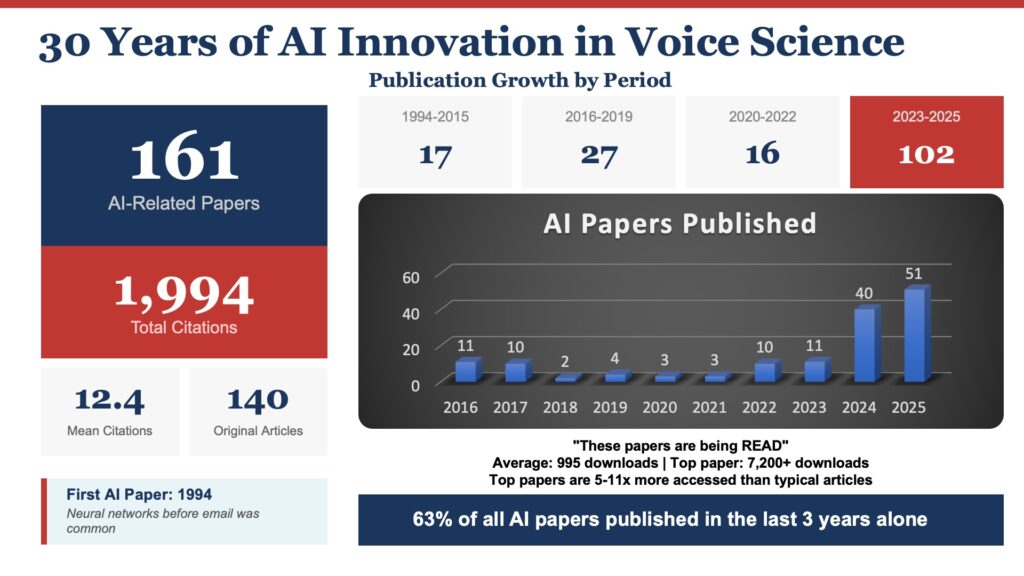
In 1994—the same year the World Wide Web began capturing public awareness and long before most professionals had ever sent an electronic mail message—the Journal of Voice published a pioneering paper by Rihkanen and colleagues titled "Spectral Pattern Recognition of Improved Voice Quality." This landmark study utilized early neural networks to analyze acoustic parameters, planting the seed for computational voice analysis.
For the next two decades, progress was steady yet deliberate. Between 1994 and 2015, the journal published 17 foundational papers exploring pattern recognition, basic machine learning algorithms, and initial attempts at automated acoustic classification. These early researchers laid the bedrock methodology, proving that computational architectures could perceive micro-variations in vocal signals that eluded even the most trained human ear.
The Acceleration: 2016–2022
As computational power grew and deep learning architectures matured, the pace of publication accelerated. From 2016 to 2019, the journal featured 27 specialized papers. This period saw the introduction of deep neural networks capable of parsing complex cepstrum vectors and multidimensional voice program parameters.
Between 2020 and 2022, an additional 16 papers expanded these applications into complex classification models, convolutional neural networks (CNNs), and preliminary machine learning models designed to address clinical bottlenecks during global disruptions like the COVID-19 pandemic.
The Exponential Explosion: 2023–Present
The timeline shifts dramatically after 2022. Between 2023 and early 2025, the Journal of Voice published an extraordinary 102 AI-related papers. In the single calendar year of 2025 alone, the journal featured 51 AI-focused publications—surpassing the total output of the first two decades combined. This explosion of research signals that AI has transitioned from an experimental niche into the mainstream methodology of modern voice science.
Supporting Context & Metrics: Real-World Impact and Global Reach
Academic output is frequently measured in citations, but the true metric of medical and scientific literature is its utility in the real world. Usage statistics from the Journal of Voice demonstrate that these computational papers are not merely sitting in digital archives; they are being actively downloaded, scrutinized, and applied by clinicians, researchers, and speech-language pathologists worldwide.
- High-Volume Engagement: The average AI-focused paper published in the journal has been downloaded nearly 1,000 times—substantially outpacing traditional baseline metrics for specialized scientific literature.
- Record-Breaking Access: A 2020 study investigating machine learning applications for COVID-19 detection via voice characteristics has amassed over 7,200 downloads, representing eleven times the median readership for articles within its volume.
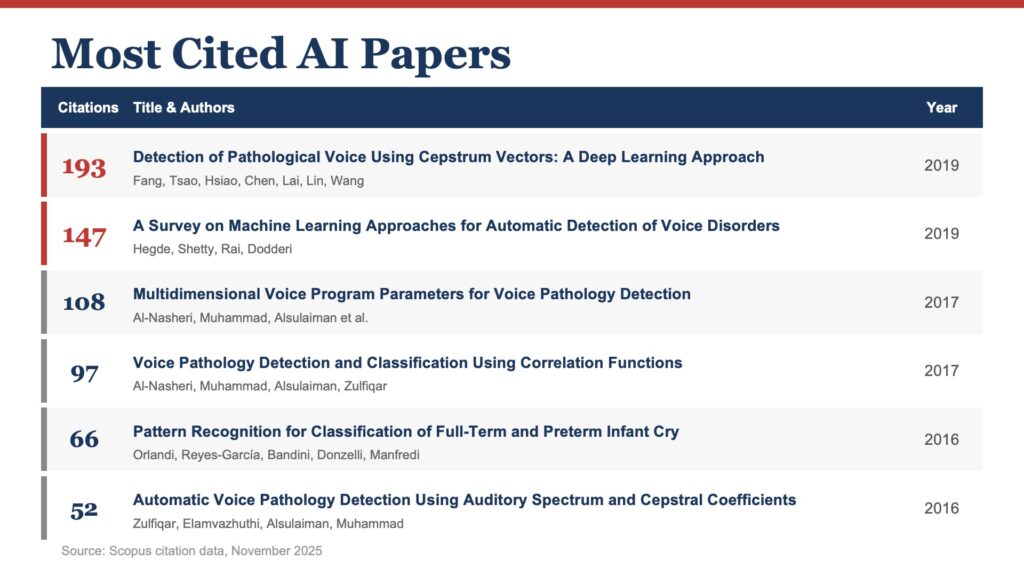
- Leading Citations: Foundational works—such as Fang and colleagues’ 2019 deep learning study on pathological voice detection (193 citations) and Hegde’s comprehensive machine learning survey (147 citations)—have each approached nearly 5,000 individual downloads. Both studies ranked among the top three most-accessed articles in their respective issues, serving as indispensable roadmaps for clinicians seeking practical, diagnostic aids.
The Global Research Community
This computational revolution is anchored by a diverse, international community of scholars. Leading contributors to the Journal of Voice’s AI repository include researchers such as Jérôme René Lechien, Dimitar Deliyski, Stephanie Zacharias, Ahmed Yousef, Paavo Alku, Leonardo Wanderley Lopes, and Maryam Naghibolhosseini. Representing institutions spanning every populated continent, these investigators underscore that modern voice science is a truly global, collaborative endeavor.
Official Statements and Landmark Research
The practical applications of this research span three major pillars: automated pathology detection, the conceptualization of the voice as a digital biomarker, and the integration of conversational AI into clinical workflows.
1. Deep Learning for Voice Pathology Detection
The cornerstone of modern computational voice research is the automated detection of laryngeal pathologies. Fang et al. (2019) demonstrated that deep neural networks could identify pathological conditions using cepstrum vectors with an accuracy level previously unattainable by standard acoustic testing. Similarly, Hegde’s systematic survey mapped the sprawling taxonomy of machine learning models, establishing standardized benchmarks for automatic voice disorder detection. Subsequent breakthroughs by Chen and Chen (2022) on deep neural networks, Fujimura’s exploration of 1D convolutional neural networks, and Cho and Choi’s comparative analyses of CNN models on laryngoscopic images have continuously pushed the boundaries of diagnostic precision.
2. The Voice as a Digital Biomarker
Perhaps the most revolutionary paradigm shift is the recognition of the human voice as a non-invasive digital biomarker—a acoustic window into systemic, neurological, and psychological health.
Research published in the journal has increasingly focused on tracking neurodegenerative disorders. For instance, Hemmerling and Wójcik-Pędziwiatr’s 2022 study on predicting the severity of Parkinson’s disease from voice signals garnered immediate academic traction, accumulating 29 citations within three years and guiding clinicians toward remote, objective monitoring of disease progression. Beyond neurology, systematic reviews have begun exploring voice quality as an early sentinel for affective disorders, including depression and bipolar disorder. The clinical implications are immense: routine vocal screening could soon flag psychological distress months before clinical manifestation, alleviating burdened healthcare infrastructure through early, proactive intervention.
3. AI Chatbots and Clinical Decision-Making
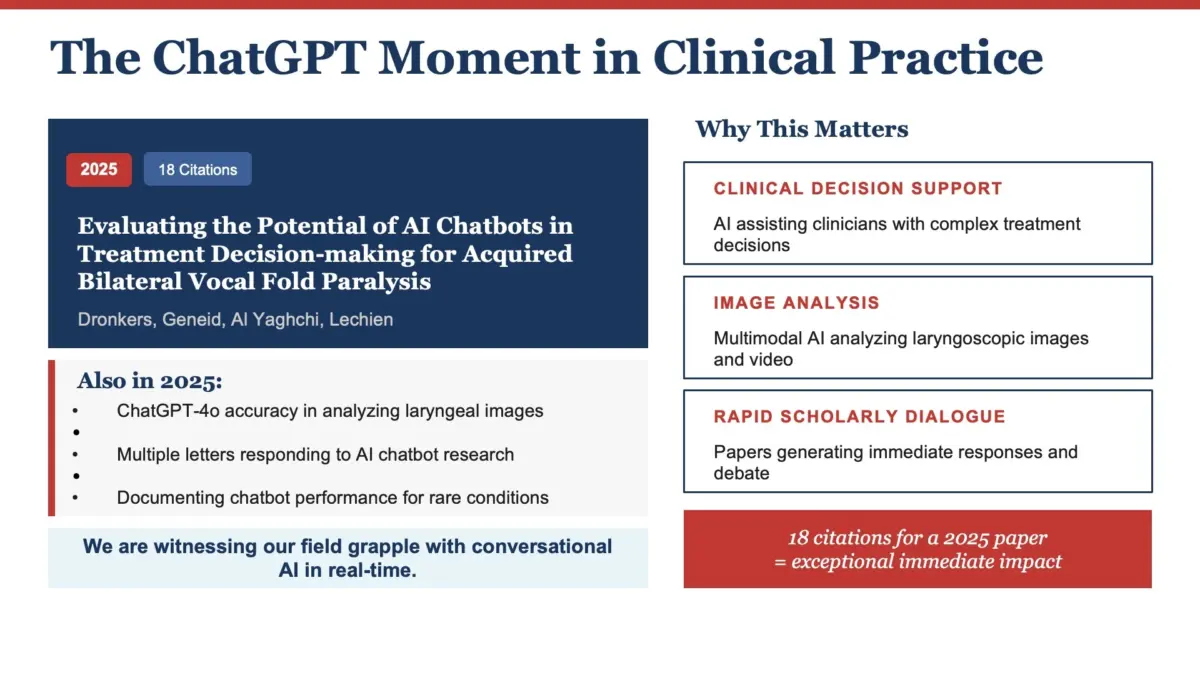
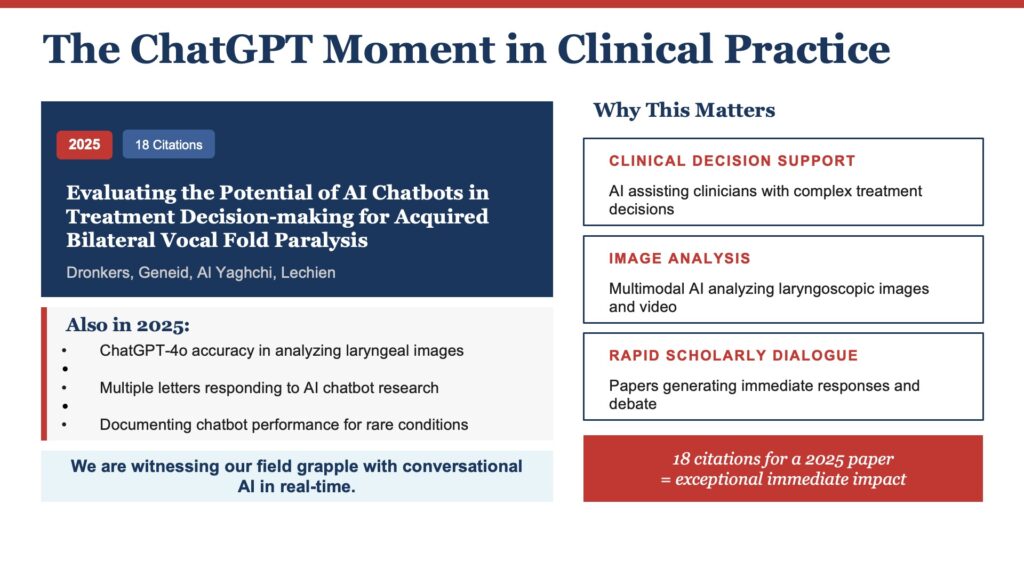
The year 2025 introduced an entirely new frontier: the evaluation of generative AI and large language models (LLMs) in direct clinical decision-making. A prime example is Dronkers and colleagues’ 2025 paper, "Evaluating the Potential of AI Chatbots in Treatment Decision-making for Acquired Bilateral Vocal Fold Paralysis," which rapidly accumulated 18 citations. Accompanied by rigorous letters to the editor and investigative responses analyzing ChatGPT-4o’s precision in evaluating laryngeal images, the field is actively and critically engaging with the promises—and limitations—of conversational AI in patient care.

Expert Perspectives: Navigating Complexity and Ethics
To contextualize these technological leaps, two prominent voices within the scientific community offer critical perspectives on the intersection of computation, clinical practice, and institutional responsibility.
Dr. Mark Berardi: Managing Complexity and Synthetic Communication
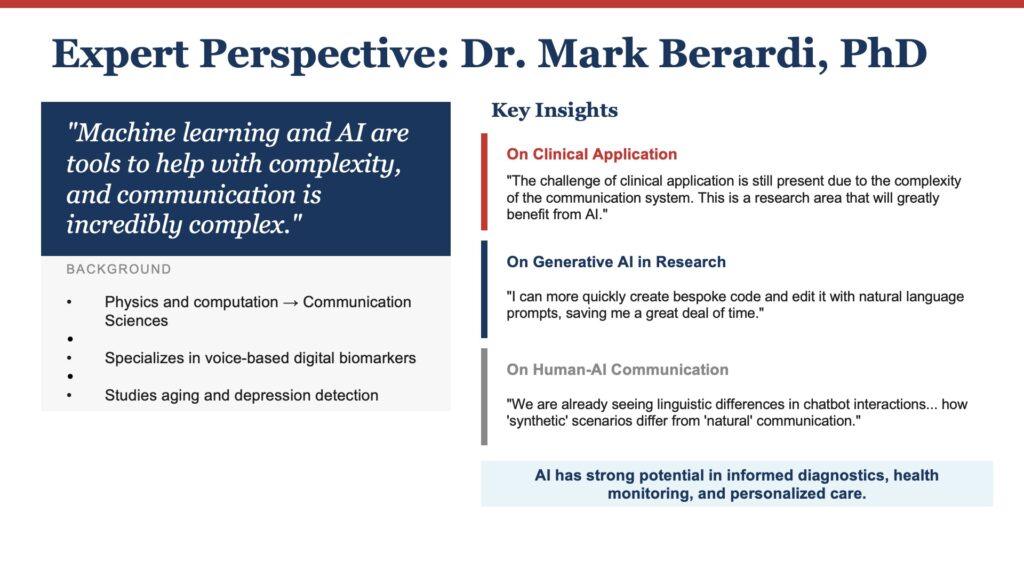
Dr. Mark Berardi, whose academic roots bridge physics, computation, and voice science, views artificial intelligence fundamentally as an instrument for managing biological complexity.
"Machine learning and AI are tools to help with complexity, and communication is incredibly complex in its neurobiological and physiological processes. So I think the application is warranted."
Dr. Berardi’s research focuses on extracting health insights for aging populations and depression from easily acquired voice signals. However, he offers a measured view on generative AI. While it may not have entirely rewritten foundational research theories overnight, he notes that it has aggressively attacked traditional academic bottlenecks. "I can now quickly create bespoke code and edit it with natural language prompts," he explains, streamlining data pipelines that once consumed weeks of manual programming.
Intriguingly, Dr. Berardi’s work also examines human-AI interaction itself. As society shifts toward "synthetic" communication environments—ranging from standard video conferencing to direct dialogues with conversational agents—linguistic and vocal adaptations occur. "We are already seeing linguistic differences in chatbot interactions," he observes, suggesting that future voice science must decode not only how humans speak to one another, but how human vocal behavior shifts when conversing with machines.
Dr. Eric Hunter: Embracing Change with Ethical Clarity
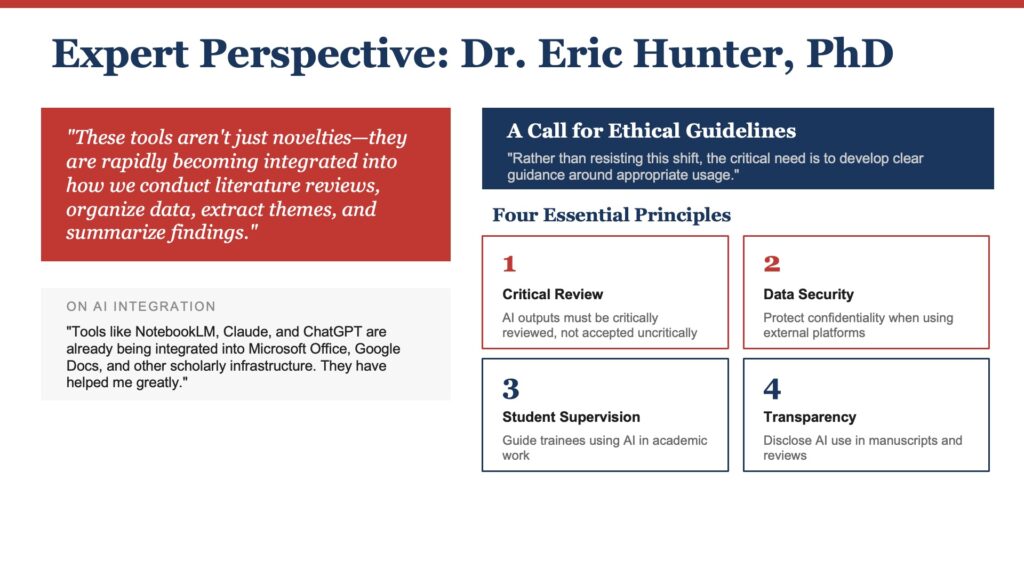
Dr. Eric Hunter emphasizes the inescapable institutional reality of artificial intelligence. These tools are no longer academic novelties; they are embedded directly into scholarly workflows, assisting in literature reviews, data synthesis, thematic extraction, and manuscript preparation.
"Large language models and AI-driven platforms are not going away. In fact, we should expect them to become increasingly embedded within common academic workflows—whether through journal article preparation, manuscript reviewing, data analysis, or collaborative writing."
As tools like Claude, ChatGPT, and specialized research assistants become native to productivity suites, Dr. Hunter issues a clear call to action: rather than resisting technological adoption, the academic community must establish transparent, rigorous ethical guidelines for both authors and reviewers. He advocates for a balanced framework built upon four foundational pillars:
- Uncompromising Transparency: Full disclosure of AI assistance in data collection, coding, and manuscript generation.
- Human Accountability: Maintaining strict human oversight for all scientific conclusions and clinical recommendations.
- Data Integrity & Privacy: Safeguarding sensitive patient acoustic data against unauthorized model training and breaches.
- Equitable Access: Ensuring that the benefits of AI-driven diagnostics do not exacerbate global healthcare disparities.
"Our field will benefit most," Dr. Hunter concludes, "if we embrace the productivity these tools offer while also building a shared ethical framework for their responsible use."
Future Outlook: The Path Forward for The Voice Foundation
As we look toward the next decade, The Voice Foundation and the Journal of Voice remain firmly committed to championing rigorous, boundary-pushing research while preserving the highest standards of scientific and clinical integrity.
The path forward requires a three-pronged commitment from our global community:
- Thoughtful Engagement: Researchers and clinicians must master AI not as an autonomous oracle, but as a sophisticated instrument designed to amplify human expertise and clinical judgment.
- Collective Ethical Stewardship: Dr. Hunter’s call for a shared ethical framework demands unified action across academic institutions, medical boards, and publishing houses.
- Continued Collaboration: The 161 published AI papers represent merely the prologue. The insights held by educators, speech-language pathologists, otolaryngologists, and computer scientists worldwide are vital to unlocking the full diagnostic potential of the human voice.
A Legacy Rooted in Innovation
In 1969, Dr. Wilbur James Gould envisioned an interdisciplinary home for the human voice—a place where otolaryngologists, vocal coaches, singers, and scientists could sit at the same table. Today, Dr. Robert Thayer Sataloff continues that pioneering tradition, guiding the Foundation through an era where computational science meets acoustic art.
The human voice has served as our fundamental instrument of connection, emotional resonance, and personal identity for hundreds of thousands of years. It carries the subtle markers of our health, our psychology, and our humanity in ways no other physiological signal can match. Now, for the first time in human history, we possess the computational sophistication to truly decode that complexity—to enhance expert clinical reach, catch subtle pathologies before they manifest as severe illnesses, and democratize access to advanced voice care across the globe.
We stand at the very center of an extraordinary moment. The next decade of voice science promises discoveries that will rewrite the textbooks of medicine. The Voice Foundation and the Journal of Voice are honored to lead the charge into this remarkable sonic frontier.
About the Author
Ian DeNolfo is Executive Director of The Voice Foundation, which publishes the peer-reviewed Journal of Voice. A graduate of The Juilliard School and The Curtis Institute of Music, he formerly performed as a leading tenor at major opera houses worldwide before transitioning to executive leadership in voice science and medicine.