
Executive Overview
The Broadway ecosystem is currently navigating a period of intense operational friction, artistic ambition, and strategic maneuvering. At the center of this cultural storm is Downstate, the provocative, critically acclaimed new drama penned by Tony Award winner Bruce Norris. Originally slated to begin its highly anticipated Broadway preview run at the Booth Theatre on October 17, the production has faced a series of cascading delays due to unexpected illness within the cast. After an initial postponement pushed the curtain-up to October 19, producers announced a further delay, setting the first official preview performance for October 20.
Despite these early production hurdles, the creative timeline remains remarkably resilient. The formal opening night is locked in for November 15, anchoring a strictly limited engagement scheduled to run through January 10, 2027. Under the visionary direction of Tony Award winner Joe Mantello, this new staging of Downstate seeks to recreate the raw, visceral impact that marked its previous incarnations in Chicago, London, and Off-Broadway. Yet, beyond the immediate trials of cast health and rehearsal adjustments, the production carries profound industry significance.
Downstate serves as the flagship theatrical vehicle for a high-profile producing team that includes Scott Rudin—making his calculated return to Broadway following a voluntary industry hiatus prompted by widespread allegations of workplace abuse—alongside media mogul Barry Diller. The return of Rudin to the Broadway landscape has sparked intense industry-wide conversations regarding rehabilitation, accountability, and the enduring pull of commercial prestige. To bolster ticket sales for Downstate—a challenging, star-free ensemble piece dealing with heavy themes—the production’s leadership has implemented an unprecedented cross-promotional ticketing incentive. Buyers purchasing tickets for early performances of Downstate receive an exclusive, single-use code granting access to $250 tickets for Small Mouth Sounds, a star-studded companion production spearheaded by the same producing duo, featuring Hollywood icons Julia Roberts and Paul Rudd.
This comprehensive report examines the trajectory of Downstate’s Broadway arrival, analyzing the logistical hurdles of the recent delays, the thematic and historical weight of Norris’s script, the pedigree of its creative ensemble, and the controversial, innovative marketing architecture devised by its producers to navigate a hyper-competitive theatrical marketplace.
Detailed Chronology: The Road to the Booth Theatre
The journey of Downstate to the Booth Theatre has been characterized by meticulous planning followed by abrupt logistical adjustments. Understanding the timeline of these delays illuminates the fragile operational mechanics of commercial theater, where the health of a tight-knit ensemble can alter multi-million-dollar schedules within hours.
The Immediate Delay Timeline
- October 17: The original date designated for the first public preview of Downstate at the Booth Theatre. Technical rehearsals and designer runs had proceeded on schedule through early October, but acute illness within the core cast forced company management to abort the first performance.
- October 19: The first rescheduled preview date. Producers initially expressed optimism that a 48-hour window would allow recovering cast members to return to the stage. However, as medical evaluations continued, it became clear that rushing the ensemble back would compromise both performer welfare and artistic integrity.
- October 20: The newly finalized date for the first public performance. The production successfully opened its doors to preview audiences at the Booth Theatre, initiating the critical final phase of public-facing development before the press opening.
- November 15: The fixed, immovable target for the official opening night. Despite the three-day cumulative delay in previews, the production schedule has absorbed the lost time without threatening the premiere date.
- January 10, 2027: The scheduled closing date for the limited engagement, cementing its 12-week footprint in the heart of the Broadway district.
Evolution of a Modern Drama
To understand the gravity of the Broadway bow, one must trace the play’s unique developmental lineage. Downstate made its world premiere in 2018 at Chicago’s renowned Steppenwolf Theatre Company, a breeding ground for fierce, socially confrontational drama. The production struck a visceral nerve, prompting an international transfer to London’s prestigious National Theatre in 2019. Following pandemic-related interruptions, the play made its long-awaited New York debut Off-Broadway at Playwrights Horizons in 2022, where it cemented its reputation as one of the most polarizing and fiercely debated theatrical works of the decade.
The decision to transfer the production to Broadway under Joe Mantello’s direction represents a structural reinvention. Rather than a carbon copy of its previous iterations, the Broadway staging utilizes the intimate acoustics and historic architecture of the Booth Theatre to amplify the claustrophobic, psychological intensity of Norris’s writing.
Supporting Context & Metrics: Artistic Pedigree and Commercial Architecture
The artistic machinery behind Downstate is formidable, uniting some of the most celebrated practitioners in contemporary American theater. However, the commercial strategies deployed to ensure the production’s financial viability represent a fascinating case study in modern Broadway economics.
The Creative Engine and Ensemble
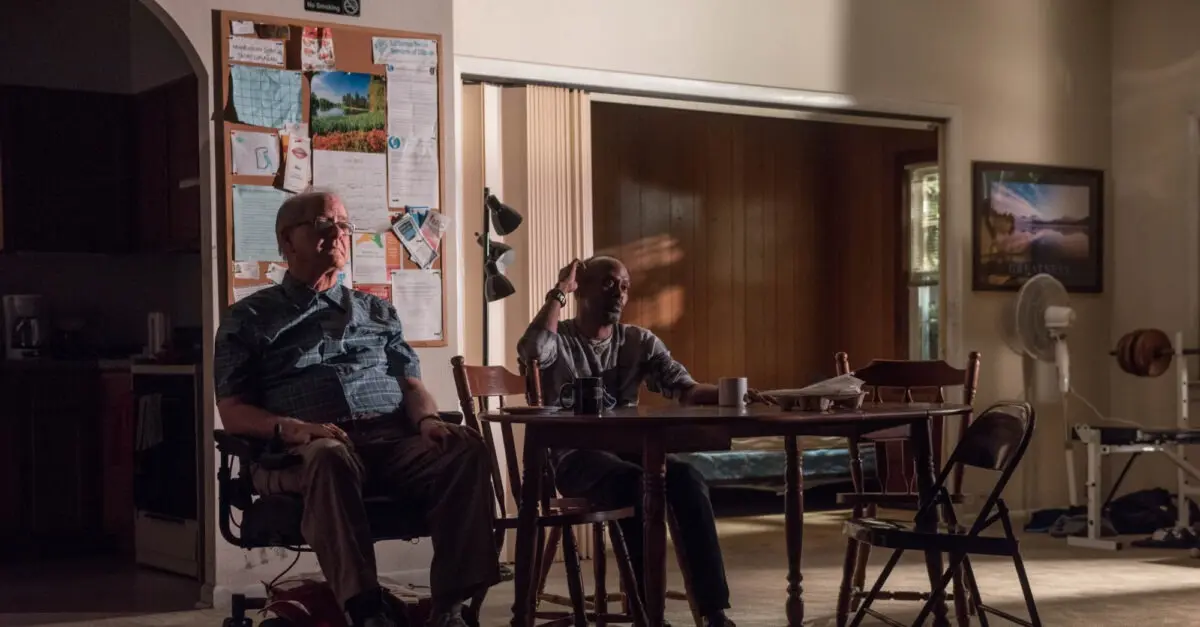
Bruce Norris, whose searing social satire Clybourne Park earned him both the Pulitzer Prize for Drama and the Tony Award for Best Play, has crafted in Downstate a work that refuses easy moral categorization. The play centers on a group of four men convicted of sexual offenses against minors, living together in a supervised Illinois halfway house. The equilibrium of their restricted, monitored existence is shattered when one of their accusers, now an adult, returns to confront them, forcing both the characters and the audience into an uncomfortable examination of justice, punishment, redemption, and societal ostracization.
Bringing this harrowing world to life requires an ensemble of extraordinary depth. The Broadway transfer benefits immensely from the inclusion of original cast members K. Todd Freeman and Francis Guinan, whose foundational familiarity with the material anchors the production’s psychological realism. They are joined by a powerhouse supporting company that includes Cassie Beck, Adrian Martinez, Al’Jaleel McGhee, Thomas Sadoski, Ivy Wolk, and Liza Colón-Zayas.
Directing this stellar ensemble is Joe Mantello, whose directorial touch has defined countless Broadway milestones, including his recent work on Death of a Salesman. Mantello’s staging is supported by a world-class design team:
- Scenic Design: Scott Pask, whose architectural vision defines the stark, institutional confines of the Illinois halfway house.
- Costume Design: Ann Roth, whose character-driven sartorial choices ground the marginalized figures in authentic Americana.
- Lighting Design: Heather Gilbert, utilizing stark, naturalistic illumination to underscore the psychological exposure of the characters.
- Sound Design: Mikaal Sulaiman, creating an atmospheric soundscape that amplifies the oppressive isolation of the setting.
The Rudin Factor and Cross-Promotional Economics
Beneath the artistic merits of the production lies a complex commercial matrix engineered by producers Scott Rudin and Barry Diller. Scott Rudin’s return to Broadway producing is arguably the most scrutinized industry storyline of the season. Following explosive journalistic investigations detailing decades of alleged verbal abuse and toxic workplace behavior, Rudin stepped away from his theatrical and cinematic empire in 2021. His reentry into the commercial theater landscape via Downstate and Small Mouth Sounds signals a calculated attempt to test the industry’s appetite for rehabilitation through commercial success.
Because Downstate is a deeply challenging, dark drama that lacks the immediate box-office draw of household movie stars, Rudin and Diller have leveraged their concurrent production of Small Mouth Sounds—which boasts the star wattage of Julia Roberts and Paul Rudd—to engineer a symbiotic ticketing strategy.
[Audience Member Purchases Ticket to "Downstate" (Oct 20 – Nov 22)]
                                  │
                                  ▼
[Receives Exclusive, Single-Use Access Code]
                                  │
                                  ▼
[Unlocks Ability to Purchase $250 Ticket for "Small Mouth Sounds"]
This masterclass in yield management addresses a persistent commercial challenge on Broadway: how to direct the overflow of star-driven ticket demand toward riskier, more intellectually demanding plays. By intertwining the ticketing ecosystems of two entirely different productions, the producers are attempting to subsidize the box-office visibility of Downstate while creating an exclusive, high-value tier of access for Small Mouth Sounds.
Official Statements and Industry Reception
As preview performances commence at the Booth Theatre, representatives for the production have maintained a transparent, reassuring posture regarding the recent delays. In an official statement released to ticket holders and press, company management emphasized that the health and safety of the cast remain paramount.
"While the unexpected illness of cast members necessitated a brief and cautious adjustment to our preview schedule, the company of Downstate is eager and ready to welcome audiences to the Booth Theatre. Under the brilliant guidance of Joe Mantello and Bruce Norris, our ensemble has poured immense dedication into this staging. We are fully on track for our November 15 opening night and look forward to sharing this vital, uncompromising work with New York."
Industry observers, meanwhile, have offered mixed reactions to the dual-pronged producing strategy. Veteran theatrical press agents and box-office analysts note that while bundling strategies are common in seasonal subscription models, cross-production ticket incentives tied to personal appearance lists are a novel, aggressive tactic in the post-pandemic commercial marketplace.
Furthermore, the theatrical community remains deeply divided on Rudin’s return. While union representatives and advocacy groups continue to monitor workplace conditions across all Rudin-associated productions, commercial investors have largely welcomed the liquidity and star power he injects back into a post-shutdown Broadway struggling with rising capitalization costs.
Future Outlook: What Lies Ahead for Downstate
As Downstate settles into its preview run at the Booth Theatre, the immediate focus shifts to audience reception and critical consensus. The play has always provoked intense debate, and its arrival on Broadway is expected to ignite fierce cultural conversations across major media outlets.
Key Milestones to Watch:
- The Press Opening (November 15): The definitive moment when major Broadway critics will weigh in on Norris’s script, Mantello’s direction, and the performances of the ensemble. Reviews will dictate whether the limited engagement can sustain strong word-of-mouth through its January close.
- The Ticketing Experiment: Analysts will closely monitor whether the cross-promotion with Small Mouth Sounds successfully translates into sustained, organic box-office momentum for Downstate once the initial wave of preview incentives concludes on November 22.
- Industry Precedent: The success or failure of Rudin’s reentry strategy will likely serve as a blueprint for other high-net-worth producers navigating public image rehabilitation while managing commercial real estate in the heart of Midtown Manhattan.
In sum, Downstate is much more than a revival of an acclaimed contemporary drama; it is a nexus point where artistic provocation, logistical resilience, and high-stakes commercial maneuvering collide. As the curtains rise at the Booth Theatre, theatergoers are invited into an unflinching exploration of human accountability—even as the production itself operates within a complex, highly scrutinized industrial machine.