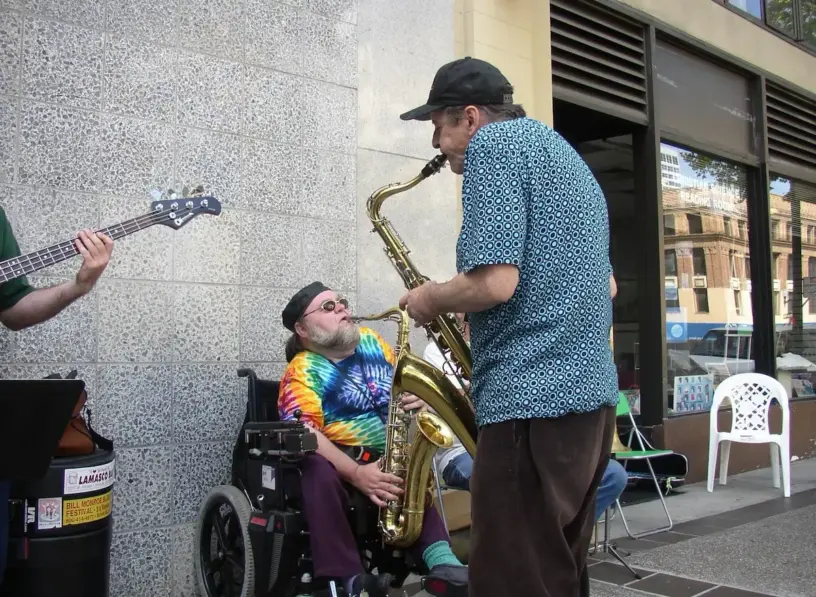



In the sprawling, often insular tapestry of American jazz history, certain figures exist as mythical anomalies—artists whose genius is inversely proportional to their mainstream renown. Bert Wilson, the underground saxophone legend, wheelchair-bound iconoclast, and uncompromising avant-garde visionary, was precisely such a figure. Surviving a childhood bout of polio that defied grim medical prognoses predicting an early grave, Wilson carved out an indelible, if largely subterranean, legacy across the West Coast and the volatile landscapes of 1960s and ’70s New York City.
Affectionately known as "Wheelz" to his peers, Wilson was a magnet for the highest-caliber improvisers of his era. From epic 13-hour jam sessions with drummer James Zitro to fleeting, incandescent artistic exchanges with John Coltrane, Joe Lovano, and David Liebman, Wilson operated at the white-hot center of creative music’s radical evolution. Yet, his story is not merely one of brushes with jazz royalty. It is a profound testament to the triumph of artistic integrity over systemic adversity. Beset by physical pain, mobility challenges, and the economic precariousness that inevitably dogs those who refuse to pander to commercial tastes, Wilson remained steadfastly devoted to his unique sonic vernacular.
This investigative retrospective examines the life, art, and enduring cultural impact of Bert Wilson—a titan of the saxophone who transformed lifelong oppression into an unyielding, swinging tour de force.
Detailed Chronology
Early Life, Polio, and Awakening (1939–1959)
Born in Evansville, Indiana, in October 1939, Bert Wilson’s introduction to the stage began before he was even school-aged. Tutored by his vaudevillian grandfather, young Bert was performing song-and-dance routines by age four. However, this nascent performance career was abruptly shattered by a diagnosis of polio. The disease left him paralyzed, unable to walk, and immobilized in his arms for years.
Confined to a hospital school in Chicago, Wilson’s worldview shifted profoundly when a fellow patient introduced him to the revolutionary sounds of bebop pioneer Charlie Parker. This auditory awakening planted the seeds for a lifelong obsession. Once he regained partial mobility, Wilson pursued formal piano studies before picking up the clarinet at age 13. By the time he relocated to Los Angeles in the late 1950s, he had discovered the saxophone at age 18—an instrument that would become his primary voice and his ultimate vehicle for liberation.
The Crucible of the Sixties and New York Migration (1960–1970s)
The 1960s placed Wilson at the epicenter of jazz’s most radical paradigm shift, as musicians grappled with the harmonic and spiritual innovations of John Coltrane and Ornette Coleman. In 1962, Wilson met 17-year-old trumpet prodigy Barbara Donald, initiating a vital, long-standing creative partnership. Around the mid-1960s, Wilson also connected with percussionist James Zitro, sparking an era of legendary, near-mythic endurance testing; a single jam session between the two notoriously lasted 13 continuous hours, ending with split lips and blistered fingers.
Wilson’s growing reputation culminated in a pivotal 1966 journey to Manhattan, engineered alongside Zitro and Donald. Packed into a car with Wilson’s wheelchair, the group traveled East so Wilson could contribute to Music From The Spheres, a seminal avant-garde classic led by alto saxophonist Sonny Simmons for the ESP-Disk label. A second ESP release soon followed, cementing Wilson and Zitro within the vanguard of free jazz.
However, life in pre-Giuliani Manhattan posed severe logistical hurdles for a disabled musician navigating walk-up apartments without elevators. Compounding these daily struggles were frequent thefts of his instruments. Seeking a more sustainable creative life, Wilson returned to the West Coast, settling in Berkeley and releasing notable underground recordings alongside drummer Smiley Winters and the Now Creative Arts Jazz Ensemble.
The Olympia Sanctuary and the Rebirth Era (Late 1970s–2013)
By the close of the 1970s, Wilson was living in Woodstock, New York, isolated and facing deteriorating living conditions. Recognizing his plight, a network of musician friends organized a benefit concert to relocate him to Olympia, Washington.
In the tranquil Pacific Northwest, Wilson found an unexpected sanctuary. It was here that he met flutist Nancy Curtis, who became his artistic collaborator, wife, and a vital voice in his working band, Rebirth. The Olympia years fostered a fertile creative ecosystem. Every Tuesday, local jazz veterans—including tenor saxophonist Chuck Stentz and pianist Jack Perciful, a veteran of the Harry James orchestra—gathered at Wilson and Curtis’s modest home for rigorous jam sessions under the moniker "Bebop Revisited."
This fertile period yielded acclaimed commercial releases, most notably 1997’s Endless Fingers on Arabesque Records, which earned a rare five-star rating from the All Music Guide, followed by Dedicated to Friends and Mothers on the Pony Boy label. Wilson continued to teach and mentor a generation of players—including Ernie Watts, Lennie Pickett, and Jeff Coffin—until his passing in 2013 at the age of 73, far outliving the grim medical prognoses of his childhood.
Supporting Context & Metrics
The Acoustic Architecture of Wilson’s Sound
To understand Bert Wilson’s musical identity is to understand an intricate paradox: he was an avant-garde outlaw deeply steeped in traditional bebop. While critics occasionally compartmentalized him as a purely "free jazz" player, Wilson’s foundational vocabulary was rooted in the masters. In a 2005 interview with Cadence magazine, he famously cited his primary influences:
"Bird, Dolphy, Rollins, Coltrane, Coleman Hawkins, and Art Tatum are my daddies and, of course, Art Blakey."
When tackling standard tunes with the Bebop Revisited ensemble, Wilson would often execute the opening melody straightforwardly, only to detonate the harmonic framework roughly eight bars in. His execution relied heavily on multiphonics—the ability to produce multiple notes simultaneously on a monophonic instrument—combined with sweeping altissimo harmonics, sudden staccato bursts, and jagged, angular phrasing.
Despite stepping far outside standard chord changes, Wilson’s improvisations retained an internal logic and deep harmonic integrity. He was a romantic balladeer at heart, merging the visceral heat of an avant-garde firebrand with the emotive lyricism of Ben Webster or Johnny Hodges.
Key Collaborators and Metrics of Influence
- Geographic Reach: Spanning Indiana, Chicago, Los Angeles, the San Francisco Bay Area, New York City, and Olympia, Washington.
- Core Discographic Milestones:
- Music From The Spheres (ESP-Disk, with Sonny Simmons)
- Smiley Etc. (1969, with Smiley Winters, Donald Garrett, Barbara Donald, and Michael White)
- Endless Fingers (Arabesque, 1997) — 5-Star All Music Guide Rating
- Dedicated to Friends and Mothers (Pony Boy Records)
- Prominent Students Mentored: Ernie Watts, Lennie Pickett (Tower of Power), and Jeff Coffin (Dave Matthews Band).
Official Statements & Archival Reflections
The profound impact Wilson left on his peers is best captured through their firsthand accounts of his unwavering dedication and singular magnetism.
Reflecting on his interactions with the jazz elite, Wilson noted in his 2005 Cadence interview:
"This is one point I want to make. Wherever I have lived in my life, the greatest musicians have always come to my house to play. I’ve been blessed, man."
His close friendship with saxophonist Jim Pepper yielded deep explorations of harmonic structure:
"Another guy who had a very rough life, but he was a beautiful cat, and we were very close and used to sit around my apartment and make far-out noises for each other and then try to take them apart and figure out what notes they had in them and how they fit against the harmonic structure."
Recalling Wilson’s uncompromising approach to performance, late reeds player Bill Ramsay recounted a wedding reception in Olympia where Wilson played a bride’s favorite song:
"Bert starts to play, and I’m getting nervous. I’m looking at my wife and saying, ‘He’s playing the melody straight; this ain’t gonna stay that way for the rest of the tune.’ Bert, about eight bars into the tune, he can’t handle it, he’s just got to take it out… and he starts playing it like, crazy, man…"
Former student Michael Olsen underscored Wilson’s pedagogical balance:
"He was a very patient teacher… But he didn’t let people slide either."
Perhaps encapsulating his life’s philosophy in the face of persistent physical and financial hardship, Wilson famously quipped:
"I got into music to play music, not to get rich and famous, though I wish I could bring my music to more people… as I always say, ‘I’m not depressed, I’m oppressed.’ Ha!"
Future Outlook
More than a decade after his passing in 2013, Bert Wilson’s legacy stands ripe for rediscovery. While his official discography—highlighted by masterpieces like Endless Fingers and his historic ESP-Disk sessions—offers a robust entry point, a vast archival treasure trove remains largely untapped. Throughout his decades of music-making, Wilson meticulously accumulated private recordings of home jam sessions, rehearsals, and live performances featuring a revolving cast of underground luminaries, including the late trumpeter Barbara Donald.
Music historians, archivists, and jazz enthusiasts increasingly recognize that figures like Wilson represent the vital connective tissue of America’s indigenous art form. As contemporary jazz continues to break down artificial barriers between mainstream standards and radical free improvisation, Wilson’s uncompromising philosophy offers a guiding light. Future initiatives to catalog, digitize, and commercially release the extensive Dr. Wheelz’ Archives promise to reintroduce a wider audience to a wheelchair-bound giant who refused to compromise his vision, ensuring that the fierce, swinging flame of Bert Wilson continues to burn brightly for generations to come.



Leave a Reply