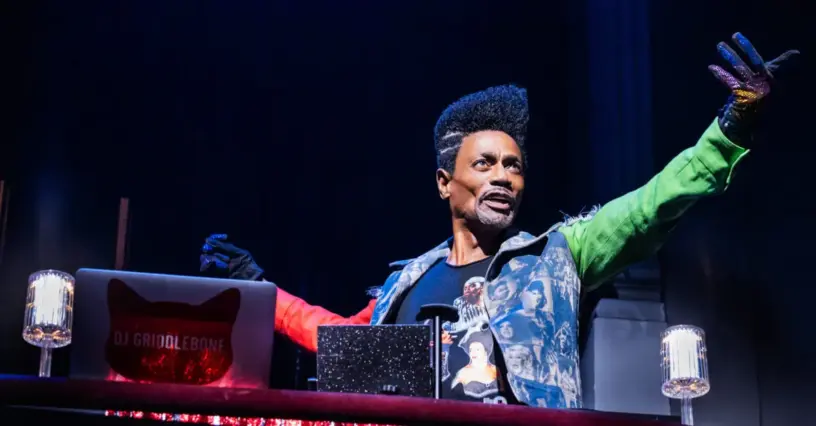
Following an acclaimed, ground-breaking run that fundamentally redefined how audiences perceive one of musical theatre’s most enduring titles, Broadway officially bid farewell to Cats: The Jellicle Ball with its final curtain call on August 8. The production—a striking reinvention of Andrew Lloyd Webber’s 1981 megahit channeled entirely through the lens of New York City’s historic underground ballroom scene—left an indelible mark on the Main Stem. Though the physical run at the Broadhurst Theatre has concluded, the cultural shockwaves of the production continue to reverberate across the theatrical landscape.
In the wake of the closure, fans mourning the loss of the production have been handed a vibrant consolation. DJ Murphy (actor and artist Logan Murphy) has officially released the show’s highly anticipated intermission house and ballroom remix playlist on SoundCloud. Featuring pulsating, dance-inspired reinterpretations of iconic Andrew Lloyd Webber compositions such as "The Phantom of the Opera," "Buenos Aires," and "He Whistled at Me," the drop includes previously unreleased tracks that were left on the cutting room floor.
Moreover, following a passionate, highly coordinated online fan campaign, producers have confirmed that Cats: The Jellicle Ball will receive an official original Broadway cast recording. Set for release via Atlantic Records this winter, the album ensures that the groundbreaking sonic identity of this cultural phenomenon will be preserved for posterity.
Yet, the legacy of Cats: The Jellicle Ball extends far beyond streaming playlists and upcoming cast albums. The production’s abrupt closing notice last month ignited a fierce industry-wide dialogue, prompting composer Andrew Lloyd Webber to sound the alarm regarding the increasingly precarious and financially unsustainable economic realities facing modern Broadway productions. This report examines the trajectory of the revival, the anatomy of its unique cultural synthesis, its critical and commercial reception, and what its departure signals for the future of commercial theatre.
Detailed Chronology
From Off-Broadway Sensation to Main Stem Triumph
The journey of Cats: The Jellicle Ball began long before its arrival on Broadway. Initially developed as a multi-extended, critically adored Off-Broadway engagement at the Perelman Performing Arts Center (PACNYC) during the summer of 2024, the production immediately captured the imagination of downtown theatregoers and cultural critics alike.
Spearheaded by co-directors Zhailon Levingston and Bill Rauch, alongside choreographers Omari Wiles and Arturo Lyons, the creative team possessed a radical vision: transforming T.S. Eliot’s anthropomorphic felines into fierce contestants walking sickening runway categories at a modern drag ball. Rather than relying on the traditional leotards and leg warmers of Gillian Lynne’s iconic 1982 choreography, this iteration immersed audiences directly into ballroom culture, complete with runway configurations, onstage seating, and a relentless infusion of vogueing, house beats, and queer nightlife aesthetics.
Following its downtown success, the production made the bold leap to the Main Stem, bringing with it an intoxicating energy that transformed the Broadway theatre space. The venue’s spatial architecture was entirely reconfigured to mimic an authentic ball, featuring runway seating that blurred the traditional boundary between spectator and participant.
Critical Acclaim and Tony Recognition
Upon transferring to Broadway, Cats: The Jellicle Ball received near-unanimous critical raves. Reviewers praised its infectious vitality, the seamless integration of musical theatre canon with authentic ballroom history, and standout performances from a stacked ensemble cast that blended ballroom legends, stage veterans, and fresh talent.
The production’s artistic brilliance was officially validated during the 2026 Tony Awards season, where it walked away with three major competitive trophies:
- Best Direction of a Musical: Zhailon Levingston and Bill Rauch
- Best Choreography: Omari Wiles and Arturo Lyons
- Best Costume Design: Qween Jean
Despite this critical validation and a fiercely devoted audience base, the production’s economic reality proved to be a different battleground. Last month, producers stunned the theatre community by announcing the musical’s August 8 closing date. The abrupt announcement laid bare the difficulties of sustaining a uniquely configured, artistically ambitious show within a Broadway ecosystem heavily reliant on massive tourist volume and traditional operating models.
The Aftermath: Intermission Remixes and Cast Recording
In the wake of the closure, the production’s creative pulse has shifted to digital and recorded mediums. DJ Murphy’s SoundCloud drop of the intermission music has offered fans a direct line back to the electric atmosphere inside the theatre. Conceived following a phone call from Associate Director Cooper Howell, the project tasked Murphy with injecting house and ballroom energy into Lloyd Webber’s timeless melodies.
Complementing the remix drop is the announcement of the official cast recording. Produced in partnership with Atlantic Records and spurred by an aggressive grassroots digital campaign from the show’s fervent fanbase, the album is scheduled for a winter release. It will immortalize performances from a landmark ensemble that included Tony winner Andrè De Shields as Old Deuteronomy, “Tempress” Chasity Moore as Grizabella, Junior LaBeija as Gus, Sydney James Harcourt as Rum Tum Tugger, and original 1982 Broadway cast member Ken Ard—who originated the role of Macavity—returning to the fold as DJ Griddlebone.
Supporting Context & Metrics
The History and Impact of Ballroom Culture
To fully understand the cultural weight of Cats: The Jellicle Ball, one must examine the deep historical roots of the underground ballroom scene. Originating in 1920s Harlem, New York City, and reaching its first major zenith during the vibrant subcultural explosions of the 1980s, the Ballroom scene was forged as a safe haven and creative outlet primarily for Black and Latino LGBTQIA+ communities.
Marginalized by mainstream society, queer people of color built their own houses—chosen families modeled after traditional kinship structures—and competed in elaborate runway categories that spanned the extravagant, the satirical, and the fabulously commonplace. Ballroom culture is also the literal birthplace of vogueing: a distinct, highly stylized dance form characterized by crisp linear movements, dramatic dips, and striking poses, which is entirely distinct from the commercialized pop-culture appropriations of the 1990s.
While the 1990 landmark documentary Paris Is Burning famously captured the ethos of this subculture, and the FX series Pose brought elements of it into the modern cultural mainstream, integrating it into a commercial Andrew Lloyd Webber musical represented an unprecedented theatrical fusion.
Reimagining a Feline Classic
Andrew Lloyd Webber’s Cats opened in London in 1979 before transferring to Broadway in 1982, where it ran for an astonishing 18 years, becoming the fifth longest-running show in Broadway history. Based on T.S. Eliot’s Old Possum’s Book of Practical Cats, the musical is famously plotless, following a tribe of Jellicle cats gathering for their annual ball to compete for the ultimate prize: being chosen to ascend to the Heaviside Layer and begin a new life.
In the original staging, Gillian Lynne’s choreography relied heavily on contemporary ballet and jazz-inflected feline mimicry. By reimagining the Jellicle tribe as drag ball contestants, Cats: The Jellicle Ball unlocked an intrinsic thematic parallel. Both universes are rooted in performance, transformation, the desperate human (or feline) need to be seen, and the search for community validation.
Creative Architecture and Ensemble
The production’s triumph was the result of a massive collaborative effort across dozens of specialized artistic disciplines. The creative infrastructure included:
- Scenic Design: Rachel Hauck
- Lighting Design: Adam Honoré
- Sound Design: Kai Harada
- Projection Design: Brittany Bland
- Hair and Wig Design: Nikiya Mathis
- Make-up Design: Rania Zohny
- Magic Design: Paul Kieve
- Sensitivity Specialist: Ann James
- Dramaturg & Gender Consultant: Josephine Kearns
- Music Supervision & Direction: William Waldrop
- Beats Arrangement & Production: Trevor Holder
- General Management: Baseline Theatrical (Nick Lugo, Jessica Fried, James Hickey)
- Lead Producers: Michael Harrison and Mike Bosner
The stellar ensemble featured an eclectic mix of seasoned Broadway veterans, ballroom royalty, and crossover talent, including Jonathan Burke as Mungojerrie, Baby Byrne as Victoria, Dava Huesca as Rumpleteazer, Dudney Joseph Jr. as Munkustrap, Robert “Silk” Mason as Magical Mister Mistoffelees, Primo Thee Ballerino as Tumblebrutus, Xavier Reyes as Jennyanydots, Nora Schell as Bustopher Jones, Bebé Nicole Simpson as Demeter, Sofia as Cassandra and Skimbleshanks, Garnet Williams as Bombalurina, Teddy Wilson Jr. as Sillabub, and Tara Lashan Clinkscales.
Additional featured performers included Legendary head judge Leiomy Maldonado as Mavacity; Kya Azeen (Pose) as Etcetera; Bryson Battle (The Voice) as Jellylorum; alongside Sherrod T. Brown, Bryce Farris, Phumzile Sojola, Kendall Grayson Stroud, B. Noel Thomas, Kalyn West, and Donté Nadir Wilder. Casting was executed by X Casting’s Victor Vazquez and Sujotta R. Pace.
Official Statements
The closure of the production and the subsequent release of its auxiliary media have prompted profound reflections from its creators and producers.
Reflecting on the unexpected genesis of the intermission remix project, DJ Murphy shared via social media:
"Many months ago I got a phone call from the Associate director of this production [Cooper Howell]. He called me with a very specific idea: house and ballroom remixes of Andrew Lloyd Webber songs for the Broadway intermission of CATS! I said ‘wait… YES.’ And thus, the Jellicle Ball remix album was born."
Beyond the celebratory audio drops, the closure of Cats: The Jellicle Ball has forced industry leaders to confront darker economic realities. In the wake of the closing notice, composer Andrew Lloyd Webber issued a public statement sounding a stark alarm regarding the financial sustainability of contemporary Broadway. Lloyd Webber highlighted how mounting operational costs, shifting tourist demographics, and narrow profit margins increasingly threaten innovative, mid-sized, and non-traditional commercial productions that dare to break theatrical molds.
Producers Michael Harrison and Mike Bosner echoed sentiments of immense pride regarding the production’s cultural footprint. While acknowledging the heartbreak of the closure, they emphasized that the primary mission—centering queer Black and Latino artistry at the heart of a global musical theatre titan—permanently altered the DNA of what a Broadway revival can achieve.
Future Outlook
As the dust settles on the Broadhurst Theatre stage, the long-term impact of Cats: The Jellicle Ball on the American theatrical canon is already coming into focus.
First, the upcoming winter release of the Atlantic Records cast recording ensures that the sonic innovations spearheaded by William Waldrop, Trevor Holder, and the ensemble will remain part of the public listening sphere indefinitely. It provides an institutional anchor for a production that defied traditional categorizations.
Second, the availability of DJ Murphy’s intermission remixes on SoundCloud democratizes a piece of ephemeral theatre history, allowing global fans to experience the distinct club-culture atmosphere that greeted audiences inside the auditorium.
Most importantly, Cats: The Jellicle Ball has left an indelible blueprint for future theatrical adapters. By proving that classical musical theatre repertoire can be authentically refracted through marginalized cultural subcultures without losing the emotional core of the source material, the production has expanded the boundaries of casting, staging, and interpretation.
Whether the industry at large heeds Andrew Lloyd Webber’s warning about Broadway’s economic sustainability remains to be seen. However, the ghost lights of the Broadhurst will continue to shine with the memory of a production that proved, unequivocally, that Jellicle cats can walk a runway, own their truth, and leave the theatrical world fundamentally transformed.

Leave a Reply