In an era saturated with hastily assembled digital audio workstations (DAW) utilities—often dismissed by audio engineers as "vibe-coded" novelties—developer Box of Rules has cut through the noise with an intriguing audio processing utility. Released recently for macOS, Windows, and Linux, Picking Fingers is a free, zero-latency bass guitar processing plugin designed to tackle a notoriously difficult post-production problem: transforming the transient profile and harmonic footprint of a recorded bass guitar from fingerstyle to picked, or vice-versa.
While the software development landscape is currently experiencing a renaissance of automated, AI-assisted, and rapid-prototype tools that frequently frustrate reviewers with their lack of depth, Picking Fingers stands apart. Rather than relying on generic EQ curves or rudimentary transient shapers, the plugin utilizes a transformation algorithm derived from real, matched captures of identical bass guitars performed alternately with a pick and bare fingers.
For mixing and tracking engineers, this capability bridges a classic production dilemma. Changing a bass performance’s articulation after the tracking stage has traditionally required heavy re-amping, rigorous transient manipulation, or re-recording the part entirely. Picking Fingers attempts to solve this within a lightweight, zero-latency footprint. Furthermore, its frictionless distribution model—offered completely free for commercial and personal use with zero registration hurdles—has made it an early talking point in the pro-audio community. This comprehensive report examines the plugin’s technical architecture, underlying development philosophy, operational workflows, and broader implications for modern software development in the music production sector.
Detailed Chronology
The Proliferation of "Vibe-Coded" Software and the Reviewer’s Dilemma
To understand the significance of Picking Fingers, one must first examine the current climate of software development in the audio industry. In recent years, platforms that accelerate code writing—coupled with simplified plugin frameworks—have led to an unprecedented flood of new releases. Inboxes across audio publications are routinely overwhelmed by lightweight utilities that replicate familiar concepts: saturation boxes, basic compressors, and algorithmic filters that offer little differentiation beyond a slick graphical user interface (GUI).
This phenomenon, often categorized by developers and reviewers as "vibe coding," presents a distinct filtering challenge. Many of these rapid-deployment plugins suffer from a lack of genuine quality control, optimization issues, or algorithmic originality. The saturation of the plugin market has forced independent reviewers and industry veterans to approach new freeware announcements with a healthy degree of skepticism, frequently drawing frustrating parallels to the early days of template-heavy development environments.
The Conception and Engineering of Picking Fingers
Despite these industry headwinds, rare exceptions emerge when a developer invests genuine effort into solving a specific, highly nuanced acoustic problem. Box of Rules positioned Picking Fingers outside the standard sea of generic utilities by focusing on an overlooked acoustic translation: the mechanical friction and transient delivery of picking versus fingerstyle playing.
Rather than guessing how a picked bass should sound through static frequency adjustments, the creators of Picking Fingers took an empirical approach. The core transformation engine is built upon real, matched audio captures. By recording the exact same instrument, signal chain, and performance dynamics using both a plectrum and fingers, the developers mapped the distinct micro-transients, harmonic upper-midrange emphasis, and low-end phase relationships native to each style.
Release and Public Reception
Upon its release, Picking Fingers was made available across all major desktop operating systems (macOS, Windows, and Linux) with an expansive array of formats, including VST3, AU, LV2, and PACE-signed AAX. Eschewing the industry-standard friction of hardware locks, cumbersome license managers, or mandatory newsletter sign-ups, Box of Rules opted for a direct download process. Users can simply select their operating system architecture and deploy the tool instantly into their DAW timeline.
This frictionless acquisition model, combined with a zero-cost commercial licensing framework, quickly propelled the plugin into online mixing communities, producer forums, and creator circles. While critics noted that the user interface retains a somewhat utilitarian aesthetic that reflects its rapid-development origins, the underlying DSP performance quickly silenced early skeptics who tested it on dense multitrack mixes.
Supporting Context & Metrics
The Acoustic Physics of Pick vs. Fingerstyle Bass
To appreciate what Picking Fingers attempts to achieve, one must examine the physical differences between fingerstyle and picked bass guitar performances.
When a bassist plays with their fingers, the flesh and nail of the digit strike the string over a broader surface area. This results in a softer, more rounded initial transient, a prominent fundamental frequency emphasis, and a warm, organic decay. The upper harmonics roll off more smoothly, blending the bass cleanly into the lower-midrange pocket of a mix.
Conversely, a plastic or polymer plectrum creates an entirely different physical interaction. The hard edge of the pick strikes the metal-wound string instantaneously, generating a sharp, high-frequency transient spike (often referred to as "click" or "scratch"), a faster initial envelope rise time, and a pronounced emphasis in the 1.5 kHz to 4 kHz range. This gives picked bass tracks an aggressive, cutting character that punches through heavy guitars and dense arrangements.
Manually transforming one style into the other has historically required exhaustive multi-band transient design, dynamic EQ automation, and complex saturation routing. Picking Fingers encapsulates these intricate frequency-dependent transient shifts into a handful of macro controls.
Plugin Architecture and Control Set
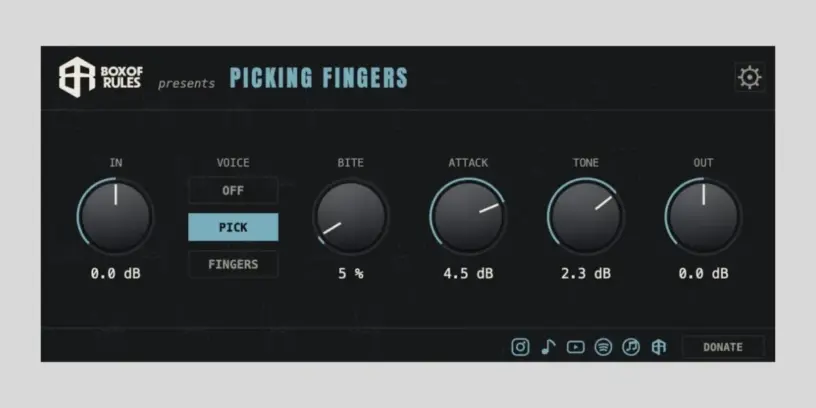
Despite its complex underlying impulse-matching foundation, Picking Fingers keeps its user interface streamlined. The control topology consists of several primary parameters:
- Voice Control: The central algorithm governing the core transformation. It pushes the tonal profile fluidly between fingerstyle warmth and picked articulation. Crucially, the low end of the audio signal is rigorously level-matched internally. This ensures that sweeping the Voice control radically alters the midrange character and transient bite without thinning out the foundational sub-frequencies or subverting the mix’s low-end integrity.
- Attack Control: Designed to dial in or pull back the specific per-note character measured during the capture phase. It allows engineers to accentuate the initial pluck or soften an overly aggressive performance.
- Bite Control: Introduces a gritty, focused front edge to the note without saturating or muddying the sustain. It targets the upper-midrange harmonics typically excited by a plectrum hitting the bridge pickup region.
- Tone Tilt ($pm$6 dB): A linear tilt filter providing rapid global brightness or darkness adjustments.
- Input and Output Trims: Standard gain-staging utilities to compensate for any perceived volume shifts introduced by extreme parameter settings.
Compatibility, Formats, and Data Collection
Operating as a zero-latency processor capable of handling both mono and stereo instances, Picking Fingers is viable for real-time tracking monitoring as well as offline mixing tasks.
- macOS: Includes VST3, AU, LV2, and PACE-signed AAX formats within a unified installer.
- Windows: Distributed in VST3-only architecture.
- Linux: Built natively for VST3 and LV2 environments.
In terms of privacy and software telemetry, Box of Rules transparently notes that the plugin records anonymous usage data to assist with future updates and stability patches. However, the developer explicitly guarantees that no audio material, user files, or personal identifying information is ever collected or transmitted.
Official Statements & Developer Insights
While independent software development teams often shroud their algorithms in proprietary mystery, the philosophy behind Box of Rules’ design choices centers on practicality and utility over marketing hyperbole.
In technical breakdowns accompanying the plugin’s release, the development team emphasized that Picking Fingers was never intended to act as a magical fix for a poorly performed bassline. Instead, it was conceived as an intelligent remedial and creative shaping tool for mixing engineers who inherit DI (Direct Input) recordings where the stylistic choice of the tracking session no longer fits the final production.
"We wanted to move past the era of guessing curves with standard parametric EQs," noted documentation from Box of Rules. "By capturing the actual physical nuances of real instruments played interchangeably with fingers and picks, the processing reflects true acoustic translation rather than artificial frequency boosts. The goal was to preserve the integrity of the performance while giving engineers absolute control over the articulation in the mix."
Industry analysts and prominent mixing educators have noted that tools like Picking Fingers signal a shift in how utility plugins are built. Rather than attempting to emulate an entire vintage hardware console—a market already heavily crowded by industry giants—boutique developers are increasingly focusing on hyper-specific functional tasks that save hours of tedious routing and multi-plugin chain management.
Future Outlook
The Evolution of Niche DSP Utilities
The arrival of Picking Fingers points toward a wider trend in audio software engineering: the rise of targeted, problem-solving micro-plugins. As native DAW capabilities expand, the demand for generic utility plugins continues to decline, while demand for intelligent, task-specific processors rises.
In the immediate future, we can expect developers to lean further into machine learning and empirical impulse mapping to solve micro-problems in mixing and tracking. If Box of Rules can successfully scale this methodology to other acoustic transitions—such as matching acoustic guitar fingerpicking styles to flatpicking, or translating snare drum wire tensions dynamically—the studio toolkit will see significant workflow optimizations.
Market Implications for Freeware Audio Software
The reception of Picking Fingers also highlights changing expectations within the freeware market. Modern bedroom producers and professional mix engineers alike have grown wary of freeware laden with aggressive monetization funnels, registration walls, and disruptive licensing software.
By offering a genuinely innovative DSP concept with zero operational friction, Box of Rules has demonstrated a viable blueprint for independent software vendors. Building community trust through transparent data policies and frictionless access establishes immediate brand equity, paving the way for future commercial releases.
Ultimately, Picking Fingers proves that even in a crowded digital marketplace saturated with repetitive code, original thinking and meticulous execution can still yield tools that earn a permanent place on the master bus or instrument channel strip. Whether used to rescue a lackluster DI track or to subtly alter the sonic bite of a modern rock production, this free utility punches well above its weight class, marking a welcome success story for independent audio engineering innovation.

Leave a Reply