
Executive Overview
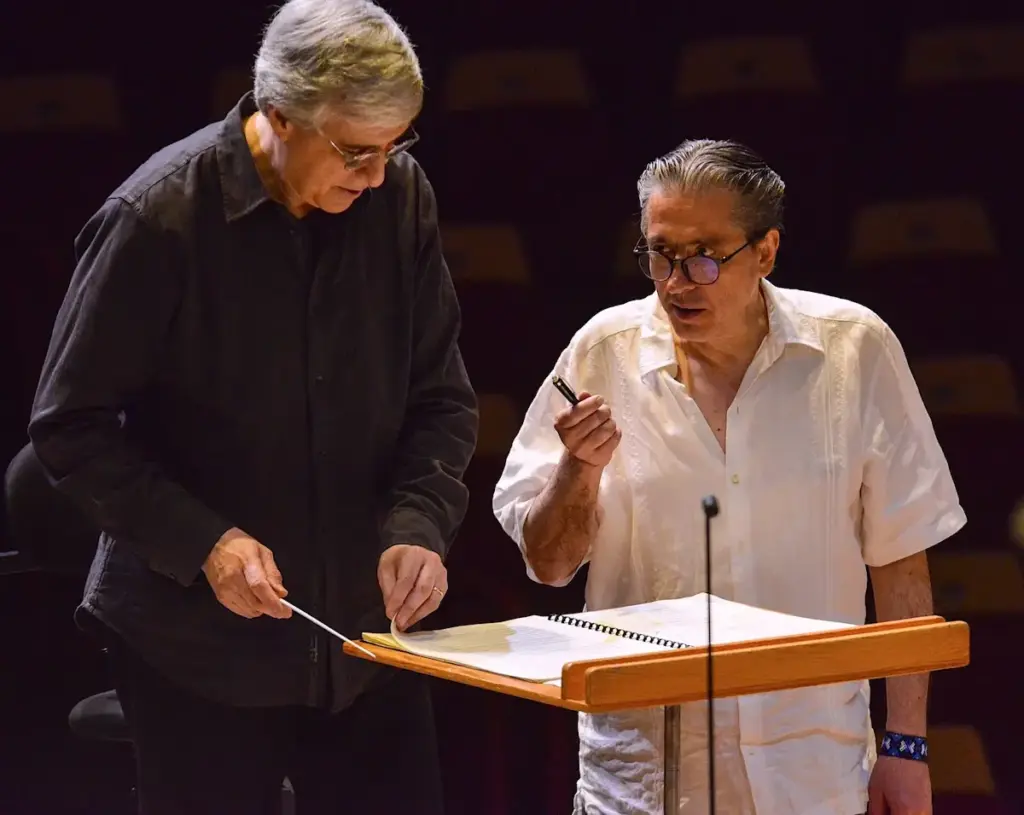
When visionary choreographer and director Sasha Waltz was commissioned in 2021 to stage Johann Sebastian Bach’s monumental St. John Passion (Johannes-Passion), she entered a realm fraught with historical tension. To transform a deeply respected, sacred oratorio into a total theatrical spectacle requires an artist willing to pull out every aesthetic stop. Yet, rather than merely illustrating a biblical narrative, Waltz—alongside conductor Leonardo García Alarcón—sought to forge a deeply human and broadly accessible experience. By bridging the chasm between centuries-old liturgical music and contemporary physical theater, the production asks modern audiences to confront the timeless questions of complicity, suffering, and mortality.
Performed by a powerhouse collaboration featuring the Dutch National Opera Chorus, the chorus and musicians of the Netherlands Bach Society, and an elite roster of international soloists, this production reimagines the ultimate sacred masterwork. It replaces dogmatic piety with stark, tactile imagery inspired by Matthias Grünewald’s legendary Isenheim Altarpiece. The result is an authoritative, emotionally pulverizing investigation of humanity that challenges spectators not just to watch, but to physically and morally position themselves within the drama.
Detailed Chronology and Scenographic Journey
The Opening Landscape: Industrial Soundscapes and Human Vulnerability
From the moment the audience steps into the auditorium, the atmosphere is charged with avant-garde theatricality. The spatial arrangement defies traditional concert-hall geometry. Twelve choir members dressed entirely in white take their positions on flanking sides of the stage, mirroring the division of the instrumentalists. String players, an organ, and conductor Leonardo García Alarcón occupy one flank, while additional string players, a harpsichord, a Baroque cello, a double bass, an oboe, and a flute balance the opposite side. Further emphasizing spatial immersion, additional choir members are seated or standing directly among the audience, holding stark white pieces of cloth.
On a slightly elevated black stage upstage, a long, rigid row of sewing machines immediately catches the eye. Eleven nude female dancers quietly take their places behind the machinery, beginning the silent, rhythmic labor of sewing their own white shirts. The harsh, mechanical clatter of the sewing machines gradually swells, transforming into dense electronic soundscapes. When these industrial noises finally evaporate into absolute silence, the atmosphere shifts with breathtaking gravity, giving way to the soaring, solemn opening chorus: "Herr, unser Herrscher."
Act I: Grace, Betrayal, and the Mechanics of Suffering
Under García Alarcón’s meticulous baton, Bach’s intricate counterpoint and lyrical musical phrases find physical form through graceful, flowing dance movements. However, as the narrative progresses into scenes of betrayal, imprisonment, and institutional violence, the choreography darkens. The dancers wield wooden sticks, heavy blocks, planks, and bodies that tremble under physical and psychological duress.
The production consciously avoids cheap didacticism. Waltz’s primary visual inspiration is derived not from standard theological iconography, but from Matthias Grünewald’s Isenheim Altarpiece, housed in the Unterlinden Museum in Colmar, Alsace. Grünewald’s panels depict the agonizing suffering of Christ with visceral, almost tangible realism: blood spilling from the crown of thorns, jagged thorns piercing taut skin, blue veins pulsing beneath translucent flesh, and lips bruised to a dying purple.
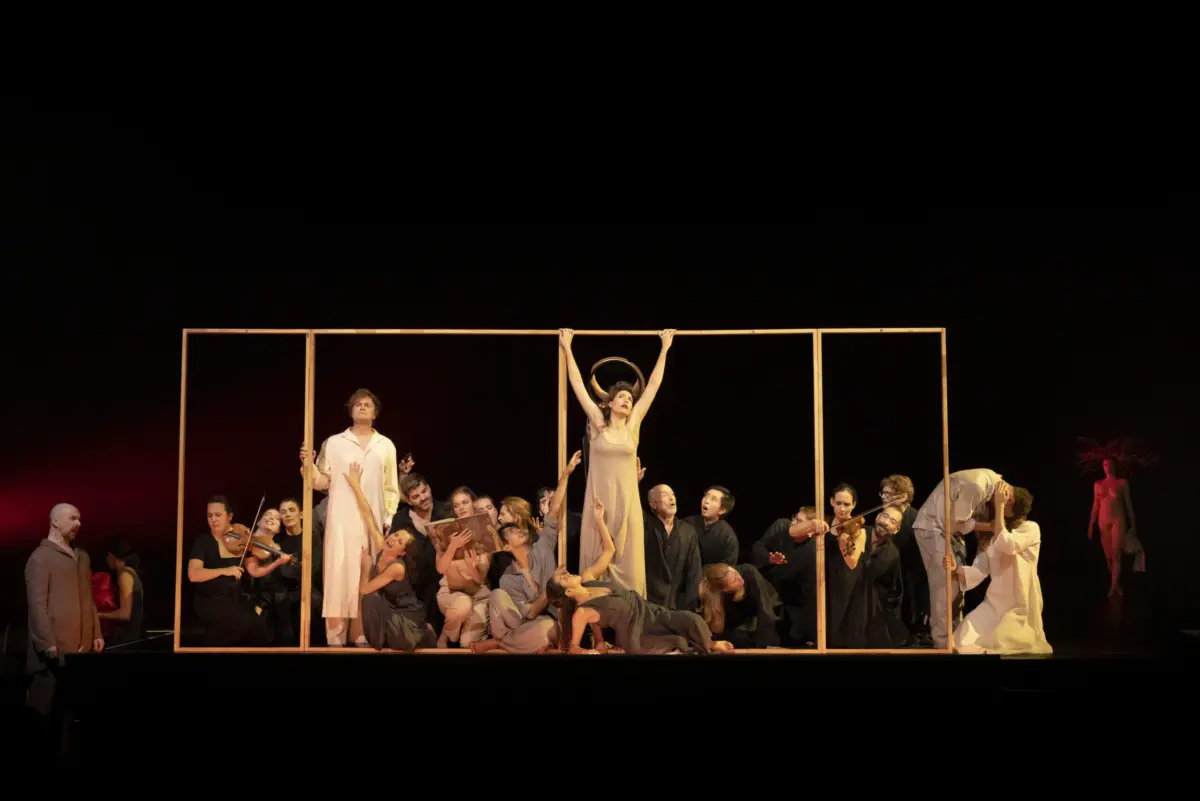
In the second half of the St. John Passion, Waltz translates these historical altarpiece panels into dynamic structures made of raw wooden sticks that rhythmically open and close. Within these shifting wooden cages, the dying and dead Jesus appears in multiple, haunting iterations, transforming the stage into an architectural living gallery of grief.
Act II and Vocal Masterclasses: The Characters Brought to Life
The dramatic architecture of the production is anchored by a stellar cast of vocalists whose characterizations cut deep into the psychological layers of the text.
- Andreas Wolf (Jesus): Portraying Jesus as an almost timid, deeply vulnerable figure both in physical appearance and vocal timbre, Wolf brought striking humanity to the role. His Jesus is innocent, caught off guard by systemic malice, yet entirely willing to accept his fate. Wolf’s commanding, bronze-colored bass-baritone provided a gorgeous, anchoring contrast to the Evangelist’s ethereal tenor, delivering lines with pitch-perfect clarity under the pressure of Pilate’s interrogation.
- Florian Boesch (Pontius Pilate): Dressed in an imposing purple cloak, Austrian singer Florian Boesch commanded the stage as a formidable, unyielding Pilate. Employing warm, earthy tones and fierce expressive power, Boesch was at his most terrifyingly effective during the crowd scenes at the opening of the second part, where he sprinted across the stage as the mob bayed for Barabbas’s release and condemned Jesus to death.
- David Fischer (The Evangelist): Fischer navigated the demanding recitatives with remarkable agility and clarity. His supple, pure, and warm vocal production made him an essential narrative anchor, guiding the audience through the harrowing historical chronology with articulate grace.
- Chelsea Zurfhüh (Soprano Soloist): The Swiss soprano showcased her profound affinity for the Baroque repertoire with a bright, crystalline voice. Exhibiting extraordinary poise and breath control in sustained melodic lines, her rendition of the aria "Ich folge dir gleichfalls mit freudigen Schritten" radiated a palpable, joyful desire to walk alongside the divine.
- Matthew Newlin (Tenor Soloist): Newlin delivered a searing interpretation of "Ach, mein Sinn," capturing the suffocating anguish of Peter after his triple denial of Christ. The aria was integrated into an extensive, emotionally devastating dance sequence exploring themes of remorse, shame, and growing self-awareness.
- Paul-Antoine Bénos-Djian (Countertenor): Known for his sensitivity and dramatic intensity, Bénos-Djian brought profound emotional depth to the pivotal aria "Es ist vollbracht," steering the second part of the oratorio toward its tragic, inevitable climax with exquisite fragility and control.
The choral forces—shifting seamlessly between tight, intimate chamber ensembles and roaring massed voices—performed with breathtaking unity. Even when split across vast acoustic spaces in the auditorium, they maintained a cohesive, warm vocal identity that resonated to the core of the room.
Supporting Context & Historical Metrics
To fully appreciate the radical nature of Sasha Waltz’s vision, one must measure it against the rigid constraints under which Johann Sebastian Bach originally operated.
| Historical Parameter | J.S. Bach’s Era (Leipzig, 1723) | Sasha Waltz & Leonardo García Alarcón (Modern Era) |
|---|---|---|
| Performance Venue | St. Thomas Church (Thomaskirche), Leipzig | Major international opera houses and concert halls |
| Contractual Limitations | Strictly regulated by the City Council; music must "not last too long," avoid operatic flair, and strictly incite devotion. | Unrestricted theatrical, choreographic, and scenographic exploration. |
| Acoustic & Spatial Design | Frontal liturgical positioning facing the altar. | 360-degree immersive spatialization; choirs and orchestras flanking and surrounding the audience. |
| Visual Elements | Minimal to none; reliance on the spoken word and theological contemplation. | Full theatrical mise-en-scène, nude dancers, sewing machines, bespoke costumes, and kinetic wooden altarpieces. |
In 1723, when Bach assumed the post of Thomaskantor in Leipzig, his creative output was tightly policed by civic authorities who feared that elaborate, dramatic church music would veer into frivolous secularism. A performance featuring dancers, industrial machinery, and explicit psychological staging would have been branded as not merely daring, but outright blasphemous. Yet, by stripping away centuries of pious dust, Waltz and García Alarcón reveal the pulsing theatrical DNA that was always latent in Bach’s score.
Official Statements and Artistic Intent
The creative ethos of the production relies on dissolving the barrier between sacred myth and contemporary human experience. In interviews surrounding the development of the work, Sasha Waltz articulated her core mission:
"Illustrating the biblical story of the ‘Johannes-Passion’ is never our primary objective. Rather, our goal is to render the work universally accessible, stripping away the requirement of a dogmatic religious background to expose the raw human nerve underneath. The music demands physical space, human sweat, and immediate psychological confrontation."
This sentiment is echoed in the rigorous musical direction of Leonardo García Alarcón, who successfully unified disparate acoustic elements across the performance space:
"When you place orchestras on opposing flanks and scatter choirs throughout the auditorium, you are no longer just performing a score—you are mapping an acoustic topography of human conflict. The musicians, singers, and dancers are locked in an ongoing dialogue with the architecture of the room and the conscience of the listener."
Visually, the production is elevated by the lighting design of David Finn and the striking, symbolic costuming by Bernd Skodzig. Every visual component—from the pristine white garments and ceremonial cloths to the heavy wooden blocks and carpentry frameworks—operates as a semiotic signifier. Nothing within the production is left to chance.
Future Outlook: The Legacy of Immersive Sacred Opera
The critical and visceral success of Sasha Waltz and Leonardo García Alarcón’s St. John Passion signals a seismic shift in how historical masterworks are curated for contemporary audiences. By fusing early music performance practice with radical, contemporary physical theater, the production breaks the mold of traditional, static concertizing.
As opera houses and festival directors globally grapple with how to keep centuries-old repertoires relevant to diverse, secularized modern audiences, the Waltz-Alarcón model offers a compelling blueprint. It proves that canonical masterpieces do not need to be "updated" with superficial modern-dress gimmicks or political cliches; instead, they can be cracked open through uncompromising artistic rigor, spatial choreography, and profound emotional empathy.
Ultimately, this production forces its audience into a state of uncomfortable, transformative self-reflection. As the final notes of the devastating chorus "Ruht wohl, ihr heiligen Gebeine" echo through the hall—offering a fragile synthesis of resignation, consolation, and hope—spectators are left facing the most demanding question of all:
In the face of systemic injustice and human suffering, where do we stand?