
Executive Overview
On November 16, 2026, Carnegie Hall played host to a rare and compelling theatrical experiment: a concert presentation of Giacomo Puccini’s gripping 1900 masterpiece, Tosca. In the realm of opera production, stripping away the traditional safety nets of heavy set designs, elaborate period costumes, and dynamic lighting can be a high-stakes gamble. Without these visual cues, the burden shifts entirely onto the orchestra and vocalists, who must forge emotional resonance from the pit and the front of the stage alone. Yet, far from exposing vulnerabilities, this minimalist approach breathed thrilling new life into a work that has seen countless interpretations worldwide.
Under the visionary musical direction of conductor Gustavo Dudamel, leading a stellar cast and the New York Philharmonic, the evening proved that opera’s true power lies in its score and narrative. Featuring a formidable quartet of global talent—including tenor Jonas Kaufmann as Cavaradossi, soprano Marina Rebeka in the title role, and baritone Ludovic Tézier as the villainous Scarpia—the performance traded theatrical pageantry for raw, unadulterated musical and dramatic truth. By removing the physical distractions of a standard staging, the evening allowed audiences to experience Puccini’s rich orchestration and intricate psychological characterizations with startling clarity, proving that less can indeed be profoundly more.
Detailed Chronology: A Play-by-Play of the Performance
Act I: The Seeds of Arrogance, Vanity, and Faith
The evening commenced with an immediate jolt of energy as Jonas Kaufmann stepped into the role of the painter Mario Cavaradossi. Kaufmann approached the character with a distinctly cocky, self-assured swagger, immediately establishing a dynamic that foreshadowed his later, defiant clashes with the state. Delivering the iconic aria "Recondita armonia" with effortless mastery, Kaufmann held the audience captive, skillfully drawing out the dotted eighth notes as the packed hall held its collective breath. His playful, confident delivery set a high-water mark for the evening.
Soon after, Marina Rebeka’s Floria Tosca burst onto the platform, completely embodying the diva’s signature blend of vanity, childish volatility, and consuming jealousy. Rebeka’s performance followed the classic operatic arc with breathtaking precision, navigating the complex emotional terrain of the narrative’s opening hours. Notably, Rebeka’s costuming mirrored this psychological journey: she appeared in a pristine white gown for Act I, symbolizing a fleeting, almost fragile purity before the encroaching political storms of Rome consumed the narrative.
Adding a poignant touch of youthful brilliance early in the evening, twelve-year-old treble Emrys Pengelly of the Saint Thomas Choir School stepped forward to sing the role of the Shepherd Boy. Pengelly’s pristine tone and exquisite technical execution delivered a moment of transcendent beauty, earning an enthusiastic, collective response from the Carnegie Hall audience.
Act II: Psychological Warfare and Minimalist Mastery
As the narrative transitioned into the dark, claustrophobic corridors of Act II, the concert format forced both singers and audience to lean heavily on micro-expressions and psychological tension rather than grand, melodramatic staging. Ludovic Tézier delivered a masterclass in minimalist acting as Baron Scarpia. Eschewing over-the-top physical malice, the French baritone weaponized his posture, subtle smirks, precise finger movements, and a chilling, lascivious gaze to telegraph Scarpia’s predatory nature.
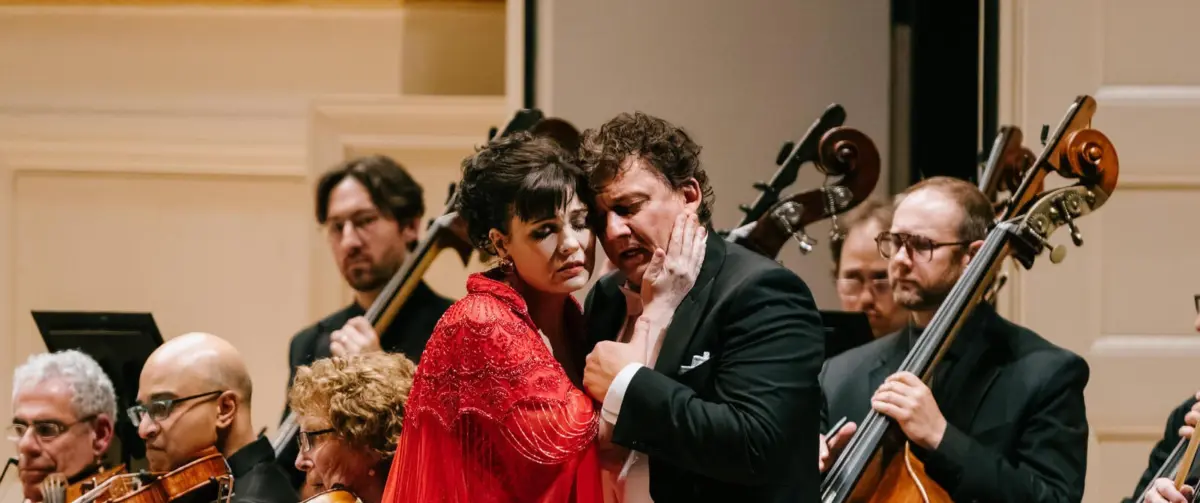
Rebeka matched this intensity, transforming in Act II from a petulant diva into a fiercely protective, clever, and defiant woman willing to sacrifice her very dignity to save her lover. This psychological chess match culminated in the opera’s famous, brutal assassination scene. While concert presentations inherently struggle with realistic stage deaths—Tézier was forced to remain upright on his feet after the fatal knifing, a testament to the necessary suspension of disbelief required in such formats—the dramatic weight of the moment was entirely undiminished. Reinforcing her character’s transformation, Rebeka appeared in a striking, symbolic red gown for this act, mirroring the bloodshed and passion defining the conflict.
Act III: The Tragic Crescendo and Final Betrayal
The final act brought the inevitable, gathering storm clouds of betrayal, execution, and tragedy. Clad now in an all-black gown representing mourning and impending doom, Marina Rebeka approached the opera’s emotional summit: "Vissi d’arte." In an era where this famous aria can sometimes feel rushed or treated as a rote contractual obligation, Rebeka slowed the tempo to a crawl. This deliberate pacing ensured that the audience did not miss a single nuance of her tone color, dynamic control, and emotional pacing. She sang with such profound conviction that the physical limitations of the concert setup entirely dissolved.
Kaufmann met this emotional intensity in Cavaradossi’s final moments with "E lucevan le stelle." Interpreting the aria at a deliberately unhurried pace supported by Dudamel’s generous phrasing, Kaufmann imbued every single note with emotional purity. The evening’s narrative trajectory—moving from youthful arrogance and playful banter to political defiance and heartbreaking finality—reached its shattering conclusion as the orchestra drove the score to its tragic, resonant finish.
Supporting Context & Metrics: The Orchestral Force and Visual Symbolism
The Dudamel Effect: Precision Without Pretense
At the heart of the performance was Gustavo Dudamel, whose kinetic energy shaped the evening without ever overshadowing the vocalists. Conducting from the podium with his back to the audience, Dudamel exercised remarkable restraint, deliberately dialing back his signature podium acrobatics to ensure the singers and the New York Philharmonic breathed as one organism.
Dudamel’s leadership was characterized by a supreme command of colla voce, consistently granting the soloists the rhythmic flexibility needed to mold their phrases. Despite presiding over a massive orchestral apparatus, Dudamel maintained absolute transparency in Puccini’s scoring, bringing fresh life into well-trodden passages. His humility was further underscored during the final curtain call; visibly sheepish and reluctant to accept solo accolades, Dudamel continually deflected praise back toward the orchestra and the principal vocalists, refusing to let ego disrupt the collective triumph of the ensemble.
Sartorial Strategy: A Visual Narrative
While traditional stage productions rely on elaborate backdrops and lighting cues to denote character evolution, the Carnegie Hall presentation utilized fashion as a deliberate narrative device. Marina Rebeka’s choice of three distinct, diva-worthy gowns served as a brilliant visual roadmap for Tosca’s character arc:
- Act I (White): Representing innocence, youthful vanity, and untroubled artistry.
- Act II (Red): Representing passion, danger, political awakening, and ultimate sacrifice.
- Act III (Black): Representing grief, despair, mourning, and the shadow of death.
By contrast, the male leads and the orchestra maintained a sleek, unified aesthetic. Kaufmann and Tézier wore formal black-tie evening wear, while Dudamel and the instrumentalists sported sophisticated stage-chic suits, keeping the visual focus strictly aligned with the unfolding musical drama.
Official Statements and Critical Reflections
Reflecting on the unique challenges and revelations of the evening, critics and attendees alike noted how the concert format forced a re-examination of the opera’s themes. Without the distraction of physical props or bustling stage traffic, deeper layers of Puccini’s score and libretto came to the surface.
Scholars and reviewers highlighted a fascinating subtext that frequently goes unnoticed in fully staged productions: Tosca’s distinct, deeply personal brand of religious piety. Unlike traditional stagings where the character’s faith appears merely as a reflection of cultural osmosis, this stripped-down presentation highlighted Tosca’s intense, focused relationship with the divine feminine—specifically the Madonna and the Magdalen. She constantly scans the room for invisible witnesses, seeking moral validation not from an abstract deity, but from these specific icons of faith.
Furthermore, critics lauded the seamless artistic synergy between the cast and the conductor. As noted in post-performance commentary, the production proved that when world-class artists commit fully to a minimalist vision, the absence of physical spectacle ceases to be a limitation and instead becomes an invitation for the audience to engage directly with the psychological core of the drama.
Future Outlook: The Evolution of Concert Opera in Major Venues
The triumph of the November 16, 2026, Tosca at Carnegie Hall signals a potential shift in how major cultural institutions approach operatic masterworks in the 21st century. As production costs for fully staged operas continue to skyrocket—and as audiences increasingly crave acoustic purity over visual gimmickry—concert-format presentations are proving to be a viable, artistically rich alternative.
This performance demonstrated that modern audiences are fully prepared to embrace an intellectual and emotional partnership with the performers, utilizing their own imaginations to fill in the missing sets, lighting cues, and blocking. By prioritizing vocal excellence, orchestral transparency, and profound character study, Carnegie Hall has set a new benchmark for symphonic opera production. Future seasons will undoubtedly look to this evening as a masterclass in how to honor a classic score by stripping away the non-essential, leaving only the unvarnished brilliance of human emotion and musical genius.