
Executive Overview
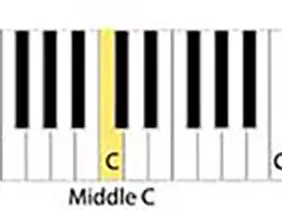
To the uninitiated, the piano keyboard is an intimidating expanse of eighty-eight alternating black and white keys, stretching across more than seven octaves of sound. Yet, within this monochrome landscape, one specific pitch serves as the undisputed geographic and psychological epicenter of Western music education: Middle C.
Referred to in scientific pitch notation as C4, identified as note number 60 within the MIDI (Musical Instrument Digital Interface) protocol, and conventionally tuned to a frequency of 256 Hz, Middle C is far more than just a random key near the middle of a grand piano. It is the definitive foundational stone upon which modern music literacy is built. It is the inaugural note introduced to aspiring pianists in their very first lessons, the root tonic of the C major scale—which contains no sharps or flats—and the vital bridge connecting the high-flying universe of the treble clef with the rumbling depths of the bass clef.
Despite its ubiquitous title, Middle C occupies a fascinating paradox. It is neither the mathematical center of an 88-key instrument (that distinction falls uncomfortably between the E and F above it), nor does it sit comfortably on the standard five-line staves of traditional sheet music without the assistance of ledger lines. Instead, it hovers in the liminal space between worlds.
This in-depth investigative feature explores the physical characteristics, historical notation structures, and pedagogical supremacy of Middle C. By examining its role in the Grand Staff, its utility in specialized C-clefs like the alto and tenor, and its enduring status as a beginner’s compass, we uncover why this single acoustic frequency remains the eternal heartbeat of musical literacy.
Detailed Chronology and Historical Evolution of Pitch and Notation
To fully appreciate Middle C, one must trace the evolution of how humans visualize and standardize sound. For centuries, music existed primarily in the oral and aural traditions before evolving into complex visual systems. The journey toward Middle C as a standardized reference point is a story intertwined with the development of the musical staff, pitch standardization, and instrument design.
From Neumes to the Stave
In early medieval Europe, Gregorian chants were annotated using neumes—graphic symbols placed above text to indicate the general upward or downward contour of a melody, though they lacked precise pitch or rhythm data. By the 11th century, Italian music theorist Guido d’Arezzo revolutionized music education by introducing reference lines. Initially employing a single colored line (usually red for F or yellow for C), Guido eventually expanded the system into a four-line staff (the tetragram), which allowed singers to read exact intervals.
As polyphonic music grew increasingly complex during the Renaissance and Baroque periods, the four-line staff expanded into the five-line staff we recognize today. Vocal ranges and instrumental capabilities expanded, necessitating a method to read music that spanned multiple registers. This gave rise to various clefs designed to anchor different voice types—soprano, alto, tenor, and bass.
The Standardization of Frequency
While the visual placement of Middle C evolved through centuries of manuscript writing, its physical frequency took much longer to standardize. For ages, pitch standards varied wildly from country to country, city to city, and even church to church. Organs in one town might be tuned a whole step higher than those in a neighboring town.
During the 18th and 19th centuries, composers like Mozart and Beethoven operated in an era where concert pitch crept steadily upward, placing immense strain on operatic singers’ vocal cords. In 1859, the French government passed a law setting the A above middle C at 435 Hz, which placed Middle C at approximately 217.5 Hz (or mathematically around 258.6 Hz depending on the temperament).
Later, the scientific pitch standard (also known as philosophical pitch) championed a clean mathematical system where C values were powers of two, placing Middle C (C4) precisely at 256 Hz (since 256 is $2^8$). While the modern international concert pitch standard ultimately settled on $A_4 = 440 text Hz$ in 1939 (implying an Equal Tempered Middle C of approximately 261.63 Hz), the 256 Hz figure remains deeply revered in acoustics, electronic music production, and physics instruction due to its clean binary properties.
Supporting Context and Metrics: Anatomy of a Note
To understand why Middle C commands such authority, we must examine its multi-dimensional profile across various musical domains.
| Parameter | Specification | Significance |
|---|---|---|
| Piano Position | 4th C from the left (5th C from right) | Situated in the physical center sector of an 88-key keyboard. |
| Scientific Pitch | C4 | Identifies its octave register above sub-contra and contra registers. |
| MIDI Protocol | Note Number 60 | The standard benchmark integer for electronic instrument interfacing. |
| Acoustic Frequency | 256 Hz (Scientific) / ~261.63 Hz (Equal Temperament) | Represents the vibration speed in hertz (cycles per second). |
| Guitar Placement | 1st fret of the 2nd string (B string) | Demonstrates cross-instrumental fretboard geography. |
| Notation Status | Ledger line below Treble / Ledger line above Bass | Serves as the central pivot point of the Grand Staff. |
The Physical Instrument and Fretboard Geography
On a standard 88-key piano, there are eight distinct C notes. Counting from the absolute left-hand side of the keyboard (starting at $A_0$), Middle C is the fourth C you encounter. Because pianos are asymmetrical—spanning from $A_0$ up to $C_8$—the exact physical midpoint of the 88 keys lands between the E and F located just above Middle C. Yet, piano manufacturers, technicians, and players universally treat Middle C as the psychological dead center of the instrument.
This centrality is not limited to keyboard instruments. On a standard six-string guitar tuned in standard tuning (E-A-D-G-B-E), Middle C ($C_4$) is found precisely on the first fret of the second string (the B string). When plucked, this note produces the exact same pitch as its keyboard and orchestral counterparts, proving that Middle C is an absolute acoustic reality, not merely a keyboard-specific construct.
Official Pedagogical Perspectives and Theoretical Frameworks
Music educators and theorists worldwide agree on the pedagogical necessity of Middle C. According to prominent music educator Ben Dunnett LRSM, founder of the Music Theory Academy, Middle C functions as the indispensable gateway for anyone embarking on a musical journey.

"Middle C is the starting point for many people in their musical journey on a keyboard. It is often the first note taught in school or in piano lessons and is a reference point we always come back to. It makes sense that a C is the first note many people are taught—it is the root note (tonic) of the key of C major, which has no sharps and flats in its key signature and so is an obvious starting point."
The Grand Staff and the 11-Line Continuum
To understand why Middle C holds this specific moniker, one must look at how sheet music is organized. When playing the piano, musicians read from two separate staves simultaneously: the Treble Clef (for the right hand) and the Bass Clef (for the left hand).
- The Treble Clef: On the treble clef staff, Middle C is written on a ledger line floating just below the bottom staff line.
- The Bass Clef: On the bass clef staff, Middle C is written on a ledger line floating just above the top staff line.
At first glance, placing a note entirely outside of both staves seems counterintuitive for something called "Middle" C. However, when these two staves are stacked together in standard piano configuration—with the Bass Clef positioned directly beneath the Treble Clef—the genius of the layout becomes clear. The ledger line above the Bass Clef and the ledger line below the Treble Clef converge to represent the exact same note.
If we merge these two staves by imagining an uninterrupted continuum, we create a hypothetical 11-line staff. Within this grand 11-line system, Middle C sits dead center on the sixth line—firmly occupying the literal and figurative middle of the musical universe.
[Treble Staff Line 5]  ---------------------
[Treble Staff Line 4]  ---------------------
[Treble Staff Line 3]  ---------------------
[Treble Staff Line 2]  ---------------------
[Treble Staff Line 1]  ---------------------
---MIDDLE C---         ======[C4]===========  <-- The Grand Convergence
[Bass Staff Line 5]    ---------------------
[Bass Staff Line 4]    ---------------------
[Bass Staff Line 3]    ---------------------
[Bass Staff Line 2]    ---------------------
[Bass Staff Line 1]    ---------------------
The C-Clefs: Alto and Tenor
While piano music relies exclusively on the Grand Staff, other orchestral instruments and vocal ranges operate outside the tidy ranges of purely high or low registers. Instruments like the viola, cello, and trombone occupy middle registers where reading excessive ledger lines in treble or bass clef would induce severe eye strain for performers.
To solve this, music history preserved specialized movable clefs known as C-Clefs, which include the Alto Clef and the Tenor Clef. The graphical symbol of a C-clef is specifically designed to point directly at Middle C:
- The Alto Clef: Primarily utilized by the viola, Middle C is positioned directly on the middle (third) line of the staff. This provides an equal distribution of staff lines above and below the note, accommodating the viola’s unique medium-low register.
- The Tenor Clef: Used by the upper ranges of the cello, bassoon, and trombone, Middle C is positioned on the fourth line up from the bottom of the staff. This provides more room below the note to accommodate lower-register passages without cluttering the page with ledger lines.
These specialized clefs further cement Middle C’s status as the absolute anchor of Western music theory. Every single clef used in standard notation—Treble, Bass, Alto, and Tenor—is fundamentally defined by its relationship to Middle C.
Future Outlook: Middle C in the Digital and Educational Age
As music education pivots toward digital landscapes, software integration, and electronic composition, the relevance of Middle C remains completely secure. Far from becoming obsolete in an era of digital audio workstations (DAWs) and algorithmic composition, Middle C has experienced a digital renaissance.
MIDI and Software Integration
In modern music production suites—such as Ableton Live, Logic Pro, Pro Tools, and FL Studio—piano roll editors visualize musical notes on a vertical pitch grid mapped against horizontal time. Within the universal MIDI protocol established in the early 1980s, Note Number 60 was universally designated as Middle C.
Whether a producer is programming virtual synthesizer patches, orchestrating virtual string sections with cinematic sample libraries, or writing complex MIDI controller scripts, Note 60 serves as the baseline reference point. Software developers, hardware synth manufacturers, and plugin designers build their user interfaces around the assumption that users understand where Middle C sits in the digital spectrum.
Pedagogical Evolution
In contemporary pedagogy, computer-aided learning apps and interactive video games (such as Yousician or Simply Piano) continue to initiate beginners with Middle C exercises. By anchoring the student’s thumbs on Middle C (using the classic five-finger hand position in C major), modern software leverages centuries-old pedagogical wisdom. This method allows novices to immediately produce recognizable melodies, understand basic intervals, and connect physical keypresses to visual notation without getting bogged down by complex accidentals.
Conclusion
Middle C is much more than a hammer striking a steel-wound string inside a wooden cabinet. It is a profound cultural and structural artifact that unites mathematics, history, physics, and art.
From its historical roots in Guido d’Arezzo’s medieval singing schools to its modern incarnation as MIDI Note 60 in Silicon Valley music software, Middle C bridges gaps. It bridges the treble and bass staves on the Grand Staff, it bridges the physical gap between left-hand and right-hand piano technique, and it bridges the gap between acoustic instruments and electronic workstations.
As long as humanity continues to organize sound into staves, clefs, and keys, Middle C will remain precisely where it has always been: sitting right in the middle of the action, serving as the unwavering heartbeat of musical literacy.