
Executive Overview
The Metropolitan Opera has long prided itself on balancing theatrical daring with operatic reverence, but its choice for the 2026–27 season opener has exposed the fragile fault lines inherent in that balancing act. Eschewing the post-pandemic trend of opening its seasons exclusively with contemporary works, the Met turned to the bedrock of the standard repertoire, mounting a brand-new production of Giuseppe Verdi’s Macbeth. Directed by Louisa Proske and conducted by Music Director Yannick Nézet-Séguin, the production arrived bearing immense expectations. It was designed to showcase soprano Lise Davidsen—arguably the definitive operatic face of Peter Gelb’s artistic vision for the company—in her much-anticipated first Met interpretation of Lady Macbeth.
Yet, what transpired on opening night proved to be an exercise in stark contrasts. While baritone Quinn Kelsey delivered a galvanic, deeply vulnerable, and vocally commanding portrayal of the title character—effectively anchoring an otherwise unstable evening—the production as a whole fractured under the weight of uneven performances, heavy-handed conducting, and a staging that oscillated between striking painterly tableaus and static, melodramatic missteps.
The evening underscored a recurring challenge for Davidsen: her undeniable vocal magnitude in heavy German and dramatic soprano repertory does not automatically translate to the idiom of nineteenth-century Italian opera. Paired with Nézet-Séguin’s penchant for bombastic orchestral textures and sluggish, occasionally dirge-like tempi, the musical execution frequently sidelined the nuances of Verdi’s score. Nevertheless, brilliant vocal turns from the supporting cast—most notably Freddie De Tommaso and Ryan Speedo Green—alongside a magnificent performance by the Met Chorus, ensured that the night was not without its transcendent moments. Ultimately, however, the production emerged as a fascinatingly flawed mixed bag, leaving critics and audiences to debate the future direction of the company’s flagship Italian offerings.
Detailed Chronology: The Opening Night Experience
Act I: The Witches’ Prophecy and the Seeds of Ambition
From the opening bars, it was clear that the musical landscape of the evening would be dominated by the pit. Yannick Nézet-Séguin’s approach to Verdi’s early masterpiece favored massive, thunderous sonic architectures over the lithe, fleet flexibility historically demanded by Italian bel canto. When the soprano entrance arrived, the friction became immediately apparent.
Lise Davidsen, stepping onto the stage as Lady Macbeth, faced an immediate uphill battle with the text and the orchestra. In her opening reading of the letter scene, "Nel dì della vittoria," Davidsen rushed through the phrasing, rendering the text flat and missing the psychological underpinnings of the character. Her rendition of "Vieni! t’affretta!" lacked resonance in the lower register, while her middle voice was frequently occluded by an over-eager orchestra. In the subsequent cabaletta, "Or tutti, sorgete," where Lady Macbeth invokes the agents of darkness, Davidsen’s coloratura was noticeably smudged. She struggled to maintain cohesion with the pit, and by declining to vary her approach across the musical repeats, her delivery of the text lapsed into monotony.
Conversely, this early sequence established Quinn Kelsey’s total mastery of the title role. Entering with a palpable, internalized dread, Kelsey’s interpretation of Macbeth’s inner turmoil was magnetic. His reading of the famous dagger monologue, "Mi si affaccia un pugnal!", began with a delicate, fragile piano that slowly mutated into an unhinged, jagged intensity. Kelsey’s baritone possessed a raw, granular edge that mapped the character’s psychological descent in real time.
Musically, the act’s tension was further exacerbated by the staging. Louisa Proske’s directorial choices placed the bulk of the action downstage, restricting the movement of the principals. In their initial duets, Davidsen and Kelsey displayed a startling lack of chemistry; rather than a power couple locked in a dark, symbiotic marriage of minds, they appeared isolated, performing in parallel rather than in concert.
Act II: Banquet Halls and Unravelling Sanity
The second act offered moments of localized brilliance that were consistently undermined by tempo and balance issues. Davidsen found more solid footing in "La luce langue," managing a chilling moment of lower-register gravity on the line "A loro un requiem, l’eternità!" As the aria expanded into "O voluttà del soglio!", she summoned impressive vocal power, her facial expressions hinting at a nascent, melancholic remorse. Yet, her drinking song, "Si colmi il calice," lacked the requisite aristocratic authority; while she executed some rousing high notes and a solid trill, the coloratura remained messy, and her choice to sing the second iteration piano registered as an arbitrary stylistic pivot rather than a dramatic choice.
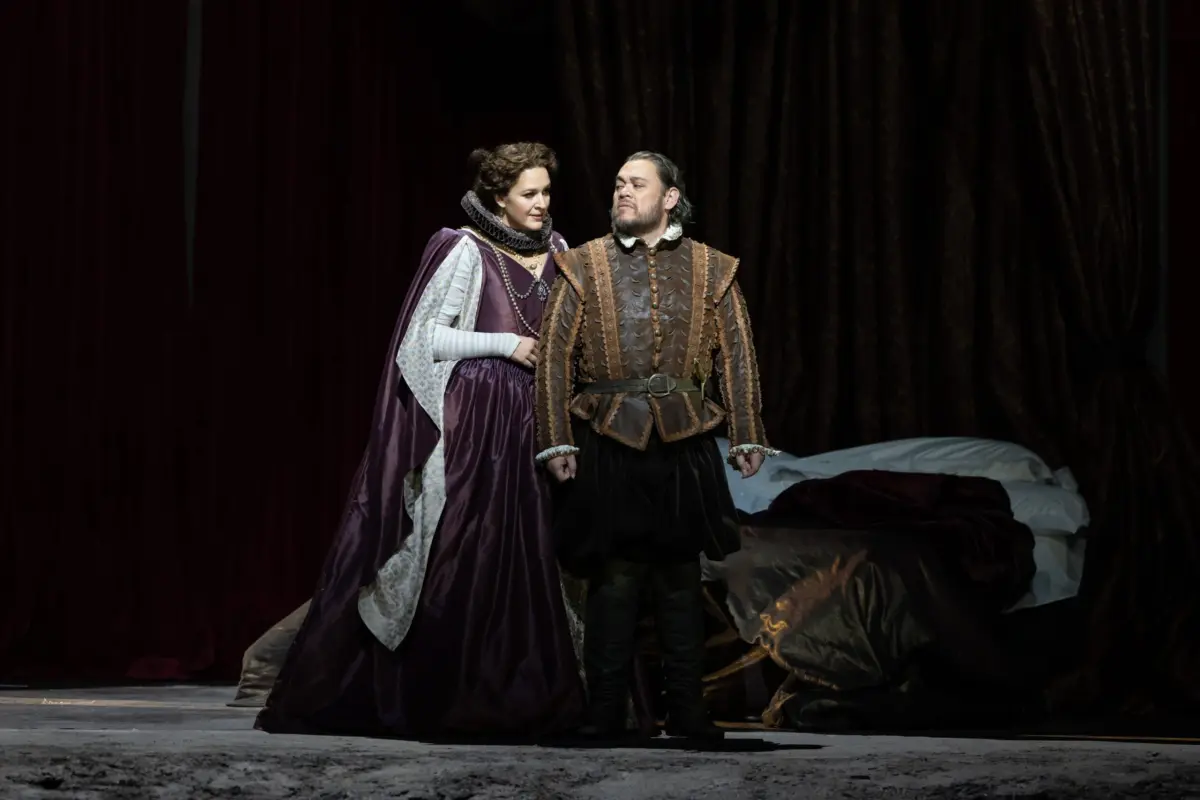
Downstage, the banquet hall scene exposed the stark divide between the two leads. As Kelsey’s Macbeth descended into gibbering madness at the apparition of Banquo—climbing onto the dining table and brandishing a knife at empty space with harrowing physical commitment—Davidsen remained virtually immobile. Standing stone-still, she offered no visible reaction to her husband’s public unraveling, draining the scene of its dramatic lifeblood.
Adding to the friction, Maestro Nézet-Séguin’s penchant for aggressive brass crescendos repeatedly overwhelmed the vocal line. During the Act I concertato and throughout key ensemble passages, the thunderous volume of the brass section swallowed the singers whole. The pacing, too, began to drag, with the conductor favoring protracted, heavy tempi that sapped the rhythmic vitality out of Verdi’s score.
Act III and IV: Witches, Madness, and the Tragic Denouement
As the opera progressed into the witches’ lair and the final tragic acts, the evening’s fortunes bifurcated even further. Quinn Kelsey delivered a tour de force in "Fuggi, regal fantasima," projecting a state of absolute, confounded terror. His vocalism was steeped in desperate pathos, culminating in an electrifying rendition of "Pietà, rispetto, amore" that showcased the finest bel canto singing of the evening. Shaping the line with a smooth, supplicating legato, Kelsey transformed the tyrannical usurper into a tragic, deeply repentant figure who earned a resounding ovation from the house.
Davidsen found her finest theatrical and vocal work in the iconic sleepwalking scene, "Una macchia è qui tuttora." Adopting a darker, more hollow vocal timbre and employing staccato phrasing to articulate Lady Macbeth’s fractured psyche, she achieved a genuinely chilling effect before concluding with a sustained, generous D-flat.
However, the musical momentum was nearly derailed in Act IV by the conductor’s handling of the choral masterpiece "Patria oppressa." Slowed to a dirge-like crawl, the chorus’s agonizingly beautiful lament was disrupted by arbitrary pauses and sluggish pacing, stripping the music of its forward impetus.
The staging choices also stumbled at the finish line. In a departure from conventional blocking, the production featured the chorus physically assaulting a living Macbeth rather than simply celebrating his defeat, a choice that bordered on the melodramatic and blunted the tragic dignity of Verdi’s final curtain.
Supporting Context & Metrics
To fully understand the weight of this production, one must examine the institutional context at the Metropolitan Opera under General Manager Peter Gelb:
- Programming Shift: This production marks the first time since the COVID-19 pandemic that the Met has opened its season with a standard-repertoire European masterwork rather than a contemporary opera, signaling a calculated bid to reassure traditionalist subscribers.
- The Davidsen Phenomenon: Lise Davidsen remains the cornerstone of the Met’s current artistic identity. Her previous triumphs in the house—most notably as Tristan und Isolde—have cemented her status as a generational Wagnerian and Strauss soprano. However, her Italian repertoire footprint at the Met remains contested, following similarly criticized outings in Tosca and La Forza del Destino.
- Vocal Standouts: Tenor Freddie De Tommaso (Macduff) and bass-baritone Ryan Speedo Green (Banquo) provided critical ballast. De Tommaso’s rendition of "Ah, la paterna mano" was hailed by critics as a masterclass in Italian stylistic phrasing, rich in dynamic variation and emotional urgency.
- The Chorus as Protagonist: Under Chorus Master Donald Palumbo, the Met Chorus delivered a multi-faceted performance, transitioning seamlessly from the eerie, multi-timbral wickedness of the coven to the bruised, pianissimo anguish of displaced refugees.
Official Statements & Critical Reception
Reflecting on the production’s dual nature, institutional insiders and cultural critics offered sharply divergent assessments:
"Opening our season with a monumental work like Verdi’s Macbeth allows us to interrogate the dark undercurrents of power, ambition, and guilt with a newly commissioned physical vocabulary. While interpretive approaches naturally spark debate, the sheer vocal and dramatic commitment on our stage tonight underscores the vitality of grand opera."
— Anonymous Metropolitan Opera Spokesperson
Critical reception in the press mirrored this dichotomy. While universally praising Quinn Kelsey’s baritonal mastery and dramatic depth—with many dubbing his performance one of the finest Verdi characterizations seen at the house in a decade—reviewers heavily penalized the evening’s musical and directional imbalances. Pundits noted that while Louisa Proske’s physical sets, featuring revolving bombed-out apertures and Montana Levi Blanco’s tactile, skin-crawling costume designs, offered plenty of visual eye-candy, they were ultimately hamstrung by static blocking and a lack of psychological cohesion between the central couple.
Future Outlook
The mixed critical reception of the 2026–27 season opener raises profound questions for the Metropolitan Opera’s immediate future. As Peter Gelb continues to navigate the financial and artistic realities of post-pandemic opera production, the pressure to deliver crowd-pleasing, critically unassailable season openers has never been higher.
For Lise Davidsen, this production serves as a crucial inflection point. While her star power remains undiminished and her core Wagnerian repertoire is peerless, her ongoing forays into Italian dramatic roles will likely face increased scrutiny from critics and audiences alike. Future engagements will require a careful reassessment of vocal tailoring and stylistic idiom if she is to conquer the Italian canon with the same authority she commands over the German.
Meanwhile, Quinn Kelsey’s triumphant turn cements his status as one of the preeminent Verdi baritons of his generation, all but guaranteeing his continued dominance in the company’s core Italian repertoire. As the run of Macbeth continues, adjustments in pit-to-stage pacing by Maestro Nézet-Séguin could help recalibrate the evening’s musical architecture. Ultimately, the production stands as a bold, if flawed, monument to the risks of grand opera—reminding audiences that even when an opening night stumbles, the sheer scale of ambition at the Met can still yield moments of unforgettable theatrical magic.