
Executive Overview
Few elements of the human anatomy are as profoundly tied to personal identity, artistic expression, and daily communication as the voice. Yet, for centuries, the physiological mechanisms governing vocal production remained shrouded in mystery, treated more as an intuitive art form than a quantifiable, medical science.
Enter Dr. Robert Thayer Sataloff—a pioneer, otolaryngologist, and Renaissance man of vocal science—who fundamentally revolutionized how the medical and artistic communities understand, diagnose, and treat injuries to the human voice.
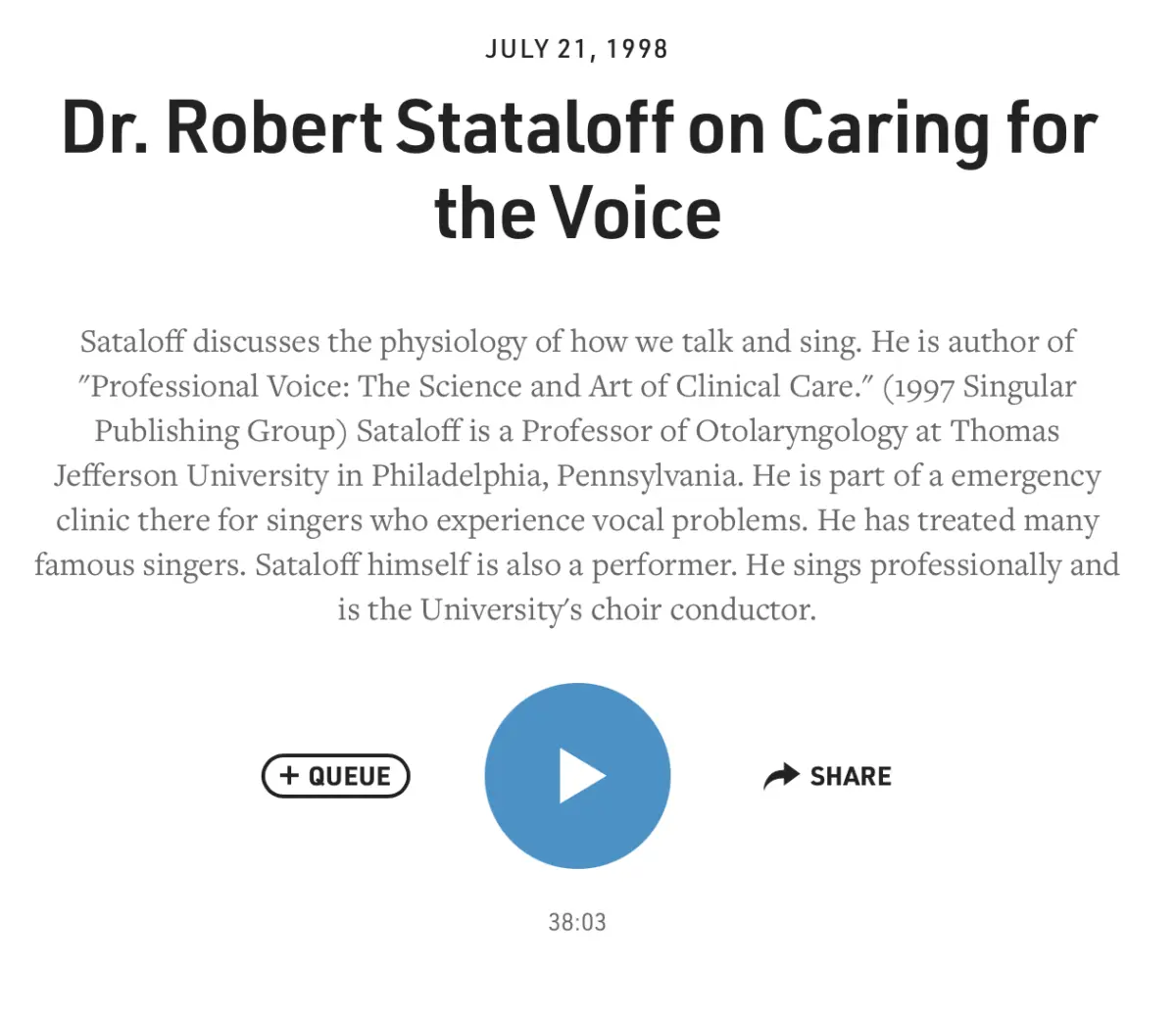
In January 2023, The Voice Foundation highlighted a pivotal piece of audio history from its archives: Dr. Sataloff’s comprehensive, wide-ranging 1998 interview with Terry Gross, the iconic host of NPR’s Peabody Award-winning cultural program Fresh Air.
Recorded during a time when voice science was shedding its fringe status and entering the mainstream medical lexicon, the conversation remains a masterclass in vocal physiology. Sataloff expertly bridged the gap between complex otolaryngology and accessible public discourse, breaking down the vulnerabilities of the human larynx, the hazards of occupational vocal strain, and the delicate intersection of psychological health and artistic performance.
This retrospective exploration examines the enduring impact of that 1998 dialogue, contextualizing Dr. Sataloff’s monumental contributions through the lens of modern voice care, medical advancements, and the ongoing cultural fascination with the human voice.
Detailed Chronology: The Evolution of Voice Care and the 1998 Milestone
To fully appreciate the significance of Dr. Sataloff’s appearance on Fresh Air in 1998, one must understand the historical trajectory of laryngology. For generations, vocal injuries—particularly among professional singers, actors, and public speakers—were often met with crude remedies, pervasive myths, or, worst of all, catastrophic misdiagnoses that ended careers.
The Pre-Specialized Era of Vocal Medicine
Prior to the late 20th century, if a professional vocalist lost their voice, they typically consulted a general Ear, Nose, and Throat (ENT) specialist. While these physicians were skilled in treating infections, tonsillitis, and basic sinus issues, they rarely possessed the specialized tools or training required to analyze the microscopic, rapid vibrations of the vocal folds.
Vocal fold mucosa vibrates hundreds to thousands of times per second. Traditional examination methods were often too slow to catch subtle pathologies, such as early-stage nodules, micro-hemorrhages, or minor scarring. Consequently, treatments frequently relied on forced vocal rest, harsh steroid regimens, or invasive surgeries that sometimes left the vocal apparatus worse than before.
The Rise of Laryngology and Dr. Sataloff’s Ascent
During the 1970s and 1980s, a paradigm shift occurred. Pioneers like Dr. Sataloff recognized that the voice required an interdisciplinary approach, combining otolaryngology, speech-language pathology, voice pedagogy, acoustics, and psychology.

By 1998, when Dr. Sataloff sat across the microphone from Terry Gross, he was already an established titan in the field. As a Professor and Chairman of the Department of Otolaryngology-Head and Neck Surgery at Drexel University College of Medicine, and conductor of the Thomas Jefferson University Choir, Sataloff uniquely embodied both the clinical scientist and the passionate artist.
The Fresh Air Broadcast: Demystifying the Larynx
When the interview hit the airwaves in 1998, Terry Gross brought her signature inquisitive style to the discussion, probing Dr. Sataloff on the mechanics of speech and song.
- The Physics of Sound Production: Sataloff vividly explained how the human voice is fundamentally a wind instrument. Air expelled from the lungs passes through the trachea, causing the vocal folds within the larynx to oscillate. This raw acoustic wave is then shaped and amplified by the vocal tract—the pharynx, oral cavity, and nasal passages.
- The Fragility of Professional Voices: Gross and Sataloff delved into the immense physical pressures faced by professional singers and actors. Sataloff detailed how a microscopic change in the mass or tension of the vocal folds—such as the formation of a tiny nodule or polyp—can radically alter a performer’s range, tone, and livelihood.
- The Mind-Body Connection: A recurring theme of the 1998 interview was the profound psychosomatic nature of the voice. Sataloff emphasized that anxiety, stress, and depression instantly manifest in laryngeal tension, altering vocal quality and creating a vicious cycle of performance anxiety and physical strain.
Supporting Context & Metrics: The Anatomy of Vocal Health
Dr. Sataloff’s clinical insights, echoed throughout his decades of research and immortalized in interviews like the one with Terry Gross, are supported by a rigorous body of medical data and anatomical metrics.
The Micro-Anatomy of the Vocal Folds
To understand why professional voice users are so vulnerable to injury, one must examine the layered structure of the vocal folds, often described using Hirano’s cover-body theory:
- Epithelium: The outermost, protective skin layer.
- Superficial Layer of the Lamina Propria (Reinke’s Space): A loose, gelatinous layer that allows the vocal fold cover to vibrate freely over the stiffer body.
- Intermediate and Deep Layers of the Lamina Propria: Composed of elastin and collagen fibers, forming the vocal ligament.
- Vocalis Muscle: The main body of the thyroarytenoid muscle, which adjusts internal tension.
During high-intensity phonation—such as belting an opera aria, shouting in a noisy stadium, or speaking continuously for an eight-hour shift—the vocal folds collide thousands of times per minute. The shear stress and impact forces concentrated in Reinke’s space can easily lead to micro-trauma, swelling, and chronic lesions if proper vocal hygiene and technique are neglected.
Key Metrics in Modern Voice Care
The following data points illustrate the prevalence and economic impact of voice disorders, validating the urgency of the preventative care championed by Dr. Sataloff:
- Prevalence: Approximately 3% to 9% of the general population suffers from a voice disorder at any given time, translating to millions of individuals in the United States alone.
- Occupational Risk: Voice-reliant professionals—including teachers, call center operators, fitness instructors, clergy, and singers—account for nearly 30% of the workforce. Among teachers, up to 50% experience voice problems during their careers, frequently resulting in absenteeism and early retirement.
- Economic Impact: Voice disorders cost the U.S. economy billions of dollars annually in direct medical expenses, lost productivity, and retraining costs for workers who can no longer perform their duties.
- Technological Progression: Stroboscopy and high-speed digital imaging (capable of capturing 2,000 to 4,000 frames per second) have evolved from experimental tools in the late 20th century into standard clinical equipment, allowing physicians to visualize mucosal wave propagation with unprecedented clarity.
Official Statements and Archival Significance
The re-promotion of the 1998 interview by The Voice Foundation—an international organization founded by Dr. Sataloff and other visionaries to advance voice science and care—underscores the timeless value of foundational medical education.
"The human voice is our most intimate instrument of communication and artistic expression. For decades, Dr. Robert Sataloff has been at the forefront of protecting and healing that instrument, combining rigorous scientific inquiry with profound empathy for the artist."
— Archival Statement, The Voice Foundation
In reflection of the interview’s enduring legacy, contemporary medical historians note that Sataloff’s ability to communicate complex medical concepts to a lay audience on a platform like NPR was a watershed moment. Before the widespread adoption of the internet and digital health blogs, programs like Fresh Air served as vital conduits for public health literacy.

Dr. Sataloff frequently reflected on the vulnerability of patients during such broadcasts, noting that losing one’s voice is often experienced as an existential crisis.
"When a patient loses their voice, they do not merely lose a physical function; they lose their primary means of connecting with the world, expressing their emotions, and defining their professional identity. Treating the voice requires treating the whole person—physically, psychologically, and socially."
— Dr. Robert Thayer Sataloff (Synthesized from educational lectures and archival interviews)
Future Outlook: The Next Era of Voice Science and Medicine
As we look toward the future, the foundational principles articulated by Dr. Sataloff in 1998 continue to serve as the bedrock for modern innovations in laryngology and voice therapy. The landscape of voice care is rapidly expanding, driven by breakthroughs in regenerative medicine, artificial intelligence, and telemedicine.
1. Regenerative Medicine and Vocal Fold Scarring
One of the most stubborn challenges discussed in early voice medicine was the treatment of vocal fold scarring (sulcus vocalis or deep fibrosis). Scar tissue lacks the pliable elasticity of healthy Reinke’s space, permanently ruining a singer’s range and tone. Today, researchers are pioneering regenerative therapies, including:
- Injectable Hydrogels and Biomaterials: Designed to mimic the extracellular matrix of the lamina propria, restoring pliability to damaged vocal folds.
- Stem Cell Therapy: Utilizing mesenchymal stem cells to regenerate healthy mucosal tissue rather than fibrous scar tissue.
2. Artificial Intelligence in Vocal Diagnostics
Machine learning algorithms and acoustic analysis software are transforming early detection. By analyzing vocal tremor, jitter, shimmer, and spectral harmonics from standard smartphone recordings, AI models can now flag early signs of neurological disorders (such as Parkinson’s disease), laryngeal cancer, and benign vocal fold lesions long before they become visually apparent during a routine physical exam.
3. Tele-Laryngology and Global Access
The COVID-19 pandemic accelerated the adoption of telehealth in voice care. While direct visualization via stroboscopy still requires an in-clinic visit, remote acoustic monitoring, asynchronous voice analysis, and tele-speech therapy have democratized access to specialized vocal rehabilitation, allowing performers and teachers in remote areas to consult with elite voice specialists.
4. Holistic Multidisciplinary Care
The model championed by Sataloff—integrating otolaryngologists, speech pathologists, singing voice specialists, pulmonologists, gastroenterologists (addressing laryngopharyngeal reflux, or LPR), and psychologists—is now the gold standard in comprehensive voice centers worldwide. As awareness of occupational vocal health grows, corporations, school districts, and performing arts academies are increasingly investing in preventative voice training, recognizing that a healthy voice is an essential asset.
Conclusion
Dr. Robert Thayer Sataloff’s 1998 interview with Terry Gross remains much more than a nostalgic artifact from the audio archives of Fresh Air and The Voice Foundation. It stands as a timeless testament to the intersection of art and science, reminding us of the immense fragility and extraordinary resilience of the human voice.
By demystifying laryngeal mechanics for millions of listeners, Sataloff helped propel vocal science out of specialized clinics and into the cultural mainstream. As medical technology marches toward regenerative therapies and AI-driven diagnostics, the core philosophy championed by Sataloff remains unchanged: to protect the human voice is to preserve the very essence of human connection.